 |
| Photo above © You put it up |
Looking for your first knitting project can be more
confusing than learning the knit stitch itself.
Hundreds of patterns are described as "easy" or "beginner friendly,"
but not every easy-looking project is suitable for someone who has
only just picked up knitting needles.
A good first project should help you practice a small number of skills,
give you visible progress, and be forgiving enough that a few uneven
stitches do not ruin the finished result.
This guide will help you choose beginner knitting projects in a sensible
order — from simple rectangular pieces to hats, baby projects, lace and
your first sweater.
Beginner Knitting Guide
This page is an independent Amazing Knitting learning resource rather
than one specific knitting pattern. Use it to choose a project that
matches the skills you already know and the skill you want to learn
next.
What Makes a Good First Knitting Project?
The best beginner project is not necessarily the smallest or the
simplest-looking project.
A useful first project usually has several of these characteristics:
- A manageable number of stitches
- Little or no complicated shaping
- A short repeating stitch pattern
- Yarn that is easy to see and handle
- Enough repetition to build muscle memory
- A finished item you actually want to use
Your first few projects should gradually introduce new techniques rather
than requiring you to learn everything at once.
Skills to Learn Before Your First Project
You do not need to know dozens of knitting techniques before starting.
For a very simple first project, focus on:
- Making a slip knot
- Casting on stitches
- The knit stitch
- Keeping stitches on the needle
- Binding off
- Weaving in yarn ends
Once those movements feel comfortable, add the purl stitch, decreases,
increases and circular knitting one project at a time.
1. Start with a Garter Stitch Scarf
A garter stitch scarf remains one of the most practical first knitting
projects.
When worked flat, you can create garter stitch simply by knitting every
row.
That gives you time to practice:
- Holding the needles
- Controlling yarn tension
- Recognizing stitches
- Turning your work
- Binding off
The shape is just a rectangle, so there is no garment fitting or complex
shaping to worry about.
Why a Scarf Is Useful for Learning
Repetition is one of the fastest ways to make the basic knitting movement
feel natural.
A scarf gives you hundreds of opportunities to repeat the same motion
while still producing something useful.
The main disadvantage is that a full-length scarf can take time, so a
small headband or cowl may be more motivating if you prefer quick
projects.
2. Try a Dishcloth or Washcloth
A knitted washcloth is a good alternative when you want a project that
finishes quickly.
It gives you a small square where you can practice basic stitches without
worrying about exact garment fit.
Cotton yarn is commonly chosen for washable household cloths.
Once you know the knit stitch, a washcloth can also become your practice
space for:
- Purl stitches
- Seed stitch
- Ribbing
- Simple eyelets
- Textured stitch patterns
3. Knit a Simple Cowl
A cowl can feel more like a finished wearable than a practice square
while still remaining relatively simple.
Some beginner cowls are worked flat as rectangles and seamed at the end.
Others introduce circular needles and knitting in the round.
Choose the flat version first if circular knitting is still unfamiliar.
4. Try an Easy Baby Blanket
A baby blanket can be an excellent first larger project because it does
not require body measurements or garment shaping.
Simple blanket patterns often repeat the same stitches across many rows,
allowing you to improve consistency.
The main consideration is commitment: even a baby blanket contains many
more stitches than a washcloth or headband.
Free Beginner Blanket Idea: Waffle Blanket
Once you are comfortable maintaining a repeating texture, explore the
free Waffle Blanket pattern in the Amazing Knitting archive.
Explore the Waffle Blanket →
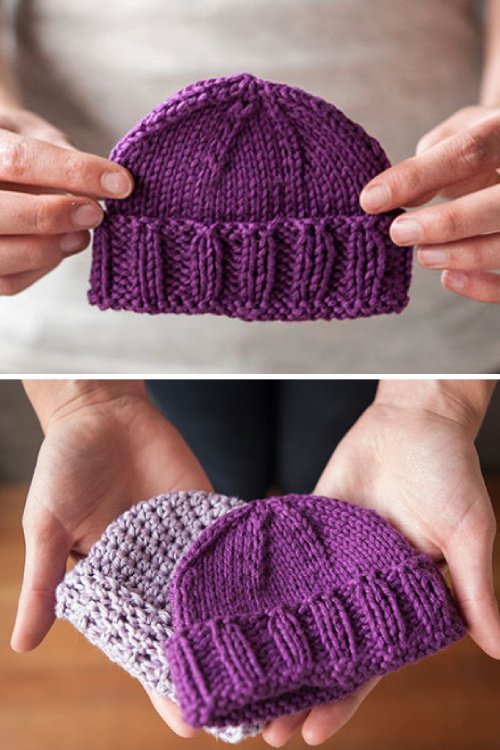
5. Move On to a Simple Hat
A basic hat introduces one important new idea: shaping.
Many hats gradually decrease stitches near the crown.
Depending on the pattern, a hat may be:
- Worked flat and seamed
- Worked in the round on circular needles
- Finished with double-pointed needles or another small-circumference method
If you are completely new, a flat-knit hat may feel easier.
6. Try a Textured Scarf
After plain garter stitch feels comfortable, a textured scarf is a good
way to learn something new without adding garment shaping.
You can practice new stitches while keeping the overall project shape
extremely simple.
Free Next-Step Project: Morning Surf Scarf
Morning Surf Scarf is a verified free pattern already available in the
Amazing Knitting archive.
It is a useful option when you are ready to move from plain knitting into
a more decorative fabric.
View Morning Surf Scarf →
7. Learn Your First Lace Pattern
Lace does not have to mean an enormous, complicated shawl.
A small lace scarf is a much friendlier introduction because the stitch
count is limited and the overall shape remains rectangular.
Before starting, become comfortable with:
- Yarn overs
- Basic decreases
- Counting stitches
- Reading repeat instructions
Free Beginner Lace Project: Little Leaf Lace Scarf
Little Leaf Lace Scarf by Sivia Harding is a particularly useful bridge
into lace knitting because it combines a straightforward scarf shape with
a repeating leaf motif.
Explore Little Leaf Lace Scarf →
8. Try Your First Triangle Shawl
A triangular shawl introduces increases and teaches you how knitted
shaping develops row by row.
The project can look sophisticated even when the basic construction is
relatively logical.
Free Shawl Idea: June Bunnies Shawl
June Bunnies Shawl is a customizable top-down triangular shawl and is
especially useful when you are ready to explore simple lace.
Explore June Bunnies Shawl →
9. Try a Baby Cardigan
A baby cardigan can be a practical introduction to garment knitting
because the project is much smaller than an adult sweater.
It may introduce:
- Garment sizing
- Increasing
- Sleeves
- Button bands
- Reading a multi-size pattern
A top-down construction can be particularly attractive because you can
see the garment shape develop as you work.
Free Baby Cardigan: Fuss Free Baby Cardigan
Louise Tilbrook's Fuss Free Baby Cardigan is a free DK-weight pattern
with a top-down raglan construction and is a useful next step once your
basic knitting feels secure.
Explore Fuss Free Baby Cardigan →
10. Knit Your First Simple Sweater
You do not need to wait years before making a sweater.
The important thing is to choose a design whose construction matches the
skills you already have.
Look for patterns with:
- Simple shapes
- Clear sizing
- Minimal complicated stitch work
- Good construction notes
- Few finishing steps
Free First-Sweater Idea: French Macaroon
French Macaroon by The Noble Thread is a small garter-stitch children's
pullover with a simple boat-neck shape and uncomplicated construction.
It can be a useful way to understand how knitted pieces become a garment
without beginning with a large adult sweater.
Explore French Macaroon →
A Simple Beginner Project Progression
A practical learning path:
1. Garter-stitch square or washcloth
2. Simple scarf or headband
3. Textured scarf or cowl
4. Simple blanket
5. Hat with basic shaping
6. Lace scarf or shawl
7. Baby cardigan
8. Simple sweater
This is not a rule. If one particular project excites you, motivation can
be more valuable than following a perfect sequence.
What Yarn Is Easiest for Beginners?
A smooth, medium-weight yarn is often easier to learn with than extremely
thin, fuzzy or novelty yarn.
You want to be able to see individual stitches clearly so that you can
recognize mistakes.
Avoid choosing yarn only because it looks beautiful in the skein.
For your first project, ease of handling is usually more useful than an
unusual texture.
Light Colors Can Be Easier to Read
Very dark yarn can make it difficult to see where one stitch ends and the
next begins.
A light or medium color can make the structure clearer while you are
learning.
Once you can recognize stitches easily, yarn color becomes much less
important.
Don't Begin with Extremely Fuzzy Yarn
Mohair-like or heavily textured yarns can hide stitches.
They can also be difficult to unravel when you need to correct an error.
Save highly fuzzy yarn for a later project unless you are already
comfortable identifying stitches by touch.
What Needles Should a Beginner Use?
Choose the needle size required by the pattern and appropriate for the
yarn rather than buying one universal "beginner needle."
For practice knitting, medium-sized needles and medium-weight yarn can
make the stitches easier to see and manipulate.
The important thing is that the needle should not make the fabric so tight
that inserting the tip becomes difficult.
Wood or Metal Needles?
Both can work well.
Wooden or bamboo needles tend to offer more surface grip, which some new
knitters find reassuring because stitches are less likely to slide away.
Smooth metal needles can feel faster once you become comfortable
controlling the stitches.
There is no single correct material for every beginner.
Don't Choose a Project Only Because It Says "Easy"
Difficulty labels vary between designers.
Before starting, scan the skills required.
A project described as beginner-friendly may still require techniques
such as:
- Knitting in the round
- Cables
- Lace
- Short rows
- Picking up stitches
- Seaming
None of these techniques is impossible for a beginner, but you should
know what you are agreeing to learn.
Choose One New Skill at a Time
A particularly effective approach is to choose each new project because
it adds one unfamiliar technique.
For example:
- Project 1: knit stitch
- Project 2: purl stitch
- Project 3: ribbing
- Project 4: decreases
- Project 5: knitting in the round
- Project 6: yarn overs and lace
- Project 7: garment shaping
This prevents a single project from becoming a collection of ten new
problems at once.
Make a Swatch When Size Matters
You can often practice freely on a scarf or washcloth.
But once you begin hats, sweaters, cardigans or fitted baby garments,
gauge becomes much more important.
A gauge swatch tells you whether your personal knitting tension produces
the dimensions expected by the pattern.
Learn How to Fix Mistakes
Becoming a confident knitter does not mean never making mistakes.
It means learning to recognize and repair them.
Useful early skills include:
- Recognizing a dropped stitch
- Unknitting stitches one at a time
- Counting stitches
- Checking pattern repeats
- Using stitch markers
- Using a lifeline in lace
Finish Your First Projects
A very simple finished project often teaches more than five ambitious
projects abandoned halfway through.
Finishing teaches additional skills such as binding off, weaving in ends,
seaming and blocking.
Choose something achievable enough that you are likely to reach that
final stage.
Don't Worry About Perfect Tension
Your first rows may look different from your twentieth row.
That is normal while your hands are learning a completely new movement.
Concentrate on forming stitches consistently rather than trying to make
your first project look machine-made.
More Beginner-Friendly Patterns on Amazing Knitting
Beginner Knitting Stitch Guides
When you want to practice new textures before using them in a full
project, explore these Amazing Knitting stitch guides:
Explore More Easy Knitting Patterns
What Should You Knit First?
If you have never completed a project before, start with a small
rectangle: a washcloth, headband or simple scarf.
If you already know knit and purl, choose a project that adds one new
skill — perhaps ribbing, a simple decrease or a textured stitch.
If you can comfortably follow a basic pattern, move to a hat, shawl or
baby cardigan.
The goal is not to remain a "beginner" until you know every technique.
Each finished project should teach you enough to make the next project
slightly more interesting.
Editorial note: This Amazing Knitting page is an
independent beginner-knitting resource. It does not reproduce another
publisher's pattern collection or copyrighted instructions. Individual
project pages linked above identify and direct readers to their respective
designers and authorized pattern sources. Please retain the photograph
and original photo credit from the previous version of this page.