Skip to content

...

Showing posts sorted by relevance for query free lace blanket knitting pattern. Sort by date Show all posts

Tulips & Rosebuds Baby Blanket - Knitting Pattern

Tulips & Rosebuds Baby Blanket - Free Pattern
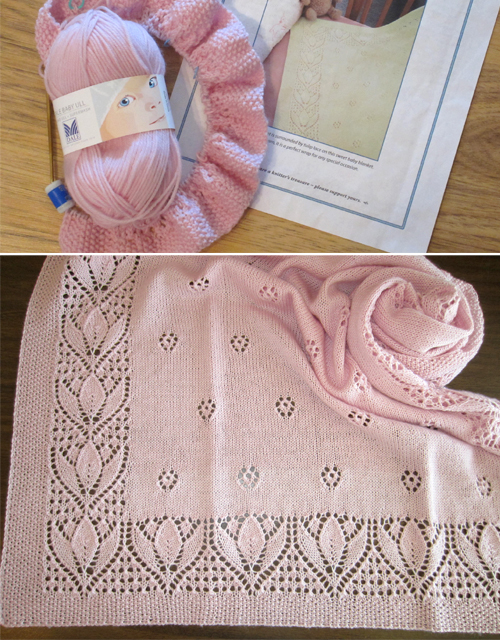
Photos above © KarenFM

The Tulips & Rosebuds Baby Blanket by Eugen Beugler is an elegant lace baby blanket featuring tiny rosebud motifs surrounded by a decorative border of knitted tulips.

Originally published by Fiber Trends, this heirloom-style design combines delicate lace with fine yarn to create a special-occasion baby blanket. The pattern includes both written and charted lace instructions.

Tulips & Rosebuds Baby Blanket at a Glance

Pattern: Tulips & Rosebuds Baby Blanket (CH51)

Designer: Eugen Beugler

Publisher: Fiber Trends

Craft: Knitting

Category: Baby Blanket

Yarn Weight: Fingering

Yardage: About 1,100 yards / 1,006 meters

Needle Size: US 4 / 3.5 mm

Gauge: 24 stitches = 4 inches in stockinette stitch

Finished Size: About 32 × 36 inches / 81 × 91 cm

Construction: One-piece rectangular blanket

Lace Instructions: Written and charted

Pattern Availability: Paid pattern

About the Tulips & Rosebuds Baby Blanket

Designed by Eugen Beugler, Tulips & Rosebuds is an heirloom-style knitted baby blanket built around two delicate floral ideas.

Small rosebud motifs decorate the center of the blanket, while a much more elaborate tulip lace design creates the surrounding border.

The combination gives the blanket an ornate appearance without relying on multiple yarn colors. The flowers are created through the structure of the knitted lace itself.

A Floral Lace Baby Blanket

Floral lace is the defining feature of this design. Instead of adding flowers after the blanket is finished, the rosebuds and tulips emerge as part of the knitted fabric.

The center uses repeating rosebud motifs, while the border introduces the larger tulip lace sections that give the blanket its distinctive frame.

This makes Tulips & Rosebuds especially appealing to knitters who enjoy lace patterns with recognizable botanical motifs.

Written and Charted Instructions

The original pattern provides the lace instructions in both written and charted form.

This is useful because knitters approach lace in different ways. Some prefer following symbols visually on a chart, while others find row-by-row written directions easier to track.

Whichever method you prefer, it is worth using stitch markers and checking your stitch count regularly when working a large lace project.

Finished Blanket Size

The published finished size is approximately:

32 × 36 inches / approximately 81 × 91 cm

This creates a generously sized baby blanket while still keeping the project considerably smaller than a full-size adult throw.

Yarn Requirements

The original pattern calls for approximately:

1,100 yards / 1,006 meters of fingering-weight yarn

Fine yarn helps preserve the definition of the lace motifs and contributes to the delicate appearance of the finished blanket.

When substituting yarn, consider not only the yarn weight but also how well the fiber holds lace definition after washing and blocking.

Needles and Gauge

The published needle size is:

US 4 / 3.5 mm

The listed gauge is:

24 stitches = 4 inches in stockinette stitch

Your individual needle size may need adjustment to achieve the intended gauge and fabric.

Knitting Skills Used

This is a lace project rather than a basic beginner blanket. Helpful skills include:

  • Comfortable knit and purl stitches
  • Reading written lace instructions or charts
  • Yarn overs
  • Lace increases and decreases
  • Keeping track of repeating stitch patterns
  • Checking stitch counts regularly
  • Blocking knitted lace

Knitters new to lace may find it helpful to practice a smaller lace swatch before beginning the full blanket.

Blocking Makes a Difference

Lace often looks very different immediately after it comes off the needles. Careful blocking helps open the eyelets and allows the floral motifs and border to become more visible.

Always follow the care instructions for your chosen yarn and avoid stretching the finished fabric beyond what the fiber can comfortably support.

Important Pattern Update

Fiber Trends has published corrections and updated information for this pattern. Ravelry notes that stitch counts for the Tulip Border section were updated in November 2022. If you are knitting this blanket, use the current official pattern and check the designer/publisher's latest errata rather than relying on an older copy found elsewhere online.

Is the Tulips & Rosebuds Baby Blanket Free?

No. The official Tulips & Rosebuds Baby Blanket (CH51) is currently a paid knitting pattern.

Older pages around the web have sometimes described or redistributed this design as a free pattern. However, the current official listing from Fiber Trends is a paid pattern.

Amazing Knitting does not reproduce the designer's copyrighted lace charts, written row-by-row instructions, or pattern PDF.

Get the Original Tulips & Rosebuds Pattern

Visit the official Ravelry listing for the current pattern, purchase information, project details, and pattern updates.

View the Original Tulips & Rosebuds Pattern →

Pattern credit: Tulips & Rosebuds Baby Blanket (CH51) was designed by Eugen Beugler and published by Fiber Trends. Pattern pricing, availability, errata, and technical information are controlled by the publisher and may change over time.

Looking for a Free Alternative?

If you came to this page specifically looking for a free baby blanket knitting pattern, you do not have to leave empty-handed. Amazing Knitting has other free lace baby blankets in the archive.

Waving Lace Baby Blanket — Free Pattern

This is a different design — not a free version of Tulips & Rosebuds — but it is another elegant knitted baby blanket featuring lace and texture, making it a useful free alternative for knitters drawn to the delicate style of the original.

View the Free Waving Lace Baby Blanket →

More Baby Blanket Knitting Patterns

Explore more baby blanket knitting patterns, lace baby blankets, and free baby blanket knitting patterns from the Amazing Knitting archive.

Before You Start

If you choose the original Tulips & Rosebuds pattern, download or purchase the current official version rather than relying on an old copy circulating elsewhere. Check the latest Fiber Trends corrections, then confirm the yarn, gauge, needle size, stitch counts, and finished measurements before casting on.

7 Free Baby Blanket Knitting Patterns for Beautiful Handmade Gifts

Looking for a beautiful baby blanket to knit for a new arrival? These 7 free baby blanket knitting patterns include simple stripes, textured hearts, classic heirloom designs and cozy stitch patterns that make wonderful handmade gifts.

Every pattern in this collection links to an updated Amazing Knitting guide where you can find the current pattern details and the original free source.

✓ All 7 patterns in this collection are free

Click any photo, title or pattern link below to visit the corresponding Amazing Knitting guide.

1. Easy Striped Baby Blanket

Easy Striped Baby Blanket free knitting pattern

Photos © Jamey - Dabbles and Babbles

Easy Striped Baby Blanket by Jamey of Dabbles & Babbles is a lovely choice for newer knitters. Soft three-color stripes are framed by a textured seed-stitch border, giving the blanket a clean, modern finish.

It is worked flat in DK yarn and measures approximately 34 × 33 inches after blocking.

View the Free Easy Striped Baby Blanket Pattern →


2. Heart Baby Blanket

Heart Baby Blanket free knitting pattern

Photo © katalysis

Heart Baby Blanket by Ann Saglimbene uses knit-and-purl texture to create repeating heart motifs directly in the fabric.

There is no stranded colorwork or intarsia involved, which makes the design especially attractive for knitters who want a decorative single-color blanket.

Our updated guide also explains why knitters should use the designer's corrected March 2024 version rather than an older copy.

View the Free Heart Baby Blanket Pattern →


3. Jordan Baby Blanket

Jordan Baby Blanket free knitting pattern

Photo © danelle1977

Jordan Baby Blanket by marianna mel is a beautiful textured design made with basic knit and purl stitches.

The raised stitch pattern gives the blanket plenty of visual interest without relying on lace or multiple yarn colors, making it a strong choice for a classic handmade baby gift.

The pattern also comes in several sizes and can be adjusted depending on the project you want to make.

View the Free Jordan Baby Blanket Pattern →


4. Treasured Heirloom Baby Blanket

Treasured Heirloom Baby Blanket free knitting pattern

Design © Lion Brand

Treasured Heirloom Baby Blanket is a classic corner-to-corner design with alternating garter and eyelet sections.

The diagonal construction gives the blanket an elegant traditional appearance while allowing the entire project to be worked as one piece.

It is a particularly nice option if you want a baby blanket that feels more like a keepsake than an everyday basic.

View the Free Treasured Heirloom Baby Blanket Pattern →


5. Rice Stitch Baby Blanket

Rice Stitch Baby Blanket free knitting pattern

Photo © Liz Chandler / PurlsAndPixels

Rice Stitch Baby Blanket by Liz Chandler is a practical textured blanket that works beautifully when you want visual interest without complicated lace or colorwork.

The pattern includes two approaches to creating the textured fabric and is a useful project for practicing knit-and-purl combinations.

The finished blanket measures approximately 40 × 40 inches and is worked in worsted-weight yarn.

View the Free Rice Stitch Baby Blanket Pattern →


6. Waffle Blanket

Waffle Blanket free knitting pattern

Waffle Blanket by Alexis Layton is all about texture. Its repeating stitch pattern creates a deeply raised surface that gives the finished blanket a cozy, substantial appearance.

The original pattern is worked in Aran-weight yarn and measures approximately 40 × 51 inches.

It can work well as a larger baby blanket, stroller blanket or small family throw.

View the Free Waffle Blanket Pattern →


7. Little Girl Pink Baby Blanket

Little Girl Pink Baby Blanket free knitting pattern

Little Girl Pink Baby Blanket by Marlaine DesChamps combines cable and lace panels for a more decorative, traditional baby-blanket look.

The original design measures approximately 35 × 46 inches and was designed for Caron Simply Soft worsted-weight yarn.

This is a lovely option when you want a handmade baby gift with a more detailed heirloom-style finish.

View the Free Little Girl Pink Baby Blanket Pattern →

Which Free Baby Blanket Should You Knit?

If you want something simple and modern, start with the Easy Striped Baby Blanket.

For textured knitting, the Jordan Baby Blanket, Rice Stitch Baby Blanket and Waffle Blanket are especially good choices.

If you are knitting for a baby shower or keepsake gift, the Heart Baby Blanket, Treasured Heirloom Baby Blanket and Little Girl Pink Baby Blanket have a more decorative, traditional feel.

Tips for Choosing a Baby Blanket Yarn

Baby blankets are used and washed often, so softness and easy care are both important. Check the original pattern's recommended yarn weight before substituting another yarn, and make a gauge swatch when the finished dimensions matter.

Smooth yarns also tend to show textured stitches, hearts, cables and lace more clearly than very fuzzy yarns.

Before You Cast On

Pattern availability can change over time. Amazing Knitting reviews the projects featured in our collections and links each one to an updated guide with the current pattern information and original designer or publisher source.

More Free Knitting Patterns

Amazing Knitting is gradually reviewing and updating its pattern archive so that older favorites are easier to identify and their current availability is clearer.

Save this collection for your next baby shower or handmade gift and explore the individual guides above to find the blanket that best matches your yarn, skill level and knitting style.

Editorial note: The knitting patterns featured in this collection belong to their respective designers and publishers. Amazing Knitting provides independent pattern guides and links to authorized sources rather than reproducing complete copyrighted pattern instructions.

Sea Shell Baby Blanket - Knitting Pattern Guide

Sea Shell Baby Blanket - Free Pattern
Photo from the web

This Sea Shell Baby Blanket is a beautiful example of how simple lace shaping can create flowing, shell-like waves across a knitted blanket.

The original Amazing Knitting post described this project as a free pattern discovered through Pinterest. However, we have not been able to verify the original designer or a legitimate current download for this exact blanket. Rather than attribute the design incorrectly, this updated page preserves the project as a knitting inspiration and pattern guide.

Pattern Availability Update

This page was originally published in 2019 as a free-pattern discovery. We can no longer verify a legitimate free source for the exact blanket shown here or confidently identify its original designer. Amazing Knitting therefore does not provide an unverified download or reproduce instructions from an unknown source.

Sea Shell Baby Blanket at a Glance

Project: Sea Shell Baby Blanket

Craft: Knitting

Category: Baby Blanket

Style: Lace / Wave / Shell Texture

Inspiration: Feather-and-fan style lace

Construction: Flat knitted blanket

Original Designer: Not reliably identified

Current Availability: Exact original free pattern not verified

About the Sea Shell Baby Blanket

The attraction of this blanket comes from its repeating waves of textured lace.

In the photograph, the knitted fabric creates a series of curved, shell-like sections that give the blanket considerably more movement than plain stockinette or garter stitch.

It is a particularly effective style for baby blankets because the repeating pattern can create an elaborate appearance without requiring complicated colorwork.

A Feather-and-Fan Style of Lace

The original Amazing Knitting post described the stitch pattern as belonging to the broad feather-and-fan family of lace patterns.

Feather-and-fan style knitting uses carefully arranged increases and decreases to make the fabric naturally rise and fall into decorative waves.

Different designers use this basic idea in many different ways, changing the number of stitches, spacing, texture and arrangement to create everything from gentle waves to pronounced scallops and shell-like motifs.

Why the Pattern Looks More Difficult Than It Is

Lace blankets can appear intimidating because a finished piece contains hundreds of openings, curves and textured sections.

In reality, many designs of this type are based on a relatively short stitch repeat worked again and again across the blanket.

Once the knitter understands where the increases and decreases occur, the visual complexity comes primarily from repetition rather than from learning a completely new technique on every row.

How Knitted Waves Are Created

The characteristic movement in feather-and-fan inspired knitting comes from balancing increases and decreases.

Yarn overs add stitches and create decorative openings. Decreases remove stitches and pull sections of the fabric together.

When these operations are arranged systematically across a row, the fabric develops the flowing curves associated with wave and shell patterns.

Choosing Yarn for a Lace Baby Blanket

Yarn choice has a major effect on how clearly a lace pattern appears.

A smooth yarn generally allows the increases, decreases and openings to remain visible. Very fuzzy yarn can soften those details and make an intricate stitch pattern harder to see.

For a baby blanket, also consider:

  • Softness against sensitive skin
  • Washability
  • Durability
  • Good stitch definition
  • Comfortable finished weight
  • Appropriate fiber care requirements

Solid Colors Show the Texture Beautifully

A single color can be especially effective for this type of blanket.

Without frequent color changes competing for attention, light and shadow emphasize the raised and open sections of the knitted fabric.

Pale neutrals can create a traditional baby-blanket appearance, while stronger colors can make the same lace structure look much more modern.

Keep Your Stitch Count Under Control

One of the most useful habits when knitting lace is checking the stitch count regularly.

A missed yarn over or decrease may not become visually obvious until several rows later. By then, correcting the error can require undoing a substantial amount of knitting.

Count stitches after important pattern rows and consider placing markers between repeats when the pattern allows it.

Use Lifelines for Lace Knitting

A lifeline is a strand of contrasting yarn or thread passed through a completed row of live stitches.

If a mistake occurs later, the knitting can be carefully unraveled back to that protected row without losing the entire project.

For a large lace blanket, inserting a lifeline periodically can save a considerable amount of time.

Blocking Makes a Big Difference

Lace often looks uneven or compressed while it is still on the needles.

Appropriate blocking after knitting allows the fabric to settle and can make the openings and wave shapes much more visible.

Always follow the care instructions for your chosen fiber and avoid stretching a baby blanket beyond the dimensions intended by the pattern.

Skills That Help

A shell or feather-and-fan style blanket commonly uses skills such as:

  • Casting on and binding off
  • Knit and purl stitches
  • Yarn overs
  • Basic decreases
  • Repeating lace sections
  • Counting stitches accurately
  • Reading written lace instructions or charts
  • Correcting simple lace mistakes
  • Blocking finished lace

Is This Exact Sea Shell Blanket Pattern Still Free?

The original 2019 Amazing Knitting post described this project as a free pattern found through Pinterest.

During our current review, however, we could not reliably identify the original designer or confirm a legitimate current free download for the exact blanket shown in the photograph.

Several unrelated knitting and crochet patterns use very similar names, so linking one of those designs here as though it were the original would be misleading.

Amazing Knitting therefore does not reproduce the old instructions or link to unofficial pattern copies.

Looking for a Free Alternative?

If you love the shell and wave effect but need a pattern that is genuinely available free today, you can still create a similar ocean-inspired look with a verified free knitted square.

Seashell Square by Daisy and Storm is a free knitting pattern that creates a seashell motif using knit and purl stitches. Individual squares can be joined with other blocks to create an afghan or blanket.

Get the Free Seashell Square Pattern →

More Free Baby Blanket Patterns

Amazing Knitting also has many baby blanket projects in the archive that you can explore for a currently available free pattern.

Explore Free Baby Blanket Patterns →

You can also browse lace baby blankets, feather-and-fan knitting, and free knitting blanket patterns.

Before You Start

If your main goal is to recreate the appearance of the blanket shown here, avoid assuming that another pattern with “Sea Shell” in its title is the same design.

Instead, choose a verified lace or feather-and-fan blanket pattern, check its required yarn and gauge, and make a swatch before committing to the full project.

Source note: This page was originally published by Amazing Knitting in 2019 as a Pinterest pattern discovery. The original designer and a legitimate current download for the exact photographed blanket could not be reliably verified during our latest review. Amazing Knitting does not claim ownership of the original photographed design or reproduce unverified pattern instructions.

Teint de Neige Baby Blanket - Free Knitting Pattern

Blanket with Lacy Pattern - Free Tutorial
Photos above © supergra 

Teint de Neige / DROPS Baby 14-22 is an elegant knitted baby blanket that combines several lace textures in a soft, traditional design.

Designed by DROPS Design and originally published in the DROPS Baby collections, the blanket measures approximately 23½ × 33½ inches (60 × 85 cm). Best of all, the complete original pattern is still available free directly from DROPS Design.

✓ Free Pattern Availability

Teint de Neige / DROPS Baby 14-22 remains available as a free official DROPS knitting pattern. The current DROPS page includes the complete instructions, lace diagrams and an official pattern correction.

Teint de Neige Blanket at a Glance

Pattern: Teint de Neige / DROPS Baby 14-22

Designer: DROPS Design

First Published: January 2006

Craft: Knitting

Category: Baby Blanket

Finished Size: Approx. 23½ × 33½ in / 60 × 85 cm

Suggested Yarn: DROPS Alpaca

Yarn Weight: Sport / 5 ply

Yarn Required: 250 g / 5 skeins

Needle: 3 mm circular needle, approx. 80 cm / 32 in

Gauge: 24 stitches × 32 rows = 4 in / 10 cm in the specified lace sections

Construction: Worked flat on a circular needle

Features: Multiple lace patterns and garter-stitch side borders

Availability: Free official pattern

About the Teint de Neige Baby Blanket

Teint de Neige is a classic lace baby blanket from DROPS Design. Rather than using one stitch repeat from beginning to end, the design combines different lace sections to create changing texture across the length of the blanket.

The off-white color used for the original version gives the project a traditional heirloom appearance and allows the lace structure to remain the main visual feature.

The finished dimensions also make it a practical baby-sized blanket rather than a full-size throw.

Finished Blanket Size

The official finished measurement is approximately:

23½ × 33½ inches / 60 × 85 cm

Remember that lace can change noticeably after washing and blocking. Matching the pattern gauge and treating your swatch in the same way as the finished blanket will give you a better idea of the final fabric.

DROPS Alpaca

The original blanket was designed using DROPS Alpaca.

The official pattern calls for:

250 g / 5 skeins in off-white

DROPS Alpaca is a Sport / 5-ply weight yarn. The relatively fine yarn helps create the delicate appearance of the lace without making the finished baby blanket excessively heavy.

Needles and Gauge

DROPS specifies an approximately 80 cm / 32-inch circular needle in 3 mm.

Although a circular needle is used, the blanket itself is worked back and forth. The circular needle simply provides enough room to comfortably hold the large number of stitches.

For the specified lace sections, the published gauge is:

24 stitches × 32 rows = 4 inches / 10 cm

DROPS also provides a separate width gauge for one of the charted sections, so consult the current official pattern before beginning.

A Blanket Made from Several Lace Sections

One reason Teint de Neige looks more elaborate than many beginner blankets is that the texture changes as the knitting progresses.

DROPS uses several charted stitch patterns rather than simply repeating one motif across the entire blanket.

This creates distinct decorative areas while maintaining a unified monochrome appearance.

Garter-Stitch Side Borders

The decorative lace is framed by simple garter-stitch edges.

These borders provide visual contrast and give the sides of the blanket a cleaner finish.

When working the lace sections, take care to keep the border stitches separate from any increases or decreases that belong only to the main pattern area.

Reading the DROPS Charts

The original pattern uses several DROPS diagrams for the lace sections. The diagrams show the pattern rows as viewed from the right side.

Before beginning a new section, identify the correct diagram and check where its repeat begins and ends.

Amazing Knitting does not reproduce these copyrighted charts. The complete current diagrams are available free on the official DROPS pattern page.

The Two Ends Are Not Identical

There is an interesting detail worth knowing before you begin: DROPS specifically notes that the pattern is not the same at both ends of the blanket.

In other words, do not assume that the second half simply mirrors the first.

Following the sequence of charts in the original instructions is important for reproducing the intended design.

Why a Circular Needle Is Useful

Newer knitters sometimes assume that using a circular needle means the project must be knitted in the round.

That is not the case here.

A circular needle is simply an efficient way to hold the width of a blanket. At the end of each row, the work is turned just as it would be when using straight needles.

Skills That Help

Helpful skills for Teint de Neige include:

  • Casting on and binding off
  • Knitting and purling
  • Working garter stitch
  • Yarn overs
  • Working increases and decreases
  • Reading lace charts
  • Following repeating stitch patterns
  • Keeping accurate stitch counts
  • Working flat on circular needles
  • Blocking knitted lace

Keep Track of Your Stitch Count

Lace knitting depends on increases and decreases balancing correctly. A missed yarn over or an extra decrease can shift the following pattern repeats.

Check your stitch count after important transition rows rather than waiting until the end of a large section.

Stitch markers may also help separate repeats where appropriate.

Consider Adding a Lifeline

If you are less confident with lace, a lifeline can make a large blanket considerably less stressful.

After completing a section correctly, thread a smooth contrasting strand through the live stitches without removing them from the needle.

If you later need to unravel several rows, the lifeline provides a safe point at which to stop.

Choosing a Substitute Yarn

You are not limited to the original off-white DROPS Alpaca, but yarn substitution should be based on more than color.

Look for a yarn that can achieve the required gauge and allows the lace motifs to remain clearly visible.

For a baby blanket, also consider softness, washing requirements, durability and how the chosen fiber behaves after blocking.

Make a Lace Swatch

For this project, a swatch worked only in stockinette will not tell you everything you need to know.

Testing one of the lace sections allows you to check gauge while also seeing whether your yarn provides enough stitch definition for the decorative pattern.

Wash and dry the swatch according to the yarn's care instructions before making your final decision.

Blocking the Finished Blanket

Lace often looks compressed immediately after it comes off the needles. Appropriate blocking allows the decorative openings and lines to settle into their intended shape.

Use a method suitable for your chosen fiber and avoid stretching the blanket far beyond its intended dimensions.

Important Pattern Correction

The official DROPS page states that Teint de Neige has received a pattern correction.

For this reason, knitters should use the current online DROPS version rather than relying solely on an old printed copy, saved transcription or instructions copied to another website many years ago.

This is another reason Amazing Knitting links directly to the current designer/publisher source instead of reproducing the knitting instructions here.

Is Teint de Neige Still Free?

Yes. Teint de Neige / DROPS Baby 14-22 remains available as a completely free knitting pattern directly from DROPS Design.

The official page contains the current instructions, diagrams, measurements and pattern correction.

Amazing Knitting does not reproduce DROPS Design's copyrighted charts or complete row-by-row instructions. This page provides an independent project guide and directs knitters to the legitimate original source.

Get the Free Teint de Neige Pattern

Use the official DROPS Design page for the complete current knitting pattern and diagrams.

Get the Free Teint de Neige Pattern →

More Free Baby Blanket Patterns

If you enjoy Teint de Neige, explore more free lace and baby blanket projects from the Amazing Knitting archive.

Explore Free Baby Blanket Patterns →

You can also browse lace baby blankets, free lace blankets, and DROPS baby blankets.

Before You Start

Open the current DROPS pattern before casting on and review the sequence of lace diagrams. Because the blanket uses several pattern sections, understanding the transitions in advance will make the project easier to follow.

Make a lace swatch, check your gauge and use the current corrected online version of the pattern rather than an old copied set of instructions.

Pattern credit: Teint de Neige / DROPS Baby 14-22 was designed and published by DROPS Design. The existing project photographs on this Amazing Knitting page are credited to supergra. Amazing Knitting does not reproduce DROPS Design's copyrighted charts or complete row-by-row knitting instructions.

Over 50 Websites to Get Free Knitting Patterns

Over 50 Websites to Get Free Knitting Patterns
Designed by © Knit Crush

Looking for free knitting patterns? There are thousands of legitimate patterns available online for baby clothes, sweaters, blankets, scarves, socks, hats, toys and almost every other knitting project you can imagine.

The challenge is no longer simply finding a pattern. It is finding a reliable free pattern from a legitimate source, especially when older Pinterest pins and search results may lead to discontinued pages, outdated downloads or unofficial copies.

This guide will help you find free knitting patterns more safely and efficiently, whether you are searching the Amazing Knitting archive, a designer's website, a yarn company or a large knitting-pattern database.

About This Updated Guide

This Amazing Knitting article was originally published in 2019 as a link to an external roundup of more than 50 free-pattern websites. We have expanded the page into an independent resource for finding legitimate free knitting patterns without reproducing another publisher's list.

Where Can You Find Free Knitting Patterns?

Free knitting patterns are published by many different types of websites.

Some come directly from independent designers. Others are published by yarn manufacturers, knitting magazines, craft websites or pattern databases.

The best source depends on what you are looking for, so it helps to understand the major types of free-pattern resources before beginning your search.

1. Designer Websites

One of the best places to find a knitting pattern is the designer's own website.

Independent designers frequently publish selected patterns free while selling other designs.

Going directly to the designer has several advantages. You are more likely to find the current version of the pattern, corrections, additional photographs and notes from the person who actually created it.

If a pattern has been updated since its original publication, the designer's current page is usually preferable to an old copied version circulating elsewhere.

2. Yarn Company Pattern Libraries

Major yarn companies can be excellent sources of free knitting patterns.

These companies publish patterns to demonstrate how their yarns can be used, which means their libraries often contain projects across many categories and skill levels.

You can find designs for:

  • Baby sweaters and cardigans
  • Baby blankets
  • Adult sweaters and pullovers
  • Hats
  • Scarves and cowls
  • Socks and slippers
  • Shawls
  • Home accessories
  • Seasonal projects

Yarn-company libraries are especially useful because older patterns sometimes remain available long after the original printed booklet has disappeared.

3. Ravelry

Ravelry is one of the most useful resources for researching knitting patterns.

Rather than simply searching the web for a phrase such as “free baby cardigan,” you can narrow results using filters such as category, yarn weight, needle size, age, construction and availability.

Pattern records can also provide useful historical information such as the designer, publication date, suggested yarn and links to the current pattern source.

Remember that a Ravelry record does not automatically mean the pattern itself is still available. Always check the current availability shown on the pattern page.

4. Knitting Magazines and Online Publications

Online knitting magazines have published many excellent free patterns over the years.

Some older designs remain available in permanent online archives, making these publications particularly useful when searching for classic knitting projects.

These sources can also be valuable because they often preserve useful information about the designer, yarn, gauge, construction and original publication date.

5. Large Craft and Pattern Websites

Large craft websites often organize patterns by project type or skill level, which can make them useful when you are looking for inspiration rather than one particular design.

A collection might focus on beginner scarves, baby booties, knitted toys or quick gifts.

When using a roundup, however, follow the link to the original pattern source whenever possible.

6. Knitting Blogs

Knitting blogs remain another useful source of free patterns, tutorials and project inspiration.

Some bloggers are also pattern designers and publish complete original designs. Others curate projects from different designers.

The distinction matters.

When a blog is discussing somebody else's pattern, look for the designer's name and a clear link to the legitimate original source.

7. Vintage and Public-Domain Knitting Resources

Knitters interested in historical projects can also explore digitized vintage knitting books, magazines and pattern leaflets.

Older knitting publications can contain fascinating sweaters, lace, socks, mittens and household projects that differ significantly from modern designs.

However, old does not automatically mean public domain. Copyright status depends on factors including publication date, jurisdiction and publication history.

If you plan to republish rather than simply knit from a vintage pattern, verify its copyright status first.

8. Amazing Knitting

You can also browse the Amazing Knitting archive.

Our library includes hundreds of knitting discoveries covering baby clothes, blankets, sweaters, scarves, hats, socks, slippers, stitches, tutorials and other projects.

We are progressively reviewing older articles to identify original designers, verify pattern availability and direct readers toward legitimate current sources whenever possible.

Browse Free Knitting Patterns →

Free Baby Knitting Patterns

Baby projects are an excellent place to explore free patterns because there are designs for many different skill levels.

You can start with baby cardigans and sweaters:

Explore Free Baby Cardigans →

Or browse baby booties:

Explore Free Baby Booties →

And baby blankets:

Explore Free Baby Blankets →

Free Sweater and Cardigan Patterns

Sweaters range from simple first-garment projects to advanced designs involving cables, lace or colorwork.

When choosing one, pay particular attention to:

  • Finished measurements
  • Recommended ease
  • Gauge
  • Yarn weight
  • Construction method
  • Available sizes
  • Required techniques

Explore Free Sweater Patterns →

Free Blanket Knitting Patterns

Blankets are another large category of free knitting patterns.

Depending on the design, a blanket can be a simple beginner project or an advanced combination of lace, cables, colorwork or modular knitting.

Baby blankets are particularly useful for practicing new techniques on a manageable scale.

Explore Free Blanket Patterns →

Free Scarf and Cowl Patterns

Scarves and cowls are useful projects for testing unfamiliar stitches without committing to the fit requirements of a sweater.

They are also good projects for experimenting with cables, lace, texture and unusual yarn.

Explore Free Scarf Patterns →

How to Tell Whether a Pattern Is Really Free

One of the biggest problems with older knitting links is that pattern availability changes.

A pattern that was free ten years ago may now be paid, discontinued or completely unavailable.

Before calling a pattern free, check the current original source.

Look for clear wording such as:

  • Free pattern
  • Free download
  • Download PDF
  • Pattern available free on the designer's website

If the only evidence that a pattern is free comes from an old Pinterest pin or an old roundup, verify it before downloading.

Free Web Pattern vs. Free PDF

A pattern does not need to include a downloadable PDF to be genuinely free.

Some designers publish the complete pattern as a free webpage while offering an optional printable or ad-free PDF for a fee.

In that situation, describe the availability accurately: free web version with optional paid PDF.

This is more useful than simply labeling everything “free” or “paid.”

Watch for Discontinued Patterns

Older pattern databases can contain records for designs whose original downloads have disappeared.

A historical record is useful for identifying the designer and project, but it does not necessarily provide permission to download a copied PDF from another website.

If the legitimate source is gone, look for a currently available alternative instead of using an unauthorized copy.

Avoid Suspicious Pattern Downloads

Be cautious when a website offers a designer's PDF without clearly identifying itself as the designer, publisher or an authorized distributor.

A safer route is usually:

  1. Identify the exact pattern name.
  2. Identify the designer.
  3. Find the designer or publisher's current page.
  4. Check the current availability.
  5. Download or follow the pattern from that legitimate source.

Check for Pattern Corrections

Another advantage of using the current source is access to corrections and updates.

Designers sometimes discover errors after publication and issue an updated PDF or an errata notice.

An old copy saved elsewhere may not include those corrections.

Check the Yarn Before You Buy It

Older patterns frequently recommend yarns that have since been discontinued.

That does not necessarily make the pattern unusable.

Instead of searching only for the exact old yarn, compare:

  • Yarn weight
  • Gauge
  • Fiber content
  • Yardage or meterage
  • Fabric characteristics

Always make a gauge swatch before committing to a substitute yarn for a fitted garment.

Start with the Project You Want to Make

Searching “free knitting patterns” can return an overwhelming number of results.

A more effective approach is to begin with a specific project:

  • Free newborn cardigan knitting pattern
  • Free baby booties knitting pattern
  • Free cable blanket knitting pattern
  • Free beginner scarf knitting pattern
  • Free top-down sweater knitting pattern
  • Free lace shawl knitting pattern

Then narrow your choices according to yarn weight, size and skill level.

Save the Designer's Name

When you find a pattern you love, save more than the photograph.

Record the pattern name and designer.

This makes it much easier to find the legitimate pattern again if a Pinterest pin, bookmark or old website link stops working in the future.

Our Approach at Amazing Knitting

Amazing Knitting is a curated discovery library rather than the owner of every pattern featured in its archive.

When a project belongs to another designer, our goal is to identify and credit that designer, provide useful independent information about the project and direct knitters to the legitimate pattern source.

If an old pattern that was once free has become paid or unavailable, we aim to make that clear rather than continuing to promise a free download that no longer exists.

Explore Free Knitting Patterns

Ready to find your next project? Browse the Amazing Knitting archive by project type.

Before Downloading a Free Pattern

Take a moment to confirm that you are using the current legitimate version.

Check the designer's name, current availability, size range, yarn requirements and whether any corrections have been published.

A few minutes of checking before casting on can prevent hours of frustration later in the project.

Editorial note: This article was originally published by Amazing Knitting in 2019 as a discovery link to a Knit Crush roundup. It has since been expanded into an original Amazing Knitting resource for finding and evaluating free knitting patterns. The original image used on this page is credited to Knit Crush.

Treasured Heirloom Baby Blanket - Free Pattern

Treasured Heirloom Baby Blanket - Free Pattern
Designed by © Lion Brand

Treasured Heirloom Baby Blanket by Lion Brand is a lovely corner-to-corner knitted blanket that combines relaxing garter stitch with delicate eyelet lace.

The diagonal construction gives this small baby blanket much more visual interest than a basic square, while the repeating garter and lace sections keep the knitting approachable.

Best of all, the original pattern is still available for free from Lion Brand, making this a beautiful choice for a baby gift or handmade keepsake.

✓ Free Pattern Availability

Treasured Heirloom Baby Blanket is currently available as a free knitting pattern from Lion Brand. Use the official Lion Brand page linked below for the complete pattern and current download access.

Treasured Heirloom Baby Blanket at a Glance

Pattern: Treasured Heirloom Baby Blanket

Designer / Publisher: Lion Brand Yarn

Lion Brand Pattern Number: 90485

Category: Baby Blanket / Afghan

Skill Level: Easy (Beginner+)

Original Yarn: LB Collection Cashmere

Yarn Weight: Light / DK

Needles: US 8 / 5 mm circular needle for the 90485 version

Gauge: 17 stitches + 22 rows = 4 in / 10 cm in garter stitch

Finished Size: Approx. 27 × 27 in / 68.5 × 68.5 cm

Construction: One piece, corner to corner

Texture: Garter stitch and diagonal eyelet lace

Availability: Free from Lion Brand

About the Treasured Heirloom Baby Blanket

The Treasured Heirloom Baby Blanket is a classic Lion Brand design that combines a simple diagonal construction with alternating sections of garter stitch and open lace.

Instead of casting on enough stitches for one full side of the blanket, the project begins at a corner and grows diagonally.

Once the blanket reaches its widest point, the shaping reverses and the fabric gradually decreases toward the opposite corner.

Finished Size

The published finished measurement is approximately:

27 × 27 inches / 68.5 × 68.5 cm

This makes it a relatively compact baby blanket that works well for gifting, stroller use or as a handmade nursery keepsake.

Corner-to-Corner Construction

One of the most appealing features of this design is its corner-to-corner construction.

The blanket is worked in one piece, beginning at one corner and increasing to create the first half of the square.

The second half decreases back toward the opposite corner.

This diagonal structure creates strong visual lines even before the lace sections are added.

Garter Stitch and Eyelet Lace

The design alternates comfortable garter-stitch sections with decorative eyelet lace.

This combination is particularly effective in a baby blanket because the garter sections provide texture and structure while the lace keeps the overall fabric visually light.

It also gives the knitter a pleasant rhythm: simple knitting is broken up by sections that require a little more attention.

Skill Level

Lion Brand classifies Treasured Heirloom Baby Blanket as:

Level 2 — Easy (Beginner+)

It is therefore a good next project for a knitter who is comfortable with basic knit stitches and wants to begin exploring simple lace, increases and decreases.

Original Yarn

Lion Brand pattern 90485 was designed using LB Collection Cashmere.

This is the version historically known as the Treasured Heirloom Baby Blanket.

The luxurious cashmere yarn helps explain the “heirloom” name, but you do not need to use the original yarn to enjoy the design.

An Interesting Pattern History

Treasured Heirloom Baby Blanket belongs to a family of Lion Brand versions built from the same basic pattern.

The design has also appeared under the name Diagonal Eyelet Baby Blanket and later as Diagonal Eyelet Baby Afghan.

The basic instructions, gauge and finished dimensions are the same, while Lion Brand changed the suggested yarn and needle size for different versions.

This is useful information if you encounter another Lion Brand version of the blanket while searching online.

Needles

For the Treasured Heirloom version (pattern 90485), the published needle is:

US 8 / 5 mm circular needle, approximately 29 in / 73.5 cm long

A circular needle is useful for holding the growing number of stitches, even though the blanket itself is worked back and forth rather than joined in the round.

Gauge

Lion Brand gives the following gauge:

17 stitches + 22 rows = 4 inches / 10 cm in garter stitch

Gauge is not only about matching a number. It affects the finished size, drape and amount of yarn your blanket will require.

Choosing a Substitute Yarn

The original cashmere creates a very soft and luxurious blanket, but many knitters will prefer a more practical yarn for everyday baby use.

When substituting, consider:

  • Softness against sensitive skin
  • Washability
  • Good stitch definition for the eyelet sections
  • Enough drape for a comfortable blanket
  • The published gauge
  • Care instructions suitable for the recipient

A washable DK or similar yarn that achieves the required gauge can be a practical choice for a frequently used baby blanket.

Do Not Choose Yarn by Weight Label Alone

An interesting detail about this Lion Brand design is that different published versions have recommended different yarns.

For that reason, matching the 17-stitch garter gauge and the fabric you want is more useful than relying only on the yarn-weight name printed on a label.

Make a swatch before committing to the entire blanket if finished size is important to you.

Why the Diagonal Layout Works So Well

Knitting a square diagonally creates natural visual movement from one corner to another.

In Treasured Heirloom, the eyelet panels emphasize those diagonal lines and make a relatively simple square blanket look much more elaborate.

This is one reason the design can look impressive without requiring extremely complicated knitting.

Keeping the Lace Sections Accurate

The eyelet sections depend on increases and decreases being correctly positioned.

If you miss a yarn over or decrease, the problem may affect both the appearance of the lace and your stitch count.

Check your work at the end of each lace section instead of waiting until much later in the blanket.

Use Lifelines If You Are New to Lace

If this is one of your first lace projects, a lifeline can make the experience much less stressful.

Insert a contrasting thread through a known-correct row before a lace section. If something goes seriously wrong, you have a safe point to return to.

Watch the Center Transition

A corner-to-corner blanket has an important transition where the increasing half becomes the decreasing half.

Mark this point carefully in your pattern or row notes so that you do not continue increasing beyond the intended size.

Keep Simple Project Notes

The repeating sections make this an excellent project to pick up and put down, but only if you know where you stopped.

Record whether you are in a garter or lace section and note your current row before putting the project away.

A simple row counter or paper checklist is enough.

Blocking the Finished Blanket

Blocking can make a noticeable difference to this design because it helps the eyelets open and allows the diagonal square to settle into an even shape.

Use a blocking method appropriate for your chosen yarn and arrange the four sides evenly without overstretching the lace.

Baby Blanket Safety and Practicality

For a baby project, yarn choice and finishing deserve as much attention as appearance.

Secure all yarn ends carefully and avoid adding loose decorative elements that could detach.

Always follow current safe-sleep guidance when deciding how and when a handmade blanket is used around an infant.

Skills Used in Treasured Heirloom Baby Blanket

  • Garter stitch
  • Working flat on circular needles
  • Increasing
  • Decreasing
  • Yarn overs
  • Simple eyelet lace
  • Corner-to-corner construction
  • Maintaining stitch counts
  • Blocking

Is Treasured Heirloom Baby Blanket Still Free?

Yes.

Lion Brand currently maintains an official page for the Treasured Heirloom Baby Blanket Pattern (Knit), pattern number 90485, with free pattern access.

Amazing Knitting does not reproduce Lion Brand's complete copyrighted knitting instructions. Use the official Lion Brand page for the current pattern.

Get the Free Treasured Heirloom Baby Blanket Pattern

Visit Lion Brand for the official pattern:

Get the Free Treasured Heirloom Baby Blanket Pattern →

More Free Baby Blankets on Amazing Knitting

If you like this combination of texture and lace, we have already verified several other free baby blanket patterns in the Amazing Knitting archive.

Or explore:

Before You Start

Download or open the current Lion Brand pattern first, then make a small garter-stitch swatch if you are substituting yarn.

Pay attention to the transition from increasing to decreasing and check your stitch count after the lace sections.

Once you understand the corner-to-corner rhythm, this becomes a satisfying combination of relaxing garter stitch and just enough lace to keep the project interesting.

Pattern credit: Treasured Heirloom Baby Blanket is a Lion Brand Yarn design, pattern 90485. The existing image on this Amazing Knitting page is credited to Lion Brand. Amazing Knitting provides an independent project guide and does not reproduce Lion Brand's complete copyrighted knitting instructions.

Lullaby Layette - Free Baby Knitting Pattern

Lullaby Layette - Free Pattern
Photo above © Lion Brand

Lullaby Layette by Lion Brand Yarn is a beautiful coordinated baby knitting set featuring four matching projects: a cardigan, hat, booties and baby blanket.

A delicate eyelet pattern ties the entire collection together, creating a classic lace-inspired look that works especially well for a handmade baby gift or coordinated newborn wardrobe.

You can knit the complete layette as a matching set or choose just one piece, such as the cardigan or blanket, as a standalone project.

Best of all, the original Lullaby Layette pattern is still officially available for free.

✓ Free Pattern Availability

Lion Brand's Lullaby Layette (Pattern #90060AD) remains available as a free knitting pattern. Current authorized sources include Lion Brand, and the pattern is also listed as free through Ravelry and LoveCrafts.

Important Pattern Update

Lion Brand has published corrections to this pattern over the years, including corrections applied in 2010 and 2021. If you have an older saved or printed copy, compare it with the current official version before beginning.

Lullaby Layette at a Glance

Pattern: Lullaby Layette / Aqua Layette Set

Designer / Publisher: Lion Brand Yarn

Pattern Number: 90060AD

First Published: January 2002

Projects: Cardigan, hat, booties and baby blanket

Suggested Yarn: Lion Brand Baby Soft

Yarn Weight: DK

Total Published Yardage: Approx. 1836 yd / 1679 m for the set

Cardigan Sizes: 3–6 months, 12 months, 24 months

Hat: One size

Booties: One size

Blanket: Approx. 22 × 33 in / 56 × 84 cm

Main Feature: Eyelet lace pattern

Availability: Free

What's Included in the Lullaby Layette?

Unlike a single baby garment pattern, Lullaby Layette gives you a coordinated collection of four projects:

  • A buttoned baby cardigan
  • A matching hat
  • A pair of baby booties
  • A rectangular baby blanket

The shared eyelet texture makes the individual pieces look like a deliberately coordinated set.

You do not have to knit all four pieces. The pattern is also useful when you simply want one matching baby accessory or garment.

The Eyelet Pattern

The defining feature of Lullaby Layette is its repeating eyelet texture.

Small openings created through lace-knitting techniques give the fabric a light decorative appearance without turning the projects into extremely open lace.

Because the same visual language appears throughout the set, the cardigan, hat, booties and blanket look especially attractive when made in the same yarn and color.

Cardigan Sizes

The cardigan is written in three sizes:

  • 3–6 months
  • 12 months
  • 24 months / 2 years

The published finished chest measurements are approximately:

18 (22, 26) in / 45.5 (56, 66) cm

Finished lengths are approximately:

10 (12, 14) in / 25.5 (30.5, 36.5) cm

Always compare the finished measurements with the intended baby's measurements rather than choosing a size only by age.

Baby Blanket Size

The finished blanket measures approximately:

22 × 33 inches / 56 × 84 cm

This compact size makes it a manageable baby project and also allows the eyelet texture to remain the main decorative feature.

Hat and Booties

The matching hat and booties are listed in one size.

They can be knitted as part of the complete set or paired with the cardigan for a smaller coordinated baby gift.

Original Yarn

The pattern was designed for Lion Brand Baby Soft, a DK-weight baby yarn.

The Ravelry pattern record lists approximately:

1836 yards / 1679 meters

for the complete set.

If you plan to make only one item, consult the current official pattern for the materials required for that specific piece.

Choosing a Substitute Yarn

You do not need to match only the brand name when choosing a substitute.

More important considerations include:

  • DK yarn weight
  • Correct gauge
  • Softness against baby's skin
  • Washability
  • Good eyelet stitch definition
  • Suitable fiber content
  • Enough yardage for your chosen pieces

Make a gauge swatch before committing to the full project, especially when substituting yarn.

Cardigan, Hat and Booties Gauge

For the smaller pieces, the published eyelet-pattern gauge is:

24 stitches × 32 rows = 4 in / 10 cm

using the specified US 4 / 3.5 mm needle.

Blanket Gauge

The blanket uses a different gauge:

22 stitches × 34 rows = 4 in / 10 cm

in the eyelet pattern with approximately US 6 / 4 mm needles.

Do not assume that the same needle size is used for every item in the layette.

Why Gauge Matters

Gauge is particularly important for the cardigan because it determines whether the finished garment matches the intended chest measurement.

It also affects the booties and hat, where even a relatively small difference in stitch size can noticeably change the finished dimensions.

For the blanket, gauge affects both finished size and yarn usage.

A Useful Introduction to Eyelet Knitting

If you already know basic knitting and purling, this set gives you an opportunity to practice decorative openwork across several different project types.

Useful skills include:

  • Knitting and purling
  • Working yarn overs
  • Working decreases
  • Maintaining an eyelet repeat
  • Checking gauge
  • Garment shaping
  • Finishing and seaming
  • Picking up or managing edge stitches where required

Keep Track of the Eyelet Repeat

Lace and eyelet patterns depend on increases and decreases occurring in the correct places.

If you accidentally omit a yarn over or decrease, the stitch count may change and later rows can become harder to follow.

Count stitches regularly while you are becoming familiar with the repeat.

Make One Piece First

If you are unsure whether you want to commit to the complete layette, begin with one of the smaller projects.

A hat or pair of booties can help you become familiar with the yarn, gauge and eyelet pattern before beginning the larger cardigan or blanket.

A Coordinated Handmade Baby Gift

The strongest appeal of Lullaby Layette is the ability to build a gift gradually.

You might knit only the cardigan, or combine the cardigan and hat, or create the entire four-piece collection for a more substantial handmade gift.

Using the same yarn and color across the pieces creates a particularly polished result.

Check the Current Pattern Before Starting

Using an Old Copy?

Lion Brand has issued corrections to Lullaby Layette. Corrections were incorporated into later versions of the pattern, including updates in 2010 and 2021. For that reason, we recommend using the latest official file rather than relying on an old printout or an unofficial copy.

Don't Confuse It with the Vintage Paragon Lullaby Layette

There is another vintage knitting pattern online called Lullaby Layette, originally published by Paragon.

That is a completely different design.

The pattern featured on this Amazing Knitting page is Lion Brand Lullaby Layette #90060AD, consisting of the eyelet cardigan, hat, booties and blanket.

When searching for project notes or yarn substitutions, including the Lion Brand pattern number can help avoid mixing information from the two unrelated patterns.

Is Lullaby Layette Still Free?

Yes.

Lion Brand's Lullaby Layette #90060AD remains available as a free knitting pattern.

Ravelry also currently identifies the pattern as free, and an authorized free downloadable version is available through LoveCrafts.

Amazing Knitting does not reproduce Lion Brand's complete copyrighted knitting instructions. Use an authorized source for the complete pattern.

Get the Free Lullaby Layette Pattern

Start with Lion Brand, the original publisher:

Get the Free Lullaby Layette Pattern →

Free PDF Alternative

LoveCrafts also currently lists the Lion Brand 90060AD pattern as a free downloadable PDF.

View the Free Pattern on LoveCrafts →

View Projects and Pattern Details

Ravelry is especially useful for browsing completed Lullaby Layette projects and checking the pattern record:

View Lullaby Layette on Ravelry →

More Free Baby Knitting Patterns

Continue with these verified free patterns already restored in the Amazing Knitting archive:

Explore More Baby Knitting

Before You Cast On

Decide whether you want to knit the complete four-piece set or begin with just one item.

Check your gauge carefully, particularly for the cardigan, hat and booties, and remember that the blanket uses a different published gauge and needle size.

Most importantly, use the current official version of Pattern #90060AD so that Lion Brand's published corrections are already incorporated.

Pattern credit: Lullaby Layette / Aqua Layette Set #90060AD is a Lion Brand Yarn design. The existing Amazing Knitting photograph is credited to Lion Brand. Amazing Knitting provides an independent project guide and does not reproduce Lion Brand's complete copyrighted knitting instructions.

Discover More From the Archive

A fresh mix of knitting patterns and tutorials from the Amazing Knitting archive.

Finding patterns from the archive…