Skip to content

...

Showing posts sorted by date for query triangular shawl knitting. Sort by relevance Show all posts

Secession Knitting Pattern

Secession Knitting Pattern
Photo above © siamjade

I'm absolutely captivated by this beautiful shawl pattern, which I discovered on Ravelry. This asymmetric triangular shawl is worked sideways in one piece, and the pattern offers instructions for two sizes. You can choose between fingering or DK weight yarn to create a petite, regular, or large shawl. Plus, the pattern includes guidance for customizing the size to your preference. Beads are optional, but I highly recommend them to add a touch of elegance.

Full Post: Secession

Leaves Bandana Cowl

Leaves Bandana Cowl
The photo above © KnittedWishes

This beautiful Leaves Bandana Cowl project is based on the popular Bandana Cowl by Purl Soho, a clever free knitting pattern that combines the warmth of a cowl with the pointed shape and extra front coverage of a bandana.

Instead of simply knitting a straight tube, the design uses short rows to create its distinctive shape. The result sits comfortably around the neck while extending farther down at the front — especially useful under a coat or jacket in colder weather.

Bandana Cowl at a Glance

Pattern: Bandana Cowl

Designer: Purl Soho

First Published: October 2011

Craft: Knitting

Category: Cowl / Neck Warmer

Yarn Weight: Aran / 10 ply

Needle Size: US 10 / 6.0 mm

Gauge: 16 stitches × 24 rows = 4 inches / 10 cm

Yardage: About 139 yards / 127 m for the one-color version

Size: One Size

Construction: In the round with short-row shaping

Pattern Availability: Free

About the Purl Soho Bandana Cowl

Purl Soho's Bandana Cowl has become a modern knitting classic because it solves a simple problem: traditional tubular cowls do not always provide much coverage at the front of the neck.

This design adds a pointed section that extends downward like a bandana, while keeping the convenience and secure fit of a cowl.

The shaping is created with short rows rather than by sewing a separate triangular piece onto the cowl.

Finished Size

The current pattern is written in one size. The finished measurements are approximately:

  • Neck opening: 17¼ inches in circumference
  • Height from the front point: 13½ inches

The neck opening is designed to stretch comfortably when the cowl is pulled over the head.

Yarn and Yardage

The current Purl Soho version uses Plenty, an Aran-weight extra-fine merino yarn.

For the standard one-color version, approximately 139 yards / 127 metres are required.

You do not have to use the original yarn, but when substituting yarn, concentrate on matching the published gauge and choosing a yarn that will feel comfortable against the neck.

Needles and Gauge

The current pattern recommends a US 10 / 6.0 mm, 16-inch circular needle.

The published gauge is:

16 stitches × 24 rows = 4 inches / 10 cm in stockinette stitch

Needle size is only a starting point. Use the needle size that allows you to obtain the correct gauge with your chosen yarn.

How the Bandana Shape Is Created

The clever part of this project is its construction. The cowl is worked in the round, but short-row shaping creates extra fabric at the front.

This gradually develops the distinctive pointed bandana shape without requiring a separate scarf or shawl to be tied around the neck.

If short rows are new to you, read through the designer's complete instructions before beginning so you understand where the shaping occurs.

Skills Used

Helpful skills for this project include:

  • Casting on
  • Knitting in the round
  • Using circular needles
  • Stockinette stitch
  • Short-row shaping
  • Binding off
  • Weaving in yarn ends

More Than One Version

Purl Soho has expanded the pattern over time, so the current version offers several styling possibilities rather than only the original solid-color cowl.

Options include a classic one-color version as well as colorblock, Breton stripe, transitional stripe, and monogram variations.

Yarn requirements vary between versions, so check the current pattern before purchasing yarn for a striped or two-color cowl.

Good News: The Pattern Is Still Free

Purl Soho's Bandana Cowl is currently available as a free knitting pattern. Ravelry also provides a free pattern download and links to Purl Soho's current version.

Why This Pattern Has Stayed Popular

The Bandana Cowl has been knitted thousands of times, and its enduring appeal is easy to understand: it uses relatively little yarn, has an unusual but practical shape, and introduces short-row shaping in a manageable accessory-sized project.

It can also be a useful way to turn a special skein of warm yarn into something that is both decorative and practical.

Get the Free Bandana Cowl Pattern

Visit the Ravelry pattern page for the current free pattern information and access to Purl Soho's pattern.

Get the Free Bandana Cowl Pattern →

Pattern credit: Bandana Cowl was designed and published by Purl Soho. The project photo featured on this Amazing Knitting page is credited to KnittedWishes. Pattern specifications and availability may change over time.

More Free Cowl Knitting Patterns

Explore more free cowl knitting patterns, bandana-style cowls, and free scarf knitting patterns from the Amazing Knitting archive.

Before You Start

Check the current Purl Soho pattern before casting on, choose which version you want to make, confirm its yarn requirements, and swatch your chosen yarn if finished size and fit are important to you.

Anisah Shawl - Knitting Pattern

Anisah Shawl - Knitting Pattern
The photo above © Dee O'Keefe
What beautiful shawl knitting pattern! I found it on Ravelry...
Anisah is a contemporary shawl featuring a textured cable and lace panel surrounded by classic garter stitch. The asymmetrical triangular shaping begins with just a few stitches which then flow into a wide panel composed of a graceful cable flanked by mesh lace. While that panel forms the left edge of the shawl, the remainder of the body is filled with squishy garter goodness. The combination of lace, cables, reverse stockinette, and garter stitch knitted in worsted weight makes the texture of all the various design elements really pop.

Full Post: Anisah

Campfire Cozy Shawl - Free Knitting Pattern

Campfire Cozy Shawl - Free knitting Pattern
Designed by © Espace Tricot

What a beautiful shawl/wrap (Free knitting pattern)! I found it on Ravelry... Extra-large triangular shawl to keep you cozy knit with sections of 4-row repeat lace, garter stitch, and stockinette, with a ribbed border. Worsted weight yarn. Available in English and French.

Download Pattern: Campfire Cozy

Ribbed Shawlette - Free Pattern

Ribbed Shawlette - Free Pattern
Designed by © Wiam's Crafts

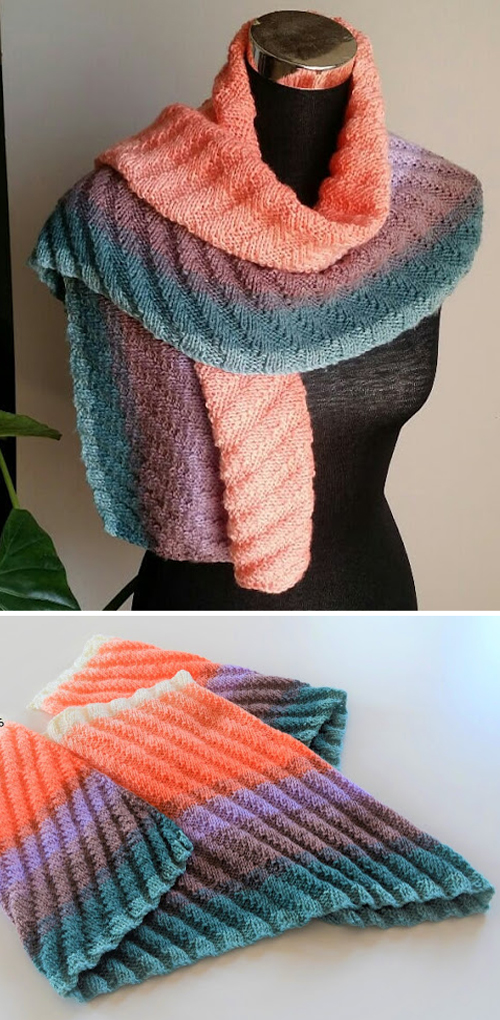
What beautiful knitting shawl/wrap (Free pattern)! Triangular chevron-shaped shawl with a textured rib design that showcases ombre or color change cake yarn. 

Full Post: Ribbed Shawlette

Simply Shawl - Knitting Pattern

Simply Shawl - Knitting Pattern
Photos above © Cheryl Faust
What beautiful knitting shawl pattern! I found it on Pinterest...
Rows of simple stitches, beautifully arranged to create this top down, triangular shawl, rich in texture and oh, so soft. Quick to knit and easy to wear, dressed up or down, Simply is sure to become a favorite go-to wardrobe accessory! 

Full Post: Simply

Endless Rainbow - Knitting Pattern

Endless Rainbow - Knitting Pattern
Photo above © wollball
What beautiful shawl knitting pattern! I found it on Ravelry...
Rainbow-colored yarns are all over the knitting world right now, and this is the pattern to make them really shine! On a semisolid background, the beautiful colors really stand out in thin stripes. On one edge of this long, triangular shawlette the yarn is given the opportunity to pool prettily in decorative little triangles. “Endless Rainbow” will look nice in a lot of different combinations of a solid and a multicolor fingering weight yarn. The reverse side looks good, too...

Full Post: Endless Rainbow

Rainbows - Free Pattern

Rainbows - Free Pattern
Photo above ©  Rahymah
What beautiful shawl knitting pattern! I found it on Ravelry...
This stylish but straightforward rainbow shawl is knitted from one end with gradual increases to form a triangular shawl, which is fun to unite and comfortable to wear. The curved border with eyelets gives it a nice touch and makes the knitting interesting.

Download Pattern: Close To You

Lily of the Valley Rosea - Knitting Pattern

Lily of the Valley Rosea - Knitting Pattern
Photo above © Alla Borisova

Lily-of-the-Valley-Rosea by Alla Borisova is an elaborate lace shawl with an unusual multi-part construction, delicate floral motifs and bead embellishment.

Originally published in 2016, the design combines a wide central section, side wings and separate lace edging to create a dramatic finished shawl suitable for special occasions.

The digital pattern is now discontinued and no longer available online from its original sources, so this page has been updated as a historical pattern guide rather than a download page.

Pattern Availability Update

Lily-of-the-Valley-Rosea by Alla Borisova has been discontinued. Ravelry currently states that the digital pattern is no longer available online, and its original publication sources are listed as out of print. Amazing Knitting does not host or link to unauthorized copies of the pattern.

Lily of the Valley Rosea at a Glance

Pattern: Lily-of-the-Valley-Rosea

Designer: Alla Borisova

Published: February 2016

Category: Shawl / Wrap

Yarn Weight: Cobweb, held three strands together

Suggested Yarn: Moscow Yarn Company Lidiya W

Needles: US 4 / 3.5 mm

Hook Sizes: 0.6 mm and 2.0 mm

Published Yardage: Approx. 2,381–2,406 yd / 2,177–2,200 m

Finished Size: Approx. 90 × 198 cm

Construction: Five-part shawl construction

Instructions: Charts only

Skill Level: Difficult / Advanced

Current Availability: Discontinued / no longer available online

About Lily of the Valley Rosea

Lily-of-the-Valley-Rosea was designed by Alla Borisova and first published in February 2016.

It is a large lace shawl with a highly decorative appearance, combining complex openwork with beads and an unusual structural approach.

The original pattern was available in both English and Russian.

An Unusual Five-Part Construction

One of the most distinctive features of this shawl is its construction.

According to the designer's published pattern information, the shawl consists of five main parts:

  • A wide central back panel
  • A knitted-on lace upper edge
  • Two side wings
  • A lower border

This is much more involved than a conventional triangular shawl worked continuously from one point or from the neckline.

Finished Size

The published finished size is approximately:

90 × 198 cm

The designer also notes that the final dimensions can vary depending on yarn weight, needle size and individual gauge.

Original Yarn

The pattern calls for approximately 135 grams of Lidiya Wool by Moscow Yarn Company.

This is an extremely fine 100% wool yarn listed at approximately 1,613 meters per 100 grams.

The original instructions specify working with three strands held together.

Why Three Fine Strands?

Holding several very fine strands together can create a fabric that still feels delicate while giving the knitter more control over the final thickness and drape.

It also affects yarn substitution. Matching only the label “lace” or “cobweb” is not enough; the combined fabric and finished gauge are what matter.

Published Yardage

Ravelry lists approximately:

2,381–2,406 yards / 2,177–2,200 meters

That figure reflects the very fine yarn and the large finished shawl.

Needles and Hooks

The published needle size is:

US 4 / 3.5 mm

The pattern information also lists crochet hooks in 0.6 mm and 2.0 mm.

These are associated with finishing and bead-related techniques in the original design.

Beaded Lace

Beads are an important decorative feature of Lily-of-the-Valley-Rosea.

The combination of fine lace yarn and beads gives the shawl a formal, almost ceremonial appearance that suits evening wear, weddings and other special occasions.

If working from a legitimate copy of the original pattern, organize the beads before beginning and use the hook size recommended for the specific bead-placement technique.

Charts Only

One important detail for prospective knitters is that the pattern is listed as charts only.

This means it is not a project for someone who relies exclusively on fully written row-by-row lace instructions.

You should be comfortable reading chart symbols and following complex lace repeats before attempting this design.

Chart Direction Matters

The designer notes that some charts show only right-side rows, while others show both right-side and wrong-side rows.

Because different charts follow different conventions, careful reading of the chart key and notes is essential.

Amazing Knitting does not reproduce the charts or the designer's copyrighted row instructions here.

Advanced Lace Techniques

The pattern uses a substantial range of lace techniques.

The designer's pattern information includes techniques such as:

  • Knit and purl stitches
  • Yarn overs
  • Knitting through the back loop
  • K2tog
  • SSK
  • Pass-slipped-stitch-over decreases
  • Centered triple decreases
  • Special multi-stitch manipulations

This combination explains why the design is classified as difficult.

Skill Level

The designer identifies Lily-of-the-Valley-Rosea as:

Difficult — for the advanced knitter

This is not simply because the shawl is large. The challenge comes from complex lace, several construction stages, charts, fine yarn and bead work.

The Lily-of-the-Valley Lace Motif

The central section of the shawl has an interesting historical connection.

The designer states that its central section uses the Maiglöckchen 603/115 stitch pattern by Herbert Niebling, published in Strick-Lehrbuch Burda in 1983.

“Maiglöckchen” is the German word for lily of the valley, which helps explain the floral character and name of the shawl.

Why Lifelines Are Especially Useful

With fine yarn and complicated lace, a lifeline can save a great deal of work.

Place one through a known-correct row at regular intervals, particularly before beginning a new chart or structural section.

If a later mistake requires unraveling, you then have a secure point to return to.

Use a Row Counter

A project with several charts benefits from disciplined row tracking.

Use a row counter, printed chart checklist or another reliable method rather than assuming you will remember where you stopped.

This is particularly important when a project is put aside between knitting sessions.

Check Stitch Counts Frequently

Complex lace can magnify a small error.

A missed yarn over or decrease may not become visually obvious until several rows later.

Checking counts at logical points can make errors much easier to locate and repair.

Choosing Substitute Yarn

If you already own a legitimate copy of the pattern and wish to substitute yarn, focus on the resulting fabric rather than matching only the printed yarn category.

Consider:

  • Combined thickness of the held strands
  • Drape
  • Stitch definition
  • Behavior during blocking
  • Strength when carrying beads
  • Total available yardage

Blocking Is Essential

Intricate lace often looks compressed directly from the needles.

Blocking allows the floral motifs to open and helps establish the final shape of the large lower border and side sections.

Follow the care requirements of your yarn and allow the shawl to dry completely while held in its intended shape.

Is Lily of the Valley Rosea Still Available?

No current authorized online copy could be verified.

Ravelry currently states: “Discontinued. This digital pattern is no longer available online.”

The listed original sources are also marked out of print.

For that reason, Amazing Knitting does not provide links to copied PDFs or unofficial archives.

View the Historical Pattern Record

Ravelry still maintains the official pattern record with the designer, yarn information, project examples and historical specifications:

View Lily of the Valley Rosea on Ravelry →

Looking for a Free Lace Shawl Instead?

If you want a complex lace project with a pattern that is currently available for free, try Begonia Swirl by Carfield Ma.

It is a different design, but it offers substantial lace knitting and its original free Ravelry download remains available.

See the Free Begonia Swirl Shawl →

Another verified free lace option in our archive is:

See the Free Birds Nest Shawl →

More Lace Shawls

Before You Start

Lily-of-the-Valley-Rosea is now a discontinued pattern. If you already own a legitimate copy, read through all of the charts and construction notes before beginning.

Prepare your yarn and beads in advance, use lifelines and a reliable row-tracking system, and expect the different construction stages to require careful attention.

If you do not already own the pattern, use the Ravelry page as a historical reference rather than downloading unverified copies from unknown websites.

Pattern credit: Lily-of-the-Valley-Rosea was designed by Alla Borisova and first published in 2016. The existing photograph on this Amazing Knitting page is credited to Alla Borisova. Amazing Knitting provides an independent historical pattern guide and does not reproduce the designer's copyrighted charts or complete knitting instructions.

Stitch Stripe Shawl Knitting Patterns

Stitch Stripe Shawl Knitting Patterns
Beauitiful Knitting Shawls 

Stitch stripe shawls are a wonderful way to combine several knitting techniques in one wearable project.

Instead of relying only on color stripes, these shawls alternate sections of garter stitch, lace, slipped stitches, moss stitch, eyelets, dropped stitches and other textures.

The result can look complex while still allowing you to work through one manageable stitch pattern at a time.

About This Guide

This Amazing Knitting page is an independent guide to textured stripe shawls. We do not reproduce designers' complete knitting instructions. Pattern availability can change, so use the original designer or publisher links for the current pattern.

What Is a Stitch Stripe Shawl?

A stitch stripe shawl is built from visible bands or sections where the knitting technique changes.

One section might be simple garter stitch, while the next introduces lace, slipped stitches, moss stitch, eyelets or another texture.

Color changes can make those sections even more obvious, but they are not essential. A single-color shawl can still show dramatic striping when the stitch patterns create enough contrast.

Why These Shawls Are So Interesting to Knit

Long shawls can sometimes become repetitive. A sampler-style design solves that by changing the knitting experience as the fabric grows.

You may spend one section working relaxing garter stitch and the next following a lace or slipped-stitch motif.

This makes textured stripe shawls especially useful for knitters who enjoy variety without wanting to make many separate small projects.

Good Techniques for Stitch Stripe Shawls

Common techniques include:

  • Garter stitch
  • Stockinette and reverse stockinette
  • Moss or seed stitch
  • Lace and eyelets
  • Slipped stitches
  • Mosaic-style colorwork
  • Dropped stitches
  • Twisted stitches
  • Bobbles
  • Textured ribs

You do not need all of these techniques in one design. Even two or three contrasting stitch patterns can produce a strong striped effect.

Free Pattern: Lueur Shawl

Lueur by Audrey Borrego is an excellent modern example of the stitch-sampler idea.

It combines several textures including twisted stitches, bicolour moss stitch, bobbles and a garter tweed motif.

The shawl is an asymmetrical triangle worked sideways and uses two colors of sport-weight yarn.

Lueur is currently available as a free Ravelry download.

View the Free Lueur Shawl Pattern →

Free Pattern: Guild Park

Guild Park by Laura Chau is another interesting textured wrap.

Published by Knitty, it combines a zigzag lace mesh with twisted stitches and dropped-stitch sections that create soft waves across the fabric.

Guild Park is a rectangular wrap worked flat in sport-weight yarn and remains available as a free Knitty pattern.

View the Free Guild Park Pattern →

Free Web Pattern: Cambria Wrap

Cambria Wrap by Alexandra Tavel is a large triangular wrap that alternates simple fabric with eyelet and lace details.

The design uses worsted-weight yarn and is approximately 76 inches / 193 cm wide with a depth of about 38 inches / 97 cm.

The designer currently offers a free web version, while a paid PDF version is also available for knitters who prefer that format.

View Cambria Wrap Pattern Information →

One Color or Several?

Both approaches work.

With a single color, the eye is drawn to the changing stitch texture. This can produce an elegant and understated shawl.

With two or more colors, the stripe structure becomes much more graphic.

If the stitch pattern is already elaborate, consider using relatively simple color combinations so that color and texture do not compete for attention.

These Patterns Are Excellent for Stash Yarn

Multi-section shawls can be useful stash projects because different colors can be assigned to different bands.

Before mixing leftover yarns, make sure they behave reasonably well together.

Similar yarn weights and compatible washing instructions usually make finishing easier.

Watch Your Gauge When the Stitch Changes

Different stitch patterns can produce very different fabric widths even when worked with the same yarn and needle.

Garter stitch, lace, slipped stitches and seed stitch may not all have the same natural gauge.

In a well-designed pattern, the designer has already accounted for these differences. Avoid changing stitch counts or needle sizes inside individual sections unless you understand how that will affect the overall shawl shape.

Use Lifelines in Lace Sections

If a shawl alternates easy texture with more complicated lace, a lifeline can be useful before beginning a difficult section.

That gives you a known-correct row to return to without undoing an earlier completed stripe.

Keep Notes as You Work

Sampler shawls are much easier to manage when you keep a simple record of your progress.

Note which section you are working, which color you used and where you stopped.

This is especially useful if the project is set aside for several days or weeks.

Blocking Makes a Big Difference

Blocking is especially important when several textures appear in one shawl.

Lace usually opens after blocking, while garter and moss stitch settle into a more even surface.

Use a method appropriate for your yarn and follow the designer's finished measurements rather than stretching every section as far as possible.

How to Choose a Stitch Stripe Shawl

Before choosing a pattern, consider what you want from the project.

  • Choose garter and simple texture if you want relaxing knitting.
  • Choose lace sections if you enjoy charts and openwork.
  • Choose slipped stitches if you want color effects without traditional stranded knitting.
  • Choose a sampler shawl if your goal is to practice several techniques in one project.
  • Choose a multicolor design if you want to use leftover yarn or mini skeins.

More Stitch Stripe Shawl Patterns

The original inspiration for this older Amazing Knitting post was a collection from In the Loop Knitting, which continues to maintain a large roundup of stitch-stripe shawl patterns from many different designers.

Some are free, while pattern availability can change over time. Always follow through to the individual designer or publisher before assuming that a pattern is still free.

Explore More Stitch Stripe Shawls at In the Loop Knitting →

Explore More Free Shawls on Amazing Knitting

Before You Start

Check the current pattern source before purchasing yarn because older roundup pages can remain online long after an individual designer has changed a pattern from free to paid or discontinued it.

Once you choose a design, read through all of its stitch sections before casting on and make sure you understand any unfamiliar techniques.

Then choose colors that allow the texture to remain visible and enjoy the changing rhythm of the different stitch patterns.

Editorial note: This Amazing Knitting page is an independent educational and discovery guide. The linked patterns belong to their respective designers and publishers. Amazing Knitting does not reproduce their complete copyrighted instructions.

Birds Nest Shawl - Free Pattern

Birds Nest Shawl - Free Pattern
Photo above © Athanasia Andritsou

Birds Nest Shawl by Athanasia Andritsou is a beautiful deep triangular lace shawl that brings together delicate lace knitting and traditional Estonian-inspired stitches.

Designed for lace-weight yarn, the shawl features intricate texture, elegant openwork and the distinctive raised details created by nupps. Best of all, the designer still offers the pattern as a free Ravelry download.

✓ Free Pattern Availability

Birds Nest Shawl is currently available as a free download directly from the designer's Ravelry store. The designer specifies that the pattern is offered for personal, non-commercial use, so please read and respect the usage terms included with the pattern.

Birds Nest Shawl at a Glance

Pattern: Birds Nest Shawl

Designer: Athanasia Andritsou

First Published: February 2015

Craft: Knitting

Category: Shawl / Wrap

Shape: Deep triangle

Yarn Weight: Lace

Suggested Yarn: Posh Yarn Miranda Lace

Yardage: 766–875 yards / 700–800 m

Needle Size: US 2 / 2.75 mm

Notable Techniques: Estonian-inspired lace and nupps

Sizing: Modular / adjustable

Current Availability: Free Ravelry download

About the Birds Nest Shawl

Designed by Athanasia Andritsou, Birds Nest Shawl is a lace project intended for knitters who want to explore something beyond basic triangular shawl construction.

The designer describes it as a deep triangular shawl featuring some of the beautiful stitches associated with Estonian knitting, including the characteristic raised details known as nupps.

The combination of open lace and dimensional texture gives the finished shawl an intricate appearance that can look especially striking after careful blocking.

The Inspiration Behind Birds Nest

The name has a lovely connection to the designer's surroundings. Athanasia Andritsou originally introduced the design while observing the birds nesting in the trees around her home.

That natural inspiration suits the pattern particularly well: the lace has an organic appearance, with repeating motifs and textured details that create movement across the triangular fabric.

Yarn and Yardage

The original shawl was designed using Posh Yarn Miranda Lace, a luxurious lace-weight yarn.

The published yardage is approximately:

766–875 yards / 700–800 metres

The original Miranda Lace yarn combines fine fibres that produce a soft fabric with a gentle halo.

If you substitute another lace yarn, consider both stitch definition and drape. Highly textured lace details can appear quite different in a very fuzzy yarn compared with a smooth, tightly spun yarn.

Needle Size

The published needle size is:

US 2 / 2.75 mm

Treat the recommended needle size as a starting point. Lace knitters often adjust needle size depending on the yarn and the amount of openness or drape they want in the finished fabric.

A Modular Shawl

One particularly useful feature of Birds Nest Shawl is that its size is modular.

The designer also notes that gauge is not particularly important for this project. That gives the knitter more flexibility than a fitted garment, where a small gauge difference can significantly affect the final size.

Yarn quantity still matters, however. If you plan to make a larger shawl, allow additional yarn rather than relying only on the quantity used for the original project.

What Are Nupps?

Nupps are small raised decorative elements strongly associated with Estonian lace knitting.

They create tiny dimensional points within the lace rather than remaining completely flat like ordinary openwork stitches.

They can require more attention than basic yarn-over lace, particularly when several loops must be handled together. If this is your first project using nupps, practicing the technique on a small swatch before beginning the shawl can make the main project more comfortable.

Charts and Written Support

Birds Nest Shawl is primarily a chart-based lace pattern.

The designer also provides written instructions after the charts, but explains that these are intended as support for the charts rather than a complete replacement for them because the chart repeat boxes need to be taken into account.

For that reason, this pattern is best approached by a knitter who is comfortable reading knitting charts or is willing to learn how chart repeats work.

Skills That Help

Useful skills for Birds Nest Shawl include:

  • Knit and purl stitches
  • Working yarn overs
  • Working decreases
  • Reading lace charts
  • Following chart repeat boxes
  • Working Estonian-style lace techniques
  • Making nupps
  • Managing fine lace-weight yarn
  • Blocking a lace shawl

Blocking the Finished Shawl

Blocking is particularly important for lace knitting.

Freshly knitted lace can look compressed because the stitches have not yet opened into their intended shapes. Careful blocking helps reveal the openwork, defines the triangular shape and allows the decorative motifs to become much easier to see.

Always follow the care instructions appropriate for the yarn you choose.

Pattern Corrections and Updates

Because Birds Nest Shawl has been available for many years, it is worth downloading the current version rather than relying on an old saved copy.

The designer uploaded a corrected version in 2018 addressing specific chart rows. Using the current Ravelry download helps ensure that you are working from the latest version provided by the designer.

Is Birds Nest Shawl Still Free?

Yes. Birds Nest Shawl is currently available as a free Ravelry download from Athanasia Andritsou.

There is an important condition: the designer states that the pattern is provided for personal, non-commercial use.

Please check the designer's complete current terms when downloading the pattern. “Free pattern” means there is no purchase price for the download; it does not mean the designer has given up copyright or usage conditions.

Get the Free Birds Nest Shawl Pattern

Download the current version directly from the designer's Ravelry listing.

Get the Free Birds Nest Shawl Pattern →

More Free Lace Shawls

If you enjoy this style of project, Amazing Knitting has more shawl and lace knitting ideas in the archive.

Explore Free Lace Shawl Patterns →

You can also browse free knitted shawls, lace knitting patterns, and triangular knitted shawls.

Before You Start

Download the latest version of the pattern first and read through the charts before casting on. If nupps are new to you, make a small practice swatch so you can become comfortable with the technique before reaching the more intricate sections of the shawl.

Also check that you have enough yarn for the size you intend to make, particularly if you plan to enlarge the modular design.

Pattern credit: Birds Nest Shawl was designed by Athanasia Andritsou. The existing project photograph on this Amazing Knitting page is credited to Athanasia Andritsou. The pattern remains the designer's copyrighted work and is currently offered free under the designer's stated personal, non-commercial usage terms. Amazing Knitting does not reproduce the designer's charts or row-by-row instructions.

Discover More From the Archive

A fresh mix of knitting patterns and tutorials from the Amazing Knitting archive.

Finding patterns from the archive…