Skip to content

...

Showing posts sorted by relevance for query stranded knitting. Sort by date Show all posts

Lamb Dance Hat - Free Pattern

Lamb Dance Hat - Free Pattern
Photo above © DROPS Design

Lamb Dance Hat / DROPS Children 34-2 is a playful free children's hat knitting pattern featuring a flock of little sheep worked in stranded colorwork.

Designed for children approximately 3 to 12 years old, the hat is worked from the bottom up in the round and finished with a pompom. It coordinates beautifully with the other Lamb Dance children's designs from DROPS.

The complete pattern remains free from DROPS Design.

✓ Free Pattern Availability

Lamb Dance Hat / DROPS Children 34-2 is currently available as a free official knitting pattern from DROPS Design. Use the official DROPS link below for the complete current instructions, chart and supporting information.

Lamb Dance Hat at a Glance

Pattern: Lamb Dance Hat / DROPS Children 34-2

Designer: DROPS Design

Pattern Number: me-053-bn

Published: March 2019

Category: Children's Hat / Beanie

Sizes: 3/4, 5/6, 7/8, 9/10 and 11/12 years

Yarn Weight: DK / Yarn Group B

Suggested Yarn: DROPS Merino Extra Fine or DROPS Lima

Main Needles: 3 mm / US 2½

Rib Needles: 2.5 mm / US 1½

Gauge: 23 stitches × 32 rows = 4 in / 10 cm

Construction: Bottom up, worked in the round

Features: Sheep colorwork, ribbing, pompom

Availability: Free official DROPS pattern

About the Lamb Dance Hat

Lamb Dance Hat is a children's colorwork hat designed by DROPS Design.

The most distinctive feature is the cheerful band of sheep worked around the hat using stranded colorwork.

Ribbing creates a comfortable lower edge, while the crown is shaped above the decorative section and finished with a pompom.

It is a particularly fun project if you want to practice stranded knitting on something smaller than a sweater or cardigan.

Five Children's Sizes

The official pattern includes five sizes:

  • 3/4 years
  • 5/6 years
  • 7/8 years
  • 9/10 years
  • 11/12 years

The corresponding published head circumferences are approximately:

50/53 – 50/53 – 53/54 – 54/56 – 54/56 cm

That's approximately 19¾–22 inches across the size range.

Age is only a general guide. If you are knitting for a specific child, measuring the head circumference is preferable.

Finished Hat Height

DROPS gives approximate finished heights of:

19 – 20 – 21 – 22 – 23 cm

That's approximately:

7½ – 8 – 8¼ – 8¾ – 9 inches

Yarn Choices

DROPS provides two suggested yarn options:

  • DROPS Merino Extra Fine
  • DROPS Lima

Both belong to DROPS Yarn Group B and work at the required DK-weight gauge, but their fiber compositions and finished feel differ.

Merino Extra Fine is a merino wool yarn, while Lima combines wool and alpaca.

Five Colors Create the Sheep Design

The original version uses five colors.

For DROPS Merino Extra Fine, the published color combination is:

  • Pistachio
  • Light Grey Blue
  • Off White
  • Black
  • Cerise

DROPS specifies 50 grams of each color for every published size.

A corresponding five-color palette is also provided for DROPS Lima.

Can You Choose Different Colors?

Absolutely. One of the enjoyable features of stranded colorwork is the opportunity to create your own palette.

The most important consideration is contrast.

The sheep and other chart details need enough contrast with the background to remain visible.

Before casting on, place your chosen colors next to each other and make sure the important motifs will not disappear into the background.

Gauge

The official gauge is:

23 stitches × 32 rows = 4 × 4 inches / 10 × 10 cm

This is measured in stockinette stitch using the larger needles.

Gauge matters for hats because the finished circumference must be comfortable without being excessively tight or loose.

Check Your Colorwork Gauge

Stranded knitting can sometimes produce a tighter gauge than ordinary one-color stockinette.

This usually happens when the floats carried behind the work are too tight.

If you are new to stranded knitting, consider making a small colorwork swatch in addition to checking your normal stockinette gauge.

Needles

DROPS recommends:

  • 3 mm / US 2½ circular needle, 40 cm / 16 in
  • 3 mm / US 2½ double-pointed needles
  • 2.5 mm / US 1½ circular needle, 40 cm / 16 in for ribbing

The published sizes are recommendations. Adjust your needles if necessary to obtain the required gauge.

Bottom-Up Construction

Lamb Dance Hat is knitted from the bottom up.

You begin with the lower edge and ribbing, then progress into the main hat and sheep colorwork before shaping the crown.

This construction allows the decorative motif to form a continuous band around the hat.

Worked in the Round

Unlike a flat-knitted hat that requires a back seam, Lamb Dance Hat is worked in the round.

Ravelry classifies the design as one-piece and seamless.

A short circular needle can be used while enough stitches remain on the needle, with double-pointed needles or another suitable small-circumference method used as the crown becomes narrower.

The Sheep Colorwork

The little sheep are the signature feature of the Lamb Dance collection.

They are created using stranded colorwork according to the chart supplied by DROPS Design.

Amazing Knitting does not reproduce the copyrighted chart here. Use the current official DROPS pattern while knitting the motif.

Keep Your Floats Relaxed

When carrying an unused color behind the work, avoid pulling it too tightly.

Tight floats can reduce the circumference of the hat and cause the colorwork fabric to pucker.

Spread the recently worked stitches gently along the right needle before changing colors. This gives the carried yarn enough length to span the stitches comfortably.

Watch Color Dominance

When two colors are carried together, the way you consistently hold them can affect how prominent each color appears in the finished motif.

Try to maintain the same relationship between your background and motif colors throughout each section.

Consistency usually produces cleaner-looking stranded colorwork.

Managing Multiple Colors

Although several colors are used across the complete hat, you will not necessarily be actively knitting with every color at the same moment.

Follow the official chart carefully and organize the yarn so that strands do not become unnecessarily tangled.

Small balls or bobbins can sometimes make multiple contrast colors easier to manage.

Crown Shaping

After the main decorative portion is complete, decreases shape the top of the hat.

As the circumference becomes too small for the short circular needle, switch to double-pointed needles or your preferred small-circumference method while following the official instructions.

The Pompom

A pompom completes the original Lamb Dance Hat.

Take care to attach it securely, particularly when the hat is intended for a child.

As with any children's garment, periodically inspect attached decorations for wear or looseness.

Skills Used in Lamb Dance Hat

This project provides practice with:

  • Knitting in the round
  • Ribbing
  • Stockinette stitch
  • Reading a colorwork chart
  • Stranded knitting
  • Managing yarn floats
  • Working with multiple colors
  • Crown decreases
  • Working a small circumference
  • Making and attaching a pompom

A Good Small Colorwork Project

If you want to try stranded knitting but are not ready to commit to a full colorwork sweater, a hat can be an excellent intermediate step.

You still get experience reading a chart, controlling floats and maintaining colorwork tension, but on a much smaller project.

Part of the Lamb Dance Collection

The hat belongs to the same DROPS children's collection as the Lamb Dance Jacket already featured on Amazing Knitting.

Both designs use the playful sheep theme, making them natural coordinating projects.

See the Free Lamb Dance Jacket →

DROPS also published a matching Lamb Dance Sweater, giving knitters several ways to use the same cheerful colorwork theme.

Is Lamb Dance Hat Still Free?

Yes.

Lamb Dance Hat / DROPS Children 34-2 remains available as a complete free knitting pattern directly from DROPS Design.

The official page includes the current written instructions, diagram and supporting information.

Amazing Knitting provides this independent project guide rather than reproducing DROPS Design's complete copyrighted pattern or chart.

Get the Free Lamb Dance Hat Pattern

Visit DROPS Design for the complete free pattern:

Get the Free Lamb Dance Hat Pattern →

More Free Children's Knitting Patterns

Continue exploring free children's projects from the Amazing Knitting archive:

Before You Start

Measure the child's head if possible, choose a suitable Yarn Group B yarn and make sure you can obtain the required gauge.

If stranded knitting is new to you, practice carrying two colors before starting the sheep section and pay particular attention to keeping your floats relaxed.

Finally, work from the current official DROPS page so that you have the complete pattern, chart and supporting information beside you.

Pattern credit: Lamb Dance Hat / DROPS Children 34-2 was designed and published by DROPS Design. Amazing Knitting does not reproduce the designer's complete copyrighted knitting instructions or colorwork chart. Please preserve the existing photograph credit shown on this page.
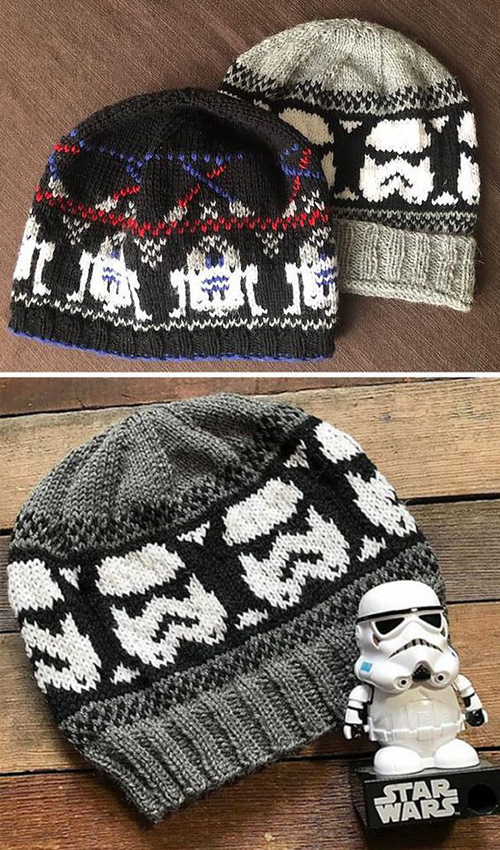
Storm Trooper Beanie – Stranded Colorwork Knitting Pattern Guide

Storm Trooper Beanie stranded colorwork knitting pattern

Storm Trooper Beanie by Lindsay (Bundle). Project photos @creeksidecrochet & © Marlaatumass.

Storm Trooper Beanie by Lindsay (Bundle) is a fun Star Wars-inspired knitted hat featuring a recognizable black-and-white helmet motif created with stranded colorwork.

Originally published in 2017, the design became popular with knitters looking for an approachable introduction to Fair Isle-style colorwork. It combines a straightforward beanie construction with a graphic motif that makes the finished hat stand out.

Pattern availability update: this pattern was previously available as a free digital pattern, but its current Ravelry record lists it as discontinued and no longer available online. We have therefore removed the old “Free Pattern” label from this page.

Storm Trooper Beanie at a Glance

  • Pattern: Storm Trooper Beanie
  • Designer: Lindsay (Bundle)
  • Published: December 2017
  • Category: Beanie / toque
  • Craft: Knitting
  • Yarn weight: Sport
  • Suggested yarn: Knit Picks Brava Sport
  • Yardage: Approximately 160–180 yd (146–165 m)
  • Needles: US 6 / 4.0 mm
  • Gauge: 23 stitches = 4 in / 10 cm
  • Construction: Bottom-up and worked in the round
  • Color technique: Stranded colorwork
  • Language: English
  • Current status: Discontinued

About the Storm Trooper Beanie

The Storm Trooper Beanie takes the familiar shape of a knitted beanie and turns it into a graphic colorwork project.

The hat uses contrasting light and dark yarn to create a Stormtrooper-inspired helmet motif around the body of the hat.

Because most of the visual impact comes from two-color stranded knitting, the project is particularly interesting for knitters who want to move beyond plain hats without tackling a highly complicated garment.

A Beginner-Friendly Introduction to Stranded Colorwork

The designer originally described the pattern as a good introduction to stranded or Fair Isle-style knitting.

Instead of creating the graphic design afterward with embroidery, the contrasting colors are worked directly into the knitted fabric.

This gives the hat its crisp, recognizable appearance while teaching an important knitting technique that can later be used for sweaters, mittens, cowls and many other projects.

How Stranded Colorwork Works

In stranded knitting, two colors are used across the same round.

While one color is being knitted, the unused yarn travels behind the fabric in strands commonly called floats.

The challenge is keeping those floats loose enough that they do not pull or distort the finished fabric.

Once you become comfortable managing two yarns, the technique can become surprisingly rhythmic.

Managing Your Colorwork Tension

Tension is one of the most important parts of stranded knitting.

If the floats behind the work are pulled too tightly, the colorwork section may become narrower than the rest of the hat and the motifs can pucker.

Try spreading the recently worked stitches naturally along the right needle before carrying the unused yarn behind them.

Your goal is a flexible fabric where the colorwork lies flat without loose loops hanging inside the hat.

Watch the Longer Floats

Graphic motifs sometimes create sections where one color is not used for several stitches.

Longer floats require a little more attention because they can become either too tight or too loose.

Depending on the distance involved, experienced colorwork knitters may choose to catch a longer float behind the fabric.

Avoid catching floats in exactly the same location on consecutive rounds, which can make the trapped yarn more visible from the front.

Worked in the Round

The Storm Trooper Beanie is worked in the round.

This construction is particularly convenient for stranded colorwork because the right side of the fabric remains facing you while the graphic motif is being created.

There is also no long vertical seam to sew after completing the main body of the hat.

Bottom-Up Construction

The hat begins at the lower edge and progresses upward toward the crown.

This familiar bottom-up structure lets you establish the circumference before working the main graphic section.

Crown decreases then shape the top of the beanie.

Sport-Weight Yarn

The original pattern uses sport-weight yarn.

The suggested yarn was Knit Picks Brava Sport, an acrylic yarn that provides clear stitch definition for graphic colorwork.

You do not necessarily need to use the exact original yarn, but any substitute should produce the required gauge and a fabric suitable for a fitted hat.

How Much Yarn?

The published pattern information lists approximately 160–180 yards (146–165 meters).

Since this is a colorwork design, you need contrasting colors rather than a single uninterrupted shade.

If you are substituting yarn, compare both yarn weight and meterage and allow a little extra for swatching.

Classic Black and White

Black and white are the obvious color choices when trying to preserve the Stormtrooper-inspired appearance.

The strong contrast also makes the charted motif easy to recognize.

However, knitters can use the same general colorwork concept with other high-contrast combinations for a more personalized result.

Why Contrast Matters

Colorwork motifs depend on contrast.

Two yarns that look very different in the skein can sometimes have surprisingly similar values when knitted together, causing the design to disappear.

A quick way to test your choices is to photograph the yarns together and view the image in grayscale. If they remain clearly different, the motif is more likely to remain visible.

Needles and Gauge

The original pattern information lists US 6 / 4.0 mm needles.

The published gauge is approximately 23 stitches per 4 inches / 10 cm.

Use these numbers as a reference rather than assuming the listed needle automatically produces the correct result.

Individual knitting tension varies, so swatching remains important.

Swatch in Colorwork

If possible, test at least part of your swatch using both colors.

Many knitters discover that their stranded knitting is tighter than their single-color stockinette.

A colorwork swatch can therefore tell you more about the final fit than a plain stockinette swatch alone.

Why Colorwork Hats Are Great Practice Projects

A hat is much smaller than a stranded sweater, making it a practical project for learning a new technique.

You can practice:

  • Reading a colorwork chart
  • Working with two colors
  • Managing floats
  • Maintaining even tension
  • Knitting in the round
  • Following repeated motifs
  • Shaping a knitted crown

Once these skills feel comfortable on a hat, larger stranded projects can seem much less intimidating.

Reading a Colorwork Chart

Colorwork charts visually represent the stitches in each round.

Each square represents a stitch and its color tells you which yarn to use.

When knitting in the round, chart rows are generally read consistently in the direction of your knitting.

Always follow the instructions supplied with the specific pattern or chart because chart conventions can vary.

Use Stitch Markers to Track Repeats

If a colorwork motif repeats around the hat, markers can make it easier to recognize where each repeat begins and ends.

This can help you catch a chart-reading mistake before it continues around several rounds.

Just make sure markers do not interfere with decreases or other shaping later in the project.

Check the Motif Frequently

One advantage of graphic colorwork is that mistakes often become visually obvious.

Stop occasionally and look at the developing design from a short distance.

A misplaced contrasting stitch can be easier to spot in the overall image than while concentrating on individual chart squares.

Keep the Inside Neat

The inside of a stranded hat will naturally show floats.

They do not need to look identical, but they should be reasonably even and flexible.

Extremely tight floats can affect fit, while very loose floats may catch on fingers when the hat is put on.

Blocking Makes a Difference

Gentle blocking can significantly improve stranded knitting.

It allows stitches to settle and can help small irregularities in tension become less noticeable.

Always choose a blocking method appropriate for the fiber content of your yarn.

Who Would Enjoy This Project?

This style of hat is especially appealing to knitters who enjoy pop-culture-inspired projects and graphic colorwork.

It was originally designed as a gift for a Star Wars fan, and that gift idea helped make the pattern popular among knitters.

The combination of a practical winter accessory and a recognizable motif gives the project much of its appeal.

Pattern Availability Update

Storm Trooper Beanie by Lindsay (Bundle) was previously available as a free knitting pattern.

However, its current Ravelry record now states that the design is discontinued and that the digital pattern is no longer available online.

Because Amazing Knitting verifies pattern availability periodically, we have removed the old “Free Pattern” description rather than continue sending readers to an unavailable download.

View the Original Pattern Record

Ravelry still maintains the historical record for the original design. It is useful for confirming the designer, yarn weight, gauge, yardage, construction and project history, even though the pattern itself is no longer available for download.

View the Storm Trooper Beanie Pattern Record →

Looking for an Available Alternative?

Because the original Lindsay (Bundle) pattern is discontinued, look for currently available stranded-colorwork beanie patterns if your main goal is to practice the same knitting techniques.

Search for designs using terms such as stranded colorwork beanie, two-color knitted hat or beginner Fair Isle hat.

Choose an alternative based on its current availability, gauge, size and yarn requirements rather than assuming that another pattern with “Stormtrooper” in its title is the same design.

Storm Trooper Beanie is a design by Lindsay (Bundle). Amazing Knitting does not reproduce the copyrighted pattern instructions. The pattern was formerly available free but is currently listed as discontinued and unavailable online.

Read Our Pattern Availability Policy →

The Blue Shimmer Yoke Cardigan - Bohus Knitting Pattern Guide

The Blue Shimmer Yoke Cardigan - Free Pattern
Photos above © schrouderknits

The Blue Shimmer (Blå Skimmer) is one of the most celebrated designs associated with the Swedish Bohus Stickning tradition.

Designed by Anna-Lisa Mannheimer Lunn in 1947, Blue Shimmer became the most popular design produced by Bohus Stickning and remains instantly recognizable for its extraordinary circular yoke, subtle color transitions and mixture of colorwork and texture.

If this beautiful cardigan brought you here, this guide will help you identify the original design, understand what makes Bohus knitting distinctive, and avoid an important source of confusion: more than one authorized reproduction of Blue Shimmer has existed, and their knitting instructions are not interchangeable.

Pattern Availability

Blue Shimmer is a historic copyrighted design with multiple authorized reproductions. We could not verify a current authorized free version of the exact Blue Shimmer Yoke Cardigan. One well-known English-language reproduction appeared in the book Poems of Color, which is now listed as out of print, while another historically accurate reproduction was produced through SOLsilke / AngoraGarnet. Amazing Knitting therefore does not reproduce the charts or direct readers to unofficial copies.

The Blue Shimmer at a Glance

Original Name: Blue Shimmer / Blå Skimmer

Designer: Anna-Lisa Mannheimer Lunn

Original Design: 1947

Tradition: Bohus Stickning

Garment Style: Circular-yoke sweater / cardigan variations

Techniques: Stranded colorwork and textured stitches

Notable Feature: Multi-color patterned yoke

Historical English Source: Poems of Color: Knitting in the Bohus Tradition

Current Status: No verified current free version of the exact cardigan

What Is Blue Shimmer?

Blue Shimmer, or Blå Skimmer, is much more than an ordinary stranded-colorwork sweater.

It belongs to the remarkable knitting tradition developed by Bohus Stickning in Sweden during the twentieth century.

The original Blue Shimmer design dates to 1947 and became one of the best-known garments associated with Bohus knitting.

Its patterned yoke combines carefully arranged colors with changes in stitch texture, producing the soft, shimmering effect that inspired the design's name.

What Was Bohus Stickning?

Bohus Stickning was a Swedish knitting organization known for exceptionally sophisticated hand-knitted garments.

Its designs became famous for combining fine yarns, unusual color relationships and technically sophisticated patterned yokes.

Unlike many stranded-knitting traditions that rely primarily on two-color geometric motifs, Bohus designs often use several closely related shades to create subtle visual transitions.

Why Blue Shimmer Became So Famous

Blue Shimmer is often singled out because its yoke demonstrates many of the qualities that made Bohus knitting distinctive.

Rather than creating a hard boundary between one motif and the next, the colors appear to move and shimmer across the surface.

Texture adds another layer of complexity, so the design changes not only through color but through the way individual stitches catch the light.

The Circular Yoke Is the Star

The patterned yoke is the visual center of Blue Shimmer.

Multiple shades are arranged around the upper body so the pattern develops continuously around the garment.

This means consistent tension is particularly important. A section worked too tightly can reduce the elasticity of the yoke, while loose floats can make the fabric uneven.

More Than Ordinary Stranded Colorwork

One reason Bohus knitting is so interesting is that the patterned areas may combine color changes with knit and purl texture.

That combination produces a surface quite different from completely smooth stranded stockinette.

For knitters familiar with Fair Isle or other stranded traditions, Bohus knitting can therefore introduce a different approach to creating depth and visual movement.

The Original Design Dates to 1947

Anna-Lisa Mannheimer Lunn designed Blue Shimmer in 1947.

Historical pattern records identify it as the most popular design produced by Bohus Stickning.

That history is important because many modern photographs show reproductions rather than garments knitted directly from an original 1940s pattern sheet.

Important: There Is More Than One Blue Shimmer Pattern

Do Not Mix the Instructions

Two authorized reproductions of the historic Blue Shimmer design are documented. They look similar but use different yarn weights, gauges, stitch counts, construction methods and directions. Choose one complete version and follow its specifications throughout.

The Poems of Color Version

One well-known reproduction appears in Poems of Color: Knitting in the Bohus Tradition.

Ravelry records the Blue Shimmer Yoke Cardigan from this source as using a sport-weight interpretation and providing sizes S, M and L.

The book itself is currently listed as out of print.

Poems of Color Cardigan Specifications

For historical reference, the Ravelry record for this specific reproduction lists:

  • Sizes: S, M, L
  • Approximate finished bust: 40, 44, 48 inches
  • Yarn weight: Sport / 5-ply interpretation
  • Main gauge: 7 stitches per inch
  • Needles listed: US 1, US 2 and US 3
  • Yardage: approximately 1,699–1,999 yards
  • Colorwork: Chart provided for the patterned section

These specifications apply to the Poems of Color reproduction. They should not be assumed to apply to other Blue Shimmer reproductions.

The SOLsilke / AngoraGarnet Reproduction

A separate authorized recreation was developed by Solveig Gustafsson in 1999.

This reproduction was created using fine Bohus-style angora-merino yarn and later became associated with AngoraGarnet.

It is not simply the Poems of Color instructions rewritten with a different yarn.

Why the Two Versions Cannot Be Combined

The documented differences include:

  • Yarn weight
  • Gauge
  • Neck stitch count
  • Bust stitch count
  • Waist stitch count
  • Construction
  • Written directions

For example, the Poems of Color interpretation uses approximately 7 stitches per inch, while the historically oriented SOLsilke / AngoraGarnet version uses a substantially finer gauge of approximately 8.25 stitches per inch.

Substituting numbers from one version into the other could therefore create serious sizing and construction problems.

The Famous Angora-Merino Fabric

Fine angora-blend yarn is closely associated with the characteristic appearance of many Bohus garments.

The halo softens transitions between neighboring colors and contributes to the almost painted appearance of the patterned yoke.

This is one reason a modern reproduction worked in a very different fiber may look sharper and less blended even when the colors are similar.

Color Is Everything

Blue Shimmer demonstrates how sophisticated colorwork does not require extremely bright contrasts.

Closely related blues, neutrals and accent shades interact to create depth rather than simple graphic separation.

When viewed from a distance, the individual motifs merge into a shimmering field of color around the shoulders.

Swatching Is Essential

Blue Shimmer is not a project where gauge should be treated casually.

A proper swatch helps you evaluate:

  • Gauge
  • Stranded tension
  • Color interaction
  • Fabric density
  • Float management
  • Behavior after washing

If you are working from an authorized reproduction, swatch using the yarn and gauge specified by that particular version.

Practice Stranded Tension First

The patterned yoke contains many stitches where uneven stranded tension would be immediately visible.

If you are new to stranded knitting, practicing on a smaller project before beginning a historic Bohus reproduction can be worthwhile.

The goal is to keep the unused yarn relaxed behind the work without allowing excessively loose floats.

Why the Wrong Yarn Can Change the Look

Matching gauge alone does not guarantee the same visual result.

Fiber content, halo, elasticity and color blending all influence the character of a Bohus-style fabric.

A smooth yarn may produce beautifully clear stitches, but it will not necessarily create the same soft transitions associated with an angora-merino blend.

Read the Chart Carefully

Historic colorwork designs reward careful chart reading.

Keep track of your current row and make sure color changes remain aligned with the intended motif.

A magnetic chart keeper, removable tape or another row-tracking method can make a large colorwork chart easier to manage.

Is The Blue Shimmer Yoke Cardigan Still Free?

We could not verify a current authorized free pattern for the exact Blue Shimmer Yoke Cardigan.

The old Amazing Knitting page described it as a free pattern, but the currently documented sources do not support continuing that claim.

One authorized English reproduction appears in the out-of-print Poems of Color book, while another authorized reproduction has been associated with SOLsilke / AngoraGarnet.

Amazing Knitting therefore treats this page as a historical pattern guide rather than a free-pattern download page.

View the Historical Pattern Record

Ravelry maintains a detailed record for the Poems of Color Blue Shimmer Yoke Cardigan, including specifications and completed projects.

View The Blue Shimmer Yoke Cardigan on Ravelry →

Why We Don't Link to Unofficial Pattern Copies

Historic knitting patterns frequently appear as scans, copied charts or PDFs on blogs, document-sharing sites and image boards.

Age alone does not establish that a particular reproduction or adaptation can be freely redistributed.

Blue Shimmer also has multiple authorized reproductions with meaningful technical differences, making an unidentified copy especially risky from both a copyright and knitting-accuracy perspective.

For those reasons, Amazing Knitting does not host the chart or link to an unofficial download.

Love This Style? Explore Free Colorwork Patterns

If Blue Shimmer brought you here because you love decorative yokes and stranded knitting, you can still use this historic garment as inspiration while choosing a currently available pattern for your next project.

Explore Amazing Knitting for:

Blue Shimmer as Knitting History

Even if you never knit the complete cardigan, Blue Shimmer is worth studying.

It demonstrates how yarn texture, subtle color relationships and carefully planned stitch patterns can work together to create something far richer than ordinary two-color knitting.

More than seventy years after the original design appeared, the yoke still looks distinctive — a strong reminder that exceptional knitting design does not depend on following short-lived trends.

Before Starting a Blue Shimmer Reproduction

First identify exactly which authorized version you own.

Then use only the yarn requirements, gauge, stitch counts and construction instructions belonging to that version.

Do not combine specifications from the Poems of Color pattern with those from the SOLsilke / AngoraGarnet reproduction simply because the finished garments look similar.

Swatch carefully, practice your stranded tension and pay close attention to the extraordinary color relationships that make Blue Shimmer one of the most memorable Bohus Stickning designs.

Historical pattern credit: Blue Shimmer / Blå Skimmer was designed by Anna-Lisa Mannheimer Lunn for the Bohus Stickning tradition in 1947. Later authorized reproductions include versions associated with Poems of Color and SOLsilke / AngoraGarnet. The existing project photograph on this Amazing Knitting page is credited to schrouderknits. Amazing Knitting provides an independent historical and project guide and does not reproduce copyrighted charts or complete knitting instructions.

September Sweater - Free Nordic Knitting Pattern

September Sweater - Free Knitting Pattern
Photo above © Lisa Clarke

September Sweater / DROPS 150-15 is a classic Nordic-style knitted pullover featuring a patterned round yoke and comfortable everyday shape.

Designed by DROPS Design, the sweater combines traditional stranded colorwork with a practical wool-and-alpaca yarn, creating a warm garment with a timeless Scandinavian look.

The pattern includes a generous adult size range from S through XXXL, making it a useful choice for knitters looking for a traditional round-yoke sweater.

Best of all, the complete September Sweater knitting pattern is still officially available for free from DROPS Design.

✓ Free Official Pattern Available

September Sweater / DROPS 150-15 remains available as a complete free knitting pattern from DROPS Design. The official page includes the current written instructions, diagrams and sizing information.

September Sweater at a Glance

Pattern: September Sweater

Pattern Number: DROPS 150-15

Designer: DROPS Design

Project: Women's Nordic Pullover

Construction: Round yoke

Sizes: S - M - L - XL - XXL - XXXL

Original Yarn: DROPS Lima

Technique: Nordic stranded colorwork

Availability: Free official DROPS pattern

About the September Sweater

September Sweater is a traditional round-yoke pullover with Nordic colorwork concentrated around the upper body.

The design uses contrasting colors to create the recognizable geometric motifs associated with Scandinavian-style knitting while keeping the remainder of the sweater comparatively simple.

This balance makes the patterned yoke the visual focus of the finished garment.

A Classic Nordic Round Yoke

Round-yoke sweaters are popular because the patterned section flows continuously around the shoulders rather than being interrupted by conventional shoulder seams.

In September Sweater, shaping and colorwork work together to create the characteristic circular upper section.

Once the patterned yoke is complete, the simpler areas allow the Nordic motifs to stand out clearly.

Sizes Included

The official DROPS pattern includes:

S - M - L - XL - XXL - XXXL

Always select your size using the measurements provided in the current official pattern rather than relying only on your usual ready-to-wear clothing size.

Original Yarn: DROPS Lima

The sweater was designed for DROPS Lima.

Lima is a wool-and-alpaca yarn that works particularly well for warm garments and traditional colorwork.

The yarn gives the sweater warmth while allowing the contrasting Nordic motifs to remain clearly defined.

Can You Substitute the Yarn?

Yes, but gauge and fabric characteristics should guide your choice.

For a colorwork sweater, a successful substitute should:

  • Match the required gauge after washing
  • Provide clear stitch definition
  • Have enough body for the patterned yoke
  • Be comfortable for a warm pullover
  • Offer enough contrast between motif colors

DROPS also provides yarn-substitution information on the official pattern page.

Choose Colors with Enough Contrast

Color selection is particularly important in Nordic knitting.

If the two shades are too similar in value, the motifs may disappear even if the individual colors look beautiful separately.

Before beginning the yoke, place your yarns next to each other and check whether the motif color is clearly distinguishable from the background.

Try the Black-and-White Photo Test

A useful way to evaluate color contrast is to photograph the yarns together and view the image in grayscale.

If the shades remain easy to distinguish without color, they are more likely to produce clearly visible motifs in the finished sweater.

Working Stranded Colorwork

The patterned yoke requires working with more than one color.

The unused yarn travels behind the active stitches as a float while the other color is being knitted.

The goal is to keep those floats relaxed enough that the finished fabric remains flexible.

Avoid Tight Floats

One of the most common problems in stranded knitting is pulling the unused yarn too tightly behind the work.

Tight floats can cause the yoke to pucker and can reduce the finished circumference.

Spread recently worked stitches along the right needle before changing colors. This helps provide enough yarn for the float to span naturally across the back of the fabric.

Keep Your Colorwork Tension Consistent

Your stockinette gauge and colorwork gauge may not automatically match.

Some knitters tighten their stitches when working with two colors, while others produce a looser fabric.

For that reason, a colorwork swatch is more informative than testing only plain stockinette.

Swatch Before Starting

A sweater represents a substantial investment of yarn and knitting time.

Make a swatch using the yarn combination you intend to use and wash it according to the yarn-care instructions before taking final measurements.

If possible, include some stranded colorwork in your swatch so you can evaluate both gauge and color contrast.

Reading the Nordic Chart

The official DROPS pattern provides diagrams for the patterned sections.

Each square represents a stitch, and the chart shows where the contrasting colors are used.

Place markers between repeats if that helps you notice mistakes before they travel too far around the yoke.

Do Not Copy Charts from Other Websites

Always use the current diagrams on the official DROPS page.

Images reposted on Pinterest, social media or old pattern collections can be incomplete, resized or separated from important written instructions.

The official source is the best place to check both the chart and the accompanying directions.

Working the Body

Much of the body provides a calmer visual background for the decorative yoke.

This makes it a useful section for settling into an even knitting rhythm after the more concentration-intensive colorwork.

Continue checking the garment dimensions as you work rather than relying entirely on row counting.

Working the Sleeves

The sleeves continue the classic pullover silhouette and require careful attention to shaping.

If you are adjusting sleeve length, remember that changes can also alter the amount of yarn required.

Try the Sweater On During Knitting

Whenever the construction allows, checking the sweater against the wearer can help you evaluate body and sleeve length.

This is particularly useful if your row gauge differs slightly from the designer's gauge.

Skills Used in September Sweater

This project can help you practice:

  • Knitting a garment
  • Working in the round
  • Reading colorwork charts
  • Stranded knitting
  • Managing yarn floats
  • Round-yoke shaping
  • Increasing and decreasing
  • Working ribbed edges
  • Blocking colorwork

Is September Sweater Beginner Friendly?

If this is your first knitting project ever, a simpler scarf, hat or plain sweater will probably be easier.

However, knitters who are already comfortable with knit and purl stitches and knitting in the round may find a Nordic yoke sweater an excellent introduction to stranded colorwork.

The key new skill is maintaining relaxed, even tension while following the color chart.

A Good First Colorwork Sweater?

A round-yoke sweater can be an attractive first larger colorwork project because the decorative knitting is concentrated into defined sections.

Work slowly through the chart, use markers between repeats, and check the fabric regularly for puckering.

Correcting a colorwork mistake is much easier when you notice it within the same round.

Blocking Is Especially Important

Freshly knitted stranded colorwork can look slightly uneven.

Proper wet blocking often helps the stitches relax and allows the motif to settle into a smoother fabric.

Follow the washing instructions for your chosen yarn and avoid stretching the sweater beyond its intended measurements.

Check the Yoke After Blocking

The finished yoke should lie comfortably around the shoulders without severe puckering or excessive loose fabric.

This is one reason both gauge and float tension matter before you reach the finishing stage.

Why This Design Still Works

Nordic sweaters have a long-lasting visual appeal because the decorative motifs provide interest without depending heavily on short-lived fashion details.

September Sweater combines that traditional character with a practical everyday pullover shape.

Important: There Is Another Famous September Sweater

Same Name, Different Pattern

PetiteKnit also publishes a very popular design called September Sweater. It is a different sweater first published in 2019 and uses brioche stitch. The pattern featured on this Amazing Knitting page is the older Nordic September Sweater / DROPS 150-15. Do not mix the yarn, gauge, sizing or instructions from the two designs.

Is September Sweater Still Free?

Yes.

DROPS Design continues to publish September Sweater / DROPS 150-15 as a complete free knitting pattern.

The official page contains the current sizing, materials, diagrams and knitting instructions in multiple languages.

Amazing Knitting does not reproduce the complete copyrighted row-by-row directions or charts. Use the official DROPS page for the full pattern.

Get the Free September Sweater Pattern

Visit DROPS Design for the complete official pattern, diagrams and instructions:

Get the Free September Sweater Pattern →

More Free Sweater Patterns on Amazing Knitting

Explore More Nordic Knitting

Before You Cast On

Begin by choosing your size from the official DROPS measurements and making a gauge swatch with your intended yarn.

Check the contrast between your colors before committing to the full yoke, and practice keeping your floats relaxed if stranded knitting is new to you.

Most importantly, keep the official DROPS pattern open while you work so you are following the current diagrams and instructions rather than an incomplete copy from another website.

Pattern credit: September Sweater / DROPS 150-15 is a DROPS Design pattern. Amazing Knitting provides an independent project guide and does not reproduce the complete copyrighted pattern instructions or charts. Please retain the existing photograph and its original credit from the previous Amazing Knitting page.

Winterstorm Hat – Nordic Snowflake Colorwork Knitting Pattern

Winterstorm Hat knitting pattern by MaBe with Nordic snowflake stranded colorwork

Vinterstormlua / Winterstorm Hat by MaBe. Project photo © stevienixed.

Vinterstormlua / Winterstorm Hat by MaBe is a striking Nordic-style knitted beanie featuring a large snowflake motif worked in two-color stranded knitting.

The crisp geometric colorwork makes this hat look much more elaborate than an ordinary winter beanie, while the limited two-color palette keeps the overall design clean and traditional.

Worked from the bottom up in DK-weight yarn, Winterstorm Hat is an appealing project for knitters who want to practice stranded colorwork on a relatively small project.

Pattern availability: We checked for a currently available legitimate free version of this exact pattern but could not verify one. The original Winterstorm Hat pattern is currently available as a paid PDF through MaBe's Ravelry store.

Winterstorm Hat at a Glance

  • Original name: Vinterstormlua / Winterstorm Hat
  • Designer: MaBe (Marit Berg)
  • Published: July 2016
  • Category: Beanie / toque
  • Construction: Bottom-up
  • Technique: Stranded colorwork
  • Design feature: Two-color snowflake motif
  • Yarn weight: DK
  • Suggested yarns: Sandnes Garn Smart or DROPS Lima
  • Needles: US 4 / 3.5 mm and US 6 / 4 mm
  • Adult sizes: Small and Medium
  • Pattern format: Charted colorwork
  • Languages: English and Norwegian
  • Current availability: Paid PDF pattern

A Classic Nordic Snowflake Hat

The defining feature of Winterstorm Hat is the bold snowflake design that wraps around the crown.

The motif uses only two colors, but the contrast between them creates a dramatic winter pattern with a distinctly Scandinavian feel.

Choosing colors with strong contrast will help the snowflake remain clearly visible from a distance.

Two-Color Stranded Knitting

Winterstorm Hat uses stranded colorwork, a technique in which two yarn colors are used across the same round.

The color that is not currently being knitted travels behind the work as a float until it is needed again.

This technique is responsible for the crisp geometric motifs seen in many traditional Nordic and Fair Isle-inspired knitting designs.

A Great Project for Learning Colorwork

A hat can be an excellent way to practice stranded knitting before committing to a larger colorwork sweater.

You still get the experience of reading a chart, changing colors and managing floats, but the project is considerably smaller than a full-size garment.

If this is your first stranded project, work slowly through the first few rounds until you become comfortable following the chart.

Choosing Colors for Winterstorm Hat

Strong contrast is one of the most important considerations when selecting yarn colors for this design.

Traditional combinations such as white with navy, charcoal, red or forest green can create a classic winter appearance.

You can also reverse the usual arrangement by using a light motif against a dark background or a dark motif against a pale background.

Check Your Color Contrast Before Knitting

Two colors can look different when they are placed next to each other in knitted fabric.

Before casting on, place the yarns together and check that there is enough light-and-dark contrast between them.

One useful trick is to take a photo of the yarns and view it in grayscale. If the colors appear almost identical in value, the snowflake motif may not stand out as clearly as you would like.

DK-Weight Yarn

The pattern is designed for DK-weight yarn.

The designer lists both Sandnes Garn Smart and DROPS Lima as suggested yarn options.

Sandnes Garn Smart is a wool yarn, while DROPS Lima combines wool and alpaca. A suitable DK substitute can also work if it produces the required fabric and fits the pattern gauge.

Choosing a Substitute Yarn

For stranded colorwork, look for yarn with good stitch definition so the edges of the snowflake remain crisp.

Wool and wool-rich yarns are popular choices because the fibers tend to work well together in stranded knitting and can create a warm, cohesive fabric.

Whatever yarn you choose, make a swatch if accurate sizing is important.

Needle Sizes

The adult pattern lists:

  • US 4 / 3.5 mm
  • US 6 / 4 mm

Using different needle sizes allows the ribbed or lower section and the main colorwork fabric to maintain appropriate structure.

Treat the listed sizes as recommendations. Your own tension determines which needles will produce the correct finished fabric.

Adult Sizes

The published pattern includes Adult Small and Adult Medium.

The designer also notes that the hat can be adapted for younger wearers by changing the yarn and needle size.

For a child-size version, MaBe specifically suggests using 2.5 mm and 3 mm needles with a thinner yarn.

Because changing yarn and needle size affects both circumference and length, check your gauge carefully when making this type of modification.

Worked From the Bottom Up

Winterstorm Hat is constructed from the bottom up.

You begin at the lower edge of the hat and work upward toward the crown, introducing the snowflake colorwork according to the pattern chart.

This is a familiar construction for knitters who have already made basic beanies in the round.

Reading the Colorwork Chart

The snowflake design is presented as a chart.

In a colorwork chart, each square represents one stitch and the color of the square tells you which yarn color to use.

When knitting in the round, chart rows are generally read repeatedly in the same direction as you work around the hat. Follow the pattern's chart instructions carefully rather than assuming the direction.

Keep Your Floats Relaxed

One of the most important skills in stranded knitting is managing the yarn carried across the back of the work.

These strands are called floats.

If the floats are pulled too tightly, the hat can pucker and lose elasticity. If they are excessively loose, they may create untidy loops inside the hat.

Aim for floats that lie comfortably behind the stitches without pulling the fabric inward.

Spread the Stitches Along the Needle

A useful way to avoid tight floats is to spread the recently worked stitches along the right-hand needle before carrying the unused color behind them.

This encourages the float to span the true width of the knitted fabric rather than a compressed group of stitches.

Check your work regularly while knitting the first few colorwork rounds.

Colorwork Tension Matters

Many knitters naturally work stranded colorwork more tightly than ordinary stockinette.

If your colorwork section suddenly becomes narrower than the lower part of the hat, tight floats or tighter overall tension may be the cause.

Relax your hands and periodically stretch the stitches gently along the needle as you work.

Consider a Colorwork Swatch

A plain stockinette swatch does not always predict your stranded colorwork gauge accurately.

If fit is important, consider swatching using both colors and a motif similar to the actual pattern.

This gives you a better idea of how your yarn, needles and colorwork tension behave together.

Keep the Yarn Organized

Working with only two colors keeps this project relatively manageable, but the yarns can still twist around each other.

Develop a consistent method for holding the background and motif colors. Some knitters hold one yarn in each hand, while others carry both yarns in the same hand.

There is no single method that works best for everyone. The important thing is maintaining comfortable, even tension.

Understanding Color Dominance

In stranded knitting, the way the two yarns are carried can subtly affect how prominent each color appears.

This is often called color dominance.

Whichever yarn-holding method you choose, try to keep the relationship between the background and motif yarns consistent throughout the snowflake section.

Consistency helps the motif look uniform across the entire hat.

Check the Snowflake as It Develops

Colorwork charts can become surprisingly intuitive once the motif starts appearing on the fabric.

Stop occasionally and look at the developing snowflake.

If one section suddenly breaks the symmetry of the design, check the chart before continuing. Catching a misplaced color early can save a great deal of unraveling later.

Blocking Your Winterstorm Hat

Gentle blocking can make a noticeable difference to stranded colorwork.

It allows the stitches to settle, helps minor tension variations relax and can make the snowflake motif appear smoother and more even.

Use a blocking method appropriate for the fiber content of your chosen yarn and avoid overstretching the ribbing.

A Warm Winter Knitting Project

Winterstorm Hat combines a practical cold-weather shape with a decorative motif that immediately suggests snow and winter.

A wool or wool-rich DK yarn can produce a warm fabric while still allowing the stranded design to remain clearly defined.

The finished hat can make a thoughtful handmade winter gift, especially when the two colors are chosen specifically for the recipient.

Winterstorm Hat Pattern Availability

Vinterstormlua / Winterstorm Hat is currently a paid knitting pattern.

During our latest review, we searched for a legitimate currently available free version of this exact MaBe design but could not verify one.

The designer currently offers the original pattern through MaBe's Ravelry Store.

The listing includes both English and Norwegian versions and is currently priced at $5.95 USD.

Older pins or websites may describe the pattern as free. Pattern availability can change over time, so we use the designer's currently available listing rather than directing readers to unofficial copies.

Get the Winterstorm Hat Pattern

Visit MaBe's current pattern listing to see the complete pattern information and obtain the original Vinterstormlua / Winterstorm Hat instructions.

Get the Winterstorm Hat Pattern →

Vinterstormlua / Winterstorm Hat is designed by MaBe. Amazing Knitting does not reproduce the designer's copyrighted chart or complete row-by-row instructions. Pattern pricing and availability can change, so please check the designer's current listing for the latest information.

Read Our Pattern Availability Policy →

Lamb Dance Kids Jacket - Free Knitting Pattern

Lamb Dance - Free Pattern
Photo above © DROPS Design

Lamb Dance by DROPS Design is a cheerful free children's cardigan knitting pattern featuring a flock of little sheep around the circular yoke.

The jacket is worked from the top down in DK-weight yarn, combining stockinette stitch, ribbing and stranded colorwork. With five sizes covering approximately 3 to 12 years, it is a playful project for knitters ready to combine garment construction with colorwork.

Best of all, the complete pattern remains free from DROPS Design.

✓ Free Pattern Availability

Lamb Dance / DROPS Children 34-1 is currently available as a free knitting pattern from DROPS Design. Use the official DROPS link below for the complete current instructions, charts and pattern information.

Lamb Dance Jacket at a Glance

Pattern: Lamb Dance / DROPS Children 34-1

Designer: DROPS Design

Pattern Number: me-054-bn

First Published: March 2019

Craft: Knitting

Category: Children's Cardigan / Jacket

Sizes: 3/4, 5/6, 7/8, 9/10 and 11/12 years

Yarn Weight: DK / 8 ply

Suggested Yarn: DROPS Merino Extra Fine or DROPS Lima

Main Needles: US 6 / 4 mm

Rib Needles: US 2½ / 3 mm

Gauge: 21 stitches × 28 rows = 4 in / 10 cm

Construction: Top down

Features: Circular yoke, stranded colorwork, sheep motif, button front

Availability: Free official pattern

About the Lamb Dance Jacket

Lamb Dance is a children's knitted cardigan from DROPS Design.

Its defining feature is the whimsical band of sheep worked around the circular yoke. Contrasting colors create the sheep and surrounding decorative pattern against the main background color.

Below the patterned yoke, the cardigan becomes much simpler, allowing the colorwork to remain the visual focus of the finished garment.

Five Children's Sizes

The official pattern includes five sizes:

  • 3/4 years — approximately 98/104 cm height
  • 5/6 years — approximately 110/116 cm
  • 7/8 years — approximately 122/128 cm
  • 9/10 years — approximately 134/140 cm
  • 11/12 years — approximately 146/152 cm

When choosing a size, compare the child's measurements with the finished measurements in the official DROPS pattern rather than relying only on age.

Finished Measurements

The published finished chest measurements are approximately:

64 – 68 – 74 – 78 – 80 cm

The corresponding finished body lengths are approximately:

35 – 39 – 43 – 47 – 51 cm

Consult the official schematic before choosing your size, especially when knitting the cardigan as a gift.

Yarn Choices

DROPS provides two suggested yarn options for Lamb Dance:

  • DROPS Merino Extra Fine
  • DROPS Lima

Both belong to DROPS Yarn Group B and fall within the DK-weight range, but their fiber compositions produce somewhat different fabrics.

DROPS Merino Extra Fine is a merino yarn, while DROPS Lima combines wool and alpaca.

If substituting another yarn, matching the required gauge is more important than simply selecting a yarn carrying the same weight label.

How Much Yarn Do You Need?

The main background color requires approximately 150 to 250 grams, depending on size.

Several contrasting colors are then used for the sheep and other elements of the colorwork.

Because the exact amounts vary by size and yarn choice, check the official DROPS materials table before purchasing your yarn.

Knitting Gauge

The official gauge is:

21 stitches × 28 rows = 4 × 4 inches / 10 × 10 cm

This gauge is measured in stockinette stitch using the larger needles.

Gauge is particularly important for children's garments because even a relatively small difference can noticeably change the finished chest circumference and length.

Needles

The pattern uses approximately:

  • 4 mm / US 6 circular needles for the main fabric
  • 4 mm / US 6 double-pointed needles or another suitable small-circumference method
  • 3 mm / US 2½ needles for the ribbing

The official pattern lists circular needle lengths appropriate for the different stages of the garment.

Needle sizes are recommendations. Adjust them if necessary to obtain the required gauge.

Top-Down Construction

Lamb Dance is knitted from the top down.

Top-down construction has several practical advantages. The yoke and upper body develop first, followed by the body and sleeves, reducing the amount of traditional garment seaming.

It can also make the overall construction easier to visualize because the cardigan grows from the neckline toward the hem.

The Circular Yoke

The sheep motif sits within a circular yoke.

Instead of using conventional armhole shaping with separately knitted front and back pieces, shaping is distributed around the upper body.

This creates the smooth rounded line that makes Nordic-style colorwork yokes so recognizable.

The Sheep Colorwork

The playful sheep are the signature feature of Lamb Dance.

The motif is created using stranded colorwork, following the chart supplied by DROPS Design.

Amazing Knitting does not reproduce that copyrighted chart here. Use the current official pattern while working the yoke.

Tips for Stranded Colorwork

If stranded knitting is relatively new to you, pay particular attention to your tension.

The unused yarn carried behind the work should have enough room to span the stitches without pulling the knitted fabric together.

Stretching the stitches gently along the right needle while changing colors can help keep the floats from becoming too tight.

Check the fabric frequently rather than waiting until the entire yoke is complete.

Swatch the Colorwork Too

Your tension when knitting stranded colorwork may differ from your ordinary stockinette tension.

If this happens, the yoke can become tighter than the body even when the stockinette portion matches the published gauge.

A small colorwork swatch can therefore be useful before beginning the main sheep section.

Button Front

Unlike the related Lamb Dance pullover, this version is a front-opening cardigan.

The official pattern calls for:

6 – 6 – 7 – 7 – 7 buttons

The exact number depends on the size being knitted.

Attach buttons securely, particularly when the garment is intended for a younger child.

Skills Used in Lamb Dance

Useful skills for this project include:

  • Casting on and binding off
  • Knit and purl stitches
  • Working ribbing
  • Knitting stockinette stitch
  • Working in the round
  • Working flat where required
  • Increasing and decreasing
  • Reading a colorwork chart
  • Stranded knitting
  • Managing yarn floats
  • Working a circular yoke
  • Making buttonholes
  • Picking up stitches where instructed
  • Weaving in multiple color ends neatly

Is Lamb Dance Suitable for Beginners?

A knitter who has already completed simple garments and is comfortable working in the round should find Lamb Dance an interesting introduction to a more decorative children's cardigan.

The colorwork yoke adds another skill layer, so a complete first-time knitter may prefer to practice stranded knitting on a small swatch before beginning.

DROPS also provides supporting technique information and video tutorials alongside many of its patterns.

A Matching Lamb Dance Collection

The cardigan is part of a small coordinated DROPS collection.

DROPS also published a Lamb Dance Sweater using the same playful sheep theme, as well as a matching Lamb Dance Hat.

This makes the design especially useful if you enjoy the motif and want to create coordinated children's knitwear.

Is Lamb Dance Still Free?

Yes.

Lamb Dance / DROPS Children 34-1 is currently available directly from DROPS Design as a complete free knitting pattern.

The official page contains the current instructions, diagrams, charts, measurements and supporting information.

Amazing Knitting provides this independent project guide rather than reproducing the complete DROPS instructions or charts.

Get the Free Lamb Dance Pattern

Use the official DROPS Design page for the complete free pattern:

Get the Free Lamb Dance Pattern →

More Free Children's Knitting Patterns

You can continue exploring Amazing Knitting for free children's cardigans, sweaters and colorwork projects.

Explore Free Children's Cardigans →

You can also browse:

Before You Start

Choose the size by comparing the child's measurements with the official DROPS schematic, then make a gauge swatch with your chosen Yarn Group B yarn.

If stranded knitting is new to you, practice carrying two colors before reaching the sheep yoke. Keeping the floats relaxed is important for maintaining a comfortable fit across the upper body.

Finally, always work from the current DROPS page so you have access to the latest version of the pattern and its supporting information.

Pattern credit: Lamb Dance / DROPS Children 34-1 was designed and published by DROPS Design. Amazing Knitting does not reproduce the designer's copyrighted charts or complete knitting instructions. Please use the official DROPS page for the free pattern.

Minilopapeysa Keyring – Free Mini Icelandic Sweater Knitting Pattern

Minilopapeysa Keyring free miniature Icelandic sweater knitting pattern by RodPrjónar

Minilopapeysa Keyring by RodPrjónar is a delightful miniature version of a traditional Icelandic lopapeysa sweater, complete with a stranded colorwork yoke and authentic sweater-style construction.

Although tiny enough to use as a keyring or ornament, the project is built much like a full-size pullover: it is worked in the round from the bottom up, the sleeves and body are joined for a circular yoke, and the underarms are finished with grafting.

The complete pattern is currently available as a free download from the designer's Ravelry store in both English and Spanish.

Design and original pattern © RodPrjónar.

Minilopapeysa Keyring Pattern Overview

  • Designer: RodPrjónar
  • Pattern: Minilopapeysa Keyring
  • Craft: Knitting
  • Category: Miniature accessory / keyring / ornament
  • First published: September 2011
  • Size: One size
  • Suggested yarn: Ístex Léttlopi
  • Yarn weight: Aran
  • Needles: US 2½ / 3.0 mm
  • Construction: Bottom up and worked in the round
  • Yoke: Circular stranded-colorwork yoke
  • Finishing: Grafted underarms
  • Main techniques: Knitting in the round, stranded colorwork, miniature garment construction and Kitchener grafting
  • Languages: English and Spanish
  • Pattern availability: Free Ravelry download

A Tiny Version of an Icelandic Lopapeysa

A lopapeysa is the distinctive Icelandic-style sweater known for its circular colorwork yoke.

The Minilopapeysa Keyring translates that familiar construction into a miniature format. Instead of simply knitting a flat sweater-shaped ornament, the design recreates many of the same techniques used in a wearable pullover.

That makes this tiny project both decorative and surprisingly educational.

Authentic Sweater Construction in Miniature

One of the most interesting features of this pattern is its construction.

The body is worked from the bottom up in the round, and the sleeves are also created before being joined with the body.

Once the pieces are brought together, the upper section forms a circular yoke, just like a traditional Icelandic sweater.

Stranded Colorwork Yoke

The decorative yoke is worked using stranded colorwork.

This means two or more yarn colors are carried across the same round, with the unused strand floating along the back of the work until it is needed again.

Because the circumference is so small, the keyring can be a useful way to practice stranded knitting without committing to a full-size colorwork sweater.

Why a Miniature Sweater Is a Great Practice Project

This project gives knitters a chance to explore sweater construction on a much smaller scale.

You can practice:

  • Working a body in the round
  • Knitting tiny sleeves
  • Joining sleeves and body
  • Working a circular yoke
  • Managing stranded colorwork
  • Grafting underarm stitches
  • Finishing a seamless-style garment

The same concepts appear in many full-size Icelandic and Fair Isle sweaters, so the skills transfer naturally to larger projects.

Yarn for the Minilopapeysa

The original pattern recommends Ístex Léttlopi, an Icelandic wool yarn classified as Aran weight.

Using Icelandic wool is especially appropriate for this design because lopapeysa sweaters are traditionally associated with Icelandic wool.

However, since this is a miniature decorative project, small leftover amounts of compatible Aran-weight yarn can also make it a practical stash-busting project.

Choosing Colors

The stranded yoke gives you plenty of room to experiment with color.

Traditional combinations often use a neutral body color with contrasting shades around the yoke, but the miniature scale also makes this a fun project for brighter or more playful combinations.

Try to choose colors with enough contrast that the yoke motif remains clearly visible.

Needles

The pattern lists US 2½ / 3.0 mm needles.

The small needle size helps create a firm miniature fabric even though the suggested yarn is Aran weight.

Because the project circumference is very small, use whichever small-circumference method you are most comfortable with, such as double-pointed needles or another method compatible with the pattern.

Working With Small Circumferences

The biggest practical challenge may not be the sweater design itself, but the tiny number of stitches around each section.

Keep the first few rounds relaxed enough that the stitches move freely on the needles.

If using double-pointed needles, distribute the stitches evenly and avoid pulling too tightly at the transitions between needles.

Stranded Colorwork Tips

Keep the floats relaxed. Tight floats can cause the miniature yoke to pucker.

Spread the stitches along the needle before carrying the unused color. This helps preserve enough length in the float.

Check color contrast before starting. The motifs are small, so low-contrast shades can disappear visually.

Avoid over-tightening. Small-circumference colorwork is already compact, so firm tension can quickly make the fabric too rigid.

Grafted Underarms

The underarm stitches are finished using grafting, often associated with Kitchener stitch.

This allows the tiny sweater to retain a smooth, nearly seamless appearance rather than closing the underarms with bulky seams.

It is another authentic garment-making technique packed into a very small project.

Skills You'll Use

  • Casting on
  • Knitting in the round
  • Working small circumferences
  • Stranded colorwork
  • Following a colorwork motif
  • Bottom-up sweater construction
  • Joining sleeves and body
  • Circular-yoke construction
  • Decreasing for the yoke
  • Kitchener stitch / grafting
  • Finishing and weaving in ends

Is This Beginner Friendly?

Minilopapeysa Keyring is a small project, but it introduces several real sweater-making techniques.

A knitter who already knows how to knit in the round may find it an excellent first introduction to stranded colorwork and circular-yoke construction.

A complete beginner may find the small circumference and grafting slightly fiddly, but the limited scale makes mistakes much faster to correct than they would be on a full-size sweater.

Ideas for Using the Finished Mini Sweater

  • Keyring: use it as the designer intended.
  • Christmas ornament: add a hanging loop for a handmade tree decoration.
  • Gift topper: attach it to a wrapped knitting-themed gift.
  • Bag charm: use it as a decorative accessory.
  • Miniature display: include several sweaters in a seasonal garland.
  • Knitter's gift: make one for a friend who loves Icelandic sweaters.

A Good Scrap-Yarn Project

Because the sweater is miniature, only small amounts of each yarn color are needed.

That makes it a practical way to use leftover Aran-weight yarn from larger projects, especially small amounts of contrasting colors that would otherwise be difficult to use.

Keep the yarn weights reasonably similar so the colorwork remains balanced.

English and Spanish Pattern Versions

The designer provides the Minilopapeysa Keyring pattern in both English and Spanish.

This makes the design accessible to a wider range of knitters and is a useful feature for a small educational project like this.

Is Minilopapeysa Keyring a Free Knitting Pattern?

Yes. Minilopapeysa Keyring by RodPrjónar is currently available as a free knitting pattern.

The exact pattern is offered as a free download through RodPrjónar's Ravelry store.

Because this is the designer's own publication source, Amazing Knitting links directly to that pattern page rather than to copied PDFs or unofficial downloads.

Get the Free Minilopapeysa Keyring Pattern →

Why This Mini Sweater Is Worth Knitting

Minilopapeysa Keyring is much more than a simple knitted novelty.

Its construction mirrors many of the techniques used in a real Icelandic-style pullover, so it provides useful practice in circular knitting, stranded colorwork, yoke shaping and grafting.

At the same time, its miniature scale makes it quick, inexpensive and ideal for using leftover yarn.

The finished piece also works in several ways—as a keyring, ornament, gift decoration or tiny celebration of traditional sweater knitting.

Pattern Availability

Amazing Knitting links readers to legitimate designer or publisher sources whenever possible. Pattern prices, download locations and availability can change after an article is published.

Read Our Pattern Availability Policy →

Amazing Knitting is an independent pattern discovery and project-guide site. The Minilopapeysa Keyring design and knitting pattern remain the intellectual property of RodPrjónar. This guide does not reproduce the designer's complete row-by-row instructions or colorwork pattern.

Discover More From the Archive

A fresh mix of knitting patterns and tutorials from the Amazing Knitting archive.

Finding patterns from the archive…