Skip to content

...

Showing posts sorted by relevance for query scarf shawl knitting pattern. Sort by date Show all posts

7 Free Shawl Knitting Patterns You'll Want to Cast On

7 free shawl knitting patterns for beautiful handmade shawls

Looking for a beautiful shawl to cast on next? A knitted shawl can be one of the most satisfying projects on your needles: large enough to showcase a special yarn, but usually much less demanding than knitting a full sweater.

This collection brings together 7 free shawl knitting patterns from the Amazing Knitting archive. You'll find everything from an easy one-skein shawl and beginner-friendly lace to dramatic openwork designs for knitters who enjoy a challenge.

Most importantly, we have checked the availability of these patterns so you can start with an Amazing Knitting project guide and then follow its link to the legitimate free pattern source.

7 Beautiful Free Shawl Knitting Patterns

The seven patterns below offer very different knitting experiences. Some are relaxing stash projects, while others feature intricate lace, interesting shaping or traditional techniques.

1. Reyna Shawl

Reyna by Noora Backlund is a wonderfully practical one-skein shawl designed specifically to show off beautiful variegated sock yarn.

Instead of hiding changing colors beneath complicated stitchwork, Reyna alternates simple garter-stitch sections with airy mesh. The result is a light triangular shawl that lets hand-dyed yarn become the star of the project.

It uses approximately 380–420 yards of light fingering or sock yarn and is worked flat from the top down.

Why knit it: Choose Reyna when you have one special skein of sock yarn in your stash and want a project that makes the most of its colors.

See the Free Reyna Shawl Pattern →

2. Multnomah

Multnomah by Kate Flagg is a much-loved shawlette that combines a simple garter-stitch body with a decorative feather-and-fan style border.

The contrast makes it particularly appealing: much of the project offers relaxing knitting before the lace edging adds a more decorative finish.

Its shawlette proportions also make Multnomah useful when you want a lighter accessory rather than a large full-coverage shawl.

Why knit it: Multnomah is a lovely bridge between simple shawl knitting and lace, with enough plain knitting to keep the project relaxing.

See the Free Multnomah Pattern →

3. June Bunnies Shawl

June Bunnies Shawl by Inese Andzane is a customizable top-down triangular shawl that alternates straightforward knitting with decorative lace sections.

One of its best features is flexibility. The designer allows the knitter to work more or fewer lace repeats, making it possible to adapt the shawl to the yarn available and the finished size you prefer.

The pattern is particularly attractive for knitters beginning to explore lace because the entire shawl does not require constant concentration.

Why knit it: Choose June Bunnies if you want to learn lace shawl knitting without jumping immediately into an extremely complicated all-over lace design.

See the Free June Bunnies Shawl Pattern →

4. Begonia Swirl

For something considerably more dramatic, Begonia Swirl by Carfield Ma creates a sweeping asymmetric lace shawl with a distinctive swirling appearance.

Designed for lace-weight yarn, the shawl expands into an elegant curved shape while intricate openwork creates the visual movement that gives Begonia Swirl its name.

Blocking is an especially important part of this project because it opens the lace and reveals the final shape.

Why knit it: Begonia Swirl is the choice for knitters who want the knitting itself to be a showpiece and enjoy watching intricate lace emerge from fine yarn.

See the Free Begonia Swirl Pattern →

5. Birds Nest Shawl

Birds Nest Shawl by Athanasia Andritsou is a deep triangular lace shawl featuring beautiful Estonian-inspired details.

The pattern uses lace-weight yarn and includes the distinctive raised elements known as nupps, giving the fabric texture as well as openwork.

This is one of the more advanced choices in our collection and is particularly suited to knitters who enjoy charts and detailed lace work.

The designer currently provides the pattern free for personal, non-commercial use, so be sure to respect the usage conditions supplied with the pattern.

Why knit it: Pick Birds Nest when you are ready for a more absorbing lace project and would like to explore Estonian-inspired techniques.

See the Free Birds Nest Shawl Pattern →

6. Carol's Clever Little Shawl

Carol's Clever Little Shawl by Carol Sanders offers something quite different from the conventional top-down triangle.

The design was inspired by a historic 1800s shawl and uses sideways construction, short rows and lace to produce its distinctive crescent-like shape.

It also includes a practical front-fastening concept, making the finished piece interesting both as a knitting project and as a wearable accessory.

The original source is now archived, but the pattern continues to be documented as available free.

Why knit it: This is an excellent choice when you want to explore an unusual shawl construction with a little knitting history behind it.

See Carol's Clever Little Shawl →

7. Lacy Baktus

Lacy Baktus by Terhi Montonen is a light, triangular scarf-shawl that combines the famously simple Baktus concept with decorative eyelets.

It is worked sideways in fingering-weight yarn, gradually increasing toward the center before decreasing again toward the opposite point.

With thousands of documented projects, Lacy Baktus has become a classic small accessory project and works particularly well when you want the yarn color to remain highly visible.

Why knit it: Choose Lacy Baktus for a relatively simple, portable project with just enough lace to keep the knitting interesting.

See the Free Lacy Baktus Pattern →

Which Free Shawl Should You Knit First?

If you're having trouble choosing, think about the kind of knitting you enjoy most.

  • For one special skein: Reyna
  • For simple knitting plus a lace border: Multnomah
  • For your first lace shawl: June Bunnies
  • For dramatic lace: Begonia Swirl
  • For an advanced lace challenge: Birds Nest Shawl
  • For unusual historical-inspired construction: Carol's Clever Little Shawl
  • For a lightweight scarf-shawl: Lacy Baktus

Choosing Yarn for a Knitted Shawl

Shawls are wonderful projects for experimenting with yarn because fit is usually more forgiving than it is in a sweater.

However, yarn weight still affects the finished size, drape and yardage. Start with the yarn weight recommended by the designer unless the pattern specifically encourages substitution.

For intricate lace, solid and gently tonal yarns often make the stitch pattern easier to see. Simpler shawls such as Reyna can be especially effective with variegated or hand-dyed yarn.

Don't Skip Blocking Your Shawl

Blocking can make an enormous difference to a finished knitted shawl, especially when lace is involved.

The fabric may look compressed while it is still on the needles. After appropriate washing and blocking, eyelets open, edges become more defined and the final shape becomes much easier to appreciate.

Always use a blocking method appropriate for your yarn's fiber content and follow the designer's finishing recommendations.

Free Pattern Availability

Amazing Knitting checks pattern availability when creating and updating our guides. The patterns in this collection were selected because a legitimate free route to the exact design was verified during our latest review.

Pattern availability can change over time. Designers retain ownership of their work and may update, move, discontinue or change the price of a pattern.

For that reason, each link above first takes you to the corresponding Amazing Knitting pattern guide. There you'll find project details, knitting tips and the current legitimate source for the complete pattern.

Read Our Pattern Availability Policy →

More Free Knitting Patterns

Finished choosing your shawl? Amazing Knitting has many more verified free projects to explore, from baby knits and blankets to quick one-skein accessories.

Explore 7 Free One-Skein Knitting Patterns →

Pattern ownership remains with the credited designers. Amazing Knitting provides independent project guides and links to legitimate pattern sources rather than reproducing copyrighted row-by-row instructions. Please check each designer's current terms before beginning a project.

7 Free Scarf Knitting Patterns for Cozy, Beautiful Projects

7 Free Scarf Knitting Patterns for Cozy, Beautiful Projects


Looking for a beautiful free scarf knitting pattern for your next project? Scarves are one of the most versatile things you can put on your needles: they are easy to customize, useful for experimenting with new stitches and perfect for turning special yarn into something you can actually wear.

This collection brings together 7 free scarf knitting patterns from the Amazing Knitting archive. You'll find quick keyhole scarves, beginner-friendly garter stitch, lace, cables, colorful chevrons and patterns that work beautifully with hand-dyed or gradient yarn.

Most importantly, each pattern below has been reviewed for current availability. Every link first takes you to our detailed Amazing Knitting guide, where you can find yarn, needle, sizing and construction information together with the legitimate current pattern source.

✓ All 7 patterns in this collection currently have a legitimate free pattern source.

7 Beautiful Free Scarf Knitting Patterns

1. ZickZack Scarf

ZickZack Scarf by Christy Kamm is a wonderfully colorful scarf built from simple chevron shaping and self-striping fingering-weight yarn.

Despite its dramatic appearance, the zigzag pattern uses straightforward increases and decreases rather than complicated colorwork techniques. Two different color-changing yarns alternate throughout the project, allowing the yarn itself to create the striking striped effect.

The finished scarf measures approximately 9 × 63 inches and uses about 831 yards of fingering-weight yarn on 3 mm needles.

Best for: Color lovers, self-striping yarn and an impressive project that is easier than it looks.

See the Free ZickZack Scarf Pattern →


2. Cherry Pie Scarf

Cherry Pie Scarf by Yucca is a short keyhole scarf featuring beautiful star-stitch texture.

Instead of wrapping long ends around your neck, one end of the scarf slips through a knitted opening, helping the scarf stay neatly in place under a coat or jacket.

It uses approximately 208 yards of DK yarn and measures about 6 inches wide by 36 inches long. The original pattern also includes a photo tutorial for the star stitch.

Best for: Quick gifts, textured knitting and anyone who wants a compact scarf that stays securely in place.

See the Free Cherry Pie Scarf Pattern →


3. Birch Trees Scarf

Birch Trees Scarf by Julia Marsh is a graceful DK-weight lace scarf with branching motifs that resemble slender trees.

Five lace panels run along the length of the scarf, framed by a moss-stitch border. The result is decorative enough to feel special while still relying on a manageable set of lace techniques.

The scarf uses approximately 380–400 meters of DK yarn and measures about 64 × 10 inches when finished.

Best for: Knitters ready to practice lace while still working a traditional rectangular scarf.

See the Free Birch Trees Scarf Pattern →


4. The Simple Thing

The Simple Thing by Melina Brell sits somewhere between a small scarf and a tiny shawl, which is exactly what makes it so useful.

It is worked sideways in relaxing garter stitch from one narrow point to the other, with tidy I-cord edges along the sides.

The original version uses only one skein of DK yarn—approximately 219–273 yards—but the designer makes the construction easy to adjust. You can knit it longer, shorter, wider or narrower depending on the amount of yarn you have.

Best for: One special skein, simple garter stitch and a lightweight scarf-style accessory.

See The Simple Thing Free Knitting Pattern →


5. Wainscot Scarf

Wainscot Scarf by Pauline Walpole is a simple, unisex bulky-weight scarf with a beautifully textured repeating stitch.

One of its biggest advantages is the rhythm of the pattern: the same stitch sequence is worked repeatedly, making it an excellent choice when you want relaxing knitting without ending up with a plain garter-stitch scarf.

The original scarf uses two skeins of Ewe Ewe Baa Baa Bulky, approximately 260–264 yards in total, and measures around 7 × 68 inches.

Best for: Easy winter knitting, gifts for men or women and quick projects in bulky merino.

See the Free Wainscot Scarf Pattern →


6. Chestnut Street Scarf

Chestnut Street Scarf by Alexandra Davidoff for Lion Brand brings classic cable texture to a straightforward rectangular scarf.

The design uses Fishermen's Wool and a traditional cable motif, producing a warm, substantial accessory with a timeless look.

Because the basic shape remains simple, the project lets you concentrate on cable technique without having to manage garment shaping at the same time.

Best for: Classic cables, wool yarn and a traditional cold- weather scarf.

See the Free Chestnut Street Scarf Pattern →


7. Morning Surf Scarf

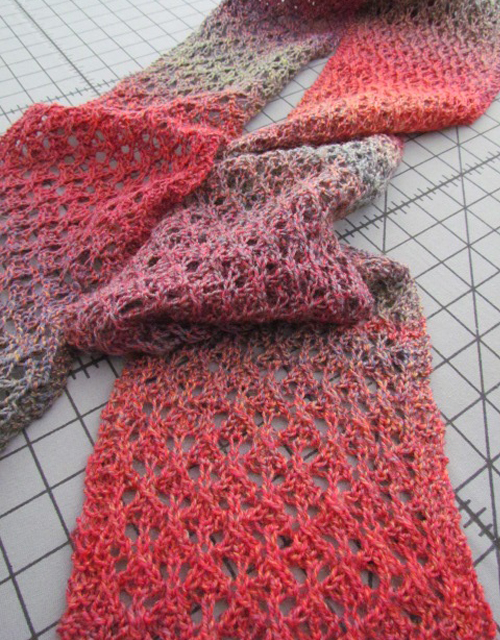
Morning Surf Scarf by Jackie Erickson-Schweitzer is a highly adaptable lace-style scarf designed to work with many different yarn weights.

Its undulating openwork pattern is particularly effective with variegated, hand-dyed or handspun yarn because the stitch structure allows the yarn's colors to remain visible.

The pattern can also be adjusted easily: the cast-on count can be changed in multiples of ten, letting you make the scarf wider or narrower to suit your yarn and preferred finished size.

Best for: Handspun yarn, variegated skeins and knitters who like easily customizable patterns.

See the Free Morning Surf Scarf Pattern →

Which Free Scarf Should You Knit First?

The best choice depends on the kind of knitting you enjoy and the yarn already waiting in your stash.

  • For dramatic color: ZickZack Scarf
  • For a quick gift: Cherry Pie Scarf
  • For lace practice: Birch Trees Scarf
  • For one special skein: The Simple Thing
  • For easy bulky knitting: Wainscot Scarf
  • For classic cables: Chestnut Street Scarf
  • For hand-dyed or handspun yarn: Morning Surf Scarf

Choosing Yarn for a Knitted Scarf

Scarves are particularly forgiving projects for experimenting with yarn because you do not usually have to match body measurements as precisely as you would with a sweater.

That does not mean yarn weight is unimportant. Changing from fingering to DK or bulky yarn can dramatically alter the width, length, drape and amount of yarn required.

For textured stitches and cables, smooth solid or lightly tonal yarns usually show the stitch pattern most clearly. Self-striping and gradient yarns are especially effective in simpler designs such as ZickZack, where the color changes become part of the visual effect.

Scarves Are Great Skill-Building Projects

A scarf can be one of the easiest ways to learn a new knitting technique without also worrying about sweater fit or complicated shaping.

This collection gives you several skills to explore:

  • Garter stitch and I-cord edges
  • Star stitch
  • Lace increases and decreases
  • Chevron shaping
  • Textured knit-and-purl patterns
  • Cable knitting
  • Working with self-striping and variegated yarn

Don't Skip Blocking

Blocking can make a noticeable difference to the appearance of a finished scarf, particularly when lace or cables are involved.

Lace may look compressed directly from the needles. After appropriate washing and blocking, the openwork can relax and the motif becomes much easier to see.

Always use a blocking method appropriate for the fiber content of your yarn and follow the original designer's recommendations when available.

More Free Knitting Collections

If you'd like a larger neck-and-shoulder accessory, explore our separate shawl collection:

Explore 7 Free Shawl Knitting Patterns →

Or if you have only one skein waiting in your stash, we also have a collection built specifically around small-yarn projects:

Explore 7 Free One-Skein Knitting Patterns →

Free Pattern Availability

All seven patterns in this collection were reviewed as currently available through legitimate free sources when this article was prepared.

Pattern availability can change over time. A designer or publisher may move a pattern, discontinue it or change it from free to paid.

For that reason, every project in this collection links first to its corresponding Amazing Knitting guide. Those pages identify the designer, provide useful project information and direct readers toward the current authorized pattern source.

Read Our Pattern Availability & Editorial Policy →

Amazing Knitting is an independent pattern discovery and project-guide site. The knitting patterns featured in this collection remain the intellectual property of their respective designers and publishers. Amazing Knitting does not reproduce their complete copyrighted row-by-row instructions or charts.

Best Friend Lace Scarf by Krista Werbil - Pattern Guide

Best Friend Lace Scarf - Free Pattern
Photo above © Krista

Best Friend Lace Scarf by Krista Werbil is an elegant, lightweight scarf built around a delicate repeating lace motif.

Its long, narrow proportions make the lace the main attraction, while the fingering-weight yarn creates a fabric that can be wrapped, draped or worn loosely without the bulk of a heavier winter scarf.

If this beautiful scarf brought you here, this guide will help you identify the original design, understand its yarn, size and construction, and find out what happened to the original pattern.

The original digital pattern is no longer available from its former source, but you still have options. We have included verified free lace patterns later in this guide that you can knit today.

Pattern Availability

Best Friend Lace Scarf is currently discontinued. The Ravelry pattern record states that the digital pattern is no longer available online, and its original source, the knitting buzz, is listed as out of print. Amazing Knitting therefore does not link to unofficial copies or reproduce the designer's complete instructions.

Best Friend Lace Scarf at a Glance

Pattern: Best Friend Lace Scarf

Designer: Krista Werbil

Original Source: the knitting buzz

Published: November 2011

Category: Lace scarf

Yarn Weight: Fingering / 4 ply

Yardage: Approx. 440 yd / 402 m

Needles: US 6 / 4 mm

Finished Size: Approx. 7 × 86 in, or desired length

Construction: One piece, rectangular, worked flat

Instructions: Written

Current Status: Discontinued

About the Best Friend Lace Scarf

Best Friend Lace Scarf is a classic example of how a relatively simple rectangular accessory can become visually striking through stitch pattern alone.

Instead of relying on cables, colorwork or elaborate garment shaping, the design uses open lace to create movement across a long, narrow scarf.

That makes the yarn and stitch definition particularly important to the final appearance.

A Long, Elegant Lace Scarf

The published finished dimensions are approximately:

7 inches wide × 86 inches long

The pattern also allows the scarf to be worked to the desired length.

Those proportions produce a noticeably long and narrow accessory rather than a wide rectangular wrap.

Why the Length Works So Well

An 86-inch scarf gives you considerable flexibility in how it can be worn.

It can be wrapped more than once around the neck, tied loosely, or left hanging so the lace pattern remains visible along most of its length.

If you are working from a legally obtained copy and decide to change the length, remember that the amount of yarn required will change too.

Fingering-Weight Yarn

The original pattern is listed for fingering / 4-ply yarn.

Fine yarn is a natural match for this type of scarf because it allows the openwork to remain light and flexible.

A much heavier yarn would produce a substantially different fabric and could change both the width and the appearance of the lace.

How Much Yarn?

The published requirement is approximately:

440 yards / 402 meters

If you already own the original pattern, use this as a starting point and allow extra yarn if you plan to lengthen the scarf.

Needle Size

The published needle size is:

US 6 / 4 mm

Lace is often worked on needles that create a more open fabric than you might expect for the yarn weight.

The important goal is not simply matching a needle number, but producing an attractive lace fabric with comfortable drape.

Worked Flat in One Piece

Best Friend Lace Scarf is constructed as a one-piece rectangle worked flat.

This means there is no garment assembly and no complicated sleeve or neckline shaping to manage.

The challenge comes instead from maintaining the lace pattern accurately over a long project.

Why Lace Scarves Are Great Skill Builders

A rectangular scarf gives you an opportunity to concentrate on stitch technique without also worrying about garment fit.

Depending on the original lace repeat, skills commonly useful for this style of project include:

  • Working yarn overs
  • Making decreases
  • Recognizing lace stitches
  • Maintaining an accurate stitch count
  • Reading written instructions
  • Keeping even tension
  • Blocking lace

Count Your Stitches Regularly

Lace usually relies on increases and decreases balancing one another.

Missing a yarn over or decrease may change the stitch count and cause the motif to shift.

Checking your stitch count regularly is much easier than discovering a mistake many rows later.

Learn to Read the Lace

One of the most useful skills you can develop is recognizing what the previous row is doing rather than relying only on the written instructions.

Look for the positions of yarn-over holes and decrease columns.

Once the motif becomes visually familiar, misplaced stitches are often easier to notice before they affect several rows.

Use a Lifeline

A lifeline can make a long lace project much less stressful.

After completing a repeat that you know is correct, thread a smooth contrasting strand through the live stitches.

If you later need to unravel your knitting, the lifeline provides a safe row where you can stop and recover the stitches.

Choosing a Substitute Yarn

If you already legally own the original Best Friend Lace Scarf pattern but need a different yarn, start by looking for a suitable fingering-weight substitute.

Consider:

  • Yardage per skein
  • Fiber content
  • Stitch definition
  • Drape
  • Elasticity
  • Behavior after blocking

The yarn does not need to be identical to the original to produce a beautiful scarf, but changing fiber characteristics can noticeably alter the finished lace.

Solid Colors Show the Lace Clearly

A solid or gently tonal yarn is often an excellent choice for a lace scarf because the stitch pattern remains easy to see.

Strongly variegated yarn can also be attractive, but rapid color changes may compete visually with a delicate lace motif.

Swatching is the easiest way to see whether your yarn and lace pattern complement each other.

Blocking Makes a Big Difference

Lace can look compressed or uneven while it is still on the needles.

Appropriate blocking helps open the yarn-over holes, straighten the edges and reveal the intended pattern.

Always use a blocking method suitable for the fiber in your chosen yarn.

Why a Scarf Makes a Thoughtful Gift

The name Best Friend Lace Scarf naturally makes this design appealing as a handmade gift.

A scarf does not require the precise body measurements of a sweater, and the long rectangular shape makes it practical to wear in several different ways.

Choosing a yarn color that suits the recipient can make a simple accessory especially personal.

What Happened to the Original Pattern?

Best Friend Lace Scarf was originally published through the knitting buzz in November 2011.

Older knitting directories may still describe it as a free pattern because that was its historical availability.

The current Ravelry record, however, marks the source as out of print and states that the digital pattern is no longer available online.

Amazing Knitting therefore no longer describes this as a currently available free pattern.

Why We Don't Reproduce the Old Instructions

A discontinued pattern does not automatically become free to copy or redistribute.

The design remains attributed to Krista Werbil, and old copies appearing elsewhere on the web do not necessarily have permission to distribute her complete instructions.

Amazing Knitting therefore provides this independent project guide instead of reconstructing or republishing the original lace pattern.

Already Have the Pattern?

If you previously downloaded or otherwise legally obtained the original Best Friend Lace Scarf pattern, you can continue using your copy. Keep the original instructions safely stored because replacing the discontinued digital pattern may now be difficult.

View the Historical Pattern Record

Ravelry still maintains the Best Friend Lace Scarf record, which is useful for confirming the designer, original specifications and browsing completed projects.

View Best Friend Lace Scarf on Ravelry →

Love This Scarf? Try These Free Lace Patterns

The original Best Friend Lace Scarf may no longer be downloadable, but you can still start a beautiful lace project today.

These free patterns have already been verified in the Amazing Knitting archive:

Explore More Free Scarf Patterns

Can You Still Get Best Friend Lace Scarf?

The original digital pattern is currently discontinued and no longer available from its former source.

Ravelry retains the historical pattern record, but it should not be confused with a current pattern download.

We recommend avoiding unofficial copies whose distribution rights cannot be verified.

If Krista Werbil republishes Best Friend Lace Scarf through an authorized source in the future, this page can be updated with the new link.

A Design Still Worth Remembering

A discontinued pattern can still provide useful knitting inspiration.

Best Friend Lace Scarf shows how a fine yarn, a repeating lace motif and simple rectangular construction can produce an elegant accessory without complicated garment shaping.

Study the finished projects for color and yarn inspiration, or choose one of the verified free lace patterns above and begin a new project today.

Pattern credit: Best Friend Lace Scarf was designed by Krista Werbil and published through the knitting buzz in November 2011. The original digital pattern is currently listed as discontinued. Amazing Knitting provides an independent historical and project guide and does not reproduce or distribute the designer's copyrighted knitting instructions. Please retain the existing photograph and its original credit from the old Amazing Knitting post.

Easy Knitting Projects for Beginners - Where to Start

Knitting Projects for Newbies
Photo above © You put it up

Looking for your first knitting project can be more confusing than learning the knit stitch itself.

Hundreds of patterns are described as "easy" or "beginner friendly," but not every easy-looking project is suitable for someone who has only just picked up knitting needles.

A good first project should help you practice a small number of skills, give you visible progress, and be forgiving enough that a few uneven stitches do not ruin the finished result.

This guide will help you choose beginner knitting projects in a sensible order — from simple rectangular pieces to hats, baby projects, lace and your first sweater.

Beginner Knitting Guide

This page is an independent Amazing Knitting learning resource rather than one specific knitting pattern. Use it to choose a project that matches the skills you already know and the skill you want to learn next.

What Makes a Good First Knitting Project?

The best beginner project is not necessarily the smallest or the simplest-looking project.

A useful first project usually has several of these characteristics:

  • A manageable number of stitches
  • Little or no complicated shaping
  • A short repeating stitch pattern
  • Yarn that is easy to see and handle
  • Enough repetition to build muscle memory
  • A finished item you actually want to use

Your first few projects should gradually introduce new techniques rather than requiring you to learn everything at once.

Skills to Learn Before Your First Project

You do not need to know dozens of knitting techniques before starting.

For a very simple first project, focus on:

  • Making a slip knot
  • Casting on stitches
  • The knit stitch
  • Keeping stitches on the needle
  • Binding off
  • Weaving in yarn ends

Once those movements feel comfortable, add the purl stitch, decreases, increases and circular knitting one project at a time.

1. Start with a Garter Stitch Scarf

A garter stitch scarf remains one of the most practical first knitting projects.

When worked flat, you can create garter stitch simply by knitting every row.

That gives you time to practice:

  • Holding the needles
  • Controlling yarn tension
  • Recognizing stitches
  • Turning your work
  • Binding off

The shape is just a rectangle, so there is no garment fitting or complex shaping to worry about.

Why a Scarf Is Useful for Learning

Repetition is one of the fastest ways to make the basic knitting movement feel natural.

A scarf gives you hundreds of opportunities to repeat the same motion while still producing something useful.

The main disadvantage is that a full-length scarf can take time, so a small headband or cowl may be more motivating if you prefer quick projects.

2. Try a Dishcloth or Washcloth

A knitted washcloth is a good alternative when you want a project that finishes quickly.

It gives you a small square where you can practice basic stitches without worrying about exact garment fit.

Cotton yarn is commonly chosen for washable household cloths.

Once you know the knit stitch, a washcloth can also become your practice space for:

  • Purl stitches
  • Seed stitch
  • Ribbing
  • Simple eyelets
  • Textured stitch patterns

3. Knit a Simple Cowl

A cowl can feel more like a finished wearable than a practice square while still remaining relatively simple.

Some beginner cowls are worked flat as rectangles and seamed at the end. Others introduce circular needles and knitting in the round.

Choose the flat version first if circular knitting is still unfamiliar.

4. Try an Easy Baby Blanket

A baby blanket can be an excellent first larger project because it does not require body measurements or garment shaping.

Simple blanket patterns often repeat the same stitches across many rows, allowing you to improve consistency.

The main consideration is commitment: even a baby blanket contains many more stitches than a washcloth or headband.

Free Beginner Blanket Idea: Waffle Blanket

Once you are comfortable maintaining a repeating texture, explore the free Waffle Blanket pattern in the Amazing Knitting archive.

Explore the Waffle Blanket →

5. Move On to a Simple Hat

A basic hat introduces one important new idea: shaping.

Many hats gradually decrease stitches near the crown.

Depending on the pattern, a hat may be:

  • Worked flat and seamed
  • Worked in the round on circular needles
  • Finished with double-pointed needles or another small-circumference method

If you are completely new, a flat-knit hat may feel easier.

6. Try a Textured Scarf

After plain garter stitch feels comfortable, a textured scarf is a good way to learn something new without adding garment shaping.

You can practice new stitches while keeping the overall project shape extremely simple.

Free Next-Step Project: Morning Surf Scarf

Morning Surf Scarf is a verified free pattern already available in the Amazing Knitting archive.

It is a useful option when you are ready to move from plain knitting into a more decorative fabric.

View Morning Surf Scarf →

7. Learn Your First Lace Pattern

Lace does not have to mean an enormous, complicated shawl.

A small lace scarf is a much friendlier introduction because the stitch count is limited and the overall shape remains rectangular.

Before starting, become comfortable with:

  • Yarn overs
  • Basic decreases
  • Counting stitches
  • Reading repeat instructions

Free Beginner Lace Project: Little Leaf Lace Scarf

Little Leaf Lace Scarf by Sivia Harding is a particularly useful bridge into lace knitting because it combines a straightforward scarf shape with a repeating leaf motif.

Explore Little Leaf Lace Scarf →

8. Try Your First Triangle Shawl

A triangular shawl introduces increases and teaches you how knitted shaping develops row by row.

The project can look sophisticated even when the basic construction is relatively logical.

Free Shawl Idea: June Bunnies Shawl

June Bunnies Shawl is a customizable top-down triangular shawl and is especially useful when you are ready to explore simple lace.

Explore June Bunnies Shawl →

9. Try a Baby Cardigan

A baby cardigan can be a practical introduction to garment knitting because the project is much smaller than an adult sweater.

It may introduce:

  • Garment sizing
  • Increasing
  • Sleeves
  • Button bands
  • Reading a multi-size pattern

A top-down construction can be particularly attractive because you can see the garment shape develop as you work.

Free Baby Cardigan: Fuss Free Baby Cardigan

Louise Tilbrook's Fuss Free Baby Cardigan is a free DK-weight pattern with a top-down raglan construction and is a useful next step once your basic knitting feels secure.

Explore Fuss Free Baby Cardigan →

10. Knit Your First Simple Sweater

You do not need to wait years before making a sweater.

The important thing is to choose a design whose construction matches the skills you already have.

Look for patterns with:

  • Simple shapes
  • Clear sizing
  • Minimal complicated stitch work
  • Good construction notes
  • Few finishing steps

Free First-Sweater Idea: French Macaroon

French Macaroon by The Noble Thread is a small garter-stitch children's pullover with a simple boat-neck shape and uncomplicated construction.

It can be a useful way to understand how knitted pieces become a garment without beginning with a large adult sweater.

Explore French Macaroon →

A Simple Beginner Project Progression

A practical learning path:

1. Garter-stitch square or washcloth

2. Simple scarf or headband

3. Textured scarf or cowl

4. Simple blanket

5. Hat with basic shaping

6. Lace scarf or shawl

7. Baby cardigan

8. Simple sweater

This is not a rule. If one particular project excites you, motivation can be more valuable than following a perfect sequence.

What Yarn Is Easiest for Beginners?

A smooth, medium-weight yarn is often easier to learn with than extremely thin, fuzzy or novelty yarn.

You want to be able to see individual stitches clearly so that you can recognize mistakes.

Avoid choosing yarn only because it looks beautiful in the skein.

For your first project, ease of handling is usually more useful than an unusual texture.

Light Colors Can Be Easier to Read

Very dark yarn can make it difficult to see where one stitch ends and the next begins.

A light or medium color can make the structure clearer while you are learning.

Once you can recognize stitches easily, yarn color becomes much less important.

Don't Begin with Extremely Fuzzy Yarn

Mohair-like or heavily textured yarns can hide stitches.

They can also be difficult to unravel when you need to correct an error.

Save highly fuzzy yarn for a later project unless you are already comfortable identifying stitches by touch.

What Needles Should a Beginner Use?

Choose the needle size required by the pattern and appropriate for the yarn rather than buying one universal "beginner needle."

For practice knitting, medium-sized needles and medium-weight yarn can make the stitches easier to see and manipulate.

The important thing is that the needle should not make the fabric so tight that inserting the tip becomes difficult.

Wood or Metal Needles?

Both can work well.

Wooden or bamboo needles tend to offer more surface grip, which some new knitters find reassuring because stitches are less likely to slide away.

Smooth metal needles can feel faster once you become comfortable controlling the stitches.

There is no single correct material for every beginner.

Don't Choose a Project Only Because It Says "Easy"

Difficulty labels vary between designers.

Before starting, scan the skills required.

A project described as beginner-friendly may still require techniques such as:

  • Knitting in the round
  • Cables
  • Lace
  • Short rows
  • Picking up stitches
  • Seaming

None of these techniques is impossible for a beginner, but you should know what you are agreeing to learn.

Choose One New Skill at a Time

A particularly effective approach is to choose each new project because it adds one unfamiliar technique.

For example:

  • Project 1: knit stitch
  • Project 2: purl stitch
  • Project 3: ribbing
  • Project 4: decreases
  • Project 5: knitting in the round
  • Project 6: yarn overs and lace
  • Project 7: garment shaping

This prevents a single project from becoming a collection of ten new problems at once.

Make a Swatch When Size Matters

You can often practice freely on a scarf or washcloth.

But once you begin hats, sweaters, cardigans or fitted baby garments, gauge becomes much more important.

A gauge swatch tells you whether your personal knitting tension produces the dimensions expected by the pattern.

Learn How to Fix Mistakes

Becoming a confident knitter does not mean never making mistakes.

It means learning to recognize and repair them.

Useful early skills include:

  • Recognizing a dropped stitch
  • Unknitting stitches one at a time
  • Counting stitches
  • Checking pattern repeats
  • Using stitch markers
  • Using a lifeline in lace

Finish Your First Projects

A very simple finished project often teaches more than five ambitious projects abandoned halfway through.

Finishing teaches additional skills such as binding off, weaving in ends, seaming and blocking.

Choose something achievable enough that you are likely to reach that final stage.

Don't Worry About Perfect Tension

Your first rows may look different from your twentieth row.

That is normal while your hands are learning a completely new movement.

Concentrate on forming stitches consistently rather than trying to make your first project look machine-made.

More Beginner-Friendly Patterns on Amazing Knitting

Beginner Knitting Stitch Guides

When you want to practice new textures before using them in a full project, explore these Amazing Knitting stitch guides:

Explore More Easy Knitting Patterns

What Should You Knit First?

If you have never completed a project before, start with a small rectangle: a washcloth, headband or simple scarf.

If you already know knit and purl, choose a project that adds one new skill — perhaps ribbing, a simple decrease or a textured stitch.

If you can comfortably follow a basic pattern, move to a hat, shawl or baby cardigan.

The goal is not to remain a "beginner" until you know every technique. Each finished project should teach you enough to make the next project slightly more interesting.

Editorial note: This Amazing Knitting page is an independent beginner-knitting resource. It does not reproduce another publisher's pattern collection or copyrighted instructions. Individual project pages linked above identify and direct readers to their respective designers and authorized pattern sources. Please retain the photograph and original photo credit from the previous version of this page.

Little Leaf Lace Scarf - Free Pattern

Little Leaf Lace Scarf - Free Pattern
Photo above © bunnyknitter

Little Leaf Lace Scarf by Sivia Harding is a graceful, beginner-friendly lace scarf built around a repeating leaf motif.

The design is light enough to show the lace clearly, yet simple enough to make a practical introduction to yarn overs, decreases and basic lace-pattern rhythm.

Its narrow rectangular shape keeps the construction straightforward, so most of your attention can stay on the decorative stitches rather than shaping or garment assembly.

Best of all, the original Little Leaf Lace Scarf pattern is still officially available as a free Ravelry download.

✓ Free Pattern Availability

Little Leaf Lace Scarf by Sivia Harding is currently listed as a free Ravelry download. The designer's Ravelry store also continues to identify the pattern as free.

Little Leaf Lace Scarf at a Glance

Pattern: Little Leaf Lace Scarf

Designer: Sivia Harding

First Published: January 2004

Historical Publication: Knitting Calendar 2005

Category: Lace scarf

Yarn Weight: Fingering or laceweight

Yardage: Approx. 200 yd / 183 m

Needles: US 5 / 3.75 mm

Gauge: 20 sts × 28 rows = 4 in / 10 cm in blocked lace pattern

Finished Size: Approx. 10.5 × 41 in

Construction: One-piece rectangular scarf worked flat

Skill Focus: Beginner lace knitting

Availability: Free Ravelry download

About the Little Leaf Lace Scarf

Little Leaf Lace Scarf is a classic small lace project in which the stitch pattern provides almost all of the visual interest.

Repeating leaf shapes travel along the scarf, creating an elegant botanical texture without requiring complicated garment construction.

Sivia Harding describes the design as an easy lace project suitable for knitters beginning to explore lace.

A Good Beginner Lace Project

Large lace shawls can feel intimidating when you are still learning how yarn overs and decreases work together.

A narrow scarf gives you a much smaller number of stitches to manage, making it easier to understand the relationship between the individual lace stitches and the finished motif.

Once the repeat becomes familiar, the project can develop a comfortable rhythm.

The Leaf Motif

The main visual feature is a repeating openwork leaf.

Yarn overs create the decorative holes, while paired decreases shape the sides of the leaf and keep the overall stitch count under control.

The result is a recognizable botanical motif created entirely through changes in the knitted fabric rather than colorwork or embroidery.

Why Leaves Work So Well in Lace

Leaf motifs are especially well suited to knitted lace because increases can widen the leaf while decreases gradually narrow it again.

This creates a natural-looking shape using the same basic techniques found in many larger shawls and lace garments.

Learning a small leaf pattern can therefore prepare you for more complex lace projects later.

Original Finished Size

The published finished dimensions are approximately:

10.5 inches wide × 41 inches long

This makes Little Leaf a relatively compact scarf rather than an oversized wrap.

The length is enough to show the repeating leaf pattern clearly while keeping the total yarn requirement modest.

Only About 200 Yards of Yarn

The original pattern calls for approximately:

200 yards / 183 meters

That modest yardage makes this a useful project for a special skein of fingering or laceweight yarn that may not be large enough for a full shawl.

Fingering or Laceweight Yarn

The pattern record recommends fingering or laceweight yarn.

These lighter yarns allow the openwork to remain delicate and keep the finished scarf flexible.

The exact appearance can change considerably depending on fiber content and yarn structure.

Needles and Gauge

The listed needle size is:

US 5 / 3.75 mm

The published blocked gauge is:

20 stitches × 28 rows = 4 inches / 10 cm

This gauge is measured over the lace pattern after blocking.

Why Gauge Still Matters on a Scarf

A scarf does not need the same precision of fit as a sweater, but gauge still affects the finished width, length, drape and yarn usage.

A much looser gauge may make the scarf wider and use more yarn, while a tighter gauge can make the lace look compressed.

A small swatch is useful for checking whether the fabric opens attractively after blocking.

Worked Flat in One Piece

Little Leaf Lace Scarf is a straightforward rectangular accessory worked back and forth in rows.

There are no sleeves, armholes or garment seams to manage.

That simplicity makes it easier to focus on learning the lace motif and maintaining consistent tension.

A Garter-Stitch Border Frames the Lace

The lace panel is framed by simple garter-stitch edging.

This creates a neat visual boundary between the open center and the outer edge of the scarf.

It also gives the knitter a few predictable stitches at the beginning and end of each row.

Skills You May Practice

  • Working yarn overs
  • Knit-two-together decreases
  • Left-leaning decreases
  • Centered decreases
  • Maintaining a lace repeat
  • Working a garter-stitch border
  • Reading your knitting
  • Blocking lace

Count Your Stitches

A missing yarn over or decrease can disturb the shape of the leaf and alter the total stitch count.

Check your stitch count periodically, especially while you are still learning the repeat.

Catching an error after one row is much easier than discovering it several repeats later.

Learn to Recognize the Leaves

Try not to rely only on the written instructions.

Watch how the yarn-over holes and decreases line up from one row to the next.

As the motif becomes familiar, you may start noticing mistakes visually before they cause a larger problem.

Use a Lifeline If You Are New to Lace

After completing a repeat that you know is correct, thread a smooth contrasting strand through the live stitches.

If you later need to unravel several rows, the lifeline provides a safe place to stop.

This can make learning lace much less stressful.

Blocking Reveals the Pattern

Like most knitted lace, Little Leaf may look compressed while it is still on the needles.

Appropriate blocking opens the yarn-over holes, straightens the scarf and makes the leaf shapes more visible.

Always use a blocking method appropriate for your yarn's fiber content.

Choosing a Yarn Substitute

The pattern does not depend on one specific yarn brand.

When choosing a substitute, look for a fingering or laceweight yarn that gives you an attractive open fabric at the required gauge.

Consider:

  • Yardage
  • Fiber content
  • Drape
  • Stitch definition
  • Halo
  • How the yarn behaves after blocking

Solid Colors Show the Leaves Clearly

A solid or gently tonal yarn is particularly effective when you want the leaf shapes to remain the main visual feature.

Strongly variegated yarn can also be attractive, but dramatic color changes may compete with a small lace motif.

Swatching is the best way to see how your chosen yarn interacts with the pattern.

A Good One-Skein Gift Project

With a published requirement of only about 200 yards, Little Leaf Lace Scarf can be an appealing gift project.

The rectangular shape avoids complicated sizing, and the botanical lace adds considerably more visual interest than plain stockinette.

It can also be a useful way to turn a small quantity of special yarn into a finished accessory.

Is Little Leaf Lace Scarf Still Free?

Yes.

Little Leaf Lace Scarf by Sivia Harding is currently listed as a free Ravelry download.

The designer's current Ravelry store also continues to identify Little Leaf Lace Scarf as a free pattern.

Amazing Knitting does not reproduce the designer's complete copyrighted row-by-row pattern. Use the authorized source below for the full instructions.

Get the Free Little Leaf Lace Scarf Pattern

Visit the current Ravelry pattern record:

Get the Free Little Leaf Lace Scarf Pattern →

More Free Lace Scarf Patterns

If you enjoy Little Leaf Lace Scarf, continue with these patterns already restored in the Amazing Knitting archive:

Explore More Lace Knitting

Before You Cast On

Choose a fingering or laceweight yarn that shows the leaf motif clearly, and make sure you have approximately 200 yards available.

Check your blocked fabric, count stitches regularly while learning the repeat, and consider adding a lifeline after successful sections.

For knitters moving from basic knitting into lace, Little Leaf Lace Scarf offers a very useful combination: a small amount of yarn, uncomplicated rectangular construction and a beautiful motif that teaches techniques used in much larger lace projects.

Pattern credit: Little Leaf Lace Scarf was designed by Sivia Harding and first published in 2004, later appearing in Knitting Calendar 2005. The existing project photograph on this Amazing Knitting page is credited to bunnyknitter. Amazing Knitting provides an independent project guide and does not reproduce the designer's complete copyrighted knitting instructions.

Campfire Cozy Shawl – Oversized Triangle Shawl Knitting Pattern

Campfire Cozy Shawl oversized triangle shawl knitting pattern by Espace Tricot

Campfire Cozy Shawl. Design © Espace Tricot.

Campfire Cozy by Espace Tricot is an oversized triangular shawl designed for exactly what its name suggests: wrapping yourself in a generous layer of handknit warmth.

The design combines several classic knitted fabrics rather than relying on a single stitch pattern. Sections of lace, garter stitch and stockinette flow through the shawl before finishing with a substantial ribbed border.

Older references to Campfire Cozy described it as a free knitting pattern. However, the original free-download route is no longer generally available, so Amazing Knitting no longer classifies this design as a current free pattern.

Campfire Cozy Shawl at a Glance

  • Designer: Espace Tricot
  • Craft: Knitting
  • Category: Shawl / Wrap
  • Shape: Triangular
  • Style: Oversized
  • Yarn weight: Worsted
  • Main fabrics: Lace, garter stitch and stockinette
  • Border: Ribbing
  • Languages: English and French
  • Availability: The older free download is no longer generally available

An Oversized Triangle Shawl for Cozy Layering

Campfire Cozy is not intended to be a tiny decorative shawlette. Its defining feature is its generous triangular shape, creating plenty of fabric to wrap around the shoulders and upper body.

That extra coverage gives the finished piece the character of both a shawl and a warm wrap, making it especially appealing for cool evenings, relaxed indoor wear and layering during colder months.

If you enjoy shawls that feel closer to wearable blankets than delicate accessories, Campfire Cozy is a particularly attractive style of project.

A Combination of Classic Knitting Textures

Much of the visual interest in Campfire Cozy comes from the transition between several different knitted fabrics.

Rather than repeating a single stitch pattern across the entire shawl, the design incorporates:

  • Garter stitch
  • Stockinette stitch
  • Lace sections
  • A ribbed border

These changes create broad areas of texture across the triangular shape while keeping the finished shawl relaxed and wearable.

The Four-Row Lace Repeat

One of the notable features of Campfire Cozy is its four-row lace repeat.

A relatively short repeating lace sequence can make a large shawl more enjoyable to knit. Once the rhythm becomes familiar, the knitter can focus more on the growing fabric instead of constantly learning a new chart or stitch sequence.

Alternating those lace sections with simpler garter and stockinette areas also helps prevent such a large project from becoming visually repetitive.

Garter Stitch Sections

Garter stitch adds visible texture and structure to the shawl.

It provides a useful contrast with the smoother stockinette sections and the more open character of the lace.

On an oversized shawl, these broad changes in texture can have more visual impact than tiny decorative details, helping the design remain interesting even when seen from a distance.

Stockinette for a Smooth Contrast

Stockinette introduces a smoother surface between the more textured portions of Campfire Cozy.

This contrast is one reason the shawl can work particularly well in a solid or subtly tonal yarn. The stitch changes themselves provide visual variety without requiring complicated colorwork.

A Substantial Ribbed Border

The shawl finishes with a ribbed border, giving the lower edge a strong and cozy textural finish.

On a large triangular shawl, the final border occupies a significant visual area, so it becomes an important part of the overall design rather than simply a narrow finishing detail.

Why Worsted-Weight Yarn Suits This Design

Campfire Cozy is designed around worsted-weight yarn.

This heavier yarn contributes to the substantial, warm character of the finished shawl and distinguishes it from lightweight lace shawls intended mainly for decorative wear.

Worsted-weight yarn can also help the differences between garter, stockinette, lace and ribbing remain clearly visible.

Choosing Yarn for an Oversized Shawl

When choosing yarn for a large wrap, consider more than color.

A yarn may feel wonderful in a single skein but behave differently when several skeins are combined into one large finished garment.

Consider:

  • The total weight of the finished shawl
  • Softness against the neck and shoulders
  • Drape
  • Stitch definition
  • Warmth
  • Fiber elasticity
  • Care requirements

A yarn that shows the different stitch textures clearly while remaining comfortable against the skin is especially suitable for this kind of shawl.

Solid or Tonal Yarn?

Because Campfire Cozy already contains several different stitch textures, a solid or gently tonal yarn can allow those details to remain visible.

Strongly variegated yarn may compete with subtle lace and texture, although the final choice depends on the effect you want.

If you are considering a highly multicolored yarn, knitting a generous swatch can help you judge how the color changes interact with the stitch pattern before committing to a large project.

A Good Balance Between Relaxing and Engaging Knitting

The design alternates more engaging lace sections with comparatively straightforward knitted fabrics.

That balance can make an oversized shawl enjoyable over a longer knitting period. Some sections require more attention, while others become rhythmic and relaxing.

This variety is one reason large shawls can remain satisfying projects even though they eventually contain many stitches.

Skills Used in Campfire Cozy

Based on the construction and stitch patterns used in the design, knitters should be comfortable with techniques associated with:

  • Knitting and purling
  • Garter stitch
  • Stockinette stitch
  • Basic lace knitting
  • Following repeating stitch sequences
  • Increasing a triangular shawl
  • Ribbing
  • Managing an increasing number of stitches
  • Binding off a long shawl edge
  • Blocking

Consult the current authorized pattern information for exact stitch counts, construction instructions and required techniques.

Is Campfire Cozy Suitable for Beginners?

A knitter who is already comfortable with basic knit and purl stitches may find Campfire Cozy an interesting next step into larger shawls and simple lace.

The four-row lace repeat is less intimidating than a lace pattern that changes on every row, while the garter and stockinette sections provide simpler stretches between the textured areas.

However, the generous finished size means the project eventually becomes quite wide, so knitters should also be comfortable managing a large number of stitches.

Using a Circular Needle for a Large Shawl

Large triangular shawls can eventually hold a considerable number of stitches.

Even when the piece is worked back and forth rather than joined in the round, a circular needle can make it easier to accommodate a long row of stitches and distribute the weight of the growing fabric.

Always follow the pattern's current needle recommendations and choose the needle size required to achieve the specified gauge.

Why Gauge Still Matters on a Shawl

Shawls are generally more forgiving than fitted sweaters, but gauge can still have a significant effect on the finished project.

A looser gauge can produce a larger and more open shawl while also increasing yarn requirements. A tighter gauge can create a denser, smaller fabric.

That difference becomes particularly important in a project that is intentionally oversized.

Plan Your Yarn Before Casting On

An oversized worsted-weight shawl is not usually a tiny stash-busting project.

Before beginning, check the current pattern information for the required yardage and make sure you have enough yarn for the complete shawl.

If you are using hand-dyed yarn, having sufficient yarn from compatible dye lots or alternating skeins may also help produce a more consistent finished fabric.

Running out near the wide ribbed border can be particularly frustrating, since the rows are longest near the end of a triangular shawl.

Blocking Campfire Cozy

Blocking can be especially valuable when a shawl combines lace with denser knitted textures.

It can help open the lace, settle the garter and stockinette sections, and define the finished triangular shape.

Always choose a blocking method appropriate for your yarn fiber and follow the yarn manufacturer's care instructions.

Ways to Wear an Oversized Triangle Shawl

The generous dimensions of a design like Campfire Cozy provide more styling flexibility than a small shawlette.

It can be:

  • Draped traditionally across the shoulders
  • Wrapped closely around the upper body
  • Worn scarf-style around the neck
  • Positioned with the triangular point toward the front
  • Layered over a sweater or simple top

The substantial worsted-weight fabric makes this style particularly useful when warmth is as important as appearance.

Who Might Enjoy Knitting Campfire Cozy?

This shawl may be a good match if you enjoy:

  • Large wearable wraps
  • Worsted-weight knitting
  • Projects with changing textures
  • Simple repeating lace
  • Garter and stockinette knitting
  • Long-term projects that become relaxing once the rhythm is established

It may be less suitable if you are specifically looking for a very small, lightweight or quick one-skein shawl.

Campfire Cozy Pattern Availability

Important: older Amazing Knitting and web references described Campfire Cozy as a free knitting pattern.

That description reflects the pattern's earlier availability and should not be interpreted as a guarantee that the old free download remains available today.

Amazing Knitting has therefore updated this page and no longer labels Campfire Cozy as a current free pattern.

Pattern availability can change over time as designers and publishers move websites, retire downloads or change how their designs are distributed.

Find the Current Campfire Cozy Pattern

If you would like to knit Campfire Cozy by Espace Tricot, use the current pattern listing below to check the latest availability and purchasing information.

View Campfire Cozy on Ravelry →

Campfire Cozy was previously promoted online as a free pattern, but availability can change over time. Amazing Knitting does not host or reproduce Espace Tricot's copyrighted pattern instructions. Please use the current authorized pattern listing for the latest availability information.

Pattern Availability at Amazing Knitting

We regularly review older Amazing Knitting pages because a knitting pattern that was free when originally featured may later move, become paid or disappear from its original source.

Read Our Pattern Availability Policy →

June Bunnies Shawl - Free Knitting Pattern

June Bunnies Shawl - Free Pattern
Photo above © Mardunk

June Bunnies Shawl by Inese Andzane is a soft, customizable triangular lace shawl designed to be simple enough for knitters taking their first steps into lace.

The design alternates relaxing sections of simple knitting with decorative lace insertions, creating an elegant shawl without making every row demanding.

It is also wonderfully flexible: the designer encourages knitters to add as many or as few lace repeats as they like, making it possible to adapt the shawl to different yarns and finished sizes.

Best of all, the original June Bunnies Shawl pattern is still officially available for free.

✓ Free Pattern Availability

June Bunnies Shawl remains available as a free Ravelry download. The designer's original Silver Lining Knits blog post is also still online and identifies the shawl as a free pattern.

June Bunnies Shawl at a Glance

Pattern: June Bunnies Shawl

Designer: Inese Andzane

Published: July 2012

Original Source: Silver Lining Knits

Category: Shawl / Wrap

Shape: Triangle

Construction: Top-down, one piece

Suggested Yarn Weight: Fingering

Published Yardage Range: 400–600 yd / 366–549 m

Size: Customizable

Instructions: Charted and written

Difficulty: Suitable for adventurous lace beginners

Availability: Free Ravelry download

About the June Bunnies Shawl

June Bunnies began with the yarn.

Designer Inese Andzane explains that she had received an exceptionally soft angora, merino and nylon blend and wanted to cast on something immediately.

Because she wanted a project simple enough to knit while watching a movie, she chose a straightforward lace idea and developed it into this triangular shawl.

That relaxed origin is still reflected in the finished design.

Why Is It Called June Bunnies?

The playful name is connected to the yarn used for one of the original shawls.

The soft angora blend reminded the designer of the softness associated with bunnies, giving the project its memorable name.

A Customizable Triangle Shawl

One of the most useful features of June Bunnies is that the finished size is not rigidly fixed.

The designer describes it as a pattern that can be adjusted for different yarn weights and different shawl sizes.

You can add more lace repeats for a larger shawl or use fewer repeats for a smaller accessory.

How Much Yarn Do You Need?

The Ravelry record gives a general range of:

400–600 yards / 366–549 meters

For a full-size shawl in fingering-weight yarn, the designer suggests approximately:

400–500 yards

A finer yarn or a larger shawl may require more.

Fingering Weight Is a Natural Starting Point

Fingering weight is the primary yarn weight associated with the pattern, but the design was intentionally created to be adaptable.

That makes June Bunnies particularly appealing when you have a special skein and want a shawl pattern that does not force you into one exact finished size.

The Original Yarn Inspiration

One of the original versions used a fingering-weight blend of:

  • 40% Angora
  • 40% Merino
  • 20% Nylon

This combination produces a soft fabric with a gentle halo.

Another version was made with a much finer merino, silk and cashmere blend, demonstrating how differently the same design can look when the fiber and yarn thickness change.

There Is No Need to Copy the Original Yarn Exactly

June Bunnies was designed with flexibility in mind.

When substituting yarn, think about the finished fabric you want rather than searching only for an exact discontinued or difficult-to-find yarn.

Consider:

  • Yarn weight
  • Total yardage
  • Drape
  • Fiber content
  • Halo
  • Stitch definition
  • How the yarn behaves after blocking

What Needle Size Should You Use?

June Bunnies is designed to work with different yarn weights, so there is no single needle size that makes sense for every version.

Choose a needle that produces an open, attractive fabric with your selected yarn.

A small swatch is useful if you are unsure whether your yarn and needle combination gives the lace enough room to open after blocking.

Top-Down Construction

June Bunnies is a top-down triangular shawl.

The project begins with relatively few stitches and grows outward as you work.

This construction is especially convenient for a customizable shawl because you can watch the triangle develop and decide how large you want the finished piece to become.

Simple Sections Between the Lace

One of the reasons June Bunnies feels approachable is that the entire shawl is not densely covered in complicated lace.

Decorative lace insertions are separated by simpler sections, giving the knitter periods of more relaxed knitting between the patterned areas.

This creates visual rhythm in the finished shawl and makes the project easier to manage.

A Good First Lace Shawl

The designer specifically describes June Bunnies as well suited to lace beginners.

Experienced lace knitters may also enjoy it as a relaxing project that does not demand constant concentration.

If you already know the basic knit and purl stitches and are ready to practice yarn overs and decreases, this can be an appealing introduction to triangular lace-shawl construction.

Skills You May Practice

  • Top-down shawl construction
  • Yarn overs
  • Lace decreases
  • Reading a lace chart
  • Following written lace directions
  • Maintaining a center line
  • Repeating lace motifs
  • Stretchy binding off
  • Blocking lace

Charted and Written Instructions

June Bunnies is particularly useful for knitters who are still learning how they prefer to follow lace.

The pattern provides both charted and written information, so you can work with the format that feels most comfortable.

Learning to compare the chart with the written instructions can also be a useful way to build chart-reading confidence.

Use a Lifeline While Learning Lace

A lifeline can save a great deal of frustration.

After completing a section you know is correct, thread a smooth contrasting yarn through the live stitches.

If you later make a mistake that requires unraveling several rows, the lifeline gives you a safe place to stop.

Count Your Stitches Regularly

Lace patterns rely on increases and decreases occurring in the correct places.

A forgotten yarn over can affect not only one row but the alignment of the following motif.

Periodic stitch counting helps you catch mistakes while they are still easy to repair.

Blocking Reveals the Lace

Do not judge the finished appearance while the shawl is still bunched together on the needles.

Appropriate blocking opens the lace, evens the stitches and allows the triangular shape to settle.

Always choose a blocking method suitable for the fiber content of your yarn.

Try a Slightly Variegated Yarn

The designer specifically suggests that June Bunnies could look lovely in a slightly variegated yarn.

Because the lace is separated by calmer sections, gentle color variation can add interest without necessarily overwhelming the stitch pattern.

For strongly variegated yarn, however, a swatch is useful to see whether the color changes compete with the lace.

Make It Smaller or Larger

One of June Bunnies' Best Features

The designer intentionally allows you to add as many or as few lace repeats as you like. This means the pattern can become a smaller shawlette or a more generous full-size shawl depending on your yarn supply and preference.

Keep Enough Yarn for the Finish

Customizable shawls create one important planning challenge: it is easy to keep knitting until very little yarn remains.

Remember that you still need enough yarn for the final lace section and bind-off.

If your yarn supply is limited, weighing the remaining yarn between sections can help you make a more informed decision about adding another repeat.

Is June Bunnies Shawl Still Free?

Yes.

June Bunnies Shawl by Inese Andzane remains officially available as a free Ravelry download.

The designer's original Silver Lining Knits blog post is also still online and continues to identify the pattern as free.

Amazing Knitting does not reproduce the designer's complete copyrighted chart or row-by-row instructions. Use the authorized pattern source below for the full directions.

Get the Free June Bunnies Shawl Pattern

The easiest current route is the official Ravelry pattern record:

Get the Free June Bunnies Shawl Pattern →

Visit the Designer's Original Post

You can also visit Inese Andzane's original Silver Lining Knits post introducing the shawl:

Visit the Original June Bunnies Shawl Post →

More Free Lace Shawls

If you enjoy June Bunnies, these verified free patterns in the Amazing Knitting archive are natural next projects:

Explore More Free Shawl Patterns

Before You Cast On

Decide how large you want your June Bunnies Shawl to become and check how much yarn you have available.

The pattern's flexibility means you do not have to reproduce one exact sample size.

Choose a yarn and needle combination that creates a fabric you enjoy, keep track of your lace repeats, and leave enough yarn for the final section and bind-off.

For a first triangular lace shawl, June Bunnies offers a particularly appealing balance: enough lace to learn something new, but enough simple knitting to keep the project relaxing.

Pattern credit: June Bunnies Shawl was designed by Inese Andzane and published through Silver Lining Knits in July 2012. Amazing Knitting provides an independent project guide and does not reproduce the designer's complete copyrighted chart or knitting instructions. Please retain the existing photograph and its original credit from the old Amazing Knitting post.

Discover More From the Archive

A fresh mix of knitting patterns and tutorials from the Amazing Knitting archive.

Finding patterns from the archive…