
 |
| Photo above © Berroco Inc. |
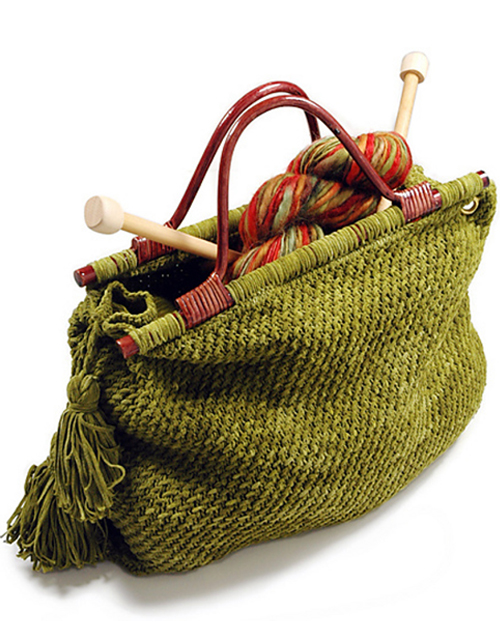
Knitting Tote by Donna Yacino for Berroco is a sturdy, structured knitted bag designed especially for carrying yarn, needles and works in progress.
The combination of textured knitting, wooden handles, decorative grommets and a reinforced bottom gives the tote a polished look while keeping it practical enough for everyday use.
Originally designed in Berroco Suede, this project is a great choice for knitters who want to make something functional rather than another garment or accessory.
Best of all, the complete Knitting Tote pattern is still officially available for free from Berroco.
✓ Free Pattern Availability
Berroco still publishes Knitting Tote by Donna Yacino as a free pattern download on its official website.
Knitting Tote at a Glance
Pattern: Knitting Tote
Designer: Donna Yacino
Publisher: Berroco
Project Type: Knitted tote bag
Skill Level: Intermediate
Suggested Yarn: Berroco Suede
Yarn Weight: Worsted
Approx. Yardage: 500 yd / 457 m
Needles: US 8 / 5 mm, 24-inch circular
Crochet Hook: 4 mm
Gauge: 24 sts × 30 rows = 4 in in pattern stitch
Finished Size: Approx. 15 in wide × 11 in high × 4½ in deep
Availability: Free official Berroco pattern
About the Berroco Knitting Tote
This tote was designed as a practical project bag with enough structure to hold knitting supplies while still looking like a finished handbag.
Berroco describes the design as sturdy and stylish, and the construction supports that goal with a firm knitted fabric, wooden handles and a reinforced base.
Unlike a soft drawstring project pouch, this tote is intended to keep its shape and stand more like a traditional bag.
Finished Size
The official finished measurements are approximately:
15 in wide × 11 in high × 4½ in deep
The height measurement does not include the handles.
This gives the bag enough room for yarn, tools and a medium-sized work in progress without making it excessively bulky.
Original Yarn: Berroco Suede
The original design uses Berroco Suede, a worsted-weight novelty yarn that gives the knitted fabric a distinctive suede-like appearance.
The official materials list calls for:
5 balls of Berroco Suede
The Ravelry record lists the project at approximately 500 yards / 457 meters.
What If Berroco Suede Is Hard to Find?
If you substitute yarn, focus on the finished fabric rather than trying to match only the original fiber appearance.
A tote needs more structure than a soft scarf or sweater.
Look for a yarn that can:
- Match the published gauge
- Create a reasonably firm fabric
- Show the textured stitch clearly
- Handle the weight of items placed inside the bag
- Resist excessive stretching
Make a swatch before committing to the full tote, especially if your substitute is much more elastic than the original yarn.
Needles and Gauge
The official pattern specifies a 24-inch US 8 / 5 mm circular needle.
The published gauge is:
24 stitches × 30 rows = 4 inches in pattern stitch
Use the needle size required to obtain gauge rather than assuming that US 8 will produce the correct fabric for every yarn.
Why Gauge Matters for a Tote Bag
Gauge affects more than appearance in a bag project.
If your stitches are too loose, the tote may stretch when filled. If they are too tight, the fabric can become difficult to work and the finished dimensions may be smaller than expected.
A firm, consistent swatch is especially useful before starting a structural project like this.
Worked in the Round
The pattern is designed to be worked in the round using a circular needle.
Circular construction reduces the need for long side seams and helps create a continuous body around the bag.
If you are new to circular knitting, check carefully that the cast-on edge is not twisted before joining.
Textured Pattern Stitch
The tote uses a textured pattern stitch rather than plain stockinette.
This gives the surface more visual interest while also contributing to the structured appearance of the bag.
The Ravelry pattern record also identifies slipped stitches among the techniques used.
Extra Materials You Will Need
This is not a yarn-and-needles-only project.
Berroco's official materials list also includes:
- A 4 mm crochet hook
- One pair of wooden handles with a 13-inch lower bar
- Four 7/16-inch grommets
- A piece of cardboard for the bottom insert
Check that you can obtain suitable handles and grommets before beginning the knitting.
Wooden Handles
The wooden handles are an important part of the original design.
They provide structure and keep the weight of the bag from being carried entirely by a knitted strap.
If you substitute another style of handle, compare its attachment points and width with the original construction before making permanent changes.
Decorative Grommets
Four metal grommets are used near the upper section of the tote.
These become attachment points for decorative twisted cords and tassels.
When installing hardware in knitted fabric, make sure it is secure and does not cut or damage the surrounding yarn.
Reinforcing the Bottom
One of the most practical details in this pattern is the reinforced base.
Berroco specifies a piece of cardboard approximately:
15 in long × 4½ in wide
as a bottom insert.
The insert helps keep the base flat when yarn and tools are placed inside.
Consider a More Durable Bottom Insert
If you plan to use the tote frequently, you may prefer to cut a removable insert from a suitable lightweight plastic or another moisture-resistant material with similar dimensions.
This would be your own modification rather than part of the original Berroco pattern.
Any substitute insert should have smooth edges so it does not catch the knitted fabric.
Do You Need to Line the Tote?
The original pattern does not require a full fabric lining in order to create the bag.
However, adding a lining can be a useful optional modification if you plan to carry small knitting tools.
A fabric lining can help prevent items such as stitch markers or needle tips from working through the knitted fabric.
Add Pockets If You Want More Organization
A handmade lining also gives you the opportunity to add internal pockets.
Useful pocket sizes might accommodate:
- Scissors
- Stitch markers
- Tape measure
- Cable needles
- Crochet hooks
- Pattern notes
Again, these are optional customizations and not part of the original Donna Yacino instructions.
Decorative Tassels and Twisted Cords
The original Berroco design includes tassels and twisted cords as finishing details.
They give the bag its distinctive decorative appearance and also make use of the installed grommets.
Follow the official pattern for the original finishing method rather than relying on reconstructed instructions from third-party sites.
Skills Used in This Project
This tote is a good project for practicing several skills in one useful object:
- Knitting in the round
- Maintaining a textured stitch pattern
- Working slipped stitches
- Checking gauge
- Using a crochet hook for finishing
- Attaching bag hardware
- Making twisted cords
- Making tassels
- Adding structural reinforcement
Is the Knitting Tote Beginner Friendly?
Berroco classifies the project as Intermediate.
That makes sense because the knitting itself is only one part of the project.
You also need to work a pattern stitch, maintain gauge, handle circular construction and complete several finishing and hardware steps.
An adventurous beginner who is comfortable following detailed instructions may still enjoy it, but it is probably not the ideal first-ever knitting project.
A Useful Project for Practicing Bag Construction
Garments require careful body sizing, while a tote allows you to focus more on structure and finishing.
This makes the project a useful introduction to how knitted fabric can be combined with rigid components such as handles and base inserts.
Prevent the Bag from Stretching
Knitted fabric naturally has some elasticity.
To keep the tote looking its best:
- Match the intended gauge
- Avoid extremely loose fabric
- Use the reinforced bottom
- Attach the handles securely
- Avoid routinely overloading the bag
- Consider a fabric lining for frequent use
Use It as a Knitting Project Bag
The finished tote is particularly well suited to holding an active knitting project.
Depending on the size of your work, it can hold yarn, circular needles, pattern notes and everyday knitting notions together in one place.
The flat reinforced bottom also makes it more practical than an unstructured knitted sack.
Or Use It as an Everyday Tote
Nothing limits the finished bag to knitting supplies.
It can also function as a general-purpose handmade tote, especially if you add a lining and internal pockets.
Keep in mind that the amount of weight it can comfortably carry depends on your yarn, gauge, finishing and hardware.
Is the Berroco Knitting Tote Still Free?
Yes.
Berroco currently maintains an official page for Knitting Tote by Donna Yacino and labels it Free Pattern Download.
Ravelry also currently lists the same pattern as free.
Amazing Knitting does not reproduce Berroco's complete copyrighted knitting instructions. Use the authorized publisher page for the full pattern.
Get the Free Knitting Tote Pattern
Use the official Berroco page for the current free pattern:
Get the Free Knitting Tote Pattern →
Pattern Details on Ravelry
Ravelry is also useful for checking the pattern record and browsing projects made by other knitters:
View Knitting Tote on Ravelry →
More Free Knitting Projects
If you would like to continue with another free project from the Amazing Knitting archive, explore:
- Morning Surf Scarf - Free Knitting Pattern
- Waffle Blanket - Free Knitting Pattern
- Shivaree Throw - Free Knitting Pattern
- Little Leaf Lace Scarf - Free Knitting Pattern
Explore More Knitted Bags
Before You Cast On
Read through the complete Berroco materials list before buying yarn.
This project requires more than needles and yarn, so having the handles, grommets, crochet hook and bottom insert ready will make the finishing process much easier.
Make a gauge swatch, aim for a firm structured fabric, and use the current official Berroco instructions for the complete stitch pattern and assembly details.
Pattern credit: Knitting Tote was designed by Donna Yacino and published by Berroco. The existing Amazing Knitting photograph is credited to Berroco Inc. Amazing Knitting provides an independent project guide and does not reproduce Berroco's complete copyrighted pattern instructions.


