Skip to content

...

Showing posts sorted by relevance for query free top knitting pattern. Sort by date Show all posts

Over 50 Websites to Get Free Knitting Patterns

Over 50 Websites to Get Free Knitting Patterns
Designed by © Knit Crush

Looking for free knitting patterns? There are thousands of legitimate patterns available online for baby clothes, sweaters, blankets, scarves, socks, hats, toys and almost every other knitting project you can imagine.

The challenge is no longer simply finding a pattern. It is finding a reliable free pattern from a legitimate source, especially when older Pinterest pins and search results may lead to discontinued pages, outdated downloads or unofficial copies.

This guide will help you find free knitting patterns more safely and efficiently, whether you are searching the Amazing Knitting archive, a designer's website, a yarn company or a large knitting-pattern database.

About This Updated Guide

This Amazing Knitting article was originally published in 2019 as a link to an external roundup of more than 50 free-pattern websites. We have expanded the page into an independent resource for finding legitimate free knitting patterns without reproducing another publisher's list.

Where Can You Find Free Knitting Patterns?

Free knitting patterns are published by many different types of websites.

Some come directly from independent designers. Others are published by yarn manufacturers, knitting magazines, craft websites or pattern databases.

The best source depends on what you are looking for, so it helps to understand the major types of free-pattern resources before beginning your search.

1. Designer Websites

One of the best places to find a knitting pattern is the designer's own website.

Independent designers frequently publish selected patterns free while selling other designs.

Going directly to the designer has several advantages. You are more likely to find the current version of the pattern, corrections, additional photographs and notes from the person who actually created it.

If a pattern has been updated since its original publication, the designer's current page is usually preferable to an old copied version circulating elsewhere.

2. Yarn Company Pattern Libraries

Major yarn companies can be excellent sources of free knitting patterns.

These companies publish patterns to demonstrate how their yarns can be used, which means their libraries often contain projects across many categories and skill levels.

You can find designs for:

  • Baby sweaters and cardigans
  • Baby blankets
  • Adult sweaters and pullovers
  • Hats
  • Scarves and cowls
  • Socks and slippers
  • Shawls
  • Home accessories
  • Seasonal projects

Yarn-company libraries are especially useful because older patterns sometimes remain available long after the original printed booklet has disappeared.

3. Ravelry

Ravelry is one of the most useful resources for researching knitting patterns.

Rather than simply searching the web for a phrase such as “free baby cardigan,” you can narrow results using filters such as category, yarn weight, needle size, age, construction and availability.

Pattern records can also provide useful historical information such as the designer, publication date, suggested yarn and links to the current pattern source.

Remember that a Ravelry record does not automatically mean the pattern itself is still available. Always check the current availability shown on the pattern page.

4. Knitting Magazines and Online Publications

Online knitting magazines have published many excellent free patterns over the years.

Some older designs remain available in permanent online archives, making these publications particularly useful when searching for classic knitting projects.

These sources can also be valuable because they often preserve useful information about the designer, yarn, gauge, construction and original publication date.

5. Large Craft and Pattern Websites

Large craft websites often organize patterns by project type or skill level, which can make them useful when you are looking for inspiration rather than one particular design.

A collection might focus on beginner scarves, baby booties, knitted toys or quick gifts.

When using a roundup, however, follow the link to the original pattern source whenever possible.

6. Knitting Blogs

Knitting blogs remain another useful source of free patterns, tutorials and project inspiration.

Some bloggers are also pattern designers and publish complete original designs. Others curate projects from different designers.

The distinction matters.

When a blog is discussing somebody else's pattern, look for the designer's name and a clear link to the legitimate original source.

7. Vintage and Public-Domain Knitting Resources

Knitters interested in historical projects can also explore digitized vintage knitting books, magazines and pattern leaflets.

Older knitting publications can contain fascinating sweaters, lace, socks, mittens and household projects that differ significantly from modern designs.

However, old does not automatically mean public domain. Copyright status depends on factors including publication date, jurisdiction and publication history.

If you plan to republish rather than simply knit from a vintage pattern, verify its copyright status first.

8. Amazing Knitting

You can also browse the Amazing Knitting archive.

Our library includes hundreds of knitting discoveries covering baby clothes, blankets, sweaters, scarves, hats, socks, slippers, stitches, tutorials and other projects.

We are progressively reviewing older articles to identify original designers, verify pattern availability and direct readers toward legitimate current sources whenever possible.

Browse Free Knitting Patterns →

Free Baby Knitting Patterns

Baby projects are an excellent place to explore free patterns because there are designs for many different skill levels.

You can start with baby cardigans and sweaters:

Explore Free Baby Cardigans →

Or browse baby booties:

Explore Free Baby Booties →

And baby blankets:

Explore Free Baby Blankets →

Free Sweater and Cardigan Patterns

Sweaters range from simple first-garment projects to advanced designs involving cables, lace or colorwork.

When choosing one, pay particular attention to:

  • Finished measurements
  • Recommended ease
  • Gauge
  • Yarn weight
  • Construction method
  • Available sizes
  • Required techniques

Explore Free Sweater Patterns →

Free Blanket Knitting Patterns

Blankets are another large category of free knitting patterns.

Depending on the design, a blanket can be a simple beginner project or an advanced combination of lace, cables, colorwork or modular knitting.

Baby blankets are particularly useful for practicing new techniques on a manageable scale.

Explore Free Blanket Patterns →

Free Scarf and Cowl Patterns

Scarves and cowls are useful projects for testing unfamiliar stitches without committing to the fit requirements of a sweater.

They are also good projects for experimenting with cables, lace, texture and unusual yarn.

Explore Free Scarf Patterns →

How to Tell Whether a Pattern Is Really Free

One of the biggest problems with older knitting links is that pattern availability changes.

A pattern that was free ten years ago may now be paid, discontinued or completely unavailable.

Before calling a pattern free, check the current original source.

Look for clear wording such as:

  • Free pattern
  • Free download
  • Download PDF
  • Pattern available free on the designer's website

If the only evidence that a pattern is free comes from an old Pinterest pin or an old roundup, verify it before downloading.

Free Web Pattern vs. Free PDF

A pattern does not need to include a downloadable PDF to be genuinely free.

Some designers publish the complete pattern as a free webpage while offering an optional printable or ad-free PDF for a fee.

In that situation, describe the availability accurately: free web version with optional paid PDF.

This is more useful than simply labeling everything “free” or “paid.”

Watch for Discontinued Patterns

Older pattern databases can contain records for designs whose original downloads have disappeared.

A historical record is useful for identifying the designer and project, but it does not necessarily provide permission to download a copied PDF from another website.

If the legitimate source is gone, look for a currently available alternative instead of using an unauthorized copy.

Avoid Suspicious Pattern Downloads

Be cautious when a website offers a designer's PDF without clearly identifying itself as the designer, publisher or an authorized distributor.

A safer route is usually:

  1. Identify the exact pattern name.
  2. Identify the designer.
  3. Find the designer or publisher's current page.
  4. Check the current availability.
  5. Download or follow the pattern from that legitimate source.

Check for Pattern Corrections

Another advantage of using the current source is access to corrections and updates.

Designers sometimes discover errors after publication and issue an updated PDF or an errata notice.

An old copy saved elsewhere may not include those corrections.

Check the Yarn Before You Buy It

Older patterns frequently recommend yarns that have since been discontinued.

That does not necessarily make the pattern unusable.

Instead of searching only for the exact old yarn, compare:

  • Yarn weight
  • Gauge
  • Fiber content
  • Yardage or meterage
  • Fabric characteristics

Always make a gauge swatch before committing to a substitute yarn for a fitted garment.

Start with the Project You Want to Make

Searching “free knitting patterns” can return an overwhelming number of results.

A more effective approach is to begin with a specific project:

  • Free newborn cardigan knitting pattern
  • Free baby booties knitting pattern
  • Free cable blanket knitting pattern
  • Free beginner scarf knitting pattern
  • Free top-down sweater knitting pattern
  • Free lace shawl knitting pattern

Then narrow your choices according to yarn weight, size and skill level.

Save the Designer's Name

When you find a pattern you love, save more than the photograph.

Record the pattern name and designer.

This makes it much easier to find the legitimate pattern again if a Pinterest pin, bookmark or old website link stops working in the future.

Our Approach at Amazing Knitting

Amazing Knitting is a curated discovery library rather than the owner of every pattern featured in its archive.

When a project belongs to another designer, our goal is to identify and credit that designer, provide useful independent information about the project and direct knitters to the legitimate pattern source.

If an old pattern that was once free has become paid or unavailable, we aim to make that clear rather than continuing to promise a free download that no longer exists.

Explore Free Knitting Patterns

Ready to find your next project? Browse the Amazing Knitting archive by project type.

Before Downloading a Free Pattern

Take a moment to confirm that you are using the current legitimate version.

Check the designer's name, current availability, size range, yarn requirements and whether any corrections have been published.

A few minutes of checking before casting on can prevent hours of frustration later in the project.

Editorial note: This article was originally published by Amazing Knitting in 2019 as a discovery link to a Knit Crush roundup. It has since been expanded into an original Amazing Knitting resource for finding and evaluating free knitting patterns. The original image used on this page is credited to Knit Crush.

Butterfly Heart Top - Free Pattern

Butterfly Heart Top - Free Pattern
Photo above © piaherno

Butterfly Heart Top / DROPS 170-4 is a beautiful sleeveless women's top featuring an eye-catching lace design around the V-neckline.

Designed by DROPS Design and worked from the top down, this summer knitting project is available in six sizes from S through XXXL. Best of all, the complete original pattern is still available free directly from DROPS Design.

✓ Free Pattern Availability

Butterfly Heart Top / DROPS 170-4 remains available as a free official DROPS knitting pattern. The complete current instructions, diagrams and measurements are available directly from DROPS Design.

Butterfly Heart Top at a Glance

Pattern: Butterfly Heart Top / DROPS 170-4

DROPS Pattern No.: vs-011

Designer: DROPS Design

Collection: DROPS 170

First Published: February 2016

Craft: Knitting

Category: Women's Sleeveless Top

Sizes: S, M, L, XL, XXL, XXXL

Suggested Yarn: DROPS Belle

Yarn Weight: DK / Yarn Group B

Main Needles: US 6 / 4 mm

Edge Needle: US 4 / 3.5 mm

Gauge: 21 stitches × 28 rows = 4 inches / 10 cm in stockinette

Construction: Top-down

Features: Lace, V-neck, sleeveless construction

Current Availability: Free official pattern

About the Butterfly Heart Top

Butterfly Heart Top is a feminine summer knitting design from DROPS Design.

Its most distinctive feature is the decorative lace around the deep V-neckline. The lace creates the visual focus of the garment while the sleeveless shape keeps the overall silhouette light and suitable for warmer weather.

The design can be worn as a summer top on its own or layered over another garment when the weather is cooler.

Sizes S to XXXL

DROPS provides the pattern in six sizes:

  • S
  • M
  • L
  • XL
  • XXL
  • XXXL

Because the pattern includes a schematic with finished measurements, compare those measurements with a garment that fits you comfortably before deciding which size to knit.

DROPS Belle Yarn

The original Butterfly Heart Top was designed in DROPS Belle.

DROPS Belle is a DK-weight summer yarn made from a blend of cotton, viscose and linen. This combination gives the finished fabric a lightweight character that suits a sleeveless lace top particularly well.

The official yarn requirements are:

  • S: 250 g
  • M: 300 g
  • L: 300 g
  • XL: 350 g
  • XXL: 400 g
  • XXXL: 400 g

The original sample is shown in DROPS Belle color Old Pink No. 11.

Needles and Gauge

For the main fabric, DROPS specifies:

US 6 / 4 mm double-pointed and circular needles

The pattern uses 40 cm / 16-inch and 80 cm / 32-inch circular needles as required during construction.

A smaller:

US 4 / 3.5 mm circular needle

is specified for the garter-stitch edges.

The published gauge is:

21 stitches × 28 rows = 4 inches / 10 cm in stockinette stitch

Use whichever needle size allows you to obtain the designer's gauge.

Worked from the Top Down

Butterfly Heart Top is a top-down knitting project.

This means construction begins around the upper part of the garment rather than at the lower hem.

The neckline and lace structure are established early in the project, with the garment developing downward from there.

Follow the official DROPS instructions carefully because different stages of the project are worked both back and forth and in the round.

The Butterfly Heart Lace

The lace pattern is what gives this top its distinctive identity.

Decorative openings radiate around the V-neck and create a strong geometric motif that can resemble a combination of butterfly wings and a heart shape.

Because the lace is positioned so prominently, accurate stitch counts are especially important.

Charts A.1 to A.13

DROPS provides a series of diagrams for the patterned sections, identified as A.1 through A.13.

Different sizes may use different diagram combinations, so identify the instructions for your selected size before beginning each patterned section.

Amazing Knitting does not reproduce these copyrighted diagrams. They are available directly on the official DROPS pattern page.

Short Rows

The pattern also uses short rows during construction.

Short-row knitting allows selected sections to gain additional rows without working all the way across the complete piece.

If you are unfamiliar with this technique, review how the pattern asks you to turn the work before beginning that section.

Garter-Stitch Edges

Garter stitch provides a simple textural contrast to the decorative lace.

The smaller US 4 / 3.5 mm needle is used for these edge sections, helping them maintain a neat appearance around the garment.

Skills That Help

Butterfly Heart Top is most comfortable for knitters who already have some experience beyond basic knit and purl stitches.

Helpful skills include:

  • Casting on and binding off
  • Knitting and purling
  • Working stockinette stitch
  • Working garter stitch
  • Yarn overs
  • Increasing and decreasing
  • Reading lace charts
  • Working short rows
  • Working back and forth
  • Knitting in the round
  • Keeping accurate stitch counts
  • Blocking lace

Reading the Lace Charts

Before starting the lace section, spend a few minutes studying the symbols and identifying the correct diagram for your size.

Lace mistakes are often easier to prevent than to repair several rows later.

Stitch markers can be helpful where appropriate, and checking your stitch count after important increase or decrease rows can prevent a small mistake from spreading through the motif.

Consider Using a Lifeline

If you are less experienced with lace knitting, a lifeline can provide useful insurance.

Thread a smooth contrasting strand through the live stitches after a correctly completed section. If a later mistake requires unraveling, the lifeline gives you a safe row to return to.

Choosing a Substitute Yarn

If DROPS Belle is not available, choose a substitute based on gauge, fiber behavior and the type of fabric you want to create.

A summer top benefits from a yarn that produces comfortable drape without hiding the lace definition.

Cotton, linen and viscose blends can behave differently from wool, particularly in elasticity and how they change after washing, so a generous gauge swatch is worthwhile.

Make and Wash Your Gauge Swatch

Gauge matters in any fitted garment, but it is particularly important when working with plant-fiber blends.

Make a swatch large enough to measure accurately and treat it the way you intend to wash the finished top.

Measure again after the swatch has dried. This can reveal whether your chosen yarn grows or changes significantly after washing.

Blocking the Lace

Lace often appears more compressed while it is still on the needles. Appropriate blocking can help the openings and decorative lines settle into their intended shape.

Follow the care instructions for your yarn and avoid overstretching the garment beyond its intended measurements.

Is Butterfly Heart Top Still Free?

Yes. Butterfly Heart Top / DROPS 170-4 remains available as a completely free knitting pattern from DROPS Design.

The official page provides the complete instructions, size-specific information, diagrams, schematic and current pattern tools.

Amazing Knitting does not reproduce DROPS Design's complete row-by-row instructions or charts. This page provides an independent project guide and directs knitters to the legitimate original source.

Get the Free Butterfly Heart Top Pattern

Use the official DROPS Design page for the complete current pattern.

Get the Free Butterfly Heart Top Pattern →

More Free Women's Knitting Patterns

If you enjoy Butterfly Heart Top, explore more free summer tops and lace knitting projects from the Amazing Knitting archive.

Explore Free Knitted Top Patterns →

You can also browse free lace tops, sleeveless tops, and DROPS knitting patterns.

Before You Start

Open the current DROPS pattern and select your size before purchasing yarn. Check the schematic and finished measurements rather than choosing solely by the S–XXXL labels.

Make and wash a gauge swatch, then familiarize yourself with the size-specific lace diagrams and short-row instructions before casting on the full garment.

Pattern credit: Butterfly Heart Top / DROPS 170-4 was designed and published by DROPS Design. The existing photograph on this Amazing Knitting page is credited to piaherno. Amazing Knitting does not reproduce DROPS Design's copyrighted charts or complete row-by-row knitting instructions.

Boy Sweater - Knitting Pattern

Boy Sweater - Knitting Pattern
Photos above © milainemicoton

Looking for a stylish boy sweater knitting pattern with practical cold-weather details? Boy Sweater by Lisa Chemery is a seamless top-down pullover for babies and children, featuring a cozy shawl collar, buttoned neck opening, raglan shaping, and textured stitch details.

The close-fitting design is intended to sit comfortably under a jacket, while the shawl collar provides extra warmth around the neck — especially useful for children who do not enjoy wearing scarves.

Boy Sweater at a Glance

Pattern: Boy Sweater

Designer: Lisa Chemery

Craft: Knitting

Category: Baby & Child Pullover

Construction: Top-down and seamless

Yarn Weight: Worsted / DK

Needles: US 6 / 4.0 mm and US 8 / 5.0 mm

Main Gauge: 20 stitches × 30 rounds = 4 inches / 10 cm in stockinette

Yardage: Approximately 275–700 yards / 251–640 m

Sizes: 3 months to 8 years

Languages: English and French

Pattern Availability: Paid pattern

About the Boy Sweater

Designed by Lisa Chemery, Boy Sweater combines the practicality of a children's pullover with several details that give it a more polished look.

The most recognizable feature is the shawl collar, which wraps softly around the neck and is paired with a small buttoned opening.

Textured knitting and twisted-rib details add visual interest without turning the sweater into a heavily decorated garment, making the design suitable for both boys and girls.

Seamless Top-Down Construction

The sweater is knitted seamlessly from the top down. The upper section begins flat, after which stitches are added for the neck placket and the body continues in the round.

The sleeves are also worked in the round, reducing the amount of garment seaming required at the end.

Top-down construction has another practical advantage: it allows knitters to see the garment taking shape from the neckline toward the hem.

The Shawl Collar

The shawl collar is one of the defining features of this sweater. After the body is completed, stitches are picked up around the neckline and the collar is worked flat.

Short rows are used to create the characteristic shawl shape, and the lower edges of the collar are then attached to the sweater body.

Besides giving the sweater its classic appearance, the collar provides extra knitted fabric around the child's neck without requiring a separate scarf.

Baby and Child Sizes

The current pattern includes a particularly useful range of sizes:

  • 3 months
  • 6 months
  • 12 months
  • 18 months
  • 2 years
  • 4 years
  • 6 years
  • 8 years

The designer provides finished garment measurements as well as intended chest measurements, so check the original pattern carefully when deciding which size to knit.

Yarn Requirements

Boy Sweater is designed for approximately:

275–700 yards / 251–640 meters

The exact amount depends on size. The designer recommends a worsted-to-DK-weight merino or merino-blend yarn.

Suggested yarns listed with the pattern include Malabrigo Rios and several DK and worsted options.

Needles and Gauge

The pattern uses two main needle sizes:

  • US 6 / 4.0 mm
  • US 8 / 5.0 mm

The published stockinette gauge after blocking is:

20 stitches × 30 rounds = 4 inches / 10 cm

The textured portion has a separate row gauge, so use the designer's current pattern instructions when swatching and selecting needle sizes.

Knitting Skills Used

This project involves more than basic stockinette knitting. Techniques used in the design include:

  • Knitting and purling
  • Increasing and decreasing
  • Top-down raglan construction
  • Knitting in the round
  • Picking up stitches
  • Short rows
  • Twisted stitches
  • Textured stitch patterns
  • Buttonholes and finishing

The combination makes Boy Sweater an interesting project for knitters who already understand the basics and want to develop their garment-knitting skills.

Is the Boy Sweater Pattern Free?

No. Boy Sweater by Lisa Chemery is currently a paid knitting pattern.

The pattern is sold through the designer's Ravelry listing. Amazing Knitting does not reproduce the designer's copyrighted instructions.

Visit the original listing below for the current price, complete sizing, materials, and purchase information.

View the Original Boy Sweater Pattern →

Pattern credit: Boy Sweater was designed by Lisa Chemery. Pattern pricing, availability, sizing, and technical information are controlled by the designer and may change over time.

Prefer a Free Alternative?

If you love the cozy shawl-collar style but would prefer a free knitting pattern, Amazing Knitting has a similar baby and child project in our archive.

Double Breasted Jacket with Shawl Collar — Free Knitting Pattern

This is a different design — not a free copy of Boy Sweater — but it offers a similar cozy shawl-collar look for babies and children and is available as a free knitting pattern.

View the Free Shawl Collar Pattern →

You can also browse our free baby sweater patterns for more no-cost options.

More Baby and Child Sweaters

Explore more boy sweater knitting patterns, baby sweater knitting patterns, and children's sweater knitting patterns from the Amazing Knitting archive.

Before You Start

If you choose the original Boy Sweater, check Lisa Chemery's current Ravelry listing before purchasing yarn. Confirm your chosen size, yarn requirement, needle sizes, gauge, notions, and any current pattern updates before casting on.

Clover - Free Pattern

Clover - Free Pattern
Photo above © DROPS Design

Clover / DROPS Children 34-4 is a free children's sweater knitting pattern from DROPS Design, featuring a decorative lace pattern, raglan shaping and comfortable top-down construction.

Designed for children approximately 2 to 12 years old, the sweater can be knitted in DROPS Air or DROPS Paris and is available in six sizes.

The complete pattern remains free on the official DROPS Design website.

✓ Free Pattern Availability

Clover / DROPS Children 34-4 is currently available as a free official knitting pattern from DROPS Design. Use the official link below for the complete current instructions, diagrams and measurements.

Clover Sweater at a Glance

Pattern: Clover / DROPS Children 34-4

Designer: DROPS Design

Pattern Number: ai-014-bn

Craft: Knitting

Category: Children's Sweater / Jumper

Sizes: 2 to 11/12 years

Suggested Yarn: DROPS Air or DROPS Paris

Gauge: 16 stitches × 20 rows = 4 in / 10 cm

Main Needles: US 9 / 5.5 mm

Rib Needles: US 7 / 4.5 mm

Construction: Top down

Features: Lace pattern, raglan shaping, long sleeves

Availability: Free official DROPS pattern

About the Clover Children's Sweater

Clover is a children's pullover designed by DROPS Design.

The sweater combines a relatively simple silhouette with decorative lace across the upper portion of the garment.

It is knitted from the top down with raglan shaping, giving knitters a practical construction method while allowing the lace to become the main decorative feature.

Six Children's Sizes

The official DROPS pattern includes six sizes:

  • 2 years
  • 3/4 years
  • 5/6 years
  • 7/8 years
  • 9/10 years
  • 11/12 years

DROPS associates these sizes with approximate child heights of:

92 – 98/104 – 110/116 – 122/128 – 134/140 – 146/152 cm

Age is only a guide. When possible, compare the child's measurements with the finished measurements in the official DROPS schematic before choosing a size.

Finished Chest Measurements

The published finished chest measurements are approximately:

68 – 72 – 76 – 84 – 86 – 94 cm

That's approximately:

26¾ – 28⅜ – 30 – 33 – 33⅞ – 37 inches

Finished length ranges from approximately 36 cm for the smallest size to 56 cm for the largest.

Two Suggested Yarn Options

One useful feature of the official Clover pattern is that DROPS provides two yarn options.

You can knit the sweater in:

  • DROPS Air
  • DROPS Paris

These yarns have very different fiber compositions and characteristics, so the finished sweater can have a different feel depending on which option you choose.

The important requirement is obtaining the pattern gauge and a fabric suitable for the garment.

DROPS Air Requirements

When using DROPS Air, the official pattern calls for approximately:

150 – 150 – 200 – 200 – 200 – 250 grams

The original DROPS sample lists color 20, Rose.

DROPS Paris Requirements

The alternative DROPS Paris version requires approximately:

300 – 300 – 400 – 400 – 400 – 500 grams

The official pattern lists color 01, Apricot, for this option.

Gauge

The required knitting gauge is:

16 stitches × 20 rows = 4 × 4 inches / 10 × 10 cm

This is measured in stockinette stitch.

Gauge is important for children's garments because it directly affects the finished chest circumference, length and yarn consumption.

Make a gauge swatch before beginning, particularly when substituting another yarn.

Needles

DROPS recommends:

  • 5.5 mm / US 9 circular and double-pointed needles for the main fabric
  • 4.5 mm / US 7 circular and double-pointed needles for the ribbing

The published needle sizes are guides. Use the needle size that allows you to obtain the required gauge.

Top-Down Construction

Clover is knitted from the top down.

This construction begins at the neckline and develops the upper body before moving down toward the hem.

Top-down sweaters can be particularly convenient for children's garments because the overall proportions become easier to visualize as the project grows.

Raglan Shaping

The sweater uses raglan shaping to form the upper body and sleeves.

Raglan construction distributes shaping around the upper garment rather than requiring separately shaped traditional armholes.

Combined with the top-down method, it creates a clean construction that works well with the decorative lace section.

The Lace Pattern

The decorative lace is one of Clover's defining features.

The motif is worked according to the diagrams supplied with the official DROPS pattern.

Amazing Knitting does not reproduce those copyrighted charts here. Follow the current official pattern for the complete stitch sequence and diagrams.

Working from a Knitting Chart

If you are relatively new to charted lace, take a little time to study the symbols before beginning the decorative section.

Keep track of both your current chart row and your position within each repeat.

Stitch markers can be useful for separating repeats where appropriate, making it easier to identify a missing yarn over or decrease before the error travels into later rows.

Count Your Stitches Regularly

Lace depends on increases and decreases remaining correctly balanced.

A forgotten yarn over or an accidental extra stitch can change the alignment of the following rows.

Checking your stitch count at logical points throughout the lace section can save considerable time later.

Consider Using a Lifeline

If lace knitting is still new to you, a lifeline can provide useful insurance.

Pass a smooth contrasting thread through a correctly completed row without interfering with the working stitches.

If you later discover an error, you have a known safe row to return to instead of unraveling blindly through the lace.

Working the Sleeves

After the body has been established, the sleeves are worked using the stitches set aside during the upper-body construction.

Smaller circumferences can be handled with double-pointed needles, magic loop or another method you are comfortable using, while still following the stitch counts and shaping in the official instructions.

Choosing the Right Size

Children's ages do not always correspond perfectly to standardized clothing sizes.

For a better result, measure a sweater that currently fits the child well and compare it with the finished measurements supplied by DROPS.

Pay particular attention to chest circumference, body length and sleeve length.

Substituting Yarn

You can use another suitable yarn instead of the two DROPS options, but do not select a substitute by yarn label alone.

Look for a yarn capable of producing the required 16 stitches × 20 rows per 10 cm while creating a fabric you like.

Fiber content also matters. A cotton yarn such as DROPS Paris behaves differently from a light blown yarn such as DROPS Air.

Always swatch when making a significant substitution.

Skills Used in Clover

This project is useful for practicing several knitting skills:

  • Top-down sweater construction
  • Raglan shaping
  • Knitting in the round
  • Knit and purl stitches
  • Ribbing
  • Increasing and decreasing
  • Yarn overs
  • Following lace diagrams
  • Working sleeves in a small circumference
  • Finishing and weaving in ends

Is Clover Suitable for Beginners?

Clover is more involved than a completely basic stockinette children's sweater because of the lace pattern and shaping.

However, a knitter who is already comfortable with knit and purl stitches, working in the round and basic increases and decreases can use it as a good opportunity to gain experience with charted lace and top-down garment construction.

Important: Use the Current Pattern

DROPS notes that the Clover pattern has received a correction.

The official page currently shows an update dated October 23, 2020 concerning the sleeve instructions.

For this reason, avoid relying on an old saved or copied version of the instructions. Work from the current official DROPS page so you have the corrected pattern.

Is the Clover Sweater Still Free?

Yes.

Clover / DROPS Children 34-4 remains available as a complete free knitting pattern directly from DROPS Design.

The official page includes the instructions, diagrams, measurements and supporting technique information.

Get the Free Clover Knitting Pattern

Visit DROPS Design for the complete current pattern:

Get the Free Clover Pattern →

More Free Children's Sweater Patterns

Looking for another children's project? The recently reviewed Lamb Dance cardigan from DROPS Design is another free pattern, featuring a playful stranded-colorwork sheep yoke.

See the Free Lamb Dance Pattern →

You can also browse more projects in the Amazing Knitting archive:

Before You Start

Choose the size using the child's measurements rather than age alone, then make a gauge swatch with your chosen yarn.

Read through the lace diagrams before reaching the patterned section and consider using stitch markers or a lifeline if charted lace is new to you.

Most importantly, work from the current DROPS page because the pattern has received a published correction since its original release.

Pattern credit: Clover / DROPS Children 34-4 was designed and published by DROPS Design. The existing photograph on this Amazing Knitting page is credited to DROPS Design. Amazing Knitting does not reproduce the designer's complete copyrighted instructions or charts.

Lamb Dance Kids Jacket - Free Knitting Pattern

Lamb Dance - Free Pattern
Photo above © DROPS Design

Lamb Dance by DROPS Design is a cheerful free children's cardigan knitting pattern featuring a flock of little sheep around the circular yoke.

The jacket is worked from the top down in DK-weight yarn, combining stockinette stitch, ribbing and stranded colorwork. With five sizes covering approximately 3 to 12 years, it is a playful project for knitters ready to combine garment construction with colorwork.

Best of all, the complete pattern remains free from DROPS Design.

✓ Free Pattern Availability

Lamb Dance / DROPS Children 34-1 is currently available as a free knitting pattern from DROPS Design. Use the official DROPS link below for the complete current instructions, charts and pattern information.

Lamb Dance Jacket at a Glance

Pattern: Lamb Dance / DROPS Children 34-1

Designer: DROPS Design

Pattern Number: me-054-bn

First Published: March 2019

Craft: Knitting

Category: Children's Cardigan / Jacket

Sizes: 3/4, 5/6, 7/8, 9/10 and 11/12 years

Yarn Weight: DK / 8 ply

Suggested Yarn: DROPS Merino Extra Fine or DROPS Lima

Main Needles: US 6 / 4 mm

Rib Needles: US 2½ / 3 mm

Gauge: 21 stitches × 28 rows = 4 in / 10 cm

Construction: Top down

Features: Circular yoke, stranded colorwork, sheep motif, button front

Availability: Free official pattern

About the Lamb Dance Jacket

Lamb Dance is a children's knitted cardigan from DROPS Design.

Its defining feature is the whimsical band of sheep worked around the circular yoke. Contrasting colors create the sheep and surrounding decorative pattern against the main background color.

Below the patterned yoke, the cardigan becomes much simpler, allowing the colorwork to remain the visual focus of the finished garment.

Five Children's Sizes

The official pattern includes five sizes:

  • 3/4 years — approximately 98/104 cm height
  • 5/6 years — approximately 110/116 cm
  • 7/8 years — approximately 122/128 cm
  • 9/10 years — approximately 134/140 cm
  • 11/12 years — approximately 146/152 cm

When choosing a size, compare the child's measurements with the finished measurements in the official DROPS pattern rather than relying only on age.

Finished Measurements

The published finished chest measurements are approximately:

64 – 68 – 74 – 78 – 80 cm

The corresponding finished body lengths are approximately:

35 – 39 – 43 – 47 – 51 cm

Consult the official schematic before choosing your size, especially when knitting the cardigan as a gift.

Yarn Choices

DROPS provides two suggested yarn options for Lamb Dance:

  • DROPS Merino Extra Fine
  • DROPS Lima

Both belong to DROPS Yarn Group B and fall within the DK-weight range, but their fiber compositions produce somewhat different fabrics.

DROPS Merino Extra Fine is a merino yarn, while DROPS Lima combines wool and alpaca.

If substituting another yarn, matching the required gauge is more important than simply selecting a yarn carrying the same weight label.

How Much Yarn Do You Need?

The main background color requires approximately 150 to 250 grams, depending on size.

Several contrasting colors are then used for the sheep and other elements of the colorwork.

Because the exact amounts vary by size and yarn choice, check the official DROPS materials table before purchasing your yarn.

Knitting Gauge

The official gauge is:

21 stitches × 28 rows = 4 × 4 inches / 10 × 10 cm

This gauge is measured in stockinette stitch using the larger needles.

Gauge is particularly important for children's garments because even a relatively small difference can noticeably change the finished chest circumference and length.

Needles

The pattern uses approximately:

  • 4 mm / US 6 circular needles for the main fabric
  • 4 mm / US 6 double-pointed needles or another suitable small-circumference method
  • 3 mm / US 2½ needles for the ribbing

The official pattern lists circular needle lengths appropriate for the different stages of the garment.

Needle sizes are recommendations. Adjust them if necessary to obtain the required gauge.

Top-Down Construction

Lamb Dance is knitted from the top down.

Top-down construction has several practical advantages. The yoke and upper body develop first, followed by the body and sleeves, reducing the amount of traditional garment seaming.

It can also make the overall construction easier to visualize because the cardigan grows from the neckline toward the hem.

The Circular Yoke

The sheep motif sits within a circular yoke.

Instead of using conventional armhole shaping with separately knitted front and back pieces, shaping is distributed around the upper body.

This creates the smooth rounded line that makes Nordic-style colorwork yokes so recognizable.

The Sheep Colorwork

The playful sheep are the signature feature of Lamb Dance.

The motif is created using stranded colorwork, following the chart supplied by DROPS Design.

Amazing Knitting does not reproduce that copyrighted chart here. Use the current official pattern while working the yoke.

Tips for Stranded Colorwork

If stranded knitting is relatively new to you, pay particular attention to your tension.

The unused yarn carried behind the work should have enough room to span the stitches without pulling the knitted fabric together.

Stretching the stitches gently along the right needle while changing colors can help keep the floats from becoming too tight.

Check the fabric frequently rather than waiting until the entire yoke is complete.

Swatch the Colorwork Too

Your tension when knitting stranded colorwork may differ from your ordinary stockinette tension.

If this happens, the yoke can become tighter than the body even when the stockinette portion matches the published gauge.

A small colorwork swatch can therefore be useful before beginning the main sheep section.

Button Front

Unlike the related Lamb Dance pullover, this version is a front-opening cardigan.

The official pattern calls for:

6 – 6 – 7 – 7 – 7 buttons

The exact number depends on the size being knitted.

Attach buttons securely, particularly when the garment is intended for a younger child.

Skills Used in Lamb Dance

Useful skills for this project include:

  • Casting on and binding off
  • Knit and purl stitches
  • Working ribbing
  • Knitting stockinette stitch
  • Working in the round
  • Working flat where required
  • Increasing and decreasing
  • Reading a colorwork chart
  • Stranded knitting
  • Managing yarn floats
  • Working a circular yoke
  • Making buttonholes
  • Picking up stitches where instructed
  • Weaving in multiple color ends neatly

Is Lamb Dance Suitable for Beginners?

A knitter who has already completed simple garments and is comfortable working in the round should find Lamb Dance an interesting introduction to a more decorative children's cardigan.

The colorwork yoke adds another skill layer, so a complete first-time knitter may prefer to practice stranded knitting on a small swatch before beginning.

DROPS also provides supporting technique information and video tutorials alongside many of its patterns.

A Matching Lamb Dance Collection

The cardigan is part of a small coordinated DROPS collection.

DROPS also published a Lamb Dance Sweater using the same playful sheep theme, as well as a matching Lamb Dance Hat.

This makes the design especially useful if you enjoy the motif and want to create coordinated children's knitwear.

Is Lamb Dance Still Free?

Yes.

Lamb Dance / DROPS Children 34-1 is currently available directly from DROPS Design as a complete free knitting pattern.

The official page contains the current instructions, diagrams, charts, measurements and supporting information.

Amazing Knitting provides this independent project guide rather than reproducing the complete DROPS instructions or charts.

Get the Free Lamb Dance Pattern

Use the official DROPS Design page for the complete free pattern:

Get the Free Lamb Dance Pattern →

More Free Children's Knitting Patterns

You can continue exploring Amazing Knitting for free children's cardigans, sweaters and colorwork projects.

Explore Free Children's Cardigans →

You can also browse:

Before You Start

Choose the size by comparing the child's measurements with the official DROPS schematic, then make a gauge swatch with your chosen Yarn Group B yarn.

If stranded knitting is new to you, practice carrying two colors before reaching the sheep yoke. Keeping the floats relaxed is important for maintaining a comfortable fit across the upper body.

Finally, always work from the current DROPS page so you have access to the latest version of the pattern and its supporting information.

Pattern credit: Lamb Dance / DROPS Children 34-1 was designed and published by DROPS Design. Amazing Knitting does not reproduce the designer's copyrighted charts or complete knitting instructions. Please use the official DROPS page for the free pattern.

Flax Sweater - Free Pattern

Flax Sweater - Free Pattern
Photo above © Angeldogknitter

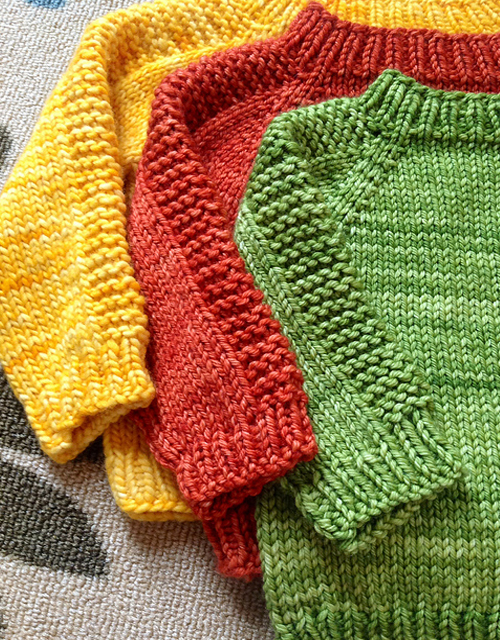
Looking for a versatile free sweater knitting pattern for babies, children, and adults? The Flax Sweater by Tin Can Knits is a modern top-down pullover designed to help knitters build confidence while learning seamless sweater construction.

Flax is part of the popular Simple Collection, a series of free patterns and tutorials created to teach essential knitting skills. With sizes ranging from babies to adults, it is a practical pattern that can be used again and again for different family members.

Flax Sweater Pattern at a Glance

Pattern: Flax Sweater

Designer: Tin Can Knits

Craft: Knitting

Category: Pullover / Sweater

Construction: Top-down and seamless

Yarn Weight: Worsted / Aran

Gauge: 18 stitches and 22 rows = 4 inches in stockinette stitch in the round

Needle Sizes: US 6 / 4.0 mm and US 8 / 5.0 mm

Yardage: Approximately 220–2100 yards (201–1920 m)

Sizes: 0–6 months through 6XL

Pattern Availability: Free

About the Flax Sweater

The Flax Sweater is one of those patterns that works especially well as a first garment project. It is designed with clean lines, simple shaping, and a seamless construction method that helps knitters understand how a sweater comes together without adding unnecessary complexity.

The sweater is worked from the top down, which means you begin at the neckline and continue through the yoke, body, and sleeves. This construction style is popular because it allows you to see the garment take shape as you knit.

Flax is also designed as part of a teaching collection, so it is supported by tutorials from Tin Can Knits that explain many of the techniques used throughout the project.

Sizes from Baby to Adult

One of the biggest advantages of the Flax pattern is its wide size range. The current worsted-weight version includes 19 sizes, beginning with babies and continuing through larger adult sizes.

Available sizes include:

  • 0–6 months
  • 6–12 months
  • 1–2 years
  • 2–4 years
  • 4–6 years
  • 6–8 years
  • 8–10 years
  • Adult sizes XS through 6XL

Because the pattern covers such a broad range, it can be a useful staple if you enjoy knitting sweaters for different members of the family.

Yarn and Gauge

The Flax worsted pattern is written for worsted / aran-weight yarn. The published gauge is:

18 stitches × 22 rows = 4 inches in stockinette stitch in the round

The listed yarn requirement ranges from approximately 220 to 2100 yards (201 to 1920 meters), depending on the size you choose.

Since Flax is available in both child and adult sizes, yarn requirements vary significantly. Always check the original pattern for the exact yardage needed for your selected size before purchasing yarn.

Needles

The pattern lists two main needle sizes:

  • US 6 / 4.0 mm
  • US 8 / 5.0 mm

The larger needles are used to achieve the main stockinette gauge, while the smaller size is used for specific sections of the sweater. Follow the original pattern instructions for the exact needle setup and construction details.

Why Flax Is Popular with Newer Sweater Knitters

Flax was created as part of Tin Can Knits' learn-to-knit series, which makes it especially useful for knitters who want to move from smaller projects into garment knitting.

The design introduces several important sweater-making skills in a relatively straightforward project, including top-down construction, knitting in the round, shaping, and finishing a seamless pullover.

At the same time, the finished sweater has a simple modern look that works well for babies, children, teenagers, and adults.

Other Versions of the Flax Sweater

Tin Can Knits now offers Flax in more than one yarn-weight version. In addition to Flax worsted, there are also lighter-weight versions including Flax DK and Flax Light.

These are separate pattern versions with different gauges, needle sizes, and yarn requirements, so be sure you are following the version that matches the yarn weight you want to use.

Is the Flax Sweater Pattern Free?

Yes. The Flax worsted sweater pattern by Tin Can Knits is currently available as a free knitting pattern.

The pattern can be accessed through the official Tin Can Knits website and is also available through Ravelry.

Get the Free Flax Sweater Pattern

Amazing Knitting does not reproduce the designer's knitting instructions. Please visit the official Tin Can Knits pattern page for the complete pattern, current sizing, tutorials, updates, and download options.

Get the Free Flax Sweater Pattern →

Pattern credit: Flax was created by Tin Can Knits as part of The Simple Collection. Pattern availability, sizing, and technical details are controlled by the designers and may change over time.

More Free Sweater Knitting Patterns

If you enjoy knitting simple sweaters, explore more free sweater knitting patterns and baby sweater knitting patterns from the Amazing Knitting archive.

Before You Start

Check the official pattern page before choosing yarn or needles so you can confirm the latest sizing, gauge, materials, and pattern notes for the version you plan to knit.

Beautiful Baby Jacket - Knitting Pattern Guide

Beautiful Baby Jacket - Free Pattern
Photo above © bubbs

This Beautiful Baby Jacket is a sweet newborn cardigan discovered through an older knitting project shared online. The original knitter praised the fit and noted that the version shown was suitable for Iben as a newborn.

This Amazing Knitting page was originally published in 2019 as a free-pattern discovery. During our latest review, however, we could not reliably identify the original pattern or verify a legitimate current free download for the exact jacket shown.

Pattern Availability Update

This page was originally described as a free knitting pattern. We can still verify the historical project information shown here, but we have not been able to verify the exact original pattern source or a legitimate current free download. For that reason, Amazing Knitting no longer labels the exact photographed jacket as a currently available free pattern.

Beautiful Baby Jacket at a Glance

Project: Beautiful Baby Jacket

Craft: Knitting

Category: Baby Jacket / Cardigan

Shown Size: Newborn, according to the original knitter's project note

Original Designer: Not reliably identified

Project Photo: © bubbs

Current Availability: Exact original pattern not verified

About This Baby Jacket

The appeal of this little jacket is its simple, traditional baby-cardigan style. It is the kind of practical knitted layer that can work well over a bodysuit, sleepsuit or other lightweight baby clothing.

What made the original project particularly interesting was the knitter's comment about the fit. She described it as the best-fitting baby jacket she had knitted and said that the version shown fitted Iben as a newborn.

That is useful historical context for the photographed project, but it should not be treated as a complete sizing specification for another pattern.

Why We Are Not Guessing the Original Pattern

Many baby jackets share similar shapes, construction methods and finishing details.

A photograph alone is therefore not enough to identify a knitting pattern accurately.

Several different baby-cardigan patterns found online resemble this general style, but similarity does not prove that they are the pattern used for the photographed jacket.

Rather than incorrectly crediting another designer, Amazing Knitting leaves the original designer unidentified until a reliable source can be established.

Choosing a Newborn Jacket Pattern

If you are looking for a similar baby jacket to knit, start by checking the pattern's actual finished measurements rather than relying entirely on an age label such as “newborn.”

Babies vary considerably in size, and designers do not always use identical measurements for newborn, 0–1 month or 0–3 month sizing.

Compare the pattern measurements with a well-fitting baby garment when possible and remember to allow appropriate room for layering.

Yarn for a Baby Jacket

We have not verified the yarn used for the exact jacket pictured here, so we do not provide an invented yarn specification.

For whichever verified pattern you choose, use the yarn weight and gauge specified by that designer.

For baby garments, useful yarn characteristics often include:

  • Softness against sensitive skin
  • Practical washing and care
  • Good stitch definition
  • Comfortable weight
  • Durability for repeated wear and washing

Gauge Matters for Baby Clothes

A small difference in gauge can have a surprisingly large effect on a tiny garment.

If your stitches are larger than the designer's gauge, the jacket can finish considerably wider and longer. If they are smaller, the finished garment may be too tight.

Always make a gauge swatch using the requirements of the verified pattern you decide to follow.

Check the Finished Measurements

Before casting on, look for measurements such as chest circumference, body length and sleeve length.

Finished measurements are usually much more useful than an age label when deciding whether a knitted baby jacket will fit as intended.

They are also useful if you are knitting the garment as a gift and want to choose a slightly larger size for future wear.

Useful Baby Cardigan Skills

The exact techniques required depend on the pattern you select, but common skills for knitted baby jackets include:

  • Casting on and binding off
  • Knit and purl stitches
  • Garter or stockinette stitch
  • Increasing and decreasing
  • Basic garment shaping
  • Working buttonholes
  • Picking up stitches
  • Working sleeves
  • Seaming, when required
  • Weaving in yarn ends neatly

Top-Down or Seamed?

Baby jackets are available in many different constructions.

A top-down cardigan may allow you to work much of the garment in one piece and can reduce finishing. Traditional patterns may instead use separate fronts, back and sleeves that are sewn together.

Neither method is automatically better. Choose a verified pattern whose construction matches the knitting techniques you enjoy.

Button Safety

If your chosen baby cardigan uses buttons, attach them very securely and inspect them regularly.

Small detachable components can present a hazard to babies and young children, so finishing deserves the same care as the knitting itself.

Is the Original Beautiful Baby Jacket Pattern Still Free?

We cannot currently confirm that.

The original Amazing Knitting article from 2019 presented this jacket as a free-pattern discovery, but it did not preserve enough reliable source information for us to identify the exact pattern and designer with confidence today.

We therefore do not provide an unverified download or point readers to a visually similar pattern while claiming that it is the original.

If the original source can be reliably identified in the future, this guide can be updated with the correct designer credit and availability.

Looking for a Free Alternative?

Fortunately, you do not need an unverified copy of this old pattern to knit a beautiful baby cardigan.

Amazing Knitting already has several baby jackets and cardigans whose original patterns have been identified and verified.

Harvest Cardigan

Harvest by Tin Can Knits is an excellent free alternative if you want a practical baby cardigan. It is a seamless design with sizes beginning at baby sizes and continuing all the way into adult sizes.

See the Free Harvest Cardigan →

Baby Kimono

For another small baby garment, explore our guide to the Garter Stitch Baby Cardigan by Joji Locatelli, also known as the Garter Stitch Baby Kimono.

See the Free Baby Kimono →

More Free Baby Knitting Patterns

You can continue exploring the Amazing Knitting archive for verified baby cardigans, sweaters, booties and blankets.

Explore Free Baby Cardigan Patterns →

You can also browse free baby sweaters, free baby booties, and free baby blankets.

Before You Start

Because the exact original instructions for the photographed jacket have not been verified, do not use measurements or material requirements from an unrelated pattern simply because its photograph looks similar.

Choose a verified baby-jacket pattern first, select the appropriate size, and then follow that designer's yarn, needle and gauge specifications.

Source note: This Amazing Knitting page was originally published in 2019 as a free-pattern discovery. The existing project photograph is credited to bubbs. During our latest review, the exact original pattern and designer could not be reliably identified. Amazing Knitting does not claim ownership of the photographed design and does not reproduce unverified or unauthorized pattern instructions.

Discover More From the Archive

A fresh mix of knitting patterns and tutorials from the Amazing Knitting archive.

Finding patterns from the archive…