Skip to content

...

Penguin Pullover - Free Pattern

Penguin Pullover - Free Pattern
Photo above © Amy Bahrt

Skating Penguin Pullover by Amy Bahrt is a playful children's sweater featuring a colorful penguin motif with a clever surprise: the penguin also hides a practical pocket.

Designed for Cascade Yarns in sizes 2, 4 and 6, this long-sleeved pullover combines classic sweater construction with intarsia colorwork and fun details. Best of all, the original pattern is still available as a free knitting pattern.

✓ Free Pattern Availability

Good news: the original Skating Penguin Pullover by Amy Bahrt is still listed as a free knitting pattern. This guide identifies the original design and provides the key project details before directing knitters to the legitimate pattern source.

Penguin Pullover at a Glance

Official Pattern: Skating Penguin Pullover

Designer: Amy Bahrt

Publisher: Cascade Yarns

First Published: October 2014

Craft: Knitting

Category: Children's Pullover

Sizes: 2, 4 and 6 years

Skill Level: Intermediate

Yarn Weight: Worsted

Needles: US 5 / 3.75 mm and US 7 / 4.5 mm

Gauge: 20 stitches × 24 rows = 4 inches / 10 cm in stockinette stitch

Techniques: Intarsia, colorwork, shaping and seaming

Special Feature: Penguin motif with hidden patch pocket

Availability: Free pattern

About the Skating Penguin Pullover

The Skating Penguin Pullover is a children's sweater designed by Amy Bahrt for Cascade Yarns.

At first glance, the colorful penguin is simply the decorative focus of the sweater. Look more closely, however, and the design reveals one of its most charming features: the penguin incorporates a functional pocket.

That combination of playful design and practical detail makes this much more memorable than a basic children's pullover.

Three Children's Sizes

The pattern includes three sizes:

  • 2 years
  • 4 years
  • 6 years

The published finished chest measurements are approximately:

  • Size 2: 26 inches
  • Size 4: 28 inches
  • Size 6: 30 inches

Finished body lengths are approximately 14½, 15½ and 16½ inches, respectively.

When choosing a size, use the finished measurements in the original pattern rather than relying only on the child's age.

Original Yarn

The original version was designed using Cascade Yarns Sateen Worsted.

It uses several colors to create the sweater, stripes and penguin illustration, including a main blue shade together with white, black, orange and yellow tones.

Because this is an intarsia project, you do not necessarily need a full sweater quantity of every contrast color. Check the original pattern before purchasing yarn for the exact requirements of your chosen size.

Needles and Gauge

The published needle sizes are:

  • US 5 / 3.75 mm
  • US 7 / 4.5 mm

The published gauge is:

20 stitches × 24 rows = 4 inches / 10 cm in stockinette stitch

Always use the needle size that allows you to obtain the required gauge. Gauge is particularly important for a child's sweater because it affects both the fit and the placement of the colorwork design.

The Penguin Motif

The large penguin gives this sweater its personality.

Instead of repeating a small motif around the garment, the design uses a prominent picture motif as the focal point of the front.

Contrasting colors define the penguin and its details against the sweater background.

The original pattern includes the information needed to position and work the colorwork correctly.

A Penguin That Hides a Pocket

The most unusual feature of this sweater is the hidden patch pocket incorporated into the penguin design.

It is a clever detail because the pocket becomes part of the illustration instead of looking like an unrelated addition to the front of the sweater.

For a child, that makes the garment both fun to wear and useful for carrying a tiny toy or other small treasure.

Working the Intarsia

The penguin motif uses intarsia, a colorwork technique particularly suited to large blocks of color.

Rather than carrying every yarn across the entire row, separate sections of yarn are used for the different color areas.

When changing colors, the yarns need to be managed carefully at the boundary so that the sections remain connected without creating holes.

If intarsia is new to you, practicing a small two-color swatch before starting the sweater can make the main project much easier.

Worked Flat and Seamed

The Skating Penguin Pullover is constructed flat in pieces and then seamed.

This traditional construction is useful for an intarsia sweater because the picture motif can be worked back and forth across the front rather than requiring the colorwork to be managed in the round.

Careful seaming at the end helps give the finished pullover a neat, structured shape.

Skill Level

The original pattern is classified as Intermediate.

Useful skills include:

  • Casting on and binding off
  • Knitting and purling
  • Working ribbing
  • Following garment shaping
  • Increasing and decreasing
  • Reading a colorwork chart
  • Working intarsia
  • Managing several yarn colors
  • Making and attaching a patch pocket
  • Seaming sweater pieces
  • Finishing and weaving in ends

Managing Several Colors

Intarsia projects can quickly become tangled if every color is worked directly from a full ball of yarn.

Small yarn bobbins or manageable lengths of contrast yarn can make the different sections easier to control.

Periodically untangling the yarn before it becomes a problem can also make the knitting much more enjoyable.

Check the Chart Placement

Before beginning the penguin section, identify the center of the sweater front and understand where the motif begins relative to your selected size.

With picture knitting, correcting a placement mistake after many rows of colorwork can be time-consuming.

A removable marker near the center of the work can provide a useful visual reference while following the chart.

Choosing Substitute Yarn

If you cannot find the original yarn, choose a substitute based primarily on gauge and fabric characteristics.

For picture knitting, a relatively smooth yarn with good stitch definition can help the edges of the penguin motif appear crisp.

Also consider washability and durability because this is a garment intended for children.

Color Ideas

You do not have to reproduce the original color palette exactly.

The penguin naturally benefits from strong contrast between black, white and the sweater background, but the main sweater color could be changed considerably.

Navy, turquoise, red, green, grey or a softer winter blue could all give the same design a different personality while preserving the recognizable penguin motif.

Is Penguin Pullover Still Free?

Yes. Skating Penguin Pullover by Amy Bahrt is still listed as a free knitting pattern.

Ravelry continues to identify the design as free, and a free downloadable version is also listed through established knitting-pattern retailers.

Amazing Knitting does not reproduce Amy Bahrt's copyrighted chart or complete row-by-row instructions. Instead, this page provides an independent project guide and directs knitters to the legitimate pattern listing.

Get the Free Penguin Pullover Pattern

Ravelry provides the pattern record and identifies the original free Cascade Yarns pattern.

Get the Free Penguin Pullover Pattern →

More Free Children's Sweaters

If you enjoy playful picture sweaters like the Penguin Pullover, continue exploring the Amazing Knitting archive for more free children's knitting patterns.

Explore Free Children's Sweater Patterns →

You can also browse animal sweaters, intarsia sweaters, and free pullover patterns.

Before You Start

Select the correct size and make a stockinette gauge swatch before beginning. Then review the penguin chart and identify where the intarsia section begins for your chosen size.

Organize the contrast yarns before reaching the colorwork section and read through the pocket construction in advance so you understand how this clever detail becomes part of the finished penguin.

Pattern credit: Skating Penguin Pullover was designed by Amy Bahrt for Cascade Yarns. The existing photograph on this Amazing Knitting page is credited to Amy Bahrt. Amazing Knitting does not reproduce the designer's copyrighted chart or complete row-by-row knitting instructions.

Baby Cardigan with Cables - Free Pattern

Baby Cardigan with Cables - Free Pattern
Photos above © Cheval Blanc

CB21 Cardigan-Jumper N°30-31 by Cheval Blanc is a classic cable-knit baby and children's cardigan originally published in the Cheval Blanc Autumn-Winter 2015/2016 collection.

The design combines traditional cable texture with a practical button-front cardigan and was published in sizes ranging from newborn through 4 years.

Pattern Availability Update

This Cheval Blanc design was originally distributed as a free knitting pattern. However, the original Cheval Blanc download page previously linked from this article is no longer reliably available. We therefore identify and document the original pattern here without linking to unauthorized copies.

Baby Cardigan with Cables at a Glance

Official Pattern: CB21 Cardigan-Jumper N°30-31

Designer / Publisher: Cheval Blanc Official

Collection: Catalogue Cheval Blanc N°21 Automne-Hiver 2015/2016

First Published: May 2015

Craft: Knitting

Category: Baby & Child Cardigan / Jumper

Sizes: Newborn to 4 years

Feature: Decorative cable knitting

Skill Level: Intermediate

Original Distribution: Free Cheval Blanc pattern; original download currently unavailable

About the Cheval Blanc Cable Cardigan

This cable cardigan comes from Cheval Blanc's Autumn-Winter 2015/2016 children's collection.

The original publication grouped a cardigan and jumper together under the pattern reference CB21 Cardigan-Jumper N°30-31. The cardigan is the design featured in the photographs on this Amazing Knitting page.

Its combination of a traditional button-front shape and prominent knitted cables gives it a classic appearance that works well for both babies and young children.

Sizes from Newborn to 4 Years

One of the strongest features of the original pattern is its generous range of children's sizes.

Cheval Blanc published the design in:

  • Newborn / birth
  • 6 months
  • 1 year
  • 2 years
  • 3 years
  • 4 years

Older English references sometimes describe the smallest sizes as 0–3 months, 6 months and 12 months. The original Cheval Blanc catalog listing identifies them as birth, 6 months and 1 year.

If you obtain an original copy of the pattern, use its finished measurements rather than relying only on age labels when choosing a size.

Classic Cable Texture

Cables give knitted children's garments a traditional, substantial appearance without requiring multiple yarn colors.

The raised texture is produced by changing the order of selected stitches so that sections appear to cross over one another.

Because the cable pattern is one of the main visual features of this cardigan, a yarn with clear stitch definition will usually show the design more effectively than an extremely fuzzy yarn.

Why Cable Cardigans Remain Popular

Cable knitting has remained a favorite for baby and children's sweaters because a relatively small number of textured panels can transform a simple cardigan.

The texture also works in almost any color. Traditional cream and natural shades emphasize the classic look, while brighter colors can make the same cable structure feel much more modern.

Choosing Yarn for a Cable Cardigan

If you have access to the original Cheval Blanc instructions and want to substitute yarn, begin with gauge rather than simply choosing a yarn that looks similar.

Cables can pull knitted fabric inward, so gauge is particularly important for a fitted garment.

Look for yarn that produces:

  • Good stitch definition
  • A comfortable fabric for a baby or child
  • Enough elasticity for the cable texture
  • Practical washing characteristics
  • The required gauge for the selected size

Swatch the Cable Pattern

For a textured cardigan, a plain stockinette swatch does not always tell the complete story.

If possible, include part of the cable motif in your test swatch. This allows you to see how the yarn behaves when stitches are crossed and whether the finished cables have enough definition.

It also gives you an opportunity to practice the cable technique before beginning the actual garment.

Skills That Help

This project was described as suitable for an intermediate knitter.

Useful skills for a cable cardigan of this type include:

  • Casting on and binding off
  • Knitting and purling
  • Working ribbing
  • Reading a cable pattern
  • Crossing stitches with a cable needle
  • Increasing and decreasing
  • Garment shaping
  • Working buttonholes
  • Seaming knitted pieces
  • Picking up stitches when required
  • Attaching buttons securely

Working With a Cable Needle

Traditional cables are commonly created by temporarily holding several stitches either in front of or behind the work while the next stitches are knitted.

When the held stitches are worked, the two groups cross and form the characteristic cable.

Pay close attention to whether stitches are held at the front or back, because changing that position changes the direction of the cable.

Keeping Track of Cable Rows

Cable patterns usually contain crossing rows separated by several simpler rows.

A row counter, removable marker or written note can help you keep track of your position in the repeat.

Checking the cable direction after every crossing is also much easier than discovering an incorrect cable many rows later.

Blocking the Finished Cardigan

Gentle blocking can help even out the knitted fabric and allow the cable motifs to settle into their final shape.

Avoid stretching the cardigan aggressively because excessive stretching can flatten the raised cable texture.

Always follow the washing and care instructions appropriate for the yarn you actually use.

About the Original Free Pattern

This pattern was originally offered by Cheval Blanc as a free knitting pattern under the reference CB21 Cardigan-Jumper N°30-31.

The original Cheval Blanc web address used by older pattern directories is no longer a reliable current download source.

Ravelry still documents the original design, designer/publisher, publication and size range, which allows the pattern to be identified accurately.

Amazing Knitting does not host or reproduce the copyrighted Cheval Blanc pattern instructions, charts or unauthorized PDF copies.

View the Original Pattern Record

You can view the Ravelry record for the original Cheval Blanc design to confirm the pattern identity and publication details.

View the Original Cheval Blanc Pattern →

Looking for a Free Alternative?

If you came here specifically looking for a cable baby cardigan that you can start knitting today, explore the free baby cardigan patterns in the Amazing Knitting archive.

Find Free Cable Baby Cardigans →

You can also browse free baby cardigans, cable baby sweaters, and free baby knitting patterns.

Before You Start

If you already have a legitimate copy of the original Cheval Blanc pattern, select your size first and check its yarn, needle and gauge requirements before purchasing materials.

Make a gauge swatch and practice the cable motif if necessary before casting on the complete cardigan. For children's garments, also make sure all buttons are attached securely.

Pattern credit: CB21 Cardigan-Jumper N°30-31 was published by Cheval Blanc in Catalogue N°21 Automne-Hiver 2015/2016. The existing photographs on this Amazing Knitting page are credited to Cheval Blanc. Amazing Knitting does not reproduce Cheval Blanc's copyrighted pattern instructions or charts.

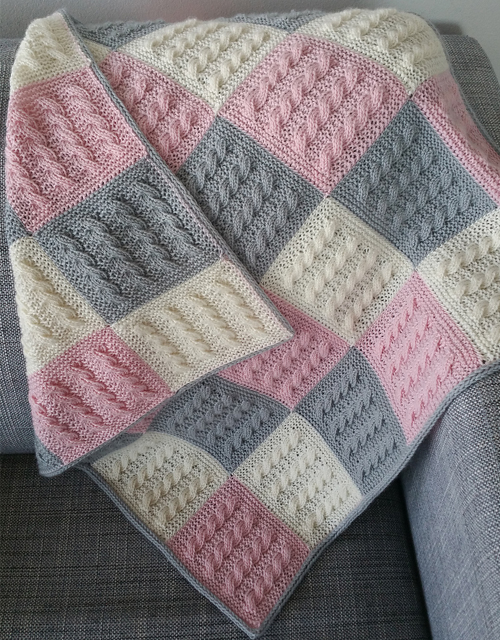
Cable Square Blanket - Knitting Pattern Guide

Cable Square Blanked - Knitting Pattern
Photo above © Audurbjort 

Cable Square Blanket by Auður Björt Skúladóttir is a striking modular knitted blanket built from colorful cable squares with an unusual feature: the cable designs are intended to look attractive from both sides.

Originally listed under the Icelandic name Kaðlabútateppi and the English title Cable Square Blanked, the project combines reversible cable knitting, multiple colors and modular blanket construction.

Pattern Availability Note

This design is still listed among Auður Björt Skúladóttir's patterns, but we could not verify a current legitimate free download for the original pattern. For that reason, Amazing Knitting does not describe it as a free pattern or link to unauthorized archived copies.

Cable Square Blanket at a Glance

Original Name: Kaðlabútateppi / Cable Square Blanked

Designer: Auður Björt Skúladóttir

Craft: Knitting

Category: Blanket / Throw

Construction: Knitted cable squares joined into a blanket

Special Feature: Reversible cable designs

Color: Designed to work beautifully with multiple colors

Finishing: I-cord edging/bind-off is associated with the designer's blanket workshop

Current Pattern Status: Original design verified; free availability not verified

About the Cable Square Blanket

Cable Square Blanket is a modular knitting project by Icelandic designer Auður Björt Skúladóttir.

Instead of knitting one very large blanket from edge to edge, the project is based around individual knitted squares. Each square provides an opportunity to work cable textures while different yarn colors add variety across the finished blanket.

The result is particularly effective because the strong cable textures and changing colors give every section its own identity while the repeated square format holds the complete design together.

The Original Icelandic Name

The pattern appears in the designer's catalog as:

Kaðlabútateppi / cable square blanked

You may therefore encounter both this original listing and the more natural English description Cable Square Blanket when searching for the project.

Amazing Knitting uses “Cable Square Blanket” in this guide because it clearly describes the project for English-speaking knitters, while retaining the original pattern name above for identification.

Reversible Cable Knitting

One of the most interesting aspects of this project is the use of reversible cables.

Traditional cable knitting often has a very obvious right side and a much less decorative reverse side. Auður Björt Skúladóttir has a particular interest in designing knitted pieces that remain attractive when viewed from either side.

This characteristic is especially useful for blankets, scarves and shawls because both surfaces are likely to remain visible during normal use.

Why Reversible Cables Work Well for Blankets

A blanket is rarely displayed with only one side visible.

It may be folded over a chair, wrapped around someone or turned in different directions. A reversible texture therefore makes practical as well as decorative sense.

In this design, the cable structure becomes part of the appearance of both sides rather than leaving the reverse as something that always needs to be hidden.

Modular Square Construction

Working a blanket as separate squares has several practical advantages.

Individual blocks are easier to carry than an entire growing blanket, making modular knitting convenient for travel or short knitting sessions.

It also allows you to experiment with different colors without carrying all of the blanket's yarn at once.

The squares are eventually arranged and joined to create the complete throw.

Playing With Color

The original project is especially attractive when worked in several colors.

You might choose a coordinated palette of related shades, use contrasting colors for a more graphic effect, or build the blanket gradually from suitable yarn in your stash.

When planning a multi-color blanket, laying the finished squares on the floor before joining them can help distribute light, dark and dominant colors more evenly.

I-Cord Finishing

Auður Björt Skúladóttir has taught this particular Cable Square Blanket as a workshop project.

In that workshop, knitters first explored reversible cable techniques and then worked on assembling and finishing the blanket with an I-cord bind off.

An I-cord finish can give a modular blanket a clean outer edge and help visually unite the individual blocks.

Needles

A Reykjavík knitting workshop taught by the designer for this blanket asked participants to bring:

4 mm / US 6 circular needles, 60–80 cm / 24–32 inches

This is useful historical information about how the project has been taught, but always follow the specifications in any current copy of the designer's pattern rather than assuming workshop materials necessarily replace the pattern's complete requirements.

Skill Level

A Reykjavík Knitting Festival class devoted to this blanket was classified as Advanced.

That does not necessarily mean every individual square will feel equally difficult, but knitters should be comfortable managing cable techniques and following textured stitch patterns.

Skills That Help

Useful skills for a project of this type include:

  • Casting on and binding off
  • Knitting and purling confidently
  • Working cable stitches
  • Understanding cable crossings
  • Following repeating stitch patterns
  • Working reversible textures
  • Maintaining consistent gauge between squares
  • Joining knitted blocks
  • Working an I-cord edge or bind-off
  • Blocking individual squares

Keeping the Squares Consistent

Gauge deserves particular attention in a modular blanket.

If one square is noticeably larger than the others, joining the blocks neatly becomes much more difficult.

Try to use yarns with compatible weights and characteristics, and check the dimensions of your first completed squares before producing a large number of blocks.

Blocking Before Assembly

Blocking the squares before final assembly can make joining considerably easier.

It allows you to bring the blocks to consistent dimensions and straighten their edges before arranging the final blanket.

Follow the care instructions appropriate for your yarn and avoid overstretching the cable texture.

Planning the Final Layout

One of the enjoyable stages of a modular blanket is arranging the finished squares.

Before joining anything permanently, place the blocks together and try several layouts. Pay attention to color balance as well as the direction and visual weight of the cable motifs.

Taking a quick photograph of each possible arrangement can make the alternatives easier to compare.

Is the Original Cable Square Blanket Pattern Free?

We could verify that Kaðlabútateppi / Cable Square Blanked is an original design by Auður Björt Skúladóttir and remains associated with her pattern catalog.

However, we could not verify a current legitimate free download for the complete original pattern.

For that reason, Amazing Knitting does not label this project as a free pattern and does not reproduce or link to unauthorized copies of the designer's instructions.

Find the Original Designer

The safest place to check the current status of the original design is Auður Björt Skúladóttir's Ravelry designer catalog.

View Auður Björt Skúladóttir's Designs →

Looking for a Free Alternative?

If you mainly like the idea of building a blanket from knitted squares, you do not need to rely on an unauthorized copy of the original pattern.

Amazing Knitting has many free blanket and cable-knitting projects in the archive that you can explore instead.

Explore Free Knitted Blanket Squares →

You can also browse free cable blankets, knitted square blankets, and free blanket knitting patterns.

Before You Start

If you obtain the original pattern legitimately, read through the designer's instructions before selecting yarn or beginning a large number of squares.

Make one test square first. Check its dimensions, cable definition and appearance from both sides before committing yarn to the complete blanket.

Pattern credit: Kaðlabútateppi / Cable Square Blanked was designed by Auður Björt Skúladóttir. The existing photograph on this Amazing Knitting page is credited to Audurbjort. Amazing Knitting does not reproduce the designer's copyrighted charts or row-by-row knitting instructions.

Cable Snooze - Free Pattern

Cable Snooze - Free Pattern
Photo above © DROPS design

Cable Snooze / DROPS Baby 33-7 is a cozy knitted baby sleeping bag by DROPS Design, combining delicate lace, double moss stitch and a practical hood.

Designed in soft merino yarn, the pattern includes sizes from premature babies through 2 years. Best of all, the complete Cable Snooze knitting pattern is still available free directly from DROPS Design.

✓ Free Pattern Availability

Cable Snooze remains available as a free official DROPS knitting pattern. This page has also been updated to correct an older size reference: the official pattern currently includes sizes from premature through 2 years.

Cable Snooze at a Glance

Pattern: Cable Snooze / DROPS Baby 33-7

Designer: DROPS Design

First Published: November 2018

Craft: Knitting

Category: Baby Sleeping / Bunting Bag

Sizes: Premature to 2 years

Suggested Yarn: DROPS Merino Extra Fine

Yarn Weight: DK / Yarn Group B

Needle: US 6 / 4 mm circular needle

Gauge: 21 stitches × 28 rows = 4 inches / 10 cm in stockinette

Main Features: Lace, double moss stitch, hood and button fastening

Current Availability: Free official pattern

About the Cable Snooze Baby Bag

Cable Snooze is more than a simple knitted blanket. DROPS designed it as a shaped baby sleeping or bunting bag with a hood and button fastening.

The combination of lace and textured double moss stitch gives the piece considerably more visual interest than a plain stockinette baby cocoon, while the hood completes the cozy wrapped appearance.

The design is unisex, so changing the yarn colour can easily give the finished project a completely different look.

Sizes from Premature to 2 Years

The current official DROPS pattern includes six sizes:

  • Premature — approximate height 40/44 cm
  • 0–1 month — approximate height 48/52 cm
  • 1–3 months — approximate height 56/62 cm
  • 6–9 months — approximate height 68/74 cm
  • 12–18 months — approximate height 80/86 cm
  • 2 years — approximate height 92 cm

Older references to this pattern sometimes describe the size range differently. For your project, always use the measurements and sizing information in the current DROPS pattern.

DROPS Merino Extra Fine

Cable Snooze was designed using DROPS Merino Extra Fine, a DK-weight merino yarn in DROPS Yarn Group B.

The official yarn quantities are:

  • Premature: 350 g
  • 0–1 month: 400 g
  • 1–3 months: 450 g
  • 6–9 months: 500 g
  • 12–18 months: 600 g
  • 2 years: 650 g

The original sample is shown in a soft light grey-green shade.

If substituting another yarn, choose one capable of producing the required gauge and a comfortable fabric suitable for a baby garment.

Needles and Gauge

DROPS specifies an:

US 6 / 4 mm circular needle, approximately 80 cm long

The published stockinette gauge is:

21 stitches × 28 rows = 4 inches / 10 cm

The recommended needle size is only a starting point. Use the needle size necessary for you to obtain the designer's gauge.

Lace and Double Moss Stitch

One of the most attractive features of Cable Snooze is the combination of two different surface textures.

The lace sections create decorative openwork, while double moss stitch provides a denser textured contrast.

Together they prevent the large knitted surface from appearing flat while still allowing the design to remain soft and suitable for a baby project.

The Hood

Cable Snooze includes an integrated knitted hood that gives the project its distinctive cozy appearance.

This also makes the construction more interesting than knitting a simple rectangular blanket or sleep sack.

Follow the current DROPS instructions and diagrams for the exact hood shaping and assembly.

Button Fastening

Buttons are another important design feature.

The number required varies with size:

  • Premature: 8 buttons
  • 0–1 month: 9 buttons
  • 1–3 months: 10 buttons
  • 6–9 months: 11 buttons
  • 12–18 months: 12 buttons
  • 2 years: 12 buttons

DROPS used its Oak No. 503 wooden buttons for the original project. If substituting buttons, check the current pattern for the appropriate size and placement.

How Cable Snooze Is Constructed

The pattern is worked primarily back and forth rather than in the round.

It combines several pattern sections, button bands and shaping before the finished pieces are assembled into the sleeping-bag form.

Ravelry classifies the pattern as worked flat and seamed, with features including lace, eyelets, a hood, buttonholes and textured stitches.

Use the original DROPS instructions for the exact stitch counts, diagrams, shaping and assembly sequence.

Charts and Written Instructions

DROPS provides diagrams for the decorative stitch patterns together with written explanations for the construction.

Before beginning, familiarize yourself with the relevant chart for your chosen size because different sizes use different diagram combinations.

Amazing Knitting does not reproduce the DROPS charts or row-by-row instructions. The complete current pattern is available free from the official source.

Skills That Help

Useful skills for Cable Snooze include:

  • Casting on and binding off
  • Knit and purl stitches
  • Working double moss stitch
  • Working yarn overs and lace decreases
  • Reading knitting charts
  • Making buttonholes
  • Working garment shaping
  • Picking up stitches
  • Basic seaming
  • Attaching buttons securely

Choosing Yarn for a Baby Project

When substituting yarn for a baby item, consider more than colour.

The yarn should produce the correct gauge and a fabric that feels soft and comfortable. Washing requirements are also important for an item likely to need frequent cleaning.

A smooth solid or gently heathered yarn can be especially effective here because it allows both the lace and moss-stitch textures to remain clearly visible.

Important Baby Safety Note

This is a wearable baby bunting or sleeping-bag style knitting project, not a substitute for current safe-sleep guidance or approved infant sleep products.

Always supervise appropriately, make sure buttons and other fastenings are attached securely, and follow current child-safety recommendations for the age and situation in which the finished item will be used.

Is Cable Snooze Still Free?

Yes. Cable Snooze / DROPS Baby 33-7 remains available as a completely free knitting pattern directly from DROPS Design.

The official DROPS page includes the current instructions, diagrams, measurements and pattern tools.

Amazing Knitting does not reproduce the copyrighted charts or complete row-by-row instructions. Instead, this guide provides project information and directs knitters to the legitimate original pattern.

Get the Free Cable Snooze Pattern

The complete current pattern is available directly from DROPS Design.

Get the Free Cable Snooze Pattern →

More Free Baby Knitting Patterns

If you enjoy Cable Snooze, explore more free baby projects from the Amazing Knitting archive.

Explore Free Baby Knitting Patterns →

You can also browse free baby blankets, free baby cardigans, and DROPS baby patterns.

Before You Start

Open the current DROPS pattern first and select the correct size before buying yarn. Check the yarn quantity, number of buttons and diagrams required for that particular size.

Make a gauge swatch in your chosen yarn before beginning. Since this is a shaped baby project rather than a simple blanket, correct gauge is important for achieving the intended finished measurements.

Pattern credit: Cable Snooze / DROPS Baby 33-7 was designed and published by DROPS Design. The existing photograph on this Amazing Knitting page is credited to DROPS Design. Amazing Knitting does not reproduce DROPS Design's charts or complete row-by-row knitting instructions.

Autumn Leaves - Free Pattern

Autumn Leaves - Free Pattern
Photo above © figandplum 

Autumn Leaves by Nikki Van De Car is a charming top-down baby cardigan featuring a beautiful leaf-lace yoke that spreads gracefully across the shoulders.

Designed in three baby sizes, Autumn Leaves combines an eye-catching decorative yoke with a practical cardigan construction. Despite the impressive appearance of the leaf pattern, the designer describes the knitting as intuitive once the repeating structure becomes familiar. Best of all, the original pattern is still available free from the designer.

✓ Free Pattern Availability

Good news: Autumn Leaves by Nikki Van De Car is still available as a free knitting pattern. The designer currently provides the pattern on her own pattern page, making that the preferred source for the current instructions.

Autumn Leaves Cardigan at a Glance

Pattern: Autumn Leaves

Designer: Nikki Van De Car

First Published: October 2008

Craft: Knitting

Category: Baby Cardigan

Sizes: 6–9, 9–12 and 12–15 months

Construction: Top-down, one-piece cardigan

Feature: Leaf-lace circular yoke

Yarn: DK or worsted weight, depending on size

Needles: US 5, US 7 or US 9, depending on size

Notions: 4 stitch markers, tapestry needle and 3 buttons

Current Availability: Free pattern

About the Autumn Leaves Baby Cardigan

The defining feature of Autumn Leaves is its decorative leaf-lace yoke.

The leaves spread around the upper cardigan and create much of the garment's visual interest before the knitting transitions into the simpler body and sleeves.

This balance makes the cardigan particularly appealing: there is enough lace to make the project special without covering the entire garment in a complicated stitch pattern.

Three Baby Sizes

Autumn Leaves includes three sizes:

  • 6–9 months
  • 9–12 months
  • 12–15 months

An important detail is that the designer changes yarn weight, needle size and gauge between the sizes. Do not assume that all three sizes use exactly the same materials.

Yarn Requirements

Nikki Van De Car currently gives the following approximate yarn requirements:

  • 6–9 months: approximately 200 yards
  • 9–12 months: approximately 250 yards
  • 12–15 months: approximately 300 yards

DK yarn is specified for the smaller size, while the designer allows DK or worsted for the middle size depending on the desired fabric. The largest size uses worsted-weight yarn.

Always check the current designer pattern before purchasing yarn because matching the appropriate gauge for your chosen size is essential.

Needle Sizes

Needle size also changes with the cardigan size:

  • 6–9 months: US 5 / 3.75 mm
  • 9–12 months: US 7 / 4.5 mm
  • 12–15 months: US 9 / 5.5 mm

The original materials list calls for a circular needle. The cardigan is worked flat; the circular needle provides a convenient way to hold the increasing number of stitches across the yoke and body.

Gauge by Size

The published gauges are:

  • US 5: 24.5 stitches × 32.5 rows = 4 inches / 10 cm
  • US 7: 18 stitches × 29 rows = 4 inches / 10 cm
  • US 9: 15.5 stitches × 23 rows = 4 inches / 10 cm

This size-specific gauge information is particularly important. Select your intended size first, then swatch with the appropriate yarn and needle combination.

The Leaf-Lace Yoke

The yoke is what gives Autumn Leaves its recognizable appearance.

Lace increases form the expanding leaf motifs as the cardigan grows outward from the neckline. The decorative shaping and garment shaping therefore work together rather than existing as separate features.

Once blocked, the open sections help define the leaves and allow the pattern to spread naturally across the baby's shoulders.

Top-Down Construction

Autumn Leaves is a top-down, one-piece cardigan.

Beginning at the neckline allows the decorative yoke to be established first. The garment then develops downward into the body and sleeves.

One-piece construction also reduces the amount of traditional garment assembly compared with sweaters knitted as separate front, back and sleeve pieces.

Seed Stitch Edging

Seed stitch provides a neat textured contrast to the open leaf lace.

Because seed stitch alternates knit and purl stitches, it creates a compact textured surface that helps frame the cardigan while allowing the lace yoke to remain the main decorative feature.

Buttons and Other Materials

In addition to yarn and needles, the designer lists:

  • 3 buttons
  • 4 stitch markers
  • A tapestry needle

Stitch markers are especially useful around a patterned yoke because they help separate important sections and make it easier to identify an error before it travels through several rows.

Written Instructions and Chart

Autumn Leaves has both written pattern information and a chart available for the decorative section.

If you are new to lace charts, comparing the chart with the written directions can be a useful way to learn how the symbols correspond to actual stitches.

Amazing Knitting does not reproduce the designer's chart or row-by-row instructions. Use Nikki Van De Car's current pattern page for the exact stitch sequence and shaping.

Skills That Help

Useful skills for Autumn Leaves include:

  • Casting on
  • Knit and purl stitches
  • Seed stitch
  • Yarn overs
  • Basic lace decreases
  • Following written lace instructions
  • Reading a knitting chart
  • Using stitch markers
  • Working buttonholes
  • Working a top-down garment
  • Binding off
  • Blocking lace

Why Blocking Matters

Lace often looks much less impressive immediately after it comes off the needles.

Gentle blocking helps the leaf motifs open and allows the shape of the yoke to become clearer.

Always follow the washing and blocking recommendations appropriate for the yarn you choose, especially for a baby garment.

Choosing a Colour

The leaf motif makes Autumn Leaves a natural candidate for warm seasonal colours such as rust, mustard, moss, burgundy or soft brown.

But the design does not need to look autumnal. Cream, pale pink, blue, lavender or soft green can turn the same pattern into a cardigan suitable for any season.

A solid or gently heathered yarn will generally make the lace leaves easier to see than a highly contrasting variegated yarn.

Is Autumn Leaves Still Free?

Yes. Autumn Leaves by Nikki Van De Car is currently available as a free knitting pattern.

The designer maintains a current online version of the pattern, and Ravelry also continues to list Autumn Leaves as free.

Amazing Knitting provides this project guide and directs readers to the legitimate original source rather than reproducing the designer's copyrighted pattern instructions.

Get the Free Autumn Leaves Pattern

The best current source is Nikki Van De Car's own Autumn Leaves pattern page.

Get the Free Autumn Leaves Pattern →

More Free Baby Cardigans

If you enjoy leaf yokes and small top-down garments, continue exploring the Amazing Knitting archive for more free baby sweater patterns.

Explore Free Baby Cardigan Patterns →

You can also browse leaf-lace baby sweaters, top-down baby cardigans, and free baby knitting patterns.

Before You Start

Decide which of the three sizes you are making before buying yarn because the recommended yarn weight, needle size and gauge change between sizes.

Make a gauge swatch, prepare your stitch markers and read through the leaf-yoke section before casting on. If lace charts are unfamiliar, keep the written directions nearby while learning the pattern.

Pattern credit: Autumn Leaves was designed by Nikki Van De Car and published in connection with What To Knit When You're Expecting. The existing photograph on this Amazing Knitting page is credited to figandplum. Amazing Knitting does not reproduce the designer's copyrighted chart or row-by-row knitting instructions.

Morning Surf Scarf - Free Pattern

Morning Surf Scarf - Free Pattern
 Photo above © BohoBerry 

Morning Surf Scarf by Jackie Erickson-Schweitzer is a wonderfully adaptable knitted scarf featuring soft, undulating openwork inspired by waves moving across the sea.

The design uses dropped yarnovers to create long, flowing stitches and an airy lace-like fabric. It is particularly attractive in variegated and handspun yarns, but one of the great advantages of Morning Surf is its flexibility: the pattern can be adapted to many different yarn weights and scarf widths.

✓ Free Pattern Availability

Good news: Morning Surf Scarf is still available as a free knitting pattern. The pattern is associated with Jackie Erickson-Schweitzer and HeartStrings FiberArts and has also been published by Spin-Off / Interweave.

Morning Surf Scarf at a Glance

Pattern: Morning Surf Scarf

Designer: Jackie Erickson-Schweitzer

Original Publication: January 1998

Craft: Knitting

Category: Scarf

Yarn Weight: Adaptable to different yarn weights

Gauge: Flexible — choose a needle that produces good drape

Width: Adjustable in 10-stitch increments

Notable Technique: Dropped yarnovers

Construction: Worked flat

Current Availability: Free pattern

About the Morning Surf Scarf

Morning Surf is a scarf where the yarn can become just as important as the stitch pattern.

Instead of dense cables or complicated colourwork, the design creates long open stitches that move gently across the fabric. The result has a wave-like appearance that works especially well with yarns containing several colours or subtle changes in texture.

This makes Morning Surf an interesting choice for a special skein of hand-dyed or handspun yarn that you want to showcase rather than hide inside a very complicated stitch pattern.

The Story Behind Morning Surf

The scarf has an especially fitting origin.

Designer Jackie Erickson-Schweitzer was inspired by a morning walk along the beach while attending a spinning event in Florida. The colours and movement of the water influenced both her choice of fibre and the undulating stitch sequence that eventually became Morning Surf.

The original scarf was created to showcase handspun yarn whose variations in colour and texture became part of the character of the finished piece.

A Pattern Designed for Different Yarns

One of the most useful characteristics of Morning Surf is that it was not designed around one rigid yarn specification.

The pattern can be adapted to a wide range of yarn sizes. Rather than insisting on one yarn weight and one needle size, the designer provides guidance for selecting needles that create a fabric with attractive drape without becoming excessively loose.

This makes Morning Surf particularly useful for:

  • Handspun yarn
  • Variegated yarn
  • Hand-dyed yarn
  • Special single skeins
  • Stash yarn
  • Experimenting with different yarn weights

Adjusting the Width

The scarf width is also easy to customize.

The cast-on can be increased or decreased in increments of 10 stitches, allowing you to make a narrower scarf or a broader wrap-like version.

Remember that increasing the width also increases yarn consumption, so allow extra yardage if you plan to make a substantially wider or longer scarf.

The Dropped-Yarnover Effect

Morning Surf gets much of its distinctive appearance from dropped yarnovers.

Yarnovers create additional loops while knitting. In this design, selected loops are later released in a controlled way, allowing the surrounding stitches to lengthen and form the characteristic open, wave-like sections.

Although the finished fabric looks unusual, the underlying concept is approachable once you understand what is supposed to happen to the extra loops.

This is one of those techniques where a small practice swatch can make the full project much easier to understand.

Why Variegated Yarn Works So Well

Highly variegated yarn can sometimes hide elaborate textured stitches. Morning Surf takes almost the opposite approach.

The elongated stitches create enough visual space for changing colours to remain visible, while the repeating waves add movement without competing heavily with the yarn.

For this reason, the pattern can be particularly effective when you have a colourful skein that looks beautiful by itself but seems difficult to match with a conventional stitch pattern.

Needle Choice

Because Morning Surf is designed for different yarn weights, there is no single needle size that every knitter must use.

The goal is to choose a needle that produces a draping fabric without becoming sloppy.

Make a small swatch first. If the fabric feels stiff, try a larger needle. If the elongated stitches look excessively loose or unstable, try a smaller needle.

Straight or Circular Needles?

The designer specifically recommends straight needles for this project.

Circular needles can technically be used for flat knitting, but the multiple yarnovers used in Morning Surf may be less convenient to slide from the flexible cable back onto the needle tip.

If you normally prefer circular needles, this is worth considering before beginning the project.

Skills That Help

Useful skills for Morning Surf include:

  • Casting on
  • Knit stitches
  • Purl stitches
  • Working yarnovers
  • Handling multiple yarnovers
  • Dropping designated loops intentionally
  • Following a repeating stitch sequence
  • Binding off
  • Blocking a knitted scarf

Use Jackie Erickson-Schweitzer's original pattern for the exact stitch sequence and row-by-row instructions.

A Good Handspun Yarn Project

Morning Surf has a particularly strong connection with handspinning. The original scarf was designed specifically to showcase the character of handspun fibre.

Handspun yarn does not always have the absolute uniformity of commercially produced yarn, but in a design like this those variations can become part of the visual effect rather than something that needs to be hidden.

The pattern later appeared in Spin-Off, making that relationship with spinning even more appropriate.

Blocking Morning Surf

Blocking helps the elongated stitches settle into position and allows the wave-like structure to become more visible.

Follow the washing instructions appropriate for your chosen fibre, especially when working with handspun or unusual blends.

Shape the damp scarf gently and allow it to dry completely before removing it from the blocking surface.

Is Morning Surf Scarf Still Free?

Yes. Morning Surf Scarf by Jackie Erickson-Schweitzer is still listed as a free knitting pattern.

The pattern has a long history, having first appeared in the late 1990s and later being published in Spin-Off.

Amazing Knitting does not reproduce the designer's copyrighted row-by-row instructions. Instead, we provide project information and direct knitters to the legitimate pattern listing.

Get the Free Morning Surf Scarf Pattern

Ravelry currently lists Morning Surf Scarf as a free pattern and provides the pattern information and source details.

Get the Free Morning Surf Scarf Pattern →

More Free Knitted Scarves

If you enjoy adaptable scarf projects, continue exploring the Amazing Knitting archive for more free patterns and stitch ideas.

Explore Free Scarf Knitting Patterns →

You can also browse lace scarf patterns, handspun knitting projects, and projects for variegated yarn.

Before You Start

Choose the yarn you would like to showcase and make a small swatch before deciding on your final needle size and scarf width.

Pay particular attention to the dropped-yarnover technique. Once you understand how the elongated stitches are created, the repeating pattern becomes much easier to recognize as you knit.

Pattern credit: Morning Surf Scarf was designed by Jackie Erickson-Schweitzer of HeartStrings FiberArts. The existing photograph on this Amazing Knitting page is credited to BohoBerry. Amazing Knitting does not reproduce the designer's copyrighted row-by-row knitting instructions.

Shivaree Throw - Free Pattern

Shivaree Throw - Free Pattern
Photo above © sonomahead

Shivaree Throw by the Berroco Design Team is a richly textured knitted blanket featuring dramatic braided cables surrounded by classic double seed stitch.

Designed in Berroco Ultra Alpaca, the combination of cables and textured background gives this throw a timeless, substantial appearance. Best of all, the original Shivaree Throw knitting pattern is still available free directly from Berroco.

✓ Free Pattern Availability

Good news: Shivaree Throw is still available as a free knitting pattern from Berroco. We have updated this guide to direct readers to the current official Berroco pattern page rather than relying on older third-party links.

Shivaree Throw at a Glance

Pattern: Shivaree Throw

Designer: Berroco Design Team

Craft: Knitting

Project Type: Throw / Home

Skill Level: Intermediate

Finished Size: Approximately 48 × 60 inches

Suggested Yarn: Berroco Ultra Alpaca

Yarn Required: 13 hanks

Main Needle: US 8 / 5 mm circular needle

Notions: Cable needle

Main Textures: Braided cables and double seed stitch

Current Availability: Free official Berroco pattern

About the Shivaree Throw

Shivaree is a generously sized knitted throw built around a repeating combination of braided cables and double seed stitch.

The cables create strong vertical lines across the blanket, while the surrounding textured stitch provides contrast and helps the cable motifs stand out.

Unlike a blanket assembled from individual squares, Shivaree is worked as one large piece. This creates a continuous pattern across the entire throw and avoids the need to join multiple knitted blocks afterward.

Finished Size

Berroco gives the finished dimensions as approximately:

48 inches wide × 60 inches long

That makes Shivaree large enough to work as a substantial sofa throw or an extra layer for a bed or reading chair.

Berroco Ultra Alpaca

The original design uses Berroco Ultra Alpaca.

The official pattern calls for:

13 hanks of Berroco Ultra Alpaca

The photographed Berroco version was made in the colour Sweet Potato #6229.

If you substitute another yarn, matching the original gauge and creating a fabric with good cable definition are more important than simply choosing a similar colour.

Needles and Equipment

Berroco specifies a:

29-inch US 8 / 5 mm circular knitting needle

The circular needle is used to comfortably hold the large number of stitches in the blanket; the throw itself is worked flat rather than joined in the round.

You will also need a cable needle for the braided cable pattern.

Gauge

Because Shivaree combines two different textures, Berroco provides gauge information for both.

For the double seed stitch section:

20 stitches × 28 rows = 4 inches

For the cable pattern:

13 stitches = 2 inches and 28 rows = 4 inches

These measurements are based on the US 8 / 5 mm needle.

Berroco specifically recommends checking gauge before beginning. With a project this large, even a modest gauge difference can affect both the finished dimensions and the amount of yarn required.

Braided Cable Design

The cables are the visual centerpiece of Shivaree.

Rather than using a single simple rope cable, the pattern creates a more elaborate braided effect through a repeating cable sequence.

Each cable section is worked over 13 stitches, with the cable pattern repeating over eight rows.

The official Berroco pattern provides the complete cable instructions and stitch glossary, including the required front- and back-crossing techniques.

Double Seed Stitch Texture

Between the braided cables is a textured stitch pattern that Berroco identifies as Double Seed Stitch.

This creates a small-scale knit-and-purl texture that contrasts nicely with the larger flowing cable motifs.

The combination is particularly effective because the quieter background texture allows the braided cables to remain the dominant feature.

How the Throw Is Constructed

Shivaree is worked flat on a circular needle.

The pattern begins with a large cast-on and establishes alternating sections of double seed stitch and cable motifs across the row.

Once the stitch patterns are established, the knitter continues the repeating textures until the piece reaches the required length.

Use Berroco's original pattern for the exact cast-on count, cable crossings, stitch sequence and row-by-row instructions.

Why Use a Circular Needle for a Flat Blanket?

A circular needle does not necessarily mean a project is knitted in the round.

Large blankets can contain hundreds of stitches, making conventional straight needles uncomfortable or impractical. A circular needle allows the flexible cable between the needle tips to support much of the weight of the project.

You simply turn the work at the end of each row and knit back and forth as you would with straight needles.

Skill Level

Berroco classifies Shivaree as an Intermediate knitting pattern.

Useful skills include:

  • Casting on a large number of stitches
  • Knitting and purling
  • Following repeating stitch patterns
  • Working with a cable needle
  • Crossing cable stitches to the front and back
  • Maintaining several pattern sections across a long row
  • Checking gauge
  • Binding off evenly
  • Blocking a large knitted project

A Good Project for Learning Cable Rhythm

Although Shivaree is not a small project, repeating cable designs can become easier to follow once their rhythm becomes familiar.

Stitch markers placed between major pattern sections may also help you notice mistakes earlier instead of discovering them several rows later.

If you are relatively new to cables, consider practicing the cable motif with spare yarn before casting on the full blanket.

Choosing a Substitute Yarn

When substituting yarn for a cable blanket, look beyond yarn weight alone.

A yarn with good stitch definition can make the braided structure easier to see. Very fuzzy yarns may soften the appearance of the cables, while a smoother yarn can emphasize every crossing.

Also consider durability, warmth and washing requirements. A throw may receive considerably more everyday use than a decorative shawl or occasional garment.

Is Shivaree Throw Still Free?

Yes. Shivaree Throw remains available as a free knitting pattern directly from Berroco.

This is the best source to use because it comes from the company and design team responsible for the original pattern.

Amazing Knitting does not reproduce Berroco's copyrighted row-by-row pattern instructions. Instead, we provide project information and direct knitters to the legitimate original source.

Get the Free Shivaree Throw Pattern

Berroco currently provides the complete free pattern on its official website.

Get the Free Shivaree Throw Pattern →

More Free Knitted Blankets

If you enjoy textured throws and cable knitting, continue exploring the Amazing Knitting archive for more free blanket patterns.

Explore Free Blanket Knitting Patterns →

You can also browse cable knit blankets, free knitted throws, and seed stitch blankets.

Before You Start

Download or open the current Berroco pattern first, then make a gauge swatch that includes the relevant textured stitches.

Because this is a large project using 13 hanks in the original version, make sure you have enough yarn before casting on. If possible, purchase the yarn for the complete blanket at the same time to reduce the chance of noticeable dye-lot differences.

Pattern credit: Shivaree Throw was designed by the Berroco Design Team. The existing project photograph on this Amazing Knitting page is credited to sonomahead. The knitting pattern remains the property of its respective rights holder. Amazing Knitting does not reproduce Berroco's copyrighted row-by-row instructions.

Discover More From the Archive

A fresh mix of knitting patterns and tutorials from the Amazing Knitting archive.

Finding patterns from the archive…