Skip to content

...

Showing posts sorted by date for query free children knitting pattern. Sort by relevance Show all posts

8 Free Animal Sweater Knitting Patterns for Kids & Babies

8 Free Animal Sweater Knitting Patterns for Kids & Babies

If you love playful colorwork and children's knitting, this collection of 8 free animal sweater knitting patterns is full of charming ideas for babies and kids.

From sheep and penguins to foxes, horses, bunnies and colorful pond creatures, these patterns turn a simple sweater or cardigan into something memorable.

Every project below links first to its corresponding Amazing Knitting pattern guide, where you can check the designer, yarn, sizing and current legitimate pattern source before starting.

8 Free Animal Sweater Knitting Patterns for Kids & Babies

1. Pondemonium Baby Sweater

Pondemonium by Jennifer Small is one of the most playful animal sweaters in the Amazing Knitting archive.

Instead of featuring just one animal, the Fair Isle design creates an entire pond scene filled with ducks, frogs, bugs and snakes, together with rows of lily pads.

The pattern includes baby and toddler sizes and is worked with stranded colorwork, making it a wonderful project for knitters who enjoy detailed picture knitting.

Best for: Colorwork lovers, baby gifts and whimsical animal-themed sweaters.

See the Free Pondemonium Baby Sweater Pattern →


2. Skating Penguin Pullover

Skating Penguin Pullover by Amy Bahrt features a large penguin motif on the front of a classic children's sweater.

The cleverest detail is that the penguin also hides a functional pocket, turning the decorative picture into part of the garment itself.

The pattern includes sizes 2, 4 and 6 years and uses worsted-weight yarn with intarsia colorwork.

Best for: Penguin lovers, picture knitting and unusual children's gifts.

See the Free Penguin Pullover Pattern →


3. Sheep Yoke Baby Cardigan

Sheep Yoke Baby Cardigan by Jennifer Little combines a traditional circular-yoke look with a playful flock of tiny sheep.

The sheep form the decorative focus around the upper part of the cardigan, while the lower body remains simple enough to keep the design balanced.

The free pattern includes two baby sizes and uses DK-weight yarn.

Best for: Baby colorwork, sheep lovers and traditional yoke-style knitting.

See the Free Sheep Yoke Baby Cardigan Pattern →


4. Lamb Dance Kids Jacket

Lamb Dance by DROPS Design is a children's cardigan featuring a cheerful row of sheep around a circular colorwork yoke.

The jacket is worked from the top down and includes five sizes covering approximately ages 3 through 12 years.

Because the body below the yoke is relatively simple, the sheep remain the clear visual focus of the finished cardigan.

Best for: Older children, Scandinavian-style colorwork and knitters who enjoy top-down construction.

See the Free Lamb Dance Kids Jacket Pattern →


5. Child's Foxy Tunic

Child's Foxy Tunic by Heather Lodinsky turns a knitted tunic into a bold fox-themed garment.

A large fox face dominates the upper front, with colorwork creating the main shape and separate knitted details completing the ears and nose.

The pattern includes sizes 2, 4, 6 and 8 years and uses DK-weight yarn.

Best for: Fox lovers, statement knits and intermediate picture-colorwork projects.

See the Free Child's Foxy Tunic Pattern →


6. All the King's Horses Toddler Jumper

All the King's Horses is a charming vintage-style toddler jumper with a decorative horse motif worked across the front.

The design uses classic flat sweater construction with separate front, back and sleeves, while the animal section provides the colorful focal point.

The current free pattern includes the complete horse motif together with the garment instructions.

Best for: Horse lovers, vintage knitting and traditional picture sweaters.

See the Free All the King's Horses Jumper Pattern →


7. Ba-Ba Toddler's Sweater

Ba-Ba Toddler's Sweater is another vintage children's jumper with playful animal-inspired colorwork.

The pattern uses dark and light wool with small contrasting details to build the motif, while the neckline is finished with a classic K2, P2 rib.

The free instructions include the front, back, sleeves and finishing details.

Best for: Vintage-style kids' knitting, animal colorwork and classic toddler sweaters.

See the Free Ba-Ba Toddler Sweater Pattern →


8. Adorable Bunny Motif Kids' Sweater

This Bunny Motif Kids' Sweater uses repeating rabbit shapes to create an all-over stranded-colorwork design.

Instead of placing one large animal on the front, the pattern creates a tessellated field of bunnies across the fabric.

The classic crewneck shape and ribbed cuffs, hem and neckline keep the garment simple enough for the repeating animal motif to become the main attraction.

Best for: Bunny lovers, repeating Fair Isle motifs and high-contrast color combinations.

See the Free Bunny Motif Kids' Sweater Pattern →

Which Animal Sweater Should You Knit First?

  • For the most colorful design: Pondemonium
  • For penguin fans: Skating Penguin Pullover
  • For a baby gift: Sheep Yoke Baby Cardigan
  • For older children: Lamb Dance Kids Jacket
  • For a bold picture motif: Child's Foxy Tunic
  • For horse lovers: All the King's Horses
  • For vintage animal style: Ba-Ba Toddler's Sweater
  • For repeating Fair Isle: Bunny Motif Kids' Sweater

Why Animal Sweaters Are So Much Fun to Knit

Animal motifs give children's knitwear personality without changing the basic purpose of the garment.

Depending on the pattern, the animal can be created with stranded colorwork, intarsia, duplicate stitch or separate knitted details.

That makes this collection useful for knitters who want to practice decorative techniques while still producing a practical sweater, cardigan or tunic.

Choosing Yarn for Children's Animal Sweaters

Smooth yarns usually show animal motifs more clearly than very fuzzy yarns, especially when the pattern relies on picture knitting or stranded colorwork.

For children's garments, also consider softness, washability and durability. Always match the original pattern gauge when substituting yarn, since the dimensions of the animal motif and the garment itself both depend on correct tension.

More Free Knitting Collections

Looking for more baby and children's garments?

Explore Free Baby Sweater & Cardigan Patterns →

Or try another fun accessory collection:

Explore 8 Free Sock & Slipper Knitting Patterns →

Free Pattern Availability

The projects in this collection were reviewed for legitimate free availability when this article was prepared.

Pattern locations, downloads and pricing can change over time. Each project therefore links first to its corresponding Amazing Knitting guide, where the current source can be checked before you begin.

Read Our Pattern Availability & Editorial Policy →

Amazing Knitting is an independent pattern discovery and project-guide site. The knitting patterns and charts featured in this collection remain the intellectual property of their respective designers and publishers. Amazing Knitting does not reproduce complete copyrighted row-by-row instructions or charts unless it has permission to do so.

Free Knitting Pattern: Adorable Bunny Motif Kids' Sweater

Free Knitting Pattern: Adorable Bunny Motif Kids' Sweater

If you’re looking for a delightful project that combines charm, cozy comfort, and classic stranded colorwork, this children's bunny sweater is a fantastic choice. Featuring an all-over repeating rabbit motif, this design brings a playful touch to everyday knitwear, making it a favorite for toddlers and young children alike.

Design Features

  • Tessellated Bunny Motif: The pattern creates an interlocking grid of sweet white bunnies set against a contrasting background color.
  • Classic Crewneck Style: Designed with ribbed cuffs, hem, and neckline for a snug, comfy fit that keeps little ones warm during chilly seasons.
  • Versatile Color Combinations: While shown here in a striking rust-red and soft white, this motif looks lovely in pastel palettes, bold high-contrast colors, or soft neutrals.

Crafting Tips

  1. Stranded Colorwork (Fair Isle): To keep the fabric elastic and comfortable for active kids, ensure you catch longer floats along the back as you work through the 32-row chart repeat.
  2. Yarn Selection: Opt for a soft, machine-washable wool blend or DK-weight yarn that feels gentle against sensitive skin.
  3. Follow the Grid: The colorwork chart clearly maps out each stitch and row repeat, making it easy to track your progress as the bunny shapes come to life.

Ready to Start Knitting?

Get your needles ready and grab your yarn! You can download the complete pattern and chart for free using the link below:

Download the Free Bunny Sweater Knitting Pattern

9 Adorable Knitted Mini Hens: The Ultimate Collection of Free Patterns!

Adorable Knitted Mini Hens Free Patterns
Adorable Knitted Mini Hens

Are you looking for a quick, satisfying project to brighten up your home or gift to a friend? There is nothing quite as charming as a handmade knitted miniature, and right now, we are obsessing over miniature hens!

Whether you are prepping for Easter decor, looking for the perfect "desk pet," or simply need a creative way to use up your scrap yarn stash, these tiny feathered friends are the answer.

I’ve just come across a fantastic roundup of 9 Knitted Mini Hens Free Patterns over at Knit-Knit, and you absolutely have to check them out.

Why You’ll Love These Patterns:

  • Stash-Buster Friendly: Most of these designs require only a tiny amount of DK or fingering weight yarn.
  • Skill-Building: From knitting flat and seaming to working in the round and mastering I-cords, there’s a project for every skill level.
  • Versatile Decor: Use them as egg cozies, tabletop ornaments, or adorable softies for children’s bedtime stories.

Featured Favorites Include:

  • The Poppy Chicken: A beginner-friendly pattern that can be knit flat.
  • Tiny Chook: A clever construction using picked-up stitches for a seamless look.
  • The Chick-in-an-Egg: A whimsical Purl Soho classic that fits right in the palm of your hand.

Ready to get clicking (and clucking)? Grab your needles and head over to the full list to find your favorite design!

Get the 9 Free Mini Hen Patterns Here!

Little Bonnie Cabled Earwarmer – Free Baby & Kids Headband Knitting Pattern

Little Bonnie Cabled Earwarmer free baby and kids headband knitting pattern

Little Bonnie Cabled Earwarmer Headband by marianna mel is a sweet, quick-knit accessory featuring a single decorative cable down the center.

The design is especially flexible because the length can be adjusted easily, making it suitable for babies from around 3 months old through older children. It can also be knitted in either DK or Aran-weight yarn depending on how light or cozy you want the finished earwarmer to be.

The complete pattern is currently available free from Marianna's Lazy Daisy Days, the designer's original website.

Design and original pattern © marianna mel / Marianna's Lazy Daisy Days.

Little Bonnie Cabled Earwarmer Pattern Overview

  • Designer: marianna mel
  • Source: Marianna's Lazy Daisy Days
  • Pattern: Little Bonnie Cabled Earwarmer Headband
  • Craft: Knitting
  • Category: Baby and children's headband / earwarmer
  • Published: January 2021
  • Age range: Approximately 3 months upwards
  • Yarn options: DK or Aran weight
  • DK needles: 4 mm
  • Aran needles: 5 mm
  • Additional tool: Cable needle
  • DK yarn amount: Approximately 20 g
  • Aran yarn amount: Approximately 30 g
  • DK width: Approximately 2¾ in / 7 cm
  • Aran width: Approximately 3½ in / 9 cm
  • Length: Approximately 12–17 in, adjustable
  • Main techniques: Knit, purl, cable knitting, seaming
  • Pattern availability: Free from the designer

A Simple Single-Cable Headband

The defining feature of Little Bonnie is the single cable running along the center of the headband.

The cable adds just enough texture to make the project feel more interesting than a basic ribbed or garter-stitch band, while keeping the construction simple enough for knitters who are new to cables.

Because the headband is worked as a narrow strip rather than in the round, it is also an approachable way to practice cable knitting without managing a large project.

Two Yarn Options

The designer provides instructions for both DK and Aran-weight yarn.

Using DK yarn creates a lighter, narrower earwarmer, while Aran yarn produces a thicker and warmer version.

This gives you some control over the final look and warmth without changing the basic cable design.

DK Version

For the lighter DK version, the designer recommends:

  • DK-weight yarn
  • Approximately 20 g of yarn
  • 4 mm knitting needles
  • Cable needle

The finished width is approximately 2¾ in / 7 cm.

The published tension is approximately:

22 stitches = 4 in / 10 cm in stockinette stitch.

Aran Version

For a warmer version, the designer suggests:

  • Aran-weight yarn
  • Approximately 30 g of yarn
  • 5 mm knitting needles
  • Cable needle

The finished width is approximately 3½ in / 9 cm.

The published tension is approximately:

18 stitches = 4 in / 10 cm in stockinette stitch.

Adjustable Length

One of the best features of this pattern is that the length is very easy to customize.

The designer gives a general range of approximately 12–17 inches, depending on the age and head size of the child.

The suggested guide is:

  • 0–3 months: about 12 in
  • 3–6 months: about 13 in
  • 6–12 months: about 14 in
  • 1–3 years: about 15 in
  • 3–12 years: about 17 in

These are rough guidelines, so measuring the child's head is always the most reliable approach.

How the Headband Is Constructed

Little Bonnie is worked flat as a long narrow strip.

The cable pattern repeats along the length until the band reaches the desired size.

After binding off, the cast-on and cast-off edges are joined with a short seam, creating the finished circular headband.

This construction is straightforward and avoids the need to knit on a small circumference.

The Cable Pattern

The central cable is worked over four stitches.

The designer explains that the cable can be crossed either to the front or to the back, as long as you remain consistent throughout the project.

That means you can choose the cable direction you find easiest or prefer visually.

A Good First Cable Project

Because the design uses only one repeating cable, Little Bonnie is an excellent small project for learning how cable stitches work.

You do not need to manage multiple crossing directions or complicated cable charts.

Once you understand how to move two stitches onto the cable needle and work them in the new order, the repeat becomes very easy to recognize.

Skills You'll Use

  • Casting on
  • Knit stitches
  • Purl stitches
  • Working flat
  • Using a cable needle
  • Working a 4-stitch cable
  • Repeating a short row sequence
  • Binding off
  • Seaming
  • Weaving in ends

Is Little Bonnie Beginner Friendly?

Little Bonnie is a good project for an advanced beginner who already knows how to knit and purl.

The only major new technique is the cable.

Because the project is small and uses a short repeating sequence, it is much less intimidating than learning cables on a sweater or large blanket.

Tips for Neater Cables

Use the same cable direction every time. The designer notes that you can hold the cable needle at the front or back, but consistency is important.

Do not pull too tightly after the cable cross. Tight tension can make the cable section narrower than the surrounding fabric.

Check the cable immediately after working it. It is easier to correct a mistake before several more rows have been knitted.

Use a row counter if needed. The repeat is short, but counting helps prevent accidental extra rows between cable crossings.

Choosing Yarn

This pattern is ideal for leftover yarn because it requires only a small amount.

A smooth yarn with good stitch definition will show the cable more clearly than a very fuzzy yarn.

For children's accessories, also consider softness and washability when choosing the fiber.

Why This Is a Good Scrap-Yarn Project

The DK version needs only around 20 g of yarn, while the Aran version uses roughly 30 g.

That makes Little Bonnie a practical way to use small leftover amounts from larger sweaters, blankets or cardigan projects.

You can also make several headbands in different colors from partial balls of yarn.

Finishing the Headband

Once the band reaches the desired length, bind off and join the two short ends.

Use a neat seam that is secure but not excessively bulky, since this area will sit against the head.

After seaming, weave in the yarn tails carefully.

Want an Adult Version?

Marianna also designed a larger version called Bonnie Cabled Earwarmer Headband.

The adult version uses a wider band and additional cables while keeping the same general style.

View the Adult Bonnie Earwarmer Pattern →

Is Little Bonnie a Free Knitting Pattern?

Yes. Little Bonnie Cabled Earwarmer Headband is currently available free directly from Marianna's Lazy Daisy Days.

The designer's page includes the complete instructions for both DK and Aran versions.

Amazing Knitting therefore links directly to the original designer source rather than reproducing the complete pattern or using an unofficial copy.

View the Free Little Bonnie Earwarmer Pattern →

Why This Headband Is Worth Knitting

Little Bonnie is a quick, practical project that teaches a useful cable technique without requiring much yarn.

The adjustable length makes it easy to customize for different ages, while the choice between DK and Aran yarn gives you control over the weight and warmth of the finished earwarmer.

It is especially useful as a small gift project, stash buster or first introduction to cable knitting.

Pattern Availability

Amazing Knitting links readers to legitimate designer or publisher sources whenever possible. Pattern prices, download locations and availability can change after an article is published.

Read Our Pattern Availability Policy →

Amazing Knitting is an independent pattern discovery and project-guide site. The Little Bonnie Cabled Earwarmer Headband design, photos and complete knitting instructions remain the intellectual property of marianna mel / Marianna's Lazy Daisy Days. This guide does not reproduce the designer's complete row-by-row pattern instructions.

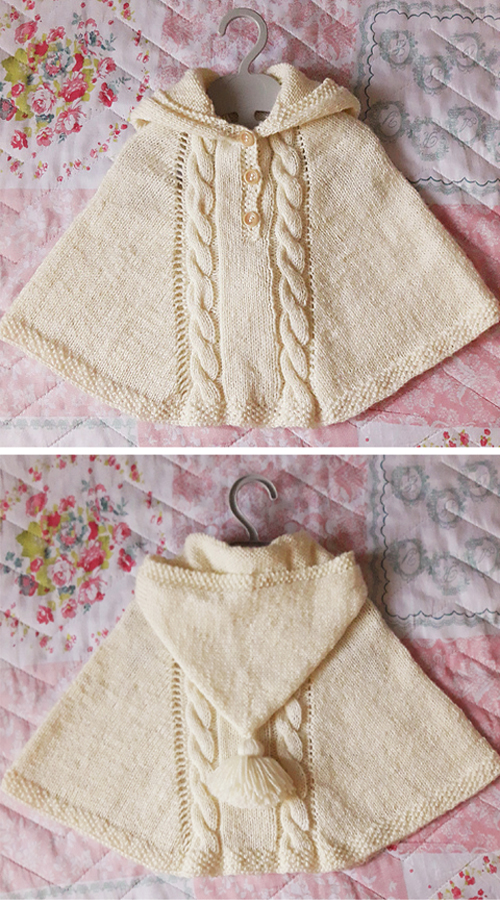
Lolo Poncho – Free Hooded Baby Poncho Knitting Pattern

Lolo Poncho free hooded baby poncho knitting pattern by Noura Sabbagh

Lolo Poncho. Photo © Noura Sabbagh

Lolo Poncho by Noura Sabbagh is a charming free hooded baby poncho knitting pattern featuring cable braids, seed stitch details and a cozy buttoned neckline.

Designed for little ones approximately 8–18 months, this sweet poncho is worked from the top down in DK-weight yarn. A pointed hood finished with a tassel and decorative cables along the sides give the design its distinctive storybook look.

Lolo Poncho Pattern Details

  • Designer: Noura Sabbagh
  • Published: January 2019
  • Craft: Knitting
  • Category: Baby / toddler poncho
  • Pattern availability: Free download
  • Size: 8–18 months
  • Yarn weight: DK / Light Weight #3
  • Suggested yarn: Nako Elit Baby
  • Yardage: Approximately 246–273 yards (225–250 m)
  • Needles: 3.5 mm (US 4) circular needles
  • Gauge: 20 stitches × 32 rows = 4 inches (10 cm) in stockinette stitch
  • Construction: Top down, one piece, worked in the round
  • Features: Hood, cables, seed stitch, buttons and tassel
  • Languages: English and Arabic

A Cozy Hooded Baby Poncho

Lolo Poncho combines the relaxed shape of a knitted poncho with several details normally associated with more structured children's garments.

The hood provides extra warmth around the head and neck, while a short buttoned opening at the front makes the poncho easier to put on and take off.

A tassel at the top of the hood adds a playful finishing touch that works especially well with the vintage-inspired shape of the design.

Beautiful Cable and Seed Stitch Details

Although much of the poncho uses simple stockinette stitch, Noura Sabbagh adds texture with seed stitch and cable braids.

The cable details run along both sides of the poncho, providing a strong decorative feature without covering the entire garment in cables.

This combination allows the smooth stockinette sections, textured seed stitch and raised cable braids to complement one another.

Lolo Poncho Size

The free pattern is written for one baby/toddler size: approximately 8–18 months.

Because children's proportions can vary considerably at the same age, check the designer's pattern information and your gauge before beginning rather than choosing the project based only on age.

Yarn Requirements

The original Lolo Poncho uses Nako Elit Baby, a DK-weight acrylic yarn.

The designer specifies approximately 100 g of lightweight #3 acrylic yarn. The pattern listing gives an estimated yardage of around 246–273 yards (225–250 m).

If you substitute another yarn, choose a suitable DK-weight option and make sure you can achieve the required gauge.

For a garment intended for a young child, softness and practical care are also useful considerations when selecting yarn.

Needles and Gauge

Lolo Poncho calls for 3.5 mm (US 4) circular needles, approximately 80 cm or longer, or the needle size needed to achieve the designer's gauge.

The specified gauge is: 20 stitches and 32 rows = 4 inches (10 cm) in stockinette stitch.

Making a gauge swatch is particularly useful for a children's garment because a difference of only a few stitches can noticeably change the finished dimensions.

Top-Down One-Piece Construction

Lolo Poncho is constructed from the top down and is primarily worked in the round as one piece.

This construction allows the poncho to grow outward and downward from the neckline while incorporating the decorative sections into the garment.

It also reduces the amount of traditional garment seaming compared with a poncho made from several large separate panels.

A Buttoned Neckline

Three buttons at the upper front add both decoration and function. They create a short opening near the neckline, making the hooded poncho easier to dress over a baby's head.

Choosing contrasting buttons can make this feature stand out, while buttons close to the yarn color create a more understated finish.

Skills Used in the Lolo Poncho

This project combines several knitting techniques, including:

  • Knitting and purling
  • Working in the round
  • Top-down construction
  • Seed stitch
  • Cable knitting
  • Reading a chart
  • Buttonholes
  • Shaping
  • Finishing a hood and tassel

For that reason, Lolo Poncho is more interesting as a skill-building project than a completely basic first knitting project.

Why Knit the Lolo Poncho?

Lolo Poncho has a distinctive look without requiring an elaborate all-over stitch pattern. The hood, cable braids, seed stitch, buttons and tassel provide plenty of visual interest while leaving large areas of simpler knitting.

The poncho shape also makes it a fun alternative to knitting another conventional baby cardigan or pullover.

It could make a lovely handmade gift for a baby or toddler, especially for cooler autumn and winter days.

About the Lolo Poncho Design

Noura Sabbagh named the pattern after her daughter. It was also her first written knitting pattern.

The pattern is available in both English and Arabic, which makes it especially useful to knitters looking for an Arabic-language version of a baby garment pattern.

Get the Free Lolo Poncho Knitting Pattern

The complete Lolo Poncho by Noura Sabbagh is currently available as a free downloadable knitting pattern from the designer's Ravelry store.

Get the Free Lolo Poncho Knitting Pattern

Pattern availability was checked when this article was updated. Availability on external websites may change over time.

Mini Snow Boots – Free Baby Booties Knitting Pattern

Mini Snow Boots free baby booties knitting pattern by DROPS Design with cables and ribbing

Mini Snow Boots by DROPS Design are cozy knitted baby booties with a charming combination of cables, ribbing and a snug sock-style fit. Designed for babies and young children, the pattern includes sizes ranging from approximately 1 month all the way to 4 years.

The tall ribbed cuff gives these little boots their winter-ready appearance, while the cable detail running down the front adds texture and makes the finished pair look much more elaborate than a basic knitted baby sock.

Best of all, the complete Mini Snow Boots pattern is still available free from DROPS Design, so knitters can follow the current official instructions directly from the original publisher.

Design and original pattern © DROPS Design / Garnstudio.

Mini Snow Boots Pattern Overview

  • Designer: DROPS Design
  • Pattern: Mini Snow Boots / DROPS Baby 31-25
  • Pattern number: pu-002-by
  • Craft: Knitting
  • Category: Baby socks / booties
  • Published: March 2018
  • Sizes: 1–3 months, 6–9 months, 12–18 months, 2 years and 3–4 years
  • Foot length: Approximately 10, 11, 12, 14 and 16 cm
  • Yarn group: DROPS Yarn Group B
  • Suggested yarn: DROPS Puna
  • Fiber: 100% alpaca
  • Yarn amount: Approximately 50 g for each listed size
  • Needles: 2.5 mm double-pointed needles
  • Additional tool: Cable needle
  • Gauge: 24 stitches and 34 rows = 10 × 10 cm in stockinette stitch
  • Construction: Worked in the round
  • Main techniques: Ribbing, cables, decreases and sock shaping
  • Pattern availability: Free official web pattern

Cozy Baby Boots With Classic Cable Detail

The feature that gives the Mini Snow Boots their distinctive look is the decorative cable running along the front of each boot.

Instead of relying only on plain stockinette stitch, the pattern combines ribbed texture and cables to create a pair of baby socks that looks almost like miniature winter boots.

The cable motif adds structure and visual interest without covering the entire piece, so the finished booties still retain a soft and comfortable appearance.

Sizes From Baby to Preschool Age

One particularly useful feature of this DROPS pattern is the wide size range. It is not limited to newborns.

The official pattern includes the following five sizes:

  • 1–3 months: approximately 10 cm foot length
  • 6–9 months: approximately 11 cm foot length
  • 12–18 months: approximately 12 cm foot length
  • 2 years: approximately 14 cm foot length
  • 3–4 years: approximately 16 cm foot length

This makes Mini Snow Boots useful for several stages of early childhood and also makes the pattern a good option for handmade baby gifts when you want more than a newborn-only size.

How the Mini Snow Boots Are Constructed

The Mini Snow Boots are worked in the round on double-pointed needles.

The knitting begins at the upper cuff and continues downward, with the decorative cable and rib structure worked according to the DROPS charts. As the piece develops, decreases shape the leg and foot.

Working the booties in the round means there is no long side seam running down the finished sock, helping create a smoother and more comfortable result.

The Ribbed Cuff

The upper section combines ribbed stitches with the central cable design. Ribbing is especially useful for baby socks because it allows the fabric to stretch while still helping the boot stay comfortably around the ankle.

When knitting the cuff, try to avoid pulling the stitches too tightly. A very firm cast-on edge can reduce the stretch of the opening and make the finished boot harder to put on.

Working the Cable Pattern

The cable detail is one of the main decorative elements in this pattern. DROPS provides charts for the patterned sections, so being comfortable reading a simple knitting chart will make the project easier to follow.

You will also need a cable needle to move stitches while creating the crossed cable sections.

If cables are still new to you, work slowly through the first repeat and check the orientation of each cable crossing before continuing. Once the repeat becomes familiar, the pattern becomes much easier to recognize.

Yarn for Mini Snow Boots

The original pattern uses DROPS Puna, a soft 100% alpaca yarn from DROPS Yarn Group B.

The official pattern calls for approximately 50 grams for each of the listed sizes, making this a relatively small-yarn project.

DROPS also allows compatible Yarn Group B alternatives, so you do not necessarily have to use the exact original yarn. The important point is to choose a substitute that allows you to obtain the required gauge and produces a comfortable fabric suitable for baby feet.

Why Gauge Matters for Baby Booties

The official gauge is:

24 stitches and 34 rows = 10 × 10 cm in stockinette stitch.

Gauge matters particularly on footwear because even a small difference can noticeably change the finished foot length and circumference.

If your stitches are larger than the pattern gauge, the booties may turn out too large. If your gauge is tighter, they may become too small or less stretchy.

For that reason, it is worth checking your tension before knitting the pair, especially if you are substituting yarn.

Needles and Tools

  • 2.5 mm double-pointed knitting needles
  • Cable needle
  • DK / DROPS Yarn Group B yarn
  • Tapestry needle for finishing
  • Stitch markers if you find them helpful for working in the round

The 2.5 mm needle size is a recommendation. As DROPS notes, you may need to adjust needle size to achieve the correct gauge for your individual knitting tension.

Skills You'll Use

  • Knitting in the round
  • Using double-pointed needles
  • Knit and purl stitches
  • Ribbing
  • Reading knitting charts
  • Working cables
  • Using a cable needle
  • Decreasing stitches
  • Shaping a sock or bootie
  • Finishing and weaving in ends

Is This a Beginner Knitting Pattern?

Mini Snow Boots are better suited to an advanced beginner or intermediate knitter than to someone making their very first knitting project.

The basic stitches themselves are familiar, but the project combines several techniques: knitting in the round, working with double-pointed needles, following cable charts and shaping a small sock.

If you already know how to knit and purl and would like to learn cables or small circular knitting, this can be an excellent next-step project.

Tips for Knitting a Neater Pair

Check your gauge first. Baby footwear is small enough that even a modest gauge difference can significantly change the final size.

Keep cable tension consistent. Cable crossings can sometimes become tighter than surrounding stitches, so avoid pulling the working yarn too firmly immediately after a cable.

Watch the joins between double-pointed needles. Moving the needle divisions occasionally can help reduce visible ladders in the fabric.

Count your decreases carefully. Correct stitch counts are important when shaping such a small piece.

Make both boots under similar conditions. Using the same needles and tension helps the finished pair match in size.

Is Mini Snow Boots a Free Knitting Pattern?

Yes. Mini Snow Boots / DROPS Baby 31-25 is currently available as a free knitting pattern directly from DROPS Design.

The official DROPS page includes the complete written instructions, pattern charts, size selection and supporting knitting resources.

Because DROPS Design is the original publisher of this pattern, we link directly to that official source rather than to third-party copies.

View the Free Mini Snow Boots Pattern at DROPS Design →

Why These Baby Boots Are Worth Knitting

Mini Snow Boots combine the practicality of warm knitted baby socks with the look of miniature cable-knit winter boots.

The small scale makes them a satisfying project when you want to practice cables without committing to a large sweater or blanket, while the five-size range gives the design much more flexibility than many newborn-only bootie patterns.

They can also make a thoughtful handmade baby gift, especially when knitted in a soft neutral yarn or a color chosen to coordinate with a baby's winter wardrobe.

Pattern Availability

Amazing Knitting links readers to legitimate designer or publisher sources whenever possible. Pattern prices, download locations and availability can change after an article is published.

Read Our Pattern Availability Policy →

Amazing Knitting is an independent pattern discovery and project-guide site. The Mini Snow Boots design and knitting pattern remain the intellectual property of DROPS Design / Garnstudio. This guide does not reproduce the publisher's complete row-by-row pattern instructions or charts.

Perky Little Hat Knitting Pattern

Perky Little Hat knitting pattern by Sharon Lentsch
Photo © GretchenHam

The Perky Little Hat by Sharon Lentsch is a quick, chunky knitted beanie designed for super bulky yarn. Its simple shape, textured brim and oversized pom-pom make it a fun cold-weather project for both children and adults.

With only about 80–85 yards of yarn required, this is also a practical one-skein project and a good choice when you want to knit a handmade gift without committing to a long project.

Perky Little Hat Pattern at a Glance

Designer: Sharon Lentsch

Craft: Knitting

Category: Beanie / Toque

Yarn Weight: Super Bulky

Suggested Yarn: Malabrigo Rasta

Yardage: 80–85 yd (73–78 m)

Needles: US 15 (10 mm)

Gauge: 2 sts and 3 rows = 1 in

Sizes: Child and Adult

Construction: Worked in the round

Instructions: Written pattern

Current Availability: Paid PDF pattern

About the Perky Little Hat

Perky Little Hat is designed as a fast, satisfying knit with a playful finished look. The super bulky yarn creates a thick fabric quickly, while the decorative brim and pom-pom give the hat its distinctive personality.

The original designer describes it as a quick project and a good gift idea. Because the pattern includes both child and adult sizing, it can also work well for coordinating family hats.

Yarn and Yardage

The pattern recommends Malabrigo Rasta, a super bulky 100% merino yarn. The listed requirement is approximately 80–85 yards (73–78 meters).

A smooth or lightly spun super bulky yarn will help preserve the definition of the brim while keeping the hat warm and substantial. Always compare your substitute yarn with the pattern gauge before beginning.

Needles and Gauge

The recommended needle size is US 15 (10 mm).

The pattern gauge is approximately 2 stitches and 3 rows per inch. Because super bulky yarn can vary considerably between brands, a gauge swatch is useful if you want the finished hat to match the intended size.

Sizes

The original pattern includes both Child and Adult sizes.

This makes Perky Little Hat useful for gift knitting, especially when you need a quick project in more than one size.

Construction and Skills

The hat is worked in the round, so familiarity with circular knitting is useful. The pattern is written rather than charted.

Its combination of super bulky yarn and straightforward construction makes it a relatively fast project, while the finished brim and pom-pom add enough detail to keep the design visually interesting.

Is the Perky Little Hat Pattern Free?

No. Although older pages around the web may describe Perky Little Hat as a free knitting pattern, the current authorized Ravelry listing is a paid PDF pattern.

Pattern pricing can change over time, so use the original designer's listing below for the latest price and availability.

Get the Perky Little Hat Pattern

Visit Sharon Lentsch's official Ravelry listing to see the complete pattern details and current purchase options.

Amazing Knitting provides project information and links readers to the authorized source rather than reproducing the designer's complete copyrighted instructions.

Favorite Cardigan Baby by PixenDk – Knitting Pattern Guide

Favorite Cardigan Baby knitting pattern by PixenDk

Favorite Cardigan Baby by PixenDk is a beautiful top-down baby and toddler cardigan featuring raglan shaping and subtle textured details across the shoulders.

The cardigan is worked while holding two strands of yarn together, creating a comfortable fabric while allowing the simple stockinette body and decorative shoulder sections to remain the focus of the design.

Pattern availability update: this pattern was originally available digitally through the designer's Ravelry store, but that source is now marked as discontinued and the digital pattern is no longer available online.

Design and featured photos: PixenDk.

Favorite Cardigan Baby Pattern Overview

  • Pattern: Favorite Cardigan Baby (ENG)
  • Designer: PixenDk
  • Published: July 2019
  • Category: Baby and toddler cardigan
  • Construction: Top-down raglan
  • Main fabric: Stockinette stitch with textured shoulders
  • Yarn: CaMaRose Yaku
  • Yarn weight: Fingering, held double
  • Gauge: 19 stitches × 27 rows = 4 in / 10 cm
  • Sizes: 0 months through 3 years
  • Pattern language: English
  • Current availability: Discontinued / no longer available online

About the Favorite Cardigan Baby

Favorite Cardigan Baby uses a classic top-down raglan construction that allows the cardigan to develop from the neckline toward the body.

Most of the garment is worked in stockinette stitch, while textured sections on the shoulders add visual interest to the otherwise clean design.

The designer also notes that the shoulder texture can be continued farther down the sleeves if you prefer a more pronounced textured effect.

Sizes

The original pattern was published in six baby and toddler sizes:

  • 0 months
  • 6 months
  • 9 months
  • 1 year
  • 2 years
  • 3 years

The approximate finished bust measurements were: 48 (54) 57 (59) 63 (65) cm.

Approximate body lengths were: 14 (16) 18 (20) 22 (24) cm.

These measurements are preserved here as useful information about the original design. They are not a replacement for the designer's complete sizing and knitting instructions.

Yarn

The featured version was knitted with CaMaRose Yaku, a 100% merino wool yarn with approximately 200 meters per 50g.

The original yarn requirements were approximately:

  • 3 skeins for the smallest sizes
  • 4 skeins for the intermediate sizes
  • 5 skeins for the largest sizes

The sample cardigan was knitted in Yaku color 1809.

The original pattern also suggested alternatives including CaMaRose Pimabomuld and Økologisk Sommeruld.

Holding Two Strands Together

An important feature of this design is that the yarn is held double while knitting.

Holding two strands of a finer yarn together produces a thicker working yarn and changes both the density and appearance of the finished fabric.

If recreating a similar cardigan with another currently available pattern, remember that simply choosing a yarn labelled with the same weight does not guarantee identical gauge.

Needles and Notions

The original published pattern information listed:

  • 3.5 mm circular needle, approximately 40 cm
  • 4 mm circular needle, approximately 60 cm
  • 4.5 mm circular needle, approximately 60 cm
  • 4 mm double-pointed needles
  • 4.5 mm double-pointed needles
  • Approximately 5–7 buttons, about 15 mm in diameter

Gauge

The documented gauge for the original design is:

19 stitches × 27 rows = 10 × 10 cm / 4 × 4 inches in stockinette stitch, holding two strands together on 4.5 mm needles.

Gauge is especially important for children's garments because it affects the finished chest circumference, sleeve proportions and overall fit.

Top-Down Raglan Construction

The cardigan is knitted from the top down using raglan shaping.

Top-down construction is popular for baby and children's sweaters because much of the garment develops as one connected piece rather than requiring several large pieces to be assembled afterward.

It can also make it easier to visualize the proportions of the garment as the body and sleeves develop.

The Textured Shoulders

Although much of Favorite Cardigan Baby is worked in simple stockinette, the shoulders introduce a contrasting textured detail.

This gives the cardigan additional visual interest without covering the entire garment in a complex stitch pattern.

According to the original description, the shoulder texture can also be continued through the full sleeve length if desired.

Useful Skills for a Similar Project

Knitters interested in top-down baby cardigans of this style will generally benefit from experience with:

  • Casting on
  • Knitting and purling
  • Working stockinette stitch
  • Raglan shaping
  • Increasing stitches
  • Working with circular needles
  • Working small circumferences
  • Making buttonholes
  • Binding off
  • Weaving in ends

Why Top-Down Baby Cardigans Are Popular

A top-down cardigan is an appealing project because the construction begins with the relatively small neckline and gradually develops into the full garment.

Baby and toddler sizes also provide an opportunity to practice garment construction on a smaller scale before committing to an adult sweater.

The button-front design makes a cardigan practical for layering, while the raglan lines give the garment a classic knitted-sweater shape.

Is Favorite Cardigan Baby Still Available?

No current authorized digital download could be verified for this exact pattern during our latest review.

The original pattern page identifies the design as Favorite Cardigan Baby (ENG) by PixenDk, but the source is now listed as out of print and the digital pattern is described as no longer available online.

For that reason, Amazing Knitting does not link to unofficial copies, reuploads or reconstructed versions of the pattern.

If PixenDk or another authorized publisher makes the exact pattern available again, this guide can be updated with the new legitimate source.

Looking for a Baby Cardigan Pattern You Can Knit Now?

You can explore our collection of baby sweaters and cardigans whose individual pattern pages provide current availability information.

Explore 9 Free Baby Sweater & Cardigan Knitting Patterns →

Pattern Availability

Amazing Knitting links readers to legitimate designer or publisher sources whenever possible. Pattern prices, download locations and availability can change after an article is published.

Read Our Pattern Availability Policy →

Amazing Knitting is an independent pattern discovery and project-guide site. Favorite Cardigan Baby and its original knitting instructions remain the intellectual property of PixenDk. This article preserves project information and does not reproduce the discontinued pattern instructions.

Odeta Baby Jacket – Free Lace Cardigan Knitting Pattern

Odeta Baby Jacket free lace cardigan knitting pattern by DROPS Design

Odeta Baby Jacket. Photos © DROPS Design & © khc805

Odeta by DROPS Design is a beautiful free baby and toddler cardigan knitting pattern combining delicate lace with classic garter stitch.

The pattern includes an impressive range of sizes from premature through 3–4 years, and the complete Odeta set also includes a pair of matching knitted slippers.

Odeta Baby Jacket Pattern Details

  • Designer: DROPS Design
  • Pattern: DROPS Baby 31-3 / bm-084-by
  • Published: March 2018
  • Craft: Knitting
  • Category: Baby and toddler cardigan
  • Pattern availability: Free from DROPS Design
  • Sizes: Premature, 0/1, 1/3, 6/9, 12/18 months, 2 years and 3/4 years
  • Yarn: DROPS BabyMerino
  • Yarn group: A
  • Yarn required for jacket: 100–200 g depending on size
  • Main needles: 3 mm circular needle
  • Crochet hook: 2.5 mm for edging and cord
  • Gauge: 24 stitches × 48 rows = 4 inches (10 cm) in garter stitch
  • Construction: Bottom up and worked flat
  • Features: Lace, garter stitch, V-neck and crochet edging
  • Matching pattern: Odeta Slippers included in the set

A Free Baby Cardigan from Premature to 4 Years

One of the most useful features of the Odeta pattern is its unusually wide size range.

DROPS provides instructions for premature babies, newborns, babies, toddlers and children up to approximately 3–4 years old.

The corresponding child heights range from approximately 40/44 cm through 98/104 cm, making it possible to use the same design at several stages of a child's early years.

Lace and Garter Stitch

Odeta combines two very different textures: decorative lace and simple garter stitch.

The lace creates the beautiful openwork detail along the lower part of the cardigan, while the garter stitch gives the rest of the jacket a soft, textured appearance.

This contrast is one of the features that makes the design look elaborate without covering the entire garment in lace.

Bottom-Up Construction

The Odeta Jacket is worked from the bottom up.

DROPS begins by working the body back and forth on a circular needle. After the initial lace section is completed, the cardigan continues in garter stitch.

Later, the work is divided for the fronts and back and stitches are added for the sleeves.

How the Sleeves Are Constructed

Odeta does not use the common method of knitting two completely separate sleeves and sewing them into armholes.

Instead, after the body has reached the required length, stitches are cast on for the sleeves as the front and back sections are completed separately.

This creates the characteristic integrated sleeve construction visible in the finished jacket.

V-Neck Shaping

The cardigan has an elegant V-shaped neckline.

Neck decreases are worked along the front edges while the upper sections of the cardigan and sleeves are being formed.

The open neckline works particularly well with the delicate lace and gives Odeta a light wrap-style appearance.

Crocheted Edging and Tie Cord

Although Odeta is primarily a knitting project, a small amount of crochet is used for the finishing.

DROPS specifies a 2.5 mm crochet hook for the decorative edging and cord.

The crocheted finish adds a delicate detail around the cardigan and complements the knitted lace pattern.

DROPS BabyMerino Yarn

The original jacket is knitted in DROPS BabyMerino, a 100% merino wool yarn from DROPS Yarn Group A.

For the jacket alone, the official pattern calls for approximately:

  • 100 g for the premature size
  • 150 g for sizes from 0/1 through 12/18 months
  • 200 g for sizes 2 years and 3/4 years

The original sample is shown in the color Light Sea Green (43).

Choosing an Alternative Yarn

DROPS also allows the design to be knitted with a suitable alternative from Yarn Group A.

When substituting yarn, matching the pattern gauge is more important than simply choosing a yarn with a similar label.

For a baby garment, also consider softness, washability and how the yarn feels against delicate skin.

Needles and Gauge

The jacket uses a 3 mm circular needle, or the needle size required to obtain the correct gauge.

The official gauge is: 24 stitches and 48 rows = 4 inches (10 cm) in garter stitch.

Even though the cardigan is worked back and forth, the circular needle is useful for comfortably holding the large number of stitches across the body and sleeves.

Why Gauge Matters for Baby Clothes

Gauge is particularly important when knitting a fitted garment such as a baby cardigan.

If your stitches are significantly larger than the specified gauge, the jacket can finish too large. If they are too small, the finished garment may be tighter than intended.

Make a swatch in garter stitch before beginning and change needle size if necessary.

Charts and Written Instructions

The Odeta Jacket uses DROPS diagrams for its lace sections together with written construction instructions.

The official pattern includes different diagrams according to size, so make sure you follow the chart specified for the size you are knitting.

DROPS also provides supporting tutorials and videos on its website for many of the techniques used in its patterns.

Skills Used in the Odeta Jacket

This project uses a combination of garment construction, lace and finishing techniques, including:

  • Garter stitch
  • Working back and forth
  • Reading a lace chart
  • Yarn overs and lace decreases
  • Increasing and decreasing
  • V-neck shaping
  • Casting on stitches for sleeves
  • Seaming
  • Picking up stitches
  • Basic crochet for the edging and cord

Is Odeta a Beginner Knitting Pattern?

Odeta is probably better suited to a knitter who is already comfortable with basic knitting and wants to move into lace and baby garment construction.

The individual techniques are manageable, but the project requires you to follow size-specific instructions, work from lace diagrams, shape the neckline and sleeves, and complete the crocheted finishing.

Taking the pattern one section at a time makes the construction much easier to understand.

The Matching Odeta Slippers

The official DROPS Baby 31-3 pattern is actually a coordinated baby set rather than only a cardigan.

It also includes Odeta Slippers, knitted with the same BabyMerino yarn and designed with lace and garter-stitch details to coordinate with the jacket.

Slipper sizes are provided across the same general age range, from premature through approximately 3–4 years.

A Lovely Handmade Baby Gift

The matching jacket and slippers make Odeta especially suitable for a handmade baby gift.

You can knit only the cardigan or make the complete coordinated set. The wide size range also means you are not limited to newborn sizing when knitting for an older baby or toddler.

Tips Before You Start

Choose your size first and mark the corresponding numbers throughout the DROPS instructions before casting on.

Pay particular attention to the section where neck decreases, division of the body and sleeve construction begin to overlap. Reading that entire section before knitting it will make the construction much easier to follow.

It is also useful to check your stitch count after completing each lace section before continuing into the garter-stitch body.

Why Knit the Odeta Baby Jacket?

Odeta combines the practicality of garter stitch with enough lace to make the finished cardigan feel special.

Its premature-to-4-years size range is particularly useful, and the matching slippers give you the option of turning the cardigan into a complete handmade baby set.

Best of all, DROPS provides the full pattern, diagrams and supporting resources free on its official website.

Get the Free Odeta Baby Jacket Pattern

The complete Odeta / DROPS Baby 31-3 pattern, including the baby jacket and matching slippers, is currently available free from DROPS Design.

Get the Free Odeta Baby Jacket Knitting Pattern

Pattern availability was checked when this article was updated. Availability on external websites may change over time.

Boy Sweater - Knitting Pattern

Boy Sweater - Knitting Pattern
Photos above © milainemicoton

Looking for a stylish boy sweater knitting pattern with practical cold-weather details? Boy Sweater by Lisa Chemery is a seamless top-down pullover for babies and children, featuring a cozy shawl collar, buttoned neck opening, raglan shaping, and textured stitch details.

The close-fitting design is intended to sit comfortably under a jacket, while the shawl collar provides extra warmth around the neck — especially useful for children who do not enjoy wearing scarves.

Boy Sweater at a Glance

Pattern: Boy Sweater

Designer: Lisa Chemery

Craft: Knitting

Category: Baby & Child Pullover

Construction: Top-down and seamless

Yarn Weight: Worsted / DK

Needles: US 6 / 4.0 mm and US 8 / 5.0 mm

Main Gauge: 20 stitches × 30 rounds = 4 inches / 10 cm in stockinette

Yardage: Approximately 275–700 yards / 251–640 m

Sizes: 3 months to 8 years

Languages: English and French

Pattern Availability: Paid pattern

About the Boy Sweater

Designed by Lisa Chemery, Boy Sweater combines the practicality of a children's pullover with several details that give it a more polished look.

The most recognizable feature is the shawl collar, which wraps softly around the neck and is paired with a small buttoned opening.

Textured knitting and twisted-rib details add visual interest without turning the sweater into a heavily decorated garment, making the design suitable for both boys and girls.

Seamless Top-Down Construction

The sweater is knitted seamlessly from the top down. The upper section begins flat, after which stitches are added for the neck placket and the body continues in the round.

The sleeves are also worked in the round, reducing the amount of garment seaming required at the end.

Top-down construction has another practical advantage: it allows knitters to see the garment taking shape from the neckline toward the hem.

The Shawl Collar

The shawl collar is one of the defining features of this sweater. After the body is completed, stitches are picked up around the neckline and the collar is worked flat.

Short rows are used to create the characteristic shawl shape, and the lower edges of the collar are then attached to the sweater body.

Besides giving the sweater its classic appearance, the collar provides extra knitted fabric around the child's neck without requiring a separate scarf.

Baby and Child Sizes

The current pattern includes a particularly useful range of sizes:

  • 3 months
  • 6 months
  • 12 months
  • 18 months
  • 2 years
  • 4 years
  • 6 years
  • 8 years

The designer provides finished garment measurements as well as intended chest measurements, so check the original pattern carefully when deciding which size to knit.

Yarn Requirements

Boy Sweater is designed for approximately:

275–700 yards / 251–640 meters

The exact amount depends on size. The designer recommends a worsted-to-DK-weight merino or merino-blend yarn.

Suggested yarns listed with the pattern include Malabrigo Rios and several DK and worsted options.

Needles and Gauge

The pattern uses two main needle sizes:

  • US 6 / 4.0 mm
  • US 8 / 5.0 mm

The published stockinette gauge after blocking is:

20 stitches × 30 rounds = 4 inches / 10 cm

The textured portion has a separate row gauge, so use the designer's current pattern instructions when swatching and selecting needle sizes.

Knitting Skills Used

This project involves more than basic stockinette knitting. Techniques used in the design include:

  • Knitting and purling
  • Increasing and decreasing
  • Top-down raglan construction
  • Knitting in the round
  • Picking up stitches
  • Short rows
  • Twisted stitches
  • Textured stitch patterns
  • Buttonholes and finishing

The combination makes Boy Sweater an interesting project for knitters who already understand the basics and want to develop their garment-knitting skills.

Is the Boy Sweater Pattern Free?

No. Boy Sweater by Lisa Chemery is currently a paid knitting pattern.

The pattern is sold through the designer's Ravelry listing. Amazing Knitting does not reproduce the designer's copyrighted instructions.

Visit the original listing below for the current price, complete sizing, materials, and purchase information.

View the Original Boy Sweater Pattern →

Pattern credit: Boy Sweater was designed by Lisa Chemery. Pattern pricing, availability, sizing, and technical information are controlled by the designer and may change over time.

Prefer a Free Alternative?

If you love the cozy shawl-collar style but would prefer a free knitting pattern, Amazing Knitting has a similar baby and child project in our archive.

Double Breasted Jacket with Shawl Collar — Free Knitting Pattern

This is a different design — not a free copy of Boy Sweater — but it offers a similar cozy shawl-collar look for babies and children and is available as a free knitting pattern.

View the Free Shawl Collar Pattern →

You can also browse our free baby sweater patterns for more no-cost options.

More Baby and Child Sweaters

Explore more boy sweater knitting patterns, baby sweater knitting patterns, and children's sweater knitting patterns from the Amazing Knitting archive.

Before You Start

If you choose the original Boy Sweater, check Lisa Chemery's current Ravelry listing before purchasing yarn. Confirm your chosen size, yarn requirement, needle sizes, gauge, notions, and any current pattern updates before casting on.

Sunny Hug - Free Knitting Pattern

Sunny Hug - Free Knitting Pattern
Photos above © DROPS Design
What a beautiful knitting children’s skirt (Free pattern)! Sunny Hug skirt with lace pattern and crochet edge, worked top down. Sizes 2 - 12 years.

Full Post: Sunny Hug

Double Breasted Jacket with Shawl Collar - Free Knitting Pattern

Double Breasted Jacket with Shawl Collar - Free Knitting Pattern
Photos above © DROPS Design

What a beautiful knitting jacket (free pattern)! Knitted double-breasted jacket with shawl collar for baby and children.

Full Post: Jacket with Shawl Collar

Checco's Dream Baby Cardigan – Free Knitting Pattern

Checco's Dream baby cardigan free knitting pattern by DROPS Design

Checco's Dream. Photo above © sofiecat

Checco's Dream is a free baby and children's cardigan knitting pattern from DROPS Design. This classic button-front jacket features a V-neck, textured seed stitch and cleverly constructed sleeves without traditional sleeve seams.

Available in sizes from approximately 1 month to 4 years, it is a versatile free cardigan pattern for babies, toddlers and young children.

Checco's Dream Pattern Details

  • Designer: DROPS Design
  • Pattern: DROPS Baby 21-11
  • Design number: ME-054-by
  • Craft: Knitting
  • Category: Baby and children's cardigan
  • Pattern availability: Free
  • Sizes: 1/3, 6/9 and 12/18 months; 2 and 3/4 years
  • Suggested yarn: DROPS Merino Extra Fine
  • Yarn group: B
  • Needles: 4 mm (US 6) circular needle
  • Gauge: 21 stitches × 28 rows = 4 inches (10 cm) in stockinette stitch
  • Buttons: 4–5 depending on size

Sizes and Finished Measurements

Checco's Dream covers a particularly useful range of baby and toddler sizes. The original DROPS pattern includes five sizes: 1/3 months, 6/9 months, 12/18 months, 2 years and 3/4 years.

Finished bust measurements range from approximately 48 to 70 cm (19 to 27½ inches), while the finished length ranges from approximately 27 to 40 cm (10⅝ to 15¾ inches), depending on the size selected.

Yarn and Needles

The original cardigan is knitted in DROPS Merino Extra Fine, a soft merino yarn in DROPS Yarn Group B.

The current official pattern lists approximately 200–300 g of yarn, depending on size. DROPS notes that this yarn quantity was corrected in an update to the online pattern.

A 4 mm (US 6) circular needle is recommended, or the needle size required to achieve the specified gauge of 21 stitches and 28 rows per 10 cm in stockinette stitch.

Textured Seed Stitch Cardigan

The textured stitch pattern gives Checco's Dream much of its classic character. It adds visual interest to the cardigan while allowing a solid-colored yarn to show the stitch definition clearly.

The design also features a V-neck and buttoned front, giving the finished jacket a traditional style that works well for both babies and toddlers.

An Unusual Seamless-Sleeve Construction

One of the most interesting features of Checco's Dream is its construction. Rather than knitting conventional separate sleeves and sewing them into armholes afterward, stitches are added as the garment progresses to form the sleeves.

The jacket is worked back and forth on a circular needle, beginning with the front sections and progressing through the shoulders and back. This approach avoids traditional sleeve seams.

Choosing a Yarn Substitute

DROPS Merino Extra Fine is the yarn specified for the original design, but DROPS also provides guidance for substituting yarns within its yarn group system.

If you choose another yarn, matching the original gauge is particularly important because gauge affects both the finished cardigan measurements and the amount of yarn required.

Get the Free Checco's Dream Knitting Pattern

The complete Checco's Dream / DROPS Baby 21-11 pattern is available free from the original publisher, DROPS Design. The official page includes the full instructions, sizing information and pattern diagram.

Get the Free Checco's Dream Pattern at DROPS Design

Pattern availability was checked when this article was updated. Availability on external websites may change over time.

Children's Slippers - Free Knitting Pattern + Video

Children's Slippers - Free Knitting Pattern + Video
Photos above © Katerina Mushyn
What beautiful knitting children's slippers (free knitting pattern)! I found it on Pinterest...  Making Slipper Boots can be so easy to do and you could probably do a pair in an afternoon, and elegant enough to send out as holiday handmade gifts.

Full Post: Children's Slippers

Jamma Slippers – Free Easy Slipper Knitting Pattern for the Whole Family

Jamma Slippers free easy slipper knitting pattern for toddler child and adults

Jamma Slippers. Photos © MyJamma Knits

Jamma Slippers by MyJamma Knits is a free beginner-friendly slipper knitting pattern with sizes for almost the whole family, from toddlers and children through adult XL.

These cozy knitted slippers are worked flat and then seamed, so you don't need to knit them in the round. Two strands of worsted-weight yarn are held together throughout, creating a thick, warm fabric while also making the slippers a practical project for combining yarn from your stash.

Jamma Slippers Pattern Details

  • Designer: MyJamma Knits
  • Published: April 2020
  • Craft: Knitting
  • Category: Slippers
  • Pattern availability: Free download
  • Skill level: Beginner-friendly
  • Sizes: Toddler, Child, Adult Small, Adult Medium, Adult Large and Adult XL
  • Yarn: Two strands of worsted-weight yarn held together
  • Yardage: Approximately 100–400 yards (91–366 m), depending on size
  • Needles: 5 mm (US 8)
  • Gauge: 5 stitches = 1 inch in garter stitch
  • Construction: Worked flat and seamed
  • Language: English

Easy Knitted Slippers for the Whole Family

One of the best features of Jamma Slippers is the generous range of sizes included in the free pattern.

The instructions cover:

  • Toddler
  • Child
  • Adult Small
  • Adult Medium
  • Adult Large
  • Adult XL

This makes the pattern useful if you want to knit matching slippers for several members of the family without searching for a different pattern for every size.

A Beginner-Friendly Slipper Pattern

The designer describes Jamma Slippers as a good pattern for beginners.

Unlike sock patterns that require knitting small circumferences in the round, these slippers are knitted back and forth as flat pieces. The finished knitting is then folded and seamed to create the slipper shape.

This straightforward construction makes the project particularly appealing if you are comfortable with basic knitting but haven't yet tried traditional sock construction.

Two Strands of Worsted Yarn Held Together

Jamma Slippers use an easy yarn technique: two strands of worsted-weight yarn are held together and knitted as one.

Holding the yarn double creates a much thicker fabric than knitting with a single strand of worsted yarn. The resulting yarn combination behaves approximately like a super bulky yarn while still allowing you to use common worsted-weight yarns.

This also makes Jamma Slippers a useful stash-busting project. You can combine leftover yarns from other projects, provided that the yarns work together and allow you to achieve the required gauge.

Yarn Ideas for Jamma Slippers

Several worsted-weight yarns are suggested for the pattern, including:

  • Red Heart Super Saver
  • Lion Brand Wool-Ease
  • Cascade 220 Superwash
  • Caron One Pound

You don't have to use one of these exact yarns. A suitable worsted-weight yarn can work as long as you hold two strands together and match the pattern gauge.

For slippers, you may also want to consider durability and ease of washing when choosing yarn, especially if you plan to wear them often.

How Much Yarn Do You Need?

Yarn requirements vary considerably because the pattern ranges from toddler slippers to Adult XL.

The pattern listing gives an overall range of approximately 100–400 yards (91–366 metres).

Check the instructions for your chosen size before selecting yarn, particularly when using leftovers or combining two different colors.

Needles and Gauge

Jamma Slippers call for 5 mm (US 8) knitting needles.

The specified gauge is: 5 stitches = 1 inch in garter stitch.

Remember that the gauge is achieved while knitting with two strands of worsted yarn held together.

Gauge is important for slippers because it directly affects the finished length and width. If your stitches are significantly larger or smaller than the designer's gauge, your slippers may not fit as expected.

Worked Flat and Seamed

Jamma Slippers are worked flat rather than knitted continuously in the round.

After knitting, the slipper is shaped through finishing and seaming. This approach keeps the knitting itself straightforward and avoids the need for double-pointed needles or other small-circumference knitting techniques.

Take your time with the seams, since neat finishing can make a noticeable difference to both the appearance and comfort of knitted slippers.

A Great Stash-Busting Knitting Project

Jamma Slippers have roots in practical scrap-yarn knitting. The designer explains that she learned the basic slipper pattern from her mother-in-law around forty years ago, and her mother-in-law used leftover yarn from other projects to make the slippers.

MyJamma Knits later modified the toe shaping and adapted the design to create the wide range of sizes included in this free version.

That history fits the pattern perfectly: because two strands are held together, you can experiment with different color combinations and put partial skeins of compatible worsted yarn to good use.

Try Two Colors Together

Holding two strands together also creates an easy opportunity to play with color.

Use two strands of the same color for a solid look, or combine two different colors for a marled effect. A solid yarn paired with a variegated or self-striping yarn can create even more variation without changing the knitting itself.

Skills Used in Jamma Slippers

This project is especially approachable for knitters who know the fundamentals and want to make their first pair of slippers.

Useful skills include:

  • Basic knitting
  • Garter stitch
  • Working back and forth
  • Holding two strands of yarn together
  • Simple shaping
  • Binding off
  • Basic seaming and finishing

Why Knit Jamma Slippers?

Jamma Slippers combine several useful qualities in one free pattern: simple flat construction, beginner-friendly techniques, six sizes and the ability to use ordinary worsted-weight yarn held double.

They're also a practical choice for handmade gifts. Once you're familiar with the construction, you can use the same pattern to knit slippers for children and adults in different yarn combinations.

Get the Free Jamma Slippers Knitting Pattern

The complete Jamma Slippers by MyJamma Knits pattern is currently available as a free download from the designer's Ravelry store.

Get the Free Jamma Slippers Knitting Pattern

Pattern availability was checked when this article was updated. Availability on external websites may change over time.

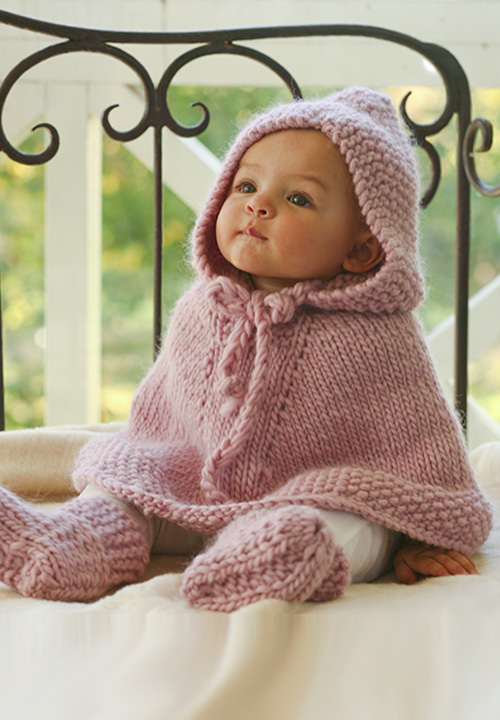
Knitted Poncho with Hood & Booties - Free pattern

Knitted Poncho with Hood & Booties - Free pattern
The photo above © DROPS design
What beautiful knitting baby poncho with hood and booty (free pattern)! I found it on Pinterest...
Set of a knitted poncho with hood and booties for baby and children in DROPS Eskimo.

Full Post: Knitted Poncho


Official Kittyville Hat - Free Pattern

Official Kittyville Hat - Free Pattern
The photo above © MiniLaura 
What beautiful hat knitting pattern! I found it on Pinterest...
These hats are the bastard children of the Lil’ Devil Baby Hat that I featured on my Web site. Kittyville is an online hodgepodge that I started in 1997 to present my somewhat off-center interests to the rest of the world. I love getting feedback and questions from faraway places, and I got so many requests for an adult version of the Lil’ Devil Baby Hat that I adapted it to fit grown-ups. It naturally evolved into the Kitty hat, which is the official headgear for Kittyville. I like to imagine people wearing it to surf my site, like a kid putting on a Captain Video helmet to watch his favorite show. You can omit the ears or horns and add your own kind of ornamentation: pom-poms, tassels, ponytails. Or just go minimal - with this basic hat shape, the possibilities are endless.

Gingersnap Cardigan – Free Baby Knitting Pattern


Gingersnap Cardigan free baby knitting pattern by Kristen Rettig

Gingersnap Cardigan designed and photographed © Kristen Rettig.

Gingersnap by Kristen Rettig is a cheerful striped baby cardigan knitting pattern designed to turn small amounts of leftover worsted-weight yarn into an adorable handmade sweater.

With bold blocks of color, simple shaping and endless possibilities for combining yarn scraps, Gingersnap is the kind of baby cardigan that can look completely different every time you knit it.

The original pattern is written primarily for the one-year size and uses approximately 360–400 yards (329–366 m) of worsted-weight yarn.

Good news: the original Gingersnap Cardigan is still available as a free knitting pattern from designer Kristen Rettig through her Ravelry store. You will find the verified free pattern link near the end of this guide.

Gingersnap Cardigan at a Glance

  • Pattern: Gingersnap
  • Designer: Kristen Rettig
  • First published: July 2015
  • Category: Baby cardigan
  • Main size: Approximately 1 year
  • Yarn weight: Worsted
  • Yardage: Approximately 360–400 yd (329–366 m)
  • Needles: US 5 / 3.75 mm and US 7 / 4.5 mm
  • Gauge: 19 sts × 28 rows = 4 in / 10 cm in stockinette
  • Construction: Worked flat and seamed
  • Color style: Stripes / color blocking
  • Pattern language: English
  • Current availability: Free Ravelry download

A Colorful Baby Cardigan Made for Yarn Scraps

One of the best things about Gingersnap is that it was designed with leftover yarn in mind.

Kristen Rettig originally made her sweaters using scraps of Rowan Pure Wool Superwash Worsted left over from other knitting projects.

That makes the cardigan especially appealing to knitters with small quantities of coordinating worsted-weight yarn waiting in their stash.

Three Colors or More

The written pattern is designed around three colors, but you do not have to limit yourself to three.

The designer encourages knitters to raid their yarn stash and experiment with three, four, five or even more colors.

This flexibility is part of the charm of Gingersnap. A carefully planned palette can create a polished color-block cardigan, while a collection of leftover yarns can produce a playful scrappy sweater.

Choosing Colors for Gingersnap

There is no single correct color combination for this cardigan.

You can use three closely related shades for a subtle effect or combine strongly contrasting colors for a bolder sweater.

Another approach is to choose one neutral shade and pair it with two brighter colors.

Before casting on, place your yarns next to each other and experiment with their order. Changing which shade appears next to another can make a surprisingly large difference to the finished cardigan.

Worsted-Weight Yarn

Gingersnap is designed for worsted-weight yarn.

Yarn options associated with the original pattern include:

  • Rowan Pure Wool Superwash Worsted
  • Rowan Handknit Cotton
  • Rowan Softknit Cotton

You do not need to find the exact original yarn. A suitable worsted-weight substitute can work as long as you can obtain the appropriate gauge and create a fabric you like.

Choosing Yarn for a Baby Sweater

Because Gingersnap is intended for a young child, softness and washability are important considerations.

The designer specifically suggests using a soft, machine-washable yarn. This makes sense for a baby or toddler cardigan that may need frequent washing.

Check the care instructions on every yarn you plan to combine. Using several yarns with very different washing requirements can make caring for the finished cardigan unnecessarily complicated.

A Great Stash-Busting Project

Gingersnap can be particularly useful when you have leftover worsted-weight yarn from larger projects.

Instead of buying several full skeins specifically for a small baby sweater, you may be able to combine suitable leftovers that already coordinate.

Make sure each yarn is similar enough in weight and behavior to produce consistent fabric throughout the cardigan.

How Much Yarn Do You Need?

Published pattern information lists approximately 360–400 yards (329–366 meters) in total.

Because the sweater is designed for multiple colors, the total yardage is divided among the shades used in the cardigan.

Your actual yarn usage can vary with gauge, yarn choice and any changes you make to the color arrangement.

Needle Sizes

The pattern lists two needle sizes:

  • US 5 / 3.75 mm
  • US 7 / 4.5 mm

Different needle sizes are useful for creating appropriate structure in areas such as borders and the main stockinette fabric.

As always, treat the listed needle sizes as a starting point and use the size that allows you to obtain the required gauge.

Gauge

The published gauge is 19 stitches and 28 rows = 4 inches / 10 cm in stockinette stitch.

Gauge matters in a fitted garment, even a small baby cardigan.

If your stitches are significantly larger than the designer's gauge, the cardigan will also become larger. If your gauge is tighter, the finished sweater can become too small.

Make a Swatch With Your Substitute Yarn

Swatching is especially helpful if you are combining several different leftover yarns.

Two yarns may both be labeled worsted weight but still behave differently when knitted.

A small swatch can help you check gauge, fabric softness, color combination and how well your selected yarns work together before you begin the cardigan.

The Original Gingersnap Size

The original free Gingersnap pattern is primarily sized for one year.

Kristen Rettig explains that she particularly likes this size because babies around that age are active, sitting up, moving around and able to show off a handmade sweater.

The pattern listing also includes a note related to making a smaller approximately six-month version.

Gingersnap for Bigger Kids Is a Different Pattern

It is important not to confuse the original free Gingersnap with Gingersnap for Bigger Kids.

The original pattern featured on this page is the free baby cardigan first published in 2015.

Kristen Rettig later developed a separate expanded pattern for bigger children with additional sizes.

That expanded version is a different pattern listing and should not be mistaken for the original free Gingersnap download linked below.

Worked Flat and Seamed

Gingersnap is a worked-flat and seamed cardigan.

This means the garment is not constructed entirely as one seamless piece in the round.

If you are new to garment knitting, this style of construction can be a useful introduction to creating individual sweater sections and assembling them into a finished cardigan.

Stockinette Makes the Colors the Star

Much of the visual impact comes from the color arrangement rather than complicated stitch patterns.

Smooth stockinette fabric provides a simple background that allows the different colored sections to stand out clearly.

This is particularly effective when using bright or strongly contrasting yarns.

Is Gingersnap Beginner Friendly?

Gingersnap can be an approachable project for a knitter who already understands the basic stitches and wants to try a small garment.

Compared with an adult sweater, a baby cardigan requires much less yarn and considerably less knitting.

However, you should be comfortable following garment shaping and finishing instructions rather than expecting the project to be as simple as a rectangular scarf or dishcloth.

Skills That Will Help

Useful skills for this cardigan include:

  • Casting on
  • Knit and purl stitches
  • Stockinette stitch
  • Changing yarn colors
  • Basic increases and decreases
  • Following garment shaping
  • Binding off
  • Seaming knitted pieces
  • Picking up stitches where instructed
  • Weaving in yarn ends
  • Finishing a knitted garment neatly

Changing Colors Neatly

Because color changes are such a visible part of Gingersnap, neat transitions help give the cardigan a polished appearance.

When beginning a new color, leave enough yarn tail to weave in securely later.

Avoid tying bulky knots in the knitted fabric unless the pattern specifically instructs you to do so.

Managing Lots of Yarn Ends

A scrappy version using many colors can create more yarn ends than a simple three-color cardigan.

Consider weaving in some ends as the project progresses rather than leaving every tail until the very end.

Take care not to pull woven ends so tightly that they distort the surrounding stockinette fabric.

Keep Your Color Changes Consistent

Before beginning, decide whether you will follow the designer's three-color arrangement or create your own palette.

If you modify the color sequence, make a simple written plan so you do not have to decide what comes next every time you reach a new section.

A quick sketch or list of color order can be surprisingly helpful.

Use Machine-Washable Yarn When Practical

A handmade baby cardigan is likely to encounter spills, food and everyday wear.

For that reason, easy-care yarn can make the finished sweater much more practical for parents.

Kristen Rettig specifically designed Gingersnap with soft, machine-washable yarns in mind.

A Cotton Version for Warmer Weather

The designer also suggests cotton yarn as an option for knitters who want a lighter sweater for warmer weather.

Rowan Handknit Cotton and Rowan Softknit Cotton are among the yarns associated with the original pattern.

When substituting cotton for wool, remember that the fibers can behave differently, so checking gauge and fabric drape before starting is worthwhile.

Blocking and Finishing

Careful finishing can transform a collection of knitted pieces into a polished little cardigan.

Follow the pattern's assembly instructions, keep seams neat and avoid pulling them excessively tight.

Gentle blocking can help the pieces settle into shape and make the stockinette fabric look more even.

Always use a blocking method appropriate for the yarn fibers you chose.

A Fun Handmade Baby Gift

Gingersnap is particularly well suited to gift knitting because every color combination can create a different personality.

Soft neutrals can make a classic cardigan, while bright contrasting shades create something playful and energetic.

You can even choose colors that match the recipient's wardrobe or use meaningful leftovers from other family knitting projects.

Why Gingersnap Remains Popular

Gingersnap has been available since 2015 and has been knitted by a large number of Ravelry users.

Its lasting appeal is easy to understand: the sweater is small, colorful, practical and adaptable to the yarn already in your stash.

Most importantly, the original baby version remains available as a free pattern from the designer.

Free Gingersnap Cardigan Knitting Pattern

Gingersnap by Kristen Rettig is currently available as a free knitting pattern.

The designer provides the original baby-cardigan pattern through Kristen Rettig's Ravelry Store, where the current listing identifies it as a free Ravelry download.

This is the exact Gingersnap pattern featured on this Amazing Knitting page: the striped worsted-weight baby cardigan first published by Kristen Rettig in 2015.

Please note that the later Gingersnap for Bigger Kids is a separate expanded pattern. The link below is specifically for the original free baby version.

Pattern availability can change over time, so Amazing Knitting checks older links and gives priority to a legitimate free source whenever the exact pattern remains officially available at no cost.

Get the Free Gingersnap Pattern

Visit Kristen Rettig's current pattern page to see the full pattern information and download the original Gingersnap baby cardigan for free.

Get the Free Gingersnap Knitting Pattern →

Gingersnap is designed by Kristen Rettig. Amazing Knitting does not reproduce the designer's copyrighted row-by-row instructions. The original baby version is currently offered as a free download by the designer. Pattern availability may change, so please check the linked source for the latest information.

Read Our Pattern Availability Policy →


Discover More From the Archive

A fresh mix of knitting patterns and tutorials from the Amazing Knitting archive.

Finding patterns from the archive…