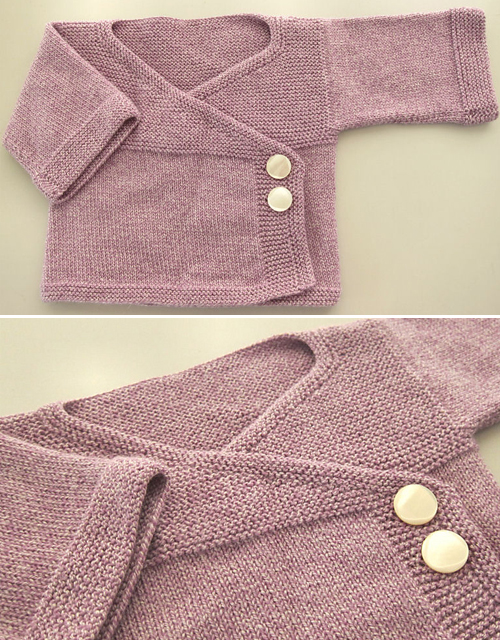
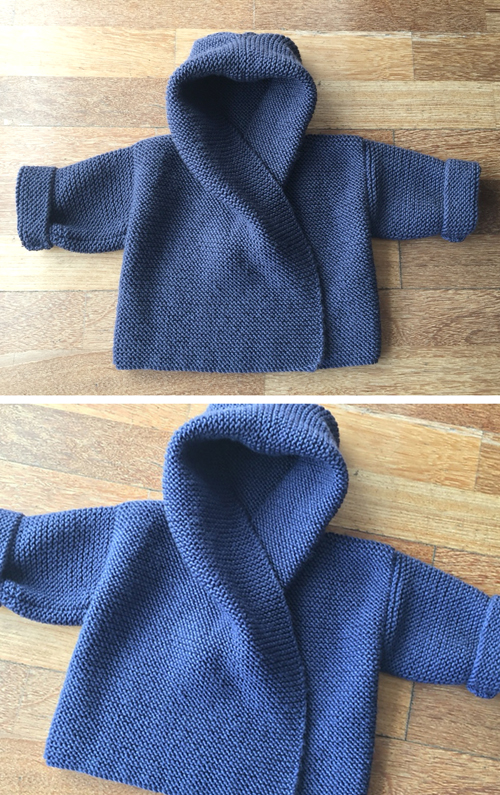
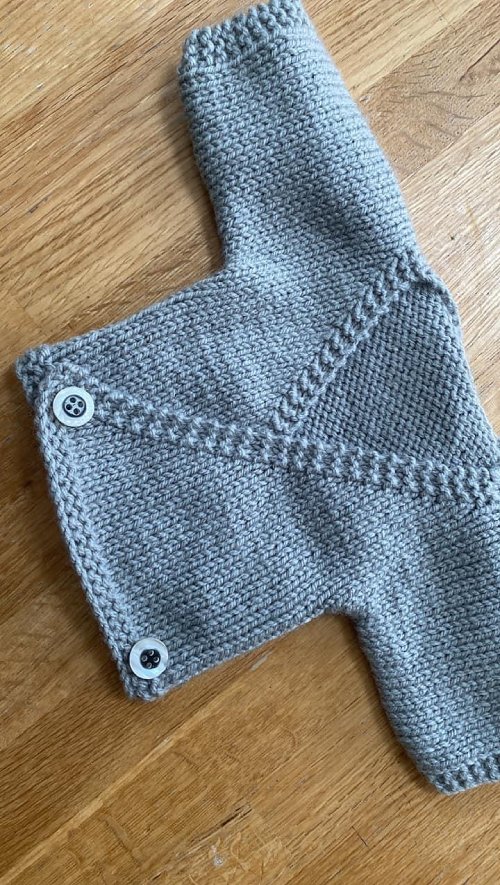
Preemie Crossover Cardigan by Jacqueline Gibb. Project photo © jakeis13.
Preemie Crossover Cardigan by Jacqueline Gibb is a
tiny wrap-style baby cardigan knitting pattern designed especially for
premature babies weighing approximately 3–5 lb.
Worked primarily in simple garter stitch with DK-weight yarn, the
cardigan has a clever crossover front, integrated sleeves and two-button
fastening.
It is also a wonderfully economical little project, requiring only
around 85–90 yards (78–82 m) of DK yarn.
Good news: the original Preemie Crossover Cardigan is
still available as a free knitting pattern directly
from designer Jacqueline Gibb through her Jacknitss Ravelry Downloads.
You will find the verified free pattern link near the end of this guide.
Preemie Crossover Cardigan at a Glance
- Pattern: Preemie Crossover Cardigan
- Designer: Jacqueline Gibb
- Published: April 2018
- Category: Premature baby cardigan
- Style: Crossover / wrap cardigan
- Size: Preemie, approximately 3–5 lb
- Chest: Approximately 11 in
- Underarm to underarm: Approximately 5.5 in
- Length: Approximately 5 in
- Yarn weight: DK
- Yardage: Approximately 85–90 yd (78–82 m)
- Needles: US 6 / 4 mm
- Gauge: 5 stitches and 6 rows = 1 in in garter stitch
- Main texture: Garter stitch
- Fastening: Two buttons
- Language: English
- Current availability: Free Ravelry download
A Tiny Cardigan Designed for Preemie Babies
This pattern was created specifically for very small premature babies
rather than simply being a standard newborn cardigan worked on smaller
needles.
The designer states that it is intended to fit a premature baby weighing
approximately 3 to 5 pounds.
The finished garment measures about 5.5 inches from underarm to
underarm and approximately 5 inches in length.
Those tiny measurements make it very different from many ordinary
newborn knitting patterns.
Simple Crossover Front
The cardigan uses a practical crossover or wrap-style
front.
Instead of two straight front edges meeting in the middle, the fronts
overlap diagonally across the baby's body.
Two buttons secure the garment and help keep the crossover shape in
place.
The diagonal front also gives this very simple garter-stitch cardigan
its distinctive appearance.
Worked Mainly in Garter Stitch
Most of the cardigan is worked in garter stitch, one of
the simplest and most useful knitting textures.
When knitting flat, garter stitch is created primarily by knitting every
row.
The resulting fabric has soft horizontal ridges and naturally lies flat,
making it particularly useful for small garments where you do not want
edges constantly curling inward.
A Clever One-Piece Style of Construction
One of the interesting features of Preemie Crossover Cardigan is the way
the garment develops as you knit.
The two front sections are shaped first, with stitches added for the
sleeves. The fronts are then joined so the knitting can continue down
the back.
This construction reduces the number of separate garment pieces that
need to be knitted and assembled later.
Some finishing is still required at the underarm and side seams.
DK-Weight Yarn
The pattern is designed for DK-weight yarn.
Jacqueline Gibb originally lists
The Women's Institute Premium Acrylic as the suggested
yarn.
You do not need to use that exact yarn. A suitable DK yarn can be
substituted if it gives you an appropriate fabric and finished size.
Only a Small Amount of Yarn Is Needed
Because the cardigan is designed for a very small premature baby, it
requires relatively little yarn.
Published pattern information lists approximately
85–90 yards (78–82 meters).
That makes this a potentially useful project for a suitable quantity of
leftover DK yarn, provided the fiber is soft, washable and appropriate
for a premature baby's delicate skin.
Choosing Yarn for a Preemie Cardigan
Yarn choice deserves extra attention when knitting clothing for a
premature baby.
Look for a yarn that feels very soft against the skin and is practical
to wash.
Avoid unnecessarily rough, scratchy or heavily textured fibers. A smooth
yarn also makes the simple garter-stitch construction look clean and
even.
If you are knitting for a hospital, neonatal unit or charity, always
check that organization's current yarn and garment requirements before
starting. Individual organizations may have specific rules regarding
fibers, colors, buttons, sizing or other garment details.
Needle Size
The main pattern uses US 6 / 4 mm knitting needles.
The designer also notes that the cardigan can be worked using
3.75 mm needles to obtain a slightly smaller finished
size.
However, changing needle size also changes the fabric, so consider the
softness and flexibility of the finished knitting rather than focusing
only on making the garment smaller.
Gauge and Finished Size
Published pattern information lists a gauge of approximately
5 stitches and 6 rows per inch in garter stitch.
Jacqueline Gibb notes that exact gauge is not the central focus of this
design because much of the pattern shaping is based on row counts rather
than measurements.
Even so, your personal knitting tension will affect the final size.
For such a tiny garment, even a small difference in gauge can represent
a meaningful difference in finished dimensions.
Is This a Beginner-Friendly Pattern?
The cardigan uses straightforward stitches, but it is more interesting
than a basic rectangular garter-stitch project.
A confident beginner who is comfortable with basic shaping may find it
an approachable first baby garment.
The pattern introduces useful techniques such as decreases, yarn overs,
casting on additional stitches for sleeves and joining sections of the
garment.
Skills You Will Need
Helpful skills for this project include:
- Casting on
- Knit stitch
- Garter stitch
- Knitting two stitches together
- Working decreases through the back loops
- Yarn overs
- Casting on additional stitches during a row
- Holding stitches temporarily
- Binding off
- Simple seaming
- Sewing on buttons securely
The Eyelet Detail
A small eyelet detail adds visual interest to the otherwise simple
garter-stitch fabric.
Eyelets are created by combining yarn overs with decreases so the stitch
count remains controlled while small decorative openings appear in the
fabric.
This subtle detail helps give the tiny cardigan a more finished
appearance without making the knitting overly complicated.
Shaping the Crossover Front
The diagonal crossover edges are created gradually through decreases.
Because the two front pieces mirror each other, the decreases are worked
differently on the left and right sides.
Pay close attention to which decrease is required for each front so the
shaping remains balanced.
Integrated Sleeves
Rather than knitting two completely separate sleeves and attaching them
later, stitches are cast on as part of the cardigan construction to form
the sleeves.
This is an efficient approach for such a small garment and helps reduce
the amount of assembly required at the end.
The underarm and side areas are then seamed during finishing.
Keep Track of Your Rows
Row counting is especially important in this pattern because the
designer uses row counts to control much of the shaping.
A row counter, notebook or simple tally sheet can help you keep the two
fronts symmetrical and ensure that the shaping happens in the correct
places.
This is particularly useful if you put the project down between knitting
sessions.
Check the Two Fronts Before Joining
Before moving on to the back section, compare the two crossover fronts.
Make sure the sleeve placement, shaping and overall dimensions appear
balanced.
Catching an error at this stage is much easier than discovering it after
the back has been completed.
Two-Button Fastening
The finished cardigan uses two buttons.
When sewing buttons onto any garment intended for a baby, attach them
extremely securely.
If you are making the cardigan for a hospital, neonatal unit or charity,
check its current requirements first because some organizations may
prefer different fastening methods or may restrict buttons on donated
garments.
A Very Quick Baby Knitting Project
With only around 85–90 yards of DK yarn and very small finished
dimensions, this cardigan can be considerably quicker to knit than a
standard baby sweater.
Garter stitch also allows much of the project to develop at a steady,
comfortable rhythm.
The shaping provides enough variety to keep the knitting interesting
without requiring complicated cable or colorwork techniques.
A Useful Small-Stash Project
The low yardage makes Preemie Crossover Cardigan a possible project for
small amounts of DK yarn remaining from larger projects.
Before using leftover yarn, make sure you know the fiber content and
care requirements and that the yarn is suitable for delicate baby
garments.
If you are unsure how much yarn remains, weighing the yarn can help you
estimate whether you have enough to complete the cardigan.
Knitting Preemie Clothes for Donation
Small premature-baby garments are often knitted with donation in mind,
but requirements vary considerably between hospitals and charities.
Before knitting a batch of cardigans, contact the intended organization
or check its current published guidelines.
Confirm the accepted sizes, yarn fibers, colors, fastening methods and
any finishing requirements.
Following the recipient organization's specifications helps ensure that
your handmade garment can actually be used.
Why the Crossover Shape Works So Well
The wrap front gives this tiny cardigan much of its charm.
It creates a clear visual feature even though the garment is primarily
knitted in simple garter stitch.
The combination of diagonal fronts, small eyelets and integrated sleeves
turns a basic knitted fabric into a distinctive miniature cardigan.
Free Preemie Crossover Cardigan Pattern
Preemie Crossover Cardigan by Jacqueline Gibb is currently
available as a free knitting pattern.
The designer provides the original pattern through
Jacknitss Ravelry Downloads, and the current listing
identifies it as a free download.
This is the exact pattern featured on this Amazing Knitting page: the
Jacqueline Gibb crossover cardigan designed for premature babies
approximately 3–5 lb.
Pattern availability can change over time, so Amazing Knitting checks
older links and prioritizes a legitimate free source whenever the exact
pattern is still officially available at no cost.
Get the Free Preemie Crossover Cardigan Pattern
Visit Jacqueline Gibb's current pattern page to see the complete details
and download the original free PDF.
Get the Free Preemie Crossover Cardigan Pattern →
Preemie Crossover Cardigan is designed by Jacqueline Gibb (Jacknitss).
Amazing Knitting does not reproduce the designer's copyrighted
row-by-row instructions. The original pattern is currently offered as
a free download by the designer. Availability may change, so please
check the linked pattern page for the latest information.
Read Our Pattern Availability Policy →