Skip to content

...

Showing posts sorted by relevance for query modular blanket knitting. Sort by date Show all posts

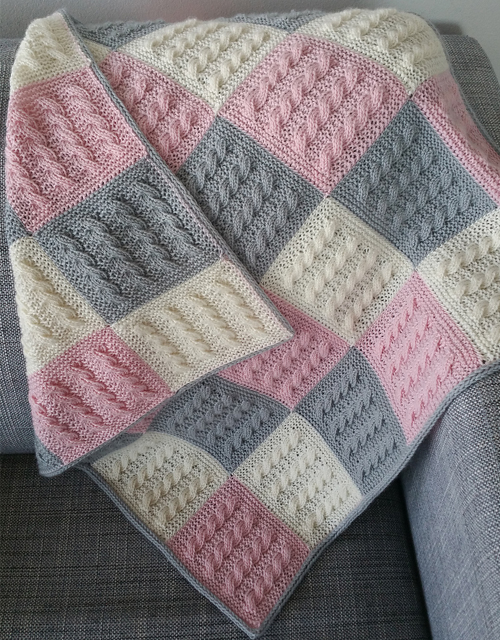
Cable Square Blanket - Knitting Pattern Guide

Cable Square Blanked - Knitting Pattern
Photo above © Audurbjort 

Cable Square Blanket by Auður Björt Skúladóttir is a striking modular knitted blanket built from colorful cable squares with an unusual feature: the cable designs are intended to look attractive from both sides.

Originally listed under the Icelandic name Kaðlabútateppi and the English title Cable Square Blanked, the project combines reversible cable knitting, multiple colors and modular blanket construction.

Pattern Availability Note

This design is still listed among Auður Björt Skúladóttir's patterns, but we could not verify a current legitimate free download for the original pattern. For that reason, Amazing Knitting does not describe it as a free pattern or link to unauthorized archived copies.

Cable Square Blanket at a Glance

Original Name: Kaðlabútateppi / Cable Square Blanked

Designer: Auður Björt Skúladóttir

Craft: Knitting

Category: Blanket / Throw

Construction: Knitted cable squares joined into a blanket

Special Feature: Reversible cable designs

Color: Designed to work beautifully with multiple colors

Finishing: I-cord edging/bind-off is associated with the designer's blanket workshop

Current Pattern Status: Original design verified; free availability not verified

About the Cable Square Blanket

Cable Square Blanket is a modular knitting project by Icelandic designer Auður Björt Skúladóttir.

Instead of knitting one very large blanket from edge to edge, the project is based around individual knitted squares. Each square provides an opportunity to work cable textures while different yarn colors add variety across the finished blanket.

The result is particularly effective because the strong cable textures and changing colors give every section its own identity while the repeated square format holds the complete design together.

The Original Icelandic Name

The pattern appears in the designer's catalog as:

Kaðlabútateppi / cable square blanked

You may therefore encounter both this original listing and the more natural English description Cable Square Blanket when searching for the project.

Amazing Knitting uses “Cable Square Blanket” in this guide because it clearly describes the project for English-speaking knitters, while retaining the original pattern name above for identification.

Reversible Cable Knitting

One of the most interesting aspects of this project is the use of reversible cables.

Traditional cable knitting often has a very obvious right side and a much less decorative reverse side. Auður Björt Skúladóttir has a particular interest in designing knitted pieces that remain attractive when viewed from either side.

This characteristic is especially useful for blankets, scarves and shawls because both surfaces are likely to remain visible during normal use.

Why Reversible Cables Work Well for Blankets

A blanket is rarely displayed with only one side visible.

It may be folded over a chair, wrapped around someone or turned in different directions. A reversible texture therefore makes practical as well as decorative sense.

In this design, the cable structure becomes part of the appearance of both sides rather than leaving the reverse as something that always needs to be hidden.

Modular Square Construction

Working a blanket as separate squares has several practical advantages.

Individual blocks are easier to carry than an entire growing blanket, making modular knitting convenient for travel or short knitting sessions.

It also allows you to experiment with different colors without carrying all of the blanket's yarn at once.

The squares are eventually arranged and joined to create the complete throw.

Playing With Color

The original project is especially attractive when worked in several colors.

You might choose a coordinated palette of related shades, use contrasting colors for a more graphic effect, or build the blanket gradually from suitable yarn in your stash.

When planning a multi-color blanket, laying the finished squares on the floor before joining them can help distribute light, dark and dominant colors more evenly.

I-Cord Finishing

Auður Björt Skúladóttir has taught this particular Cable Square Blanket as a workshop project.

In that workshop, knitters first explored reversible cable techniques and then worked on assembling and finishing the blanket with an I-cord bind off.

An I-cord finish can give a modular blanket a clean outer edge and help visually unite the individual blocks.

Needles

A Reykjavík knitting workshop taught by the designer for this blanket asked participants to bring:

4 mm / US 6 circular needles, 60–80 cm / 24–32 inches

This is useful historical information about how the project has been taught, but always follow the specifications in any current copy of the designer's pattern rather than assuming workshop materials necessarily replace the pattern's complete requirements.

Skill Level

A Reykjavík Knitting Festival class devoted to this blanket was classified as Advanced.

That does not necessarily mean every individual square will feel equally difficult, but knitters should be comfortable managing cable techniques and following textured stitch patterns.

Skills That Help

Useful skills for a project of this type include:

  • Casting on and binding off
  • Knitting and purling confidently
  • Working cable stitches
  • Understanding cable crossings
  • Following repeating stitch patterns
  • Working reversible textures
  • Maintaining consistent gauge between squares
  • Joining knitted blocks
  • Working an I-cord edge or bind-off
  • Blocking individual squares

Keeping the Squares Consistent

Gauge deserves particular attention in a modular blanket.

If one square is noticeably larger than the others, joining the blocks neatly becomes much more difficult.

Try to use yarns with compatible weights and characteristics, and check the dimensions of your first completed squares before producing a large number of blocks.

Blocking Before Assembly

Blocking the squares before final assembly can make joining considerably easier.

It allows you to bring the blocks to consistent dimensions and straighten their edges before arranging the final blanket.

Follow the care instructions appropriate for your yarn and avoid overstretching the cable texture.

Planning the Final Layout

One of the enjoyable stages of a modular blanket is arranging the finished squares.

Before joining anything permanently, place the blocks together and try several layouts. Pay attention to color balance as well as the direction and visual weight of the cable motifs.

Taking a quick photograph of each possible arrangement can make the alternatives easier to compare.

Is the Original Cable Square Blanket Pattern Free?

We could verify that Kaðlabútateppi / Cable Square Blanked is an original design by Auður Björt Skúladóttir and remains associated with her pattern catalog.

However, we could not verify a current legitimate free download for the complete original pattern.

For that reason, Amazing Knitting does not label this project as a free pattern and does not reproduce or link to unauthorized copies of the designer's instructions.

Find the Original Designer

The safest place to check the current status of the original design is Auður Björt Skúladóttir's Ravelry designer catalog.

View Auður Björt Skúladóttir's Designs →

Looking for a Free Alternative?

If you mainly like the idea of building a blanket from knitted squares, you do not need to rely on an unauthorized copy of the original pattern.

Amazing Knitting has many free blanket and cable-knitting projects in the archive that you can explore instead.

Explore Free Knitted Blanket Squares →

You can also browse free cable blankets, knitted square blankets, and free blanket knitting patterns.

Before You Start

If you obtain the original pattern legitimately, read through the designer's instructions before selecting yarn or beginning a large number of squares.

Make one test square first. Check its dimensions, cable definition and appearance from both sides before committing yarn to the complete blanket.

Pattern credit: Kaðlabútateppi / Cable Square Blanked was designed by Auður Björt Skúladóttir. The existing photograph on this Amazing Knitting page is credited to Audurbjort. Amazing Knitting does not reproduce the designer's copyrighted charts or row-by-row knitting instructions.

Mitered Corner Blanket - Free Pattern

Mitered Corner Blanket - Free Pattern
Photo above © purlsoho

Mitered Corner Blanket by Purl Soho is a striking modular blanket built from 192 small mitered squares that flow through a carefully planned sequence of colors.

Although the finished blanket looks complex, its construction is wonderfully logical: each new square grows directly from neighboring squares by picking up stitches along their edges.

That means all 192 squares become one continuous blanket without sewing the individual squares together. The original Purl Soho pattern remains available online for free.

✓ Free Pattern Availability

Mitered Corner Blanket is currently available as a free knitting pattern directly from Purl Soho. Use the official pattern page linked below for the complete knitting instructions, schematic and current pattern information.

Mitered Corner Blanket at a Glance

Pattern: Mitered Corner Blanket

Designer: Jake Canton for Purl Soho

Published: January 2019

Category: Blanket / Throw

Original Yarn: Purl Soho Linen Quill

Yarn Weight: Fingering, held double

Needles: US 6 / 4 mm

Gauge: 22 stitches × 44 rows = 4 in / 10 cm in garter stitch, yarn held double

Sizes: Small Throw and Large Throw

Finished Size: 36 × 48 in or 48 × 64 in

Number of Squares: 192

Construction: Modular mitered squares joined as you knit

Seaming: No square assembly required

Availability: Free official Purl Soho pattern

About the Mitered Corner Blanket

Mitered Corner Blanket was designed for Purl Soho by Jake Canton and first published in January 2019.

The blanket is built from a grid of 192 small squares. Color changes across the grid create gradual transitions that make the finished project look almost like a textile painting.

What makes the construction especially clever is that these are not 192 separately knitted squares waiting to be sewn together at the end.

Instead, the blanket grows continuously as stitches for each new square are picked up from previously completed squares.

Two Finished Sizes

Purl Soho provides two sizes:

  • Small Throw: approximately 36 × 48 inches / 91 × 122 cm
  • Large Throw: approximately 48 × 64 inches / 122 × 163 cm

Both versions use the same 192-square layout.

The difference is the size of each individual square.

Square Size

Each finished square should measure approximately:

  • Small Throw: 3 × 3 inches
  • Large Throw: 4 × 4 inches

This is why gauge matters even though the project is a blanket. Small differences multiplied across many squares can noticeably change the final dimensions.

192 Squares — But No Sewing Them Together

Seeing “192 squares” might make you imagine an enormous pile of motifs that must eventually be assembled.

Fortunately, that is not how this blanket is constructed.

After the initial square, stitches for subsequent squares are picked up along the edges of existing squares as directed in the pattern.

The blanket therefore grows as one connected piece.

For knitters who enjoy modular blankets but dislike sewing dozens or hundreds of pieces together, this is one of the most appealing features of the design.

How a Mitered Square Gets Its Shape

A knitted mitered square begins as a row of stitches and becomes progressively smaller through centered decreases.

Those decreases pull the fabric toward the center diagonal, creating the characteristic square shape and visible directional lines.

Once you understand the rhythm of one square, the basic process becomes highly repetitive.

Amazing Knitting does not reproduce Purl Soho's complete square instructions here. Use the official free pattern for the exact stitch counts and decrease sequence.

Original Yarn: Linen Quill

The original blanket uses Purl Soho Linen Quill.

Linen Quill is a fingering-weight yarn containing:

  • 50% fine highland wool
  • 35% alpaca
  • 15% linen

Each 100-gram skein contains approximately 439 yards / 401 meters.

Important: The Yarn Is Held Double

Important Yarn Note

Although Linen Quill is a fingering-weight yarn, the Mitered Corner Blanket is knitted with two strands held together throughout the project. Keep this in mind when choosing a substitute yarn or calculating yardage.

Holding two strands together is also important to the original color design because combining different shades creates intermediate colors between the main palette tones.

Color Mixing Is Part of the Design

This blanket is more than a collection of solid-colored squares.

By holding two strands together, Purl Soho can combine two different colors in a single square.

Those combinations create gradual visual transitions as the blanket moves from one color family into another.

This is what gives the original blanket its watercolor-like appearance.

Original Color Palettes

Purl Soho has presented the blanket in several coordinated palettes, including:

  • Warm
  • Cool
  • Dawn
  • Mountain

You can follow one of the published palettes or use the construction as inspiration for your own color arrangement.

Choosing Your Own Colors

If you want to create a custom palette, think about how adjacent colors will interact when two strands are held together.

A useful approach is to arrange your skeins from one color family into another before beginning.

Photograph the arrangement or label each color so that you can reproduce your plan later.

With 192 squares, relying on memory alone can become confusing.

Needles

The published needle size is:

US 6 / 4 mm

Purl Soho notes that either circular or straight needles can be used.

Use whichever style feels comfortable, but choose the actual needle size according to the gauge you obtain with your yarn.

Gauge

The published gauge is:

22 stitches × 44 rows = 4 × 4 inches / 10 × 10 cm

This is measured in garter stitch with the yarn held double.

Knit Garter and Purl Garter

An interesting feature of the original blanket is that some squares are worked with knit garter stitch while others use purl garter stitch.

Purl Soho specifically recommends making sure that your gauge is correct in both.

If your knit and purl tension differs significantly, you may need to adjust your needle size or technique to keep the squares consistent.

Why Consistent Square Size Matters

A single square that is slightly larger may not seem important.

Across a grid of 192 squares, however, repeated gauge differences can affect the overall shape of the blanket.

Measure some of your early squares before progressing too far.

For the Small Throw, aim for approximately 3 inches square; for the Large Throw, approximately 4 inches square.

Picking Up Stitches Neatly

Picking up stitches is one of the key skills in this project.

Because each new square grows directly from its neighbors, consistent pickup technique helps keep the joins neat and the grid even.

Avoid picking up stitches at random intervals just to reach the required number. Follow the edge structure and the designer's instructions so the new square sits naturally against the existing fabric.

A Good Modular Knitting Project

One advantage of this construction is psychological as well as practical.

Instead of thinking about knitting an entire 48- or 64-inch blanket, you can focus on completing one small square at a time.

Each finished square becomes a visible unit of progress.

That can make a large long-term blanket project feel much more manageable.

Managing Yarn Ends

A project involving many colors naturally creates yarn ends.

Do not wait until the very last square to think about finishing them.

Weaving in ends periodically can prevent the back of the blanket from becoming overwhelming near the end of the project.

Leave tails long enough to secure them properly according to your yarn and finishing method.

Choosing a Substitute Yarn

You do not have to use Linen Quill, but substitution requires some planning because the original pattern holds fingering-weight yarn double.

Consider:

  • The published gauge
  • The size of each finished square
  • How two strands behave together
  • Color-mixing possibilities
  • Drape and weight of the finished blanket
  • Total yardage
  • Washing and care requirements

Make at least one complete mitered square with your substitute yarn before committing to enough yarn for the full blanket.

Blocking the Finished Blanket

Blocking can help even out the grid and settle small differences between neighboring squares.

Follow the care instructions for your chosen yarn and arrange the blanket so that the outer edges are straight without aggressively stretching individual squares.

Skills Used in Mitered Corner Blanket

  • Garter stitch
  • Centered decreases
  • Picking up stitches
  • Working modular squares
  • Holding two yarn strands together
  • Changing and combining colors
  • Maintaining consistent gauge
  • Weaving in ends
  • Blocking a large knitted blanket

Is Mitered Corner Blanket Still Free?

Yes.

Purl Soho continues to provide the complete Mitered Corner Blanket pattern for free on its official website.

This is the best source to use because it contains the designer's instructions, color information, schematic and current pattern notes.

Amazing Knitting does not reproduce Purl Soho's complete copyrighted knitting instructions.

Get the Free Mitered Corner Blanket Pattern

Visit Purl Soho for the complete official free pattern:

Get the Free Mitered Corner Blanket Pattern →

You can also view the Ravelry record for project examples and pattern specifications:

View Mitered Corner Blanket on Ravelry →

More Free Blanket Knitting Patterns

If you enjoy geometric or textured blankets, these already-verified Amazing Knitting patterns are also worth exploring:

Or browse:

Before You Start

Make one complete test square before beginning the full 192-square blanket. Check both your gauge and the finished square dimensions.

Remember that the original fingering-weight Linen Quill is held double throughout, and organize your colors before beginning if you plan to reproduce the gradual color transitions.

Finally, keep the official Purl Soho pattern open while working so that you can follow the correct square sequence and color schematic rather than relying on copied versions elsewhere.

Pattern credit: Mitered Corner Blanket was designed for Purl Soho by Jake Canton and first published in 2019. The existing photograph on this Amazing Knitting page is credited to Purl Soho. Amazing Knitting provides an independent project guide and does not reproduce Purl Soho's complete copyrighted knitting instructions.

Slip Stitch Sampler Throw - Free Pattern

Slip Stitch Sampler Throw - Free Pattern
Photos above © DrBron

Slip Stitch Sampler Throw by Irina Poludnenko is a colorful free knitting pattern originally published by Lion Brand. It combines slip-stitch colorwork with a modular log-cabin-inspired construction to create a large, eye-catching throw.

Six sections use the same basic log-cabin design in different color combinations, producing a sampler-style blanket without requiring complicated stranded colorwork.

The pattern is still available as a free knitting pattern, with a current downloadable version available through LoveCrafts.

✓ Free Pattern Availability

Slip Stitch Sampler Throw, Lion Brand pattern L10347, is currently available as a free downloadable knitting pattern. Use the current pattern source below for the complete instructions.

Slip Stitch Sampler Throw at a Glance

Pattern: Slip Stitch Sampler Throw

Designer: Irina Poludnenko

Publisher: Lion Brand Yarn

Pattern Number: L10347

Category: Blanket / Throw

Yarn Weight: Aran

Original Yarn: Lion Brand Vanna's Choice

Needles: US 8 / 5 mm

Gauge: 16 stitches × 24 rows = 4 in / 10 cm in slip-stitch pattern

Yardage: Approx. 3,570 yd / 3,264 m

Finished Size: Approx. 50 × 75 in / 127 × 190.5 cm

Construction: Modular squares, seamed

Techniques: Slip stitches, mosaic-style colorwork, stripes

Availability: Free downloadable pattern

About the Slip Stitch Sampler Throw

Slip Stitch Sampler Throw was designed by Irina Poludnenko for Lion Brand Yarn.

Rather than making one enormous uninterrupted panel, the blanket uses the same log-cabin-inspired design six times in different color combinations.

Once the individual sections are complete, they are assembled into a large rectangular throw.

The result is a colorful sampler blanket with strong geometric structure and plenty of visual variety.

Finished Size

The published finished dimensions are approximately:

50 × 75 inches / 127 × 190.5 cm

This is a substantial throw rather than a small lap blanket, so expect it to become a fairly large project both in knitting time and total yarn requirement.

Original Yarn

The pattern was designed using Lion Brand Vanna's Choice, an Aran-weight acrylic yarn.

The original yarn is listed at approximately 170 yards per 100-gram ball.

The published blanket uses multiple colors to create the changing combinations across its six main sections.

Original Color Plan

The published version uses nine colors:

  • Dusty Blue
  • Chocolate
  • Rust
  • Olive
  • Dusty Purple
  • Brick
  • Pea Green
  • Mustard
  • Purple

The original quantities total 21 balls of Vanna's Choice.

Dusty Blue, Olive and Dusty Purple use three balls each, while the other six colors use two balls each.

Total Yardage

Ravelry records total published yardage of approximately:

3,570 yards / 3,264 meters

That large quantity reflects both the generous finished dimensions and the nine-color construction.

If substituting yarn, calculate your requirements carefully before beginning, particularly if some colors will be difficult to replace later from the same dye lot.

Needles

The published needle size is:

US 8 / 5 mm

Needle size is only a starting point. Use the size that allows you to obtain the required gauge with your chosen yarn.

Gauge

The published gauge is:

16 stitches × 24 rows = 4 × 4 inches / 10 × 10 cm

This gauge is measured in the slip-stitch pattern.

Even though a blanket does not need to fit a body, gauge still matters here because six separate sections eventually need to work together as one finished throw.

What Is Slip-Stitch Colorwork?

Slip-stitch colorwork can create surprisingly elaborate-looking patterns without requiring you to work several yarn colors across the same row at once.

Selected stitches are slipped rather than worked, allowing color from an earlier row to remain visible in the new row.

The technique can produce geometric color effects while keeping the actual knitting relatively approachable.

Why Slip Stitches Work Well Here

The strong colors already give this blanket plenty of visual energy. Slip stitches add another layer of texture and pattern without requiring complex stranded colorwork across every row.

They also complement the geometric log-cabin structure particularly well.

Keep Slipped Stitches Relaxed

One of the most important habits in slip-stitch knitting is avoiding excessive tension.

If the yarn carried past slipped stitches is pulled too tightly, the fabric can become compressed or distorted.

Allow the stitches to remain comfortably spaced on the needle as you work across each section.

Log-Cabin-Inspired Construction

Traditional log-cabin knitting builds outward in sections, creating strong geometric blocks of color.

Slip Stitch Sampler Throw uses this visual idea repeatedly, creating six versions of the same basic design in different color combinations.

This repetition is useful because once you understand how one section develops, the overall construction becomes much easier to visualize.

Six Main Sections

The throw is modular rather than one-piece.

Six major sections are knitted and later assembled to create the finished 50 × 75-inch blanket.

Modular construction has an important practical advantage: you do not need to carry the entire weight of a large blanket on your needles throughout the project.

Managing Nine Colors

A nine-color project benefits from a little organization.

Before casting on, label your colors according to the pattern and keep leftover yarn clearly identified.

Avoid relying only on memory, especially when several shades are similar.

A simple note showing the yarn name, color letter and remaining ball count can prevent confusion later in the project.

Choosing Your Own Palette

You do not have to reproduce the original Lion Brand colors exactly.

The geometric construction makes this an excellent project for creating your own coordinated palette.

Consider combining:

  • Warm autumn shades
  • Cool blues and greens
  • Muted vintage colors
  • Bright contrasting colors
  • Neutrals with a few strong accent shades

Whatever palette you choose, make sure neighboring colors have enough contrast for the slip-stitch pattern to remain visible.

Substituting the Yarn

If you use another Aran-weight yarn, make a slip-stitch swatch before buying the full quantity.

Look for a yarn that provides:

  • Good stitch definition
  • Consistent gauge
  • Comfortable drape
  • Colors with useful contrast
  • Care instructions suitable for a large blanket

Wash your swatch according to the yarn manufacturer's directions to see how the finished fabric changes.

Assembly Matters

Ravelry classifies the design as seamed.

Because separate sections eventually form one large geometric blanket, careful assembly is important.

Before sewing, block the sections if appropriate for your yarn and lay them out in the intended arrangement.

Check orientation and color placement before joining anything permanently.

Keep the Seams Flexible

A blanket seam should be secure without becoming a rigid ridge.

Pulling the joining yarn too tightly can cause the assembled throw to pucker along the seams.

Periodically lay the work flat while joining the sections to make sure the seam tension remains comfortable.

Important Pattern Correction

Important Before You Knit

Lion Brand published corrections for pattern L10347 on April 17, 2013. For that reason, use a current corrected version of the pattern rather than relying on an old copy saved from the original publication period.

Corrections are one of the main reasons Amazing Knitting links readers back to legitimate current pattern sources rather than reproducing old instructions.

Skill Level

Lion Brand classified the project as:

Easy+ / Level 3

The blanket is large, but the modular construction and repetition mean that project size should not automatically be confused with technical difficulty.

Skills Used in This Project

  • Knitting and purling
  • Slipping stitches
  • Changing colors
  • Reading repeating stitch patterns
  • Modular knitting
  • Picking up or working from existing sections as directed
  • Maintaining consistent gauge
  • Seaming knitted sections
  • Weaving in multiple yarn ends
  • Blocking and finishing a large blanket

Is Slip Stitch Sampler Throw Still Free?

Yes.

Slip Stitch Sampler Throw by Irina Poludnenko is still listed as a free knitting pattern, and a free downloadable PDF of Lion Brand pattern L10347 is currently available through LoveCrafts.

Amazing Knitting does not reproduce the designer's complete copyrighted instructions. Use the legitimate pattern source for the complete knitting directions.

Get the Free Slip Stitch Sampler Throw Pattern

The Lion Brand L10347 pattern is currently available as a free downloadable PDF from LoveCrafts:

Get the Free Slip Stitch Sampler Throw Pattern →

You can also view the Ravelry pattern record for project examples, specifications and historical pattern information:

View Slip Stitch Sampler Throw on Ravelry →

More Free Blanket Knitting Patterns

If you enjoy textured and colorful blanket projects, explore more verified free patterns in the Amazing Knitting archive:

Before You Start

This is a large multi-color project, so organize your nine colors before casting on and make a swatch in the actual slip-stitch pattern.

Pay particular attention to keeping slipped stitches relaxed and keeping the dimensions of the modular sections consistent so that assembly is easier later.

Most importantly, use a current corrected version of Lion Brand L10347 rather than an old copied version of the instructions.

Pattern credit: Slip Stitch Sampler Throw was designed by Irina Poludnenko for Lion Brand Yarn. The existing project photographs on this Amazing Knitting page are credited to DrBron. Amazing Knitting provides an independent project guide and does not reproduce the designer's complete copyrighted knitting instructions.

Over 50 Websites to Get Free Knitting Patterns

Over 50 Websites to Get Free Knitting Patterns
Designed by © Knit Crush

Looking for free knitting patterns? There are thousands of legitimate patterns available online for baby clothes, sweaters, blankets, scarves, socks, hats, toys and almost every other knitting project you can imagine.

The challenge is no longer simply finding a pattern. It is finding a reliable free pattern from a legitimate source, especially when older Pinterest pins and search results may lead to discontinued pages, outdated downloads or unofficial copies.

This guide will help you find free knitting patterns more safely and efficiently, whether you are searching the Amazing Knitting archive, a designer's website, a yarn company or a large knitting-pattern database.

About This Updated Guide

This Amazing Knitting article was originally published in 2019 as a link to an external roundup of more than 50 free-pattern websites. We have expanded the page into an independent resource for finding legitimate free knitting patterns without reproducing another publisher's list.

Where Can You Find Free Knitting Patterns?

Free knitting patterns are published by many different types of websites.

Some come directly from independent designers. Others are published by yarn manufacturers, knitting magazines, craft websites or pattern databases.

The best source depends on what you are looking for, so it helps to understand the major types of free-pattern resources before beginning your search.

1. Designer Websites

One of the best places to find a knitting pattern is the designer's own website.

Independent designers frequently publish selected patterns free while selling other designs.

Going directly to the designer has several advantages. You are more likely to find the current version of the pattern, corrections, additional photographs and notes from the person who actually created it.

If a pattern has been updated since its original publication, the designer's current page is usually preferable to an old copied version circulating elsewhere.

2. Yarn Company Pattern Libraries

Major yarn companies can be excellent sources of free knitting patterns.

These companies publish patterns to demonstrate how their yarns can be used, which means their libraries often contain projects across many categories and skill levels.

You can find designs for:

  • Baby sweaters and cardigans
  • Baby blankets
  • Adult sweaters and pullovers
  • Hats
  • Scarves and cowls
  • Socks and slippers
  • Shawls
  • Home accessories
  • Seasonal projects

Yarn-company libraries are especially useful because older patterns sometimes remain available long after the original printed booklet has disappeared.

3. Ravelry

Ravelry is one of the most useful resources for researching knitting patterns.

Rather than simply searching the web for a phrase such as “free baby cardigan,” you can narrow results using filters such as category, yarn weight, needle size, age, construction and availability.

Pattern records can also provide useful historical information such as the designer, publication date, suggested yarn and links to the current pattern source.

Remember that a Ravelry record does not automatically mean the pattern itself is still available. Always check the current availability shown on the pattern page.

4. Knitting Magazines and Online Publications

Online knitting magazines have published many excellent free patterns over the years.

Some older designs remain available in permanent online archives, making these publications particularly useful when searching for classic knitting projects.

These sources can also be valuable because they often preserve useful information about the designer, yarn, gauge, construction and original publication date.

5. Large Craft and Pattern Websites

Large craft websites often organize patterns by project type or skill level, which can make them useful when you are looking for inspiration rather than one particular design.

A collection might focus on beginner scarves, baby booties, knitted toys or quick gifts.

When using a roundup, however, follow the link to the original pattern source whenever possible.

6. Knitting Blogs

Knitting blogs remain another useful source of free patterns, tutorials and project inspiration.

Some bloggers are also pattern designers and publish complete original designs. Others curate projects from different designers.

The distinction matters.

When a blog is discussing somebody else's pattern, look for the designer's name and a clear link to the legitimate original source.

7. Vintage and Public-Domain Knitting Resources

Knitters interested in historical projects can also explore digitized vintage knitting books, magazines and pattern leaflets.

Older knitting publications can contain fascinating sweaters, lace, socks, mittens and household projects that differ significantly from modern designs.

However, old does not automatically mean public domain. Copyright status depends on factors including publication date, jurisdiction and publication history.

If you plan to republish rather than simply knit from a vintage pattern, verify its copyright status first.

8. Amazing Knitting

You can also browse the Amazing Knitting archive.

Our library includes hundreds of knitting discoveries covering baby clothes, blankets, sweaters, scarves, hats, socks, slippers, stitches, tutorials and other projects.

We are progressively reviewing older articles to identify original designers, verify pattern availability and direct readers toward legitimate current sources whenever possible.

Browse Free Knitting Patterns →

Free Baby Knitting Patterns

Baby projects are an excellent place to explore free patterns because there are designs for many different skill levels.

You can start with baby cardigans and sweaters:

Explore Free Baby Cardigans →

Or browse baby booties:

Explore Free Baby Booties →

And baby blankets:

Explore Free Baby Blankets →

Free Sweater and Cardigan Patterns

Sweaters range from simple first-garment projects to advanced designs involving cables, lace or colorwork.

When choosing one, pay particular attention to:

  • Finished measurements
  • Recommended ease
  • Gauge
  • Yarn weight
  • Construction method
  • Available sizes
  • Required techniques

Explore Free Sweater Patterns →

Free Blanket Knitting Patterns

Blankets are another large category of free knitting patterns.

Depending on the design, a blanket can be a simple beginner project or an advanced combination of lace, cables, colorwork or modular knitting.

Baby blankets are particularly useful for practicing new techniques on a manageable scale.

Explore Free Blanket Patterns →

Free Scarf and Cowl Patterns

Scarves and cowls are useful projects for testing unfamiliar stitches without committing to the fit requirements of a sweater.

They are also good projects for experimenting with cables, lace, texture and unusual yarn.

Explore Free Scarf Patterns →

How to Tell Whether a Pattern Is Really Free

One of the biggest problems with older knitting links is that pattern availability changes.

A pattern that was free ten years ago may now be paid, discontinued or completely unavailable.

Before calling a pattern free, check the current original source.

Look for clear wording such as:

  • Free pattern
  • Free download
  • Download PDF
  • Pattern available free on the designer's website

If the only evidence that a pattern is free comes from an old Pinterest pin or an old roundup, verify it before downloading.

Free Web Pattern vs. Free PDF

A pattern does not need to include a downloadable PDF to be genuinely free.

Some designers publish the complete pattern as a free webpage while offering an optional printable or ad-free PDF for a fee.

In that situation, describe the availability accurately: free web version with optional paid PDF.

This is more useful than simply labeling everything “free” or “paid.”

Watch for Discontinued Patterns

Older pattern databases can contain records for designs whose original downloads have disappeared.

A historical record is useful for identifying the designer and project, but it does not necessarily provide permission to download a copied PDF from another website.

If the legitimate source is gone, look for a currently available alternative instead of using an unauthorized copy.

Avoid Suspicious Pattern Downloads

Be cautious when a website offers a designer's PDF without clearly identifying itself as the designer, publisher or an authorized distributor.

A safer route is usually:

  1. Identify the exact pattern name.
  2. Identify the designer.
  3. Find the designer or publisher's current page.
  4. Check the current availability.
  5. Download or follow the pattern from that legitimate source.

Check for Pattern Corrections

Another advantage of using the current source is access to corrections and updates.

Designers sometimes discover errors after publication and issue an updated PDF or an errata notice.

An old copy saved elsewhere may not include those corrections.

Check the Yarn Before You Buy It

Older patterns frequently recommend yarns that have since been discontinued.

That does not necessarily make the pattern unusable.

Instead of searching only for the exact old yarn, compare:

  • Yarn weight
  • Gauge
  • Fiber content
  • Yardage or meterage
  • Fabric characteristics

Always make a gauge swatch before committing to a substitute yarn for a fitted garment.

Start with the Project You Want to Make

Searching “free knitting patterns” can return an overwhelming number of results.

A more effective approach is to begin with a specific project:

  • Free newborn cardigan knitting pattern
  • Free baby booties knitting pattern
  • Free cable blanket knitting pattern
  • Free beginner scarf knitting pattern
  • Free top-down sweater knitting pattern
  • Free lace shawl knitting pattern

Then narrow your choices according to yarn weight, size and skill level.

Save the Designer's Name

When you find a pattern you love, save more than the photograph.

Record the pattern name and designer.

This makes it much easier to find the legitimate pattern again if a Pinterest pin, bookmark or old website link stops working in the future.

Our Approach at Amazing Knitting

Amazing Knitting is a curated discovery library rather than the owner of every pattern featured in its archive.

When a project belongs to another designer, our goal is to identify and credit that designer, provide useful independent information about the project and direct knitters to the legitimate pattern source.

If an old pattern that was once free has become paid or unavailable, we aim to make that clear rather than continuing to promise a free download that no longer exists.

Explore Free Knitting Patterns

Ready to find your next project? Browse the Amazing Knitting archive by project type.

Before Downloading a Free Pattern

Take a moment to confirm that you are using the current legitimate version.

Check the designer's name, current availability, size range, yarn requirements and whether any corrections have been published.

A few minutes of checking before casting on can prevent hours of frustration later in the project.

Editorial note: This article was originally published by Amazing Knitting in 2019 as a discovery link to a Knit Crush roundup. It has since been expanded into an original Amazing Knitting resource for finding and evaluating free knitting patterns. The original image used on this page is credited to Knit Crush.

Sweet Gemma Baby Blanket - Knitting Pattern

Sweet Gemma Baby Blanket - Knitting Pattern
Photos above © Triona Murphy & © Savbacke Photography
What beautiful knitting baby blanket pattern! I found it on Ravelry...
Cable and lace number blanket squares are worked individually in the round from the center out and then joined using a crochet hook for this modular blanket. The cable and lace pattern is provided in both charted and written out formats. Knit up in worsted weight yarn, it’s the perfect size for a crib or stroller blanket. You can even use individual squares to make matching pillows.

Full Post: Sweet Gemma

Discover More From the Archive

A fresh mix of knitting patterns and tutorials from the Amazing Knitting archive.

Finding patterns from the archive…