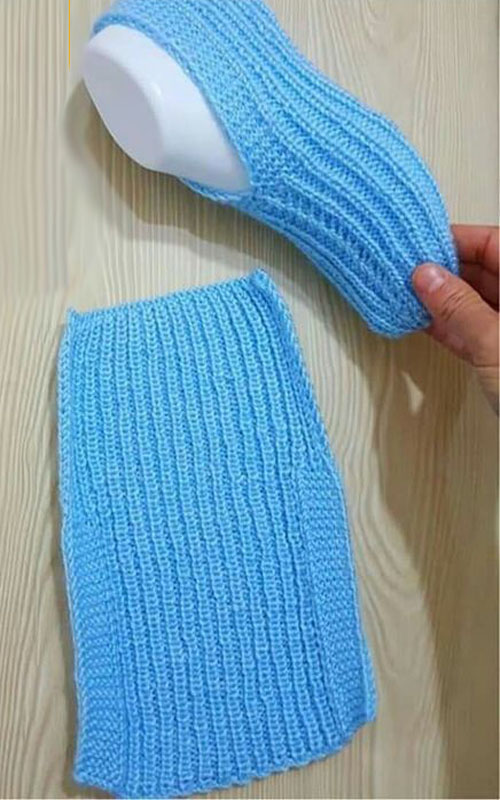
 |
| The photo above @ Gülümseten Marifetler |
Full Post: Super Easy Booties

|
| The photo above @ Gülümseten Marifetler |
Full Post: Super Easy Booties
 |
| Photos above © MmeUlma & © sorrelwood |
Looking for a simple and charming baby wrap cardigan knitting pattern? This garter-stitch cardigan is a classic crossover design that is worked largely in one piece, making it especially appealing to knitters who prefer simple construction and minimal finishing.
The cardigan has a soft wrap-over front and a timeless handmade look that works beautifully for newborn gifts, baby showers, and everyday baby wear.
Pattern Type: Baby Wrap Cardigan
Craft: Knitting
Category: Baby Cardigan / Wrap Sweater
Main Stitch: Garter Stitch
Construction: Worked mainly in one piece
Direction: Bottom-up, beginning with the back
Original Source: MmeUlma / Madam Ulma
This little cardigan uses a wrap-over construction rather than a traditional button-front shape. The crossover front gives the garment a soft, comfortable look while also making it easy to layer over other baby clothes.
The design was originally shared through the MmeUlma blog and became popular online through knitting and Pinterest communities.
One of the most appealing features of this cardigan is its construction. The garment is worked largely in one piece, beginning at the back and building upward.
One-piece baby garments can be especially attractive to knitters because they reduce the number of separate pieces that need to be assembled at the end.
This also helps create a clean, simple silhouette that suits the minimalist style of the cardigan.
The cardigan is worked in garter stitch, one of the most useful and beginner-friendly knitting textures.
Garter stitch creates a soft, ridged fabric that lies flat naturally and does not curl at the edges in the same way as stockinette stitch.
That makes it a practical choice for baby garments, where soft texture and simple finishing are often desirable.
Wrap-style cardigans are popular for babies because the crossover front creates a flexible fit and avoids a bulky center-front opening.
They can also be layered over bodysuits, sleepsuits, and lightweight tops, making them useful through changing temperatures.
The simple shape also works well in both traditional baby colors and more modern, gender-neutral shades.
Because the design relies on garter stitch and relatively simple construction, this type of cardigan can be a good transition project for knitters who are comfortable with scarves, blankets, or baby accessories and want to try a small garment.
The main skills typically involved include basic knit stitches, shaping, and managing the wrap-front construction.
The original source page is no longer consistently accessible, so the current yarn specification cannot be verified reliably.
If you are recreating a similar wrap cardigan, choose a soft yarn suitable for baby garments and pay close attention to washability, fiber comfort, and gauge.
Always follow the original pattern specifications if you have a saved copy of the pattern, since yarn weight and needle size directly affect the finished size.
This Amazing Knitting page originally linked to a free pattern page from MmeUlma.
At the moment, the original external page is no longer reliably accessible without a Google sign-in, so we cannot confirm whether the pattern is still publicly available in its original form.
Amazing Knitting does not reproduce the original designer's knitting instructions.
The button below points to the original MmeUlma page that was linked from this article. Its current accessibility may vary.
Visit the Original Baby Cardigan Source →
Source note: This design was originally shared through MmeUlma. The original source page is currently not consistently accessible, so Amazing Knitting has intentionally avoided adding unverified sizing, yarn, needle, or gauge information.
Explore more baby cardigan knitting patterns, baby wrap cardigan ideas, and baby sweater knitting patterns from the Amazing Knitting archive.
If you have access to the original MmeUlma instructions, use the designer's specified yarn, needle size, gauge, and measurements rather than relying on substitutions from other baby cardigan patterns.

Sheep Yoke Baby Cardigan by Jennifer Little is a charming baby sweater featuring a playful flock of sheep around a colorful patterned yoke. The combination of traditional colorwork, tiny sheep and a practical button-front cardigan makes this an especially memorable hand-knit for a baby.
The pattern was originally published on Jennifer Little's Looking Glass Knits in 2007 and is still available free from the designer's original pattern page.
The cardigan is designed in DK-weight yarn and includes two baby sizes. Instead of changing the stitch counts between sizes, the designer uses different needle sizes and gauges, allowing the same yoke chart and stitch counts to be used for both versions.
Design © Jennifer Little / Looking Glass Knits.
The feature that immediately makes this baby cardigan stand out is its sheep-patterned yoke. Small sheep are arranged around the upper part of the sweater and surrounded by contrasting geometric colorwork.
The sheep aren't simply decorative blocks of color. The original design uses texture to help them stand out from the surrounding stockinette fabric, while duplicate-stitch details are added later to create features such as the heads and legs.
One sheep at the center back even faces forward rather than following the direction of the rest of the flock, giving the yoke an especially playful detail.
Jennifer Little designed the cardigan for approximately 6–9 months and 9–12 months.
An interesting feature of the pattern is the way the two sizes are created. The stitch counts and colorwork chart remain the same; instead, the knitter uses a different needle size and gauge to produce the smaller or larger cardigan.
For that reason, making and measuring a gauge swatch is particularly important for this project. Choose the needle size that produces the gauge required for the size you want rather than relying only on the needle number printed in the pattern.
The original pattern calls for DK-weight superwash wool. The designer used Knit Picks Swish DK for the sample.
The original palette combines a main neutral color with blue, green, cream and black. A pink accent is also included in the girl's version described by the designer.
You don't have to reproduce the original colors exactly. The sheep motif can work beautifully with many combinations, but choosing shades with enough contrast will help the individual sections of the yoke remain clearly visible.
A soft washable DK yarn is also a practical choice for a baby garment, provided your substitute yarn produces the required gauge and a comfortable fabric.
The Sheep Yoke Baby Cardigan is a top-down yoke design. Knitting begins at the neck and progresses through the patterned yoke before the stitches are divided for the sleeves and body.
The cardigan is worked flat rather than as a pullover in the round. After the yoke is complete, sleeve stitches are held while the body is worked downward. The sleeves are then completed separately.
Button bands are added along the front edges by picking up stitches, and the finishing process includes seaming the sleeves, weaving in the ends, blocking and adding the buttons.
The yoke combines several techniques, making this a fun project for knitters who want to practice decorative colorwork on a relatively small garment.
The designer worked the sheep using stranded colorwork, but notes that intarsia can also be used if that method feels more comfortable.
Some of the final sheep details are added with duplicate stitch. The forward-facing sheep at the center back also receives small French-knot eyes.
Because the cardigan is worked flat, the patterned yoke involves working colorwork on both right-side and wrong-side rows. Knitters who are accustomed only to stranded knitting in the round may want to take their time through this section.
Check your gauge first. This matters more than usual because the designer uses gauge to create the two different cardigan sizes while keeping the underlying stitch counts the same.
When working the yoke increases, read the designer's chart notes carefully. The increases need to be distributed through the appropriate chart sections, but they should not form obvious vertical increase lines.
It can also help to organize your yarn before beginning the sheep section. Several colors appear within a relatively small area, so keeping individual yarn sources separated can make the colorwork much easier to manage.
Finally, don't skip the designer's notes accompanying the original pattern. Jennifer includes several useful explanations about the chart, colorwork options and possible modifications.
Yes. Jennifer Little provides the Sheep Yoke Baby Cardigan pattern free on her original Looking Glass Knits website.
The original web version includes the materials, gauge information, yoke chart guidance, knitting instructions and the designer's additional notes.
Because the designer's original free page is still available, Amazing Knitting links directly to that source rather than to unofficial pattern copies.
View the Free Sheep Yoke Baby Cardigan Pattern →
The link above takes you to Jennifer Little's original Looking Glass Knits pattern page, where you can read the complete free pattern and the designer's notes.
The Sheep Yoke Baby Cardigan has the charm of a traditional Fair Isle-inspired baby sweater without looking overly formal. The little flock turns the colorwork yoke into the focal point, while the simple lower body keeps the overall design balanced.
It is also a manageable way to explore several useful sweater-making skills in one small project: yoke shaping, colorwork, sleeve division, button bands and decorative finishing.
And because the original pattern remains freely available from the designer, it is an excellent choice for knitters looking for a distinctive free baby cardigan knitting pattern.
Amazing Knitting links readers to legitimate designer or publisher sources whenever possible. Pattern availability, download locations and other details can change after an article is published.
Read Our Pattern Availability Policy →
Amazing Knitting is an independent pattern discovery and project-guide site. The Sheep Yoke Baby Cardigan design and pattern remain the intellectual property of Jennifer Little. This guide does not reproduce the designer's complete chart or row-by-row knitting instructions.
 |
| The photo above @ peterlinzi |
Looking for a sweet and practical free baby cardigan knitting pattern? The Charlie Baby Cardigan Jacket by marianna mel is a classic little knitted cardigan designed for newborns and young babies.
With its simple styling and DK-weight yarn, Charlie works beautifully for both baby boys and girls. The pattern includes several small baby sizes and also offers options for different front styles, making it a versatile project for baby gifts, coming-home outfits, and everyday wear.
Pattern: Charlie Baby Cardigan Jacket
Designer: marianna mel
Published by: Marianna's Lazy Daisy Days
Craft: Knitting
Category: Baby Cardigan / Jacket
Yarn Weight: DK
Suggested Needle Size: US 6 / 4.0 mm
Gauge: 22 stitches = 4 inches in stocking stitch
Sizes: Newborn, 0–3 months, 3–6 months
Pattern Availability: Free
Charlie is a charming baby cardigan designed by marianna mel of Marianna's Lazy Daisy Days. Its classic shape makes it suitable for either a baby boy or girl, and the smallest size was designed especially with newborn babies in mind.
This is also a useful pattern for knitters who enjoy making handmade baby gifts. The small dimensions keep the project manageable, while the straightforward styling makes it easy to personalize through your choice of yarn color and buttons.
The pattern currently includes three baby sizes:
The original newborn version has approximate finished measurements of 16 inches (41 cm) wide, 8½ inches (21.5 cm) long, and a 5-inch (13 cm) sleeve length.
Always check the designer's current pattern instructions before choosing a size, since the original pattern page is the authoritative source for measurements and any later updates.
Charlie is designed for DK-weight yarn, sometimes also described as 8-ply depending on where you live.
A soft, comfortable yarn suitable for baby garments is a practical choice. Since baby clothes are frequently worn directly over lightweight clothing, consider softness, washability, and care requirements when selecting your yarn.
You can also change the personality of this little cardigan simply through color: classic white and cream create a traditional look, while soft pastels or brighter modern shades can make the same design feel completely different.
The pattern lists:
Matching the designer's gauge is particularly important for a small baby garment, where even a relatively small difference in tension can noticeably affect the finished size.
One interesting feature of the Charlie pattern is that it has developed over time. In addition to the original cardigan, the designer added instructions for a fully buttoned front version in all of the available sizes.
There is also an option for making a shorter cropped version, which the designer suggests can work especially well when worn over a little dress.
Check the current original pattern page to see the available variations before deciding which version you would like to knit.
Small cardigans are especially useful projects for baby showers, newborn gifts, and handmade keepsakes. Charlie's simple styling also means that it can be made ahead of time when you do not yet know whether the new baby will be a boy or girl.
Pairing the cardigan with coordinating baby accessories can also turn a single knitted garment into a complete handmade gift set.
The designer has created other pieces to coordinate with the Charlie cardigan, including matching baby booties, a hat, mittens, and a blanket.
This makes Charlie particularly useful if you enjoy creating coordinated newborn sets rather than knitting just one garment.
Yes. The Charlie Baby Cardigan Jacket by marianna mel is currently available as a free knitting pattern.
Amazing Knitting does not reproduce the designer's knitting instructions. Please visit the original pattern source to view the complete instructions, measurements, variations, and any updates from the designer.
Visit Marianna's original Charlie Baby Cardigan page for the complete free knitting pattern.
Get the Free Charlie Baby Cardigan Pattern →
Pattern credit: Charlie Baby Cardigan Jacket was designed by marianna mel and published through Marianna's Lazy Daisy Days. Pattern availability, sizing, and technical details are controlled by the designer and may change over time.
Looking for another small project? Explore more baby cardigan knitting patterns, baby sweater knitting patterns, and baby booties knitting patterns from the Amazing Knitting archive.
Visit the designer's original pattern page before buying yarn or beginning your project. Confirm the latest size information, gauge, materials, button requirements, and instructions for the version of Charlie you plan to knit.
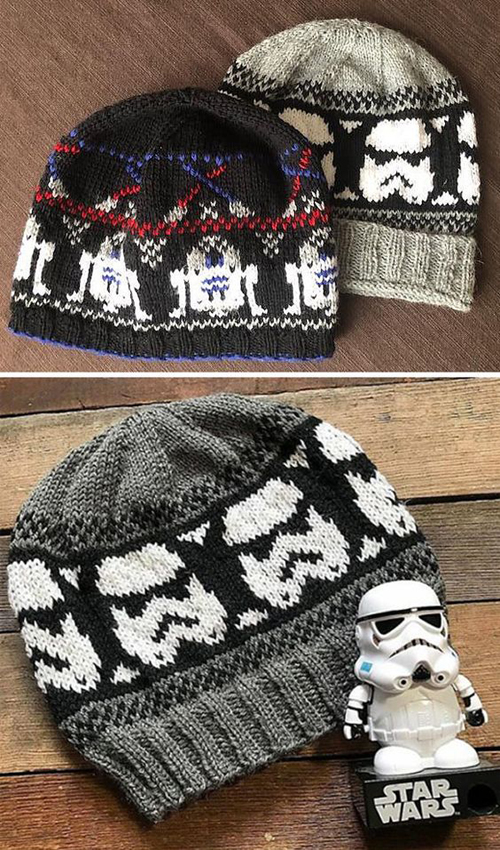
Storm Trooper Beanie by Lindsay (Bundle). Project photos @creeksidecrochet & © Marlaatumass.
Storm Trooper Beanie by Lindsay (Bundle) is a fun Star Wars-inspired knitted hat featuring a recognizable black-and-white helmet motif created with stranded colorwork.
Originally published in 2017, the design became popular with knitters looking for an approachable introduction to Fair Isle-style colorwork. It combines a straightforward beanie construction with a graphic motif that makes the finished hat stand out.
Pattern availability update: this pattern was previously available as a free digital pattern, but its current Ravelry record lists it as discontinued and no longer available online. We have therefore removed the old “Free Pattern” label from this page.
The Storm Trooper Beanie takes the familiar shape of a knitted beanie and turns it into a graphic colorwork project.
The hat uses contrasting light and dark yarn to create a Stormtrooper-inspired helmet motif around the body of the hat.
Because most of the visual impact comes from two-color stranded knitting, the project is particularly interesting for knitters who want to move beyond plain hats without tackling a highly complicated garment.
The designer originally described the pattern as a good introduction to stranded or Fair Isle-style knitting.
Instead of creating the graphic design afterward with embroidery, the contrasting colors are worked directly into the knitted fabric.
This gives the hat its crisp, recognizable appearance while teaching an important knitting technique that can later be used for sweaters, mittens, cowls and many other projects.
In stranded knitting, two colors are used across the same round.
While one color is being knitted, the unused yarn travels behind the fabric in strands commonly called floats.
The challenge is keeping those floats loose enough that they do not pull or distort the finished fabric.
Once you become comfortable managing two yarns, the technique can become surprisingly rhythmic.
Tension is one of the most important parts of stranded knitting.
If the floats behind the work are pulled too tightly, the colorwork section may become narrower than the rest of the hat and the motifs can pucker.
Try spreading the recently worked stitches naturally along the right needle before carrying the unused yarn behind them.
Your goal is a flexible fabric where the colorwork lies flat without loose loops hanging inside the hat.
Graphic motifs sometimes create sections where one color is not used for several stitches.
Longer floats require a little more attention because they can become either too tight or too loose.
Depending on the distance involved, experienced colorwork knitters may choose to catch a longer float behind the fabric.
Avoid catching floats in exactly the same location on consecutive rounds, which can make the trapped yarn more visible from the front.
The Storm Trooper Beanie is worked in the round.
This construction is particularly convenient for stranded colorwork because the right side of the fabric remains facing you while the graphic motif is being created.
There is also no long vertical seam to sew after completing the main body of the hat.
The hat begins at the lower edge and progresses upward toward the crown.
This familiar bottom-up structure lets you establish the circumference before working the main graphic section.
Crown decreases then shape the top of the beanie.
The original pattern uses sport-weight yarn.
The suggested yarn was Knit Picks Brava Sport, an acrylic yarn that provides clear stitch definition for graphic colorwork.
You do not necessarily need to use the exact original yarn, but any substitute should produce the required gauge and a fabric suitable for a fitted hat.
The published pattern information lists approximately 160–180 yards (146–165 meters).
Since this is a colorwork design, you need contrasting colors rather than a single uninterrupted shade.
If you are substituting yarn, compare both yarn weight and meterage and allow a little extra for swatching.
Black and white are the obvious color choices when trying to preserve the Stormtrooper-inspired appearance.
The strong contrast also makes the charted motif easy to recognize.
However, knitters can use the same general colorwork concept with other high-contrast combinations for a more personalized result.
Colorwork motifs depend on contrast.
Two yarns that look very different in the skein can sometimes have surprisingly similar values when knitted together, causing the design to disappear.
A quick way to test your choices is to photograph the yarns together and view the image in grayscale. If they remain clearly different, the motif is more likely to remain visible.
The original pattern information lists US 6 / 4.0 mm needles.
The published gauge is approximately 23 stitches per 4 inches / 10 cm.
Use these numbers as a reference rather than assuming the listed needle automatically produces the correct result.
Individual knitting tension varies, so swatching remains important.
If possible, test at least part of your swatch using both colors.
Many knitters discover that their stranded knitting is tighter than their single-color stockinette.
A colorwork swatch can therefore tell you more about the final fit than a plain stockinette swatch alone.
A hat is much smaller than a stranded sweater, making it a practical project for learning a new technique.
You can practice:
Once these skills feel comfortable on a hat, larger stranded projects can seem much less intimidating.
Colorwork charts visually represent the stitches in each round.
Each square represents a stitch and its color tells you which yarn to use.
When knitting in the round, chart rows are generally read consistently in the direction of your knitting.
Always follow the instructions supplied with the specific pattern or chart because chart conventions can vary.
If a colorwork motif repeats around the hat, markers can make it easier to recognize where each repeat begins and ends.
This can help you catch a chart-reading mistake before it continues around several rounds.
Just make sure markers do not interfere with decreases or other shaping later in the project.
One advantage of graphic colorwork is that mistakes often become visually obvious.
Stop occasionally and look at the developing design from a short distance.
A misplaced contrasting stitch can be easier to spot in the overall image than while concentrating on individual chart squares.
The inside of a stranded hat will naturally show floats.
They do not need to look identical, but they should be reasonably even and flexible.
Extremely tight floats can affect fit, while very loose floats may catch on fingers when the hat is put on.
Gentle blocking can significantly improve stranded knitting.
It allows stitches to settle and can help small irregularities in tension become less noticeable.
Always choose a blocking method appropriate for the fiber content of your yarn.
This style of hat is especially appealing to knitters who enjoy pop-culture-inspired projects and graphic colorwork.
It was originally designed as a gift for a Star Wars fan, and that gift idea helped make the pattern popular among knitters.
The combination of a practical winter accessory and a recognizable motif gives the project much of its appeal.
Storm Trooper Beanie by Lindsay (Bundle) was previously available as a free knitting pattern.
However, its current Ravelry record now states that the design is discontinued and that the digital pattern is no longer available online.
Because Amazing Knitting verifies pattern availability periodically, we have removed the old “Free Pattern” description rather than continue sending readers to an unavailable download.
Ravelry still maintains the historical record for the original design. It is useful for confirming the designer, yarn weight, gauge, yardage, construction and project history, even though the pattern itself is no longer available for download.
View the Storm Trooper Beanie Pattern Record →
Because the original Lindsay (Bundle) pattern is discontinued, look for currently available stranded-colorwork beanie patterns if your main goal is to practice the same knitting techniques.
Search for designs using terms such as stranded colorwork beanie, two-color knitted hat or beginner Fair Isle hat.
Choose an alternative based on its current availability, gauge, size and yarn requirements rather than assuming that another pattern with “Stormtrooper” in its title is the same design.
Storm Trooper Beanie is a design by Lindsay (Bundle). Amazing Knitting does not reproduce the copyrighted pattern instructions. The pattern was formerly available free but is currently listed as discontinued and unavailable online.
 |
| Photos above © Katerina Mushyn |
Full Post: Warm Baby Booties

Holding Hands Baby Blanket. Photo © sworley
Holding Hands Baby Blanket by Yasemin Ersoy is a free textured baby blanket knitting pattern that turns a simple rectangular blanket into something much more interesting through repeating raised motifs.
Worked with DK-weight yarn, the design combines large areas of smooth knitting with textured details and a seed-stitch gauge. The result is a classic baby blanket that works beautifully as a handmade newborn or baby-shower gift.
The charm of the Holding Hands Baby Blanket comes from the contrast between its smoother background and repeating textured motifs. These raised sections break up the fabric and create the distinctive look that gives the blanket its name.
Because the texture is built directly into the knitting, there are no separate decorative pieces to attach afterward.
The original pattern calls for DK-weight yarn and 3.5 mm (US 4) knitting needles. Approximately 1,200 yards (1,097 m) of yarn are listed for the project.
The suggested yarn is Ingelise Palma, a DK-weight blend of cotton, rayon and linen. If you substitute another yarn, choose one that gives good stitch definition so the blanket's textured motifs remain clearly visible.
The blanket is an appealing choice for knitters who are comfortable with basic knitting and want to move into more interesting textured projects.
The design uses familiar knitting techniques to build the repeating texture across the blanket. Paying attention to the pattern repeats and checking your work as each motif develops will help keep the design consistent.
This pattern offers a nice balance between a practical baby blanket and an interesting knitting project. The neutral geometric texture can work with many different yarn colors, making it easy to adapt for a nursery or handmade gift.
A solid or lightly tonal yarn is especially effective because it allows the shadows created by the raised stitches to become part of the design.
The complete Holding Hands Baby Blanket pattern by Yasemin Ersoy is currently available as a free download from the designer's pattern page.
Get the Free Holding Hands Baby Blanket Pattern
Pattern availability was checked when this article was updated. Availability on external websites may change over time.

Checco's Dream. Photo above © sofiecat
Checco's Dream is a free baby and children's cardigan knitting pattern from DROPS Design. This classic button-front jacket features a V-neck, textured seed stitch and cleverly constructed sleeves without traditional sleeve seams.
Available in sizes from approximately 1 month to 4 years, it is a versatile free cardigan pattern for babies, toddlers and young children.
Checco's Dream covers a particularly useful range of baby and toddler sizes. The original DROPS pattern includes five sizes: 1/3 months, 6/9 months, 12/18 months, 2 years and 3/4 years.
Finished bust measurements range from approximately 48 to 70 cm (19 to 27½ inches), while the finished length ranges from approximately 27 to 40 cm (10⅝ to 15¾ inches), depending on the size selected.
The original cardigan is knitted in DROPS Merino Extra Fine, a soft merino yarn in DROPS Yarn Group B.
The current official pattern lists approximately 200–300 g of yarn, depending on size. DROPS notes that this yarn quantity was corrected in an update to the online pattern.
A 4 mm (US 6) circular needle is recommended, or the needle size required to achieve the specified gauge of 21 stitches and 28 rows per 10 cm in stockinette stitch.
The textured stitch pattern gives Checco's Dream much of its classic character. It adds visual interest to the cardigan while allowing a solid-colored yarn to show the stitch definition clearly.
The design also features a V-neck and buttoned front, giving the finished jacket a traditional style that works well for both babies and toddlers.
One of the most interesting features of Checco's Dream is its construction. Rather than knitting conventional separate sleeves and sewing them into armholes afterward, stitches are added as the garment progresses to form the sleeves.
The jacket is worked back and forth on a circular needle, beginning with the front sections and progressing through the shoulders and back. This approach avoids traditional sleeve seams.
DROPS Merino Extra Fine is the yarn specified for the original design, but DROPS also provides guidance for substituting yarns within its yarn group system.
If you choose another yarn, matching the original gauge is particularly important because gauge affects both the finished cardigan measurements and the amount of yarn required.
The complete Checco's Dream / DROPS Baby 21-11 pattern is available free from the original publisher, DROPS Design. The official page includes the full instructions, sizing information and pattern diagram.
Get the Free Checco's Dream Pattern at DROPS Design
Pattern availability was checked when this article was updated. Availability on external websites may change over time.
 |
| Photos above © Yarnspirations |
Download Pattern: I’m a Hoot Hat
 |
| The photo above © Monica Hellberg |
Full Post: Nettle Essence
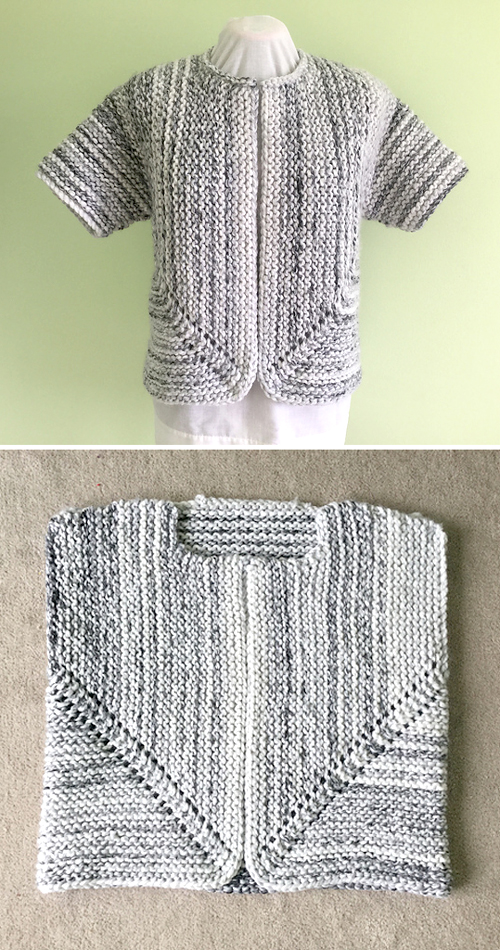
Jutka Cardigan. Photo © Anakire
Jutka Cardigan by Irina Poludnenko is a free easy cardigan knitting pattern featuring cozy garter stitch, short sleeves and super bulky yarn.
Designed for Lion Brand Yarn, this chunky cardigan is worked primarily in garter stitch on large needles. The pattern includes five women's sizes from S through 2X, making it an appealing project for knitters looking for a simple, wearable cardigan that works up with thick yarn.
One of the most appealing features of Jutka is its extensive use of garter stitch. Instead of relying on complicated cables, lace or colorwork, the cardigan gets much of its texture from the simple ridges created by knitting every row.
Lion Brand rates the pattern Easy (Beginner+), making it an interesting next step for knitters who are comfortable with basic knitting and want to move into garment construction.
Jutka is designed for #6 Super Bulky yarn. The original pattern uses Lion Brand Wool-Ease Thick & Quick, a thick wool-blend yarn often used for warm garments and quick-knitting projects.
The large stitches emphasize the horizontal ridges of the garter stitch while giving the finished cardigan a substantial, cozy appearance.
If you substitute another yarn, choose a suitable super bulky yarn and use your gauge rather than the yarn label alone to determine whether it will work for the pattern.
The free pattern includes five women's sizes: S (M, L, 1X, 2X).
The finished bust measurements, with the cardigan buttoned, are approximately:
Finished length ranges from approximately 21½ to 27½ inches, depending on the selected size.
Compare these finished garment measurements with your preferred fit before deciding which size to knit.
The original design uses Lion Brand Wool-Ease Thick & Quick in the Fossil colorway.
The pattern calls for approximately 5 (6, 7, 8, 9) balls for sizes S (M, L, 1X, 2X), respectively.
If you use a substitute yarn, calculate your requirements according to yardage rather than simply buying the same number of balls, since skein sizes vary between yarn brands.
Jutka uses a 9 mm (US 13) circular knitting needle, approximately 40 inches (101.5 cm) long.
The specified gauge is: 8 stitches + 17 rows = approximately 4 inches (10 cm) in garter stitch.
Gauge matters when knitting a cardigan because even a small difference across a few stitches can become several inches across the finished garment. Make a swatch before beginning, particularly if you are substituting yarn.
Jutka has an interesting construction that keeps much of the garment connected during knitting. The main body is worked in one piece, while the short sleeves are knitted separately.
The cardigan's simple garter-stitch fabric allows the shaping and silhouette to become the main features of the design rather than an elaborate stitch pattern.
After the main pieces are complete, finishing includes joining the required sections and working the neckline edge according to the designer's instructions.
Unlike a traditional long-sleeved chunky cardigan, Jutka has short sleeves. This gives the garment an unusual layering-friendly shape.
Wear it over a long-sleeved top in cooler weather, or use it as a substantial outer layer when you want warmth around the body without full bulky sleeves.
Although Lion Brand rates Jutka as an easy pattern, it is still a garment rather than a basic rectangular beginner project.
Useful skills include:
If you have already completed scarves, cowls or other simple projects, Jutka can provide an opportunity to apply familiar stitches to a wearable garment.
Jutka combines simple knitting with an unusual modern silhouette. Super bulky yarn and large needles create bold garter-stitch texture, while the short sleeves keep the finished cardigan from looking like a conventional chunky sweater.
The five-size range and straightforward stitch pattern also make it useful for knitters who want to concentrate on garment construction rather than complex decorative techniques.
The complete Jutka Cardigan by Irina Poludnenko is currently available from Lion Brand Yarn. Lion Brand may require a free account or sign-in to access its free pattern.
Get the Free Jutka Cardigan Pattern at Lion Brand
Pattern availability was checked when this article was updated. Availability and access requirements on external websites may change over time.
 |
| The photo above © Fiona64 |
Full Post: Ardent