Stole Dunes. Design © Svetlana Gordon.
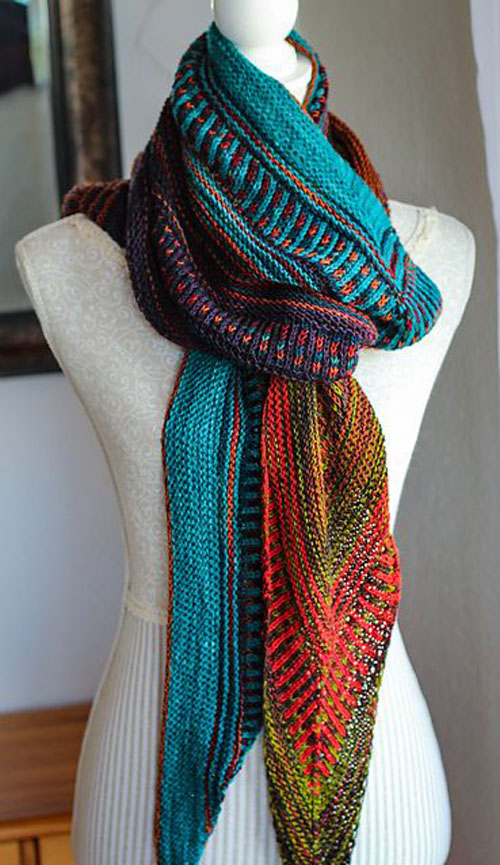
Stole Dunes by Svetlana Gordon is a dramatic rectangular
knitted stole with flowing sections that resemble layers of wind-shaped
sand dunes.
Rather than relying on a conventional repeating lace motif, the design
uses unusual shaping and changes in knitting direction to create its
distinctive sculptural waves.
The result is a lightweight statement wrap that looks complex but is
built as one continuous, seamless piece.
Important availability note: Stole Dunes is currently a
paid pattern. Older references describing it as free
should therefore be considered outdated.
Stole Dunes at a Glance
- Designer: Svetlana Gordon
- Published: October 2018
- Category: Stole / scarf / wrap
- Shape: Rectangle
- Construction: One piece and seamless
- Yarn weight: Lace
- Suggested yarn: Schachenmayr Fashion Tahiti
- Yardage: Approximately 2111–2133 yd (1930–1950 m)
- Main needle: US 2½ / 3.0 mm
- Additional needle: US 1½ / 2.5 mm
- Gauge: Approximately 28 sts × 32 rows = 4 in / 10 cm
- Finished size: Approximately 65 × 220 cm
- Instructions: Written pattern, charts and photo tutorial
- Language: English
- Current availability: Paid pattern
What Makes Stole Dunes So Unusual?
The first thing you notice about Stole Dunes is the movement in the
fabric.
Long curved sections appear to flow across the stole rather than simply
running vertically or horizontally from one edge to another.
These sweeping lines give the finished wrap the appearance of layered
sand dunes shaped by the wind.
This construction is what makes Stole Dunes immediately recognizable
among rectangular knitted wraps.
An Unconventional Knitting Construction
Stole Dunes is not constructed like a basic rectangular scarf where you
cast on one short edge and simply knit straight to the other end.
The designer uses repeated changes in direction to build the flowing
sections of the fabric.
Svetlana specifically notes that the project contains
many work turns.
Understanding how those sections connect is therefore more important
than approaching the project as an ordinary row-by-row scarf.
One Continuous Seamless Piece
Despite its elaborate appearance, the stole is designed to be
knitted seamlessly and without breaking the yarn.
That is one of the most interesting features of the design.
Instead of making numerous individual motifs and sewing them together,
the knitter creates the changing directions as part of one continuous
construction.
Why the Pattern Looks More Difficult Than It Is
Svetlana describes the project as something that may initially appear
complicated.
However, once the underlying knitting principle becomes clear, the
process becomes considerably easier to understand.
This makes Stole Dunes a good example of a pattern where understanding
the construction can be more important than memorizing individual
stitches.
The Wave-Like Dune Sections
The defining feature of the stole is its repeated flowing sections.
Each section changes the visual direction of the fabric, creating the
impression that one knitted wave overlaps or continues into another.
When several sections are combined, the eye follows the movement across
the entire rectangular stole.
Gradient Yarn Enhances the Design
The original sample uses
Schachenmayr Tahiti, a lightweight yarn with gradual
color changes.
A gradient works particularly well with Stole Dunes because the changing
color helps reveal the unusual direction of the knitted sections.
Instead of producing ordinary horizontal stripes, the color transitions
follow the architecture of the fabric and emphasize its flowing shape.
About the Original Yarn
The original pattern information references Schachenmayr Tahiti.
Svetlana later noted that availability and naming of this yarn changed
in some markets, with Fashion Tahiti appearing as the
relevant later product name.
This means knitters should not worry if the exact older yarn listed in
photographs is difficult to locate.
The more important goal is choosing a yarn that produces the kind of
lightweight fabric and color effect you want.
Yarn Weight and Yardage
The pattern is listed with approximately
2111–2133 yards (1930–1950 meters) of lace-weight yarn.
That may sound like a large amount, but remember that lace yarn contains
substantial yardage for its weight and the original stole is a generous
wrap measuring around 220 cm long.
Always check the current designer pattern before purchasing yarn,
especially if you plan to change the dimensions.
Can You Use a Different Yarn Weight?
Yes. The designer specifically notes that
heavier or lighter yarn can be used.
However, changing yarn weight will also change the amount of yarn
required and the dimensions of the finished stole.
A heavier yarn can produce a more substantial wrap, while a finer yarn
can create an even lighter and more delicate fabric.
Choosing Yarn for Stole Dunes
When substituting yarn, consider more than just the weight printed on
the label.
Look at:
- Drape
- Total yardage
- Fiber content
- Color transitions
- Stitch definition
- Finished fabric weight
- Behavior after blocking
Because the unusual construction is the main feature of Stole Dunes,
the yarn should allow that structure to remain visible.
Solid, Tonal or Gradient?
All three can produce interesting results, but each emphasizes something
different.
A solid yarn puts the focus almost entirely on the
construction and texture.
A tonal yarn introduces subtle variation without
overwhelming the knitted structure.
A long gradient can emphasize the changes in knitting
direction and create dramatic flowing bands of color.
Needle Sizes
The published pattern lists
US 2½ / 3.0 mm and
US 1½ / 2.5 mm needles.
Needle size should always be considered together with your yarn,
tension and desired fabric.
If substituting a different yarn weight, you may also need to change
needle size.
Gauge
The listed gauge is approximately
28 stitches and 32 rows = 4 inches / 10 cm.
Svetlana notes that gauge is somewhat conditional in this project
because the knitting moves in different directions.
This is another reason to think about the overall fabric rather than
treating the project exactly like a fitted sweater where a small gauge
difference can dramatically change fit.
Finished Size
The original finished dimensions are approximately:
- Width: 65 cm / about 25.6 in
- Length: 220 cm / about 86.6 in
This creates a generously sized rectangular stole that can be wrapped,
draped or worn over the shoulders.
The designer also indicates that the length can be adjusted.
Is Stole Dunes an Easy Pattern?
This is probably not the best choice for someone's very first knitting
project.
The individual techniques may be familiar to an experienced knitter,
but the unusual construction requires attention until the logic of the
pattern becomes clear.
An adventurous intermediate knitter who enjoys learning new construction
methods may find it particularly rewarding.
Skills That Will Help
It is useful to be comfortable with:
- Knit and purl stitches
- Yarn overs
- Decreases
- Slipping stitches
- Turning the work
- Following charts
- Following written instructions
- Keeping track of repeated sections
- Reading your knitting
Expect Many Turns
One detail worth knowing before you begin is that the construction uses
many turns.
This is intentional and is part of how the fabric changes direction to
create the dune effect.
If you are accustomed to knitting straight across every row, the first
sections may require more concentration.
Use the Charts to Understand the Structure
The pattern includes charts as well as written information and a photo
tutorial.
For a project with unusual directional construction, charts can be
especially useful because they help you see relationships that may be
harder to visualize from text alone.
Svetlana notes that after the knitting principle becomes familiar, the
charts toward the end of the pattern become particularly useful.
Do Not Add Extra Selvedge Stitches
One technical note from the designer is worth highlighting before you
begin.
The selvedge stitches are already included in the pattern's
stitch counts.
Do not automatically add additional edge stitches simply because that is
something you normally do when knitting a scarf or stole.
Follow the designer's stitch counts exactly.
Take Time With the First Section
With an unconventional pattern, the first section is often where the
learning happens.
Work slowly, compare the developing fabric with the pattern photographs,
and make sure you understand where each turn occurs.
Once you recognize the underlying structure, subsequent sections can
become much more intuitive.
Use Lifelines if Needed
If you are nervous about losing progress, a removable lifeline can be
helpful at logical points in the project.
This gives you a known-good row to return to if you later discover a
mistake.
It can be particularly useful while you are still learning how the
directional sections are constructed.
Keep Notes as You Knit
A row counter or simple project notes can save time on a long stole.
Record where you stop, which chart or section you are working on, and
any yarn or needle adjustments you make.
This is especially useful if Stole Dunes is a project you work on over
several weeks rather than continuously.
Blocking Is an Important Finishing Step
Blocking can help the finished stole settle into its intended shape and
reveal the flowing structure more clearly.
The correct blocking method depends on your chosen fiber, so always
follow the care instructions for your yarn.
With a large rectangular wrap, take time to arrange the overall
dimensions evenly rather than focusing on only one section.
How to Wear Stole Dunes
The generous rectangular shape gives you several styling options.
- Drape it over both shoulders as a traditional stole.
- Wrap it around the neck as an oversized scarf.
- Let the long ends hang freely to display the wave pattern.
- Wrap one end over a shoulder for an asymmetric look.
- Use it as a lightweight layer over a dress or simple top.
A Showcase for Gradient Yarn
Stole Dunes is especially interesting for knitters who enjoy gradient
yarn but want something more unusual than ordinary stripes.
Because the knitting changes direction, the color progression becomes
part of the architecture of the piece.
The finished result can look very different depending on where each
color transition appears.
Current Pattern Availability
Stole Dunes is not currently a free knitting pattern.
The current designer listing offers the pattern for purchase through
Svetlana Gordon's Ravelry Store.
At the time this guide was reviewed, the listed price was
$6.50 USD. Prices and availability can change, so check
the designer's current listing for the latest information.
Get the Stole Dunes Knitting Pattern
The current authorized pattern listing includes the complete
instructions, charts, schematic and photo tutorial from designer
Svetlana Gordon.
View the Stole Dunes Pattern on Ravelry →
Stole Dunes is designed by Svetlana Gordon. Amazing Knitting does not
reproduce the designer's complete copyrighted instructions, charts or
photo tutorial. Pattern price and availability are controlled by the
designer and may change over time.
Read Our Pattern Availability Policy →