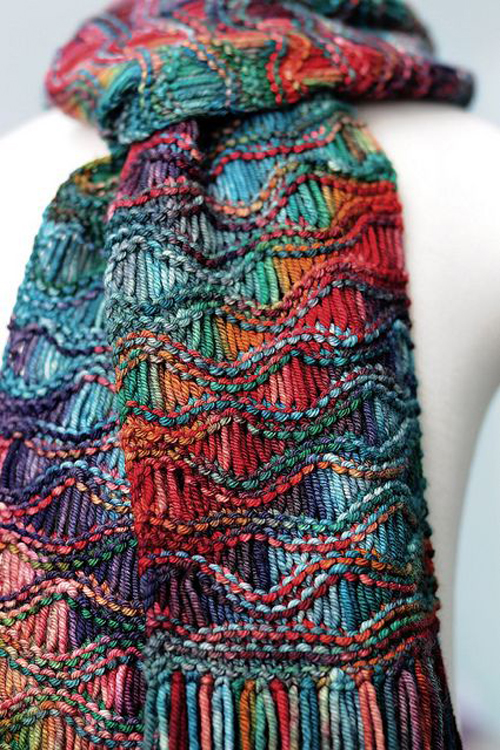
Reversible Cabled Brioche Stitch Scarf by Saralyn Harvey is a wonderfully plush scarf that combines the deep softness of brioche knitting with bold cable crossings.
Unlike many cable scarves that have a clearly defined right and wrong side, this design looks attractive from both sides, making it especially practical for an accessory that naturally twists and turns while being worn.
The complete pattern is still available free from the designer's original FireFlower Knits page.
Design and original pattern © Saralyn Harvey / FireFlower Knits.
Reversible Cabled Brioche Scarf Pattern Overview
- Designer: Saralyn Harvey
- Original source: FireFlower Knits
- Pattern: Reversible Cabled Brioche Stitch Scarf
- Craft: Knitting
- Category: Scarf
- Published: October 2007
- Finished size: Approximately 5 × 56 in
- Yarn weight: Worsted
- Suggested yarn: Knit Picks Andean Silk
- Yardage: Approximately 350–400 yd / 320–366 m
- Needles: US 7 / 4.5 mm
- Additional tool: Cable needle
- Main techniques: Brioche stitch, yarn overs, slipped stitches and brioche cables
- Skill level: Intermediate
- Construction: Worked flat
- Fabric: Thick, soft and reversible
- Pattern availability: Free from the designer
Why This Scarf Is Truly Reversible
The special appeal of this scarf is that there is no unattractive back side.
Traditional cables usually look very different on the reverse of the fabric, but this design combines cabling with brioche structure so the scarf remains visually interesting from both directions.
That is especially useful for scarves because the fabric naturally flips, folds and twists while being worn.
What Is Brioche Stitch?
Brioche knitting creates a thick, elastic fabric by combining slipped stitches, yarn overs and worked-together stitches.
The result has more depth and loft than ordinary ribbing or stockinette, which is why brioche scarves often feel especially soft and warm.
In this pattern, the brioche structure becomes the foundation for the cable design.
Brioche Cables
The defining technical feature of the scarf is the brioche cable.
Instead of crossing ordinary knit stitches, groups that include brioche stitches and yarn overs are moved together using a cable needle.
This produces broad raised twists while preserving the soft, dimensional quality of the brioche fabric.
How Often Are the Cables Worked?
One helpful feature is that you do not cable on every row.
The designer notes that the cable crossings are separated by long sections of ordinary brioche knitting.
This gives the project a comfortable rhythm: once the brioche sequence becomes familiar, most rows can be worked relatively smoothly until the next cable crossing.
Original Finished Size
The original scarf measures approximately:
5 inches wide × 56 inches long.
The designer also notes that additional yarn can be used to make a longer version.
For example, the original source mentions that five skeins would allow a scarf around 70 inches long.
Can You Make the Scarf Wider?
Yes. The designer provides guidance for adding extra cable repeats.
Each additional cable section requires extra cast-on stitches and increases the finished width.
This allows you to adapt the project from a relatively narrow scarf to a wider wrap-style accessory if desired.
Yarn for the Reversible Cabled Brioche Scarf
The original pattern uses Knit Picks Andean Silk, a worsted-weight blend of alpaca, silk and merino.
The published requirement is approximately:
350–400 yards / 320–366 meters.
A soft yarn is particularly suitable for this project because brioche creates a thick fabric that sits directly against the neck.
Choosing a Yarn Substitute
If the original yarn is unavailable, choose a smooth worsted-weight yarn with good stitch definition.
Useful characteristics include:
- Softness
- Elasticity
- Good cable definition
- Enough loft for brioche texture
- Comfort against the skin
Very fuzzy yarn can soften the appearance of the cables, while extremely stiff yarn may reduce the natural squishiness of the brioche fabric.
Needles
The original pattern recommends US 7 / 4.5 mm knitting needles.
Because brioche tension varies from knitter to knitter, use the listed size as a starting point rather than an absolute rule.
Your finished fabric should feel soft and full rather than excessively loose or stiff.
Why a Cable Needle Is Recommended
The designer specifically recommends using a cable needle for the brioche cable crossings.
Brioche stitches can be more difficult to control than standard cable stitches because yarn overs are part of the stitch structure.
Using a cable needle helps prevent those loops from slipping or becoming misaligned during the crossing.
A Row Counter Is Useful
Saralyn Harvey also recommends using a row counter.
The majority of the scarf is repetitive brioche, so it can be easy to lose track of when the next cable row should occur.
A row counter allows you to enjoy the repetitive sections without constantly recounting the fabric.
Skills You'll Use
- Casting on
- Knit stitches
- Slipping stitches
- Yarn overs
- Working brioche stitch
- Working stitches together
- Using a cable needle
- Crossing brioche cables
- Tracking row repeats
- Binding off in pattern
- Weaving in ends
Is This a Beginner Pattern?
The designer classifies the scarf as an intermediate knitting project.
The basic cable concept is not unusually difficult, but brioche stitch behaves differently from ordinary knit-and-purl fabric.
It is therefore best suited to knitters who already understand basic brioche or are comfortable carefully learning a new stitch structure.
If this is your first brioche project, practice the basic brioche sequence on a small swatch before beginning the full scarf.
Tips for Brioche Knitting
Do not rush dropped stitches. Brioche fabric contains yarn overs and slipped stitches, so a dropped stitch can travel through the fabric differently from ordinary stockinette.
Use lifelines if needed. Running a lifeline through a stable row can make it easier to recover if you need to unravel several rows.
Watch your yarn-over placement. Missing one yarn over can change the stitch count and disrupt the next row.
Count regularly. Brioche mistakes are often easier to fix immediately than after several cable repeats.
Tips for Neater Brioche Cables
Keep the cable crossing relaxed. Tightening too much can make the crossing narrower than the surrounding fabric.
Make sure yarn overs stay with the correct stitches. This is especially important while moving stitches onto the cable needle.
Use a cable needle with enough grip. A very slippery cable needle can make brioche loops harder to control.
Check both sides. Because the scarf is reversible, inspect the front and back after each cable row to catch problems early.
Blocking the Finished Scarf
Brioche fabric can stretch considerably during blocking.
Block gently and avoid pulling the scarf aggressively unless you intentionally want to increase the length or width.
Always follow the care instructions for your chosen yarn.
Natural-fiber blends may relax noticeably after washing, so taking measurements before and during blocking can be useful.
Why This Scarf Is So Warm
Brioche creates a deeper fabric than standard stockinette because the stitch structure contains extra yarn and trapped air.
That added thickness helps make the finished scarf soft, cushioned and warm.
Using wool, alpaca or another insulating fiber can enhance that effect further.
Is the Reversible Cabled Brioche Stitch Scarf Free?
Yes. Reversible Cabled Brioche Stitch Scarf by Saralyn Harvey is currently available free from the designer's original FireFlower Knits website.
Amazing Knitting links directly to the original designer source rather than reproducing the complete row-by-row pattern.
View the Free Reversible Cabled Brioche Scarf Pattern →
Why This Scarf Is Worth Knitting
This design combines three qualities that are unusually useful in one scarf: reversibility, warmth and dramatic texture.
Brioche makes the fabric soft and thick, while the cable crossings add enough visual interest to turn a simple rectangular scarf into a distinctive accessory.
Because the scarf looks attractive from both sides, you also do not have to worry about arranging it so that one particular surface always faces outward.
For knitters ready to move beyond basic brioche, it is an excellent project for learning how cables can be incorporated into brioche fabric.
Pattern Availability
Amazing Knitting links readers to legitimate designer or publisher sources whenever possible. Pattern prices, download locations and availability can change after an article is published.
Read Our Pattern Availability Policy →
Amazing Knitting is an independent pattern discovery and project-guide site. The Reversible Cabled Brioche Stitch Scarf design and complete knitting instructions remain the intellectual property of Saralyn Harvey / FireFlower Knits. This guide does not reproduce the designer's complete row-by-row pattern instructions.