![]() |
| Photos above © The New Domestic |
...
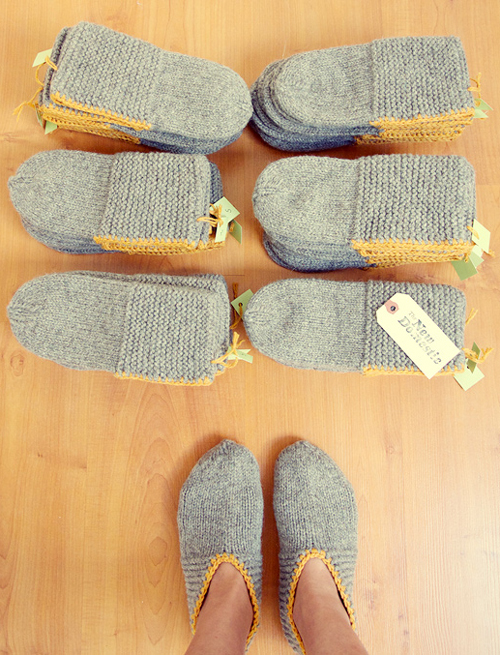
Coziest Wool Slippers
Cloud Slippers – Free Easy Slipper Knitting Pattern
Cloud Slippers. Photos © Adrienne Sullivan
Looking for an easy free slipper knitting pattern? Cloud Slippers by Adrienne Sullivan are soft, cozy slippers designed to knit up quickly with super bulky yarn and large needles.
This beginner-friendly pattern uses only basic knitting skills, and each slipper is worked flat in one piece before being folded and seamed. With four adult sizes for women and men, Cloud Slippers are a practical choice for cozy house slippers, quick gifts or a satisfying weekend knitting project.
Cloud Slippers Pattern Details
- Designer: Adrienne Sullivan
- Published: July 2019
- Craft: Knitting
- Category: Adult slippers
- Pattern availability: Free download
- Skill level: Beginner-friendly
- Yarn weight: Super Bulky
- Suggested yarn: Lion Brand Wool-Ease Thick & Quick
- Yardage: Approximately 55–90 yards (50–82 m)
- Needles: 10 mm (US 15)
- Gauge: 8 stitches × 16 rows = 4 inches in garter stitch
- Construction: Worked flat in one piece and seamed
- Sizes: Four adult sizes for women and men
An Easy Slipper Knitting Pattern for Beginners
One of the best features of Cloud Slippers is how little knitting experience you need to make them.
The pattern uses basic knit and purl stitches along with casting on and binding off. There is no complicated sock construction and no need to knit a traditional turned heel.
This makes the project particularly appealing if you want to try knitting something for your feet without starting with a conventional sock pattern.
Worked Flat and Seamed
Cloud Slippers are knitted flat rather than in the round. Each slipper is made as one piece and then folded in half.
The final shape is created by seaming the knitted piece from the toe toward the heel. This simple construction eliminates the need for double-pointed needles or other small-circumference knitting techniques.
If knitting socks in the round feels intimidating, this construction can be a much more approachable way to make a cozy pair of knitted slippers.
Cloud Slippers Sizes
The free pattern includes four adult sizes:
- Women's Small: US shoe sizes 5–7
- Women's Medium: US shoe sizes 8–10
- Men's Medium: US shoe sizes 8–10
- Men's Large: US shoe sizes 11–13
Choose the size according to the recipient's shoe size and check the designer's original pattern information before beginning.
Super Bulky Yarn Makes Them a Quick Knit
The original Cloud Slippers were designed with Lion Brand Wool-Ease Thick & Quick, a super bulky yarn that produces a thick, warm fabric while knitting up rapidly on large needles.
Depending on the size, the pattern requires only approximately 55–90 yards (50–82 m) of super bulky yarn.
That relatively small yardage makes these slippers an interesting option when you have a partial ball of suitable super bulky yarn left from another project.
Needles and Gauge
The pattern calls for 10 mm (US 15) knitting needles. The specified gauge is:
8 stitches × 16 rows = 4 inches (10 cm) in garter stitch.
Because slippers need to fit the foot reasonably well, gauge is still worth checking even though this is a quick and simple project.
A One-Ball Slipper Project
Adrienne Sullivan designed Cloud Slippers so that a pair can be made with just one ball of the suggested Lion Brand Wool-Ease Thick & Quick or an equivalent amount of suitable super bulky yarn.
Combined with the large needles and simple construction, this makes Cloud Slippers particularly attractive when you need a relatively quick handmade gift.
Why Knit Cloud Slippers?
Cloud Slippers combine several features that make a small knitting project especially satisfying: thick yarn, large needles, simple stitches and minimal construction.
They are also available in both women's and men's sizes, so the same pattern can be used to make cozy slippers for several people.
Consider them for holiday gifts, house slippers, cold-weather knitting or simply as a quick project between larger sweaters and blankets.
A Prize-Winning Slipper Pattern
Cloud Slippers was the winner of the 2019 STIK X Lion Brand Pattern Contest.
Since its publication, the simple one-piece construction has made it a popular choice among knitters looking for an approachable pair of chunky knitted slippers.
Get the Free Cloud Slippers Knitting Pattern
The complete Cloud Slippers pattern by Adrienne Sullivan is currently available as a free download.
Get the Free Cloud Slippers Knitting Pattern
Pattern availability was checked when this article was updated. Availability on external websites may change over time.
Simply Shawl - Knitting Pattern
![]() |
| Photos above © Cheryl Faust |
Liesel Lace Leaf Scarf - Free Pattern
![]() |
| The photo above © Grace and Alice Schnebly |
Snood Forest Witch - Knitting Pattern
![]() |
| Photo above © Svetlana Gordon |
Claire's Leafy Blanket - Free Pattern
![]() |
| Photo above © LaMagliaia |
Carol’s Clever Little Shawl – Free Vintage-Inspired Knitting Pattern
Carol's Clever Little Shawl by Carol Sanders. Photo © hellskitsch.
Carol's Clever Little Shawl by Carol Sanders is a charming vintage-inspired wrap with an unusual construction and an especially clever way of staying securely around the shoulders.
Inspired by a historic shawl from the 1800s, the design is worked sideways in garter stitch, shaped with short rows and decorated with lace points that are created as you knit.
The most memorable feature appears at the front: instead of relying on a separate shawl pin or button, the knitted tips interlace to help hold the shawl closed.
The original designer website is no longer available, but the pattern has been archived and is still available free.
Carol's Clever Little Shawl at a Glance
- Designer: Carol Sanders
- First published: November 2007
- Inspiration: Historic 1800s shawl
- Category: Shawl / wrap
- Construction: Worked sideways
- Main fabric: Garter stitch
- Shaping: Short rows
- Detail: Lace points worked as part of the shawl
- Yarn weight: DK or worsted
- Yardage: Approximately 550–650 yd (503–594 m)
- Main needles: US 10½ / 6.5 mm
- Additional needles: US 10 double-pointed needles
- Sizes: Small and Large
- Language: English
- Availability: Free archived pattern
A Shawl Inspired by the 1800s
One of the most interesting things about Carol's Clever Little Shawl is the history behind its shape.
Carol Sanders created the pattern after studying a historic shawl from the 1800s.
Rather than attempting to reproduce a museum piece stitch for stitch, she developed a knitting pattern based on the construction and distinctive features she observed.
The result feels traditional without looking like a conventional modern triangular shawl.
What Makes This Little Shawl So Clever?
The answer is primarily in the front closure.
The ends of the shawl form elongated decorative points. These front tips can be interlaced, allowing the shawl to stay around the shoulders without an ordinary button or separate shawl pin.
It is a practical detail that also becomes one of the main decorative features of the finished piece.
A Keyhole-Style Front Fastening
This interlocking construction gives Carol's shawl something of a keyhole shawl character.
Instead of constantly adjusting loose ends, the wearer can use the knitted front sections to help secure the wrap.
That makes the design especially appealing when you want the warmth of a small shawl but need your hands to remain free.
Worked Sideways
Carol's Clever Little Shawl is knitted from side to side.
This is quite different from a traditional triangular shawl worked from the neck downward or from the bottom point upward.
The sideways construction allows the shape, decorative points and shoulder curve to develop gradually as the knitting progresses.
Garter Stitch Forms the Main Fabric
Much of the shawl is based on simple garter stitch.
This makes the design approachable even though its finished shape looks unusual.
Garter stitch also creates a soft, reversible fabric with plenty of texture and flexibility—both useful qualities in a small shoulder wrap.
Lace Edging Is Added as You Knit
The decorative lace is not simply sewn onto the shawl after the main body is finished.
Instead, the lace points are incorporated as the shawl is knitted.
This integrated construction keeps the project visually interesting while avoiding the need to make one long separate lace edging and attach it afterward.
The Distinctive Knitted Points
The pointed sections are an important part of the personality of this design.
They give the lower edge a decorative rhythm and help distinguish the shawl from a plain garter-stitch wrap.
Although the points may look complicated in finished photographs, knitters who have made the shawl often note that the construction becomes easier to understand once the first point has been completed.
Short Rows Shape the Shawl
Short rows allow the fabric to curve around the shoulders.
Instead of working every stitch across every row, the knitting is turned before reaching the end at specific points.
Repeating this controlled shaping adds fabric where it is needed and creates a more wearable curved form.
Why Short Rows Are Useful Here
Without shaping, a simple rectangular strip would tend to sit very differently around the shoulders.
Short rows allow the shawl to gain depth through the back while maintaining its distinctive front sections.
This is a useful example of how knitting construction can create shape without sewing separate garment pieces together.
Two Sizes
The archived pattern provides Small and Large options.
The larger shawl is created by working additional points in the body, making the design relatively adaptable without completely changing the underlying construction.
Check the original pattern carefully before beginning so you know which size instructions you intend to follow.
How Much Yarn Do You Need?
The published materials call for approximately:
- Small: about 550 yards
- Large: about 650 yards
This corresponds to roughly 503–594 meters, depending on size.
Actual usage can vary with your yarn, gauge and any size modifications, so having a little extra yarn is always useful.
DK or Worsted-Weight Yarn
The pattern is suitable for approximately DK to worsted-weight yarn.
This gives knitters considerably more flexibility than a pattern tied to one highly specific yarn.
When substituting, focus on obtaining a fabric that is soft enough to drape around the shoulders while still showing the garter texture and lace points clearly.
Choosing Yarn for This Shawl
Since the shawl is worn close to the neck and shoulders, comfort matters.
Consider:
- Softness against the skin
- Drape
- Warmth
- Stitch definition
- Total yardage
- Fiber care requirements
A yarn that is very stiff may make the interlocking front sections less comfortable, while a yarn with pleasant drape can help the shawl settle naturally around the shoulders.
Solid or Tonal Colors Work Beautifully
Because the construction itself provides plenty of visual interest, a solid or tonal yarn can be an excellent choice.
It allows the garter ridges, lace points and curved shaping to remain clearly visible.
A gently variegated yarn can also work, but very dramatic color changes may compete with some of the structural details.
Needle Sizes
The pattern lists US 10½ / 6.5 mm needles for the main knitting.
It also calls for US 10 double-pointed needles for part of the construction.
As always, the listed needle sizes are a starting point. Your yarn and individual tension determine the fabric you actually create.
Why Are Double-Pointed Needles Used?
The unusual front and pointed sections require more flexibility than a basic rectangular scarf.
Double-pointed needles make it possible to manipulate smaller groups of stitches during these parts of the construction.
If you have never used DPNs before, review how to hold and control them before reaching that stage of the pattern.
Is Carol's Clever Little Shawl Beginner Friendly?
A confident beginner who already knows basic knitting may find the project an interesting next step, but it is not quite as simple as a plain garter-stitch scarf.
The main body uses familiar stitches, while the short-row shaping, lace points and unusual front construction add the challenge.
For an intermediate knitter, the pattern can be a relatively accessible introduction to historical-inspired shawl construction.
Skills That Will Help
Before beginning, it is useful to be comfortable with:
- Casting on
- Knit stitches
- Garter stitch
- Basic lace techniques
- Increases and decreases
- Short rows
- Turning the work
- Using double-pointed needles
- Keeping track of repeated sections
- Binding off
Take Your Time With the First Point
The decorative points are likely to be the least familiar part of the project for many knitters.
Work slowly through the first one and pay attention to how the stitches create the shape.
Once you understand the construction, later points should be much easier to visualize.
Keep Track of the Short Rows
Short-row shaping works best when the turning points remain consistent.
A row counter, removable marker or simple written notes can help you remember where you are, especially if you put the project down between knitting sessions.
Avoid relying entirely on memory when working an unfamiliar shaping sequence.
Check Your Stitch Counts
Lace, shaping and decorative points can make an unnoticed mistake more difficult to find several rows later.
Check stitch counts at useful points in the pattern and correct errors early.
This is particularly helpful while you are learning the logic of the shawl's construction.
Blocking the Finished Shawl
Blocking can help the lace points open and allow the curved body of the shawl to settle into a smoother shape.
The appropriate blocking method depends on your chosen fiber, so follow the care instructions for your yarn.
Avoid overstretching the garter-stitch body simply to make the lace points more dramatic.
How to Wear Carol's Clever Little Shawl
The compact shape makes this shawl particularly useful as a shoulder warmer.
You can:
- Interlace the front tips to secure it around the shoulders.
- Wear it over a blouse or simple top.
- Layer it over a dress for extra warmth.
- Use it as a lightweight alternative to a cardigan.
- Wear the ends loose when you do not need the front fastening.
A Practical Alternative to a Large Shawl
Not every shawl needs to be large enough to wrap several times around the body.
Carol's design concentrates warmth around the neck, upper back and shoulders while keeping the overall piece relatively compact.
The secure front construction also makes it useful when you want to move around without constantly readjusting a loose wrap.
Why This Pattern Has Lasted
Carol's Clever Little Shawl was first published in 2007, yet knitters continue to seek out the pattern many years later.
Its appeal comes from a combination of historical inspiration, approachable garter stitch and a construction that is genuinely different from most modern shawls.
Hundreds of completed projects have been recorded by knitters, showing how adaptable the design can be across different yarns and colors.
Important Note About the Original Website
The original Cheryl Oberle Designs website that hosted the pattern is no longer accessible.
This does not mean the pattern has become unavailable.
The free pattern has been preserved through the Internet Archive / Wayback Machine, and its current Ravelry record directs knitters to that archived source.
Pattern Use Note From the Designer
Carol Sanders shared the pattern freely but included an important request with it.
The archived pattern states that the pattern should not be sold and asks knitters not to make finished shawls from it for sale. It is intended to be freely shared with appropriate credit to the designer.
Please respect those terms when using the pattern.
Get the Free Carol's Clever Little Shawl Pattern
Carol's Clever Little Shawl is currently listed as a free pattern on Ravelry.
Because the original designer website is no longer online, Ravelry is particularly useful here: its current pattern record identifies the correct design and directs knitters to the archived authorized pattern.
Get the Free Carol's Clever Little Shawl Pattern →
Carol's Clever Little Shawl is designed by Carol Sanders and was created after studying a historic 1800s shawl. Amazing Knitting does not reproduce the complete copyrighted pattern instructions. The original website is no longer accessible, so please use the current Ravelry record to reach the archived pattern.
Chevron Scarf - Free Pattern
| Photo above © Carolyn Mader |
Jasmine Dress - Knitting Pattern
![]() |
| Photo above © Suzie Sparkles |
Shawl Collar Baby Coat - Knitting Pattern
![]() |
| Photos above © sweetkm |
Smockie Baby Dress – Vintage Smocked Knitting Pattern
Smockie by Sublime Yarns. Project photo © karriesknits.
Smockie by Sublime Yarns is a charming sleeveless baby dress with a vintage-inspired shape, square neckline and beautifully textured smocked yoke.
Originally published in 2007 in The Second Little Sublime Hand Knit Book, the design combines simple garter and stockinette knitting with decorative smocking to create a classic little garment for babies.
Smockie was originally available through a Sublime Yarns pattern book. That publication is now listed as out of print, so this Amazing Knitting page is presented as a pattern guide rather than promising a current free download.
Smockie at a Glance
- Pattern: Smockie
- Designer: Sublime Yarns
- Published: August 2007
- Original source: Sublime #606, The Second Little Sublime Hand Knit Book
- Category: Baby dress / sleeveless smock
- Construction: Worked flat, bottom-up and seamed
- Neckline: Square neck
- Fastening: Shoulder fastening with 2 buttons
- Yarn weight: DK
- Suggested yarn: Sublime Baby Cashmere Merino Silk DK
- Yardage: Approximately 381–635 yd (348–581 m)
- Needles: US 6 / 4.0 mm and US 3 / 3.25 mm
- Gauge: 22 sts × 28 rows = 4 in / 10 cm in stockinette
- Sizes: 0–3, 3–6, 6–12 and 12–18 months
- Languages: English and Finnish editions recorded
- Current status: Original publication out of print
What Is the Smockie Knitting Pattern?
Smockie is a sleeveless knitted baby smock that combines the simplicity of a small dress with a decorative textured upper section.
The lower part of the garment has a clean, understated appearance, allowing the distinctive smocked yoke to become the focal point.
Its square neckline and small shoulder fastening add to the traditional look and make the design immediately recognizable.
A Vintage-Inspired Baby Smock
Although Smockie was published in 2007, its styling draws strongly on traditional children's clothing.
Smocked dresses and tops have been used in children's wardrobes for generations, particularly when a decorative yoke is paired with a simpler lower body.
Sublime translated that familiar look into knitting, using texture rather than fabric embroidery to give the upper section its distinctive appearance.
The Smocked Yoke Is the Star
The most eye-catching feature is the textured smocked section across the upper part of the garment.
It adds dimension to an otherwise straightforward silhouette and gives the finished dress much of its vintage character.
A solid or gently tonal yarn can be particularly effective here because light and shadow can emphasize the raised texture.
Square Neckline
Smockie's square neckline is another important part of the design.
It creates a crisp frame around the textured yoke and gives the garment a noticeably different look from the round-neck baby sweaters and cardigans commonly seen in knitting patterns.
Sleeveless Construction
Because Smockie is sleeveless, there are no full sleeves to knit.
This keeps the silhouette light and makes the finished piece suitable for layering over a bodysuit, blouse or long-sleeved top when additional warmth is needed.
It also keeps attention focused on the yoke and dress shape.
Worked Flat and Seamed
Smockie is a traditional worked-flat knitting pattern.
Rather than knitting the entire dress seamlessly in the round, the garment pieces are worked back and forth and later assembled.
Knitters who prefer classic garment construction may find this approach familiar and easy to understand.
Bottom-Up Construction
The pattern is worked from the bottom upward.
This means the simpler lower portion is established before reaching the more decorative upper section.
As you approach the yoke and neckline, shaping and texture become more important, so careful row tracking becomes increasingly useful.
Garter and Stockinette Stitch
The design uses familiar knitting foundations including garter stitch and stockinette stitch.
These simpler areas provide a visual contrast with the smocked texture.
They also mean that much of the garment uses techniques that many knitters already know.
Four Baby Sizes
Smockie was published in four sizes:
- 0–3 months
- 3–6 months
- 6–12 months
- 12–18 months
This range makes the design suitable from newborn-size knitting through the early toddler stage.
Always select your size using the measurements and gauge in the original pattern rather than relying only on the age label.
Suggested Yarn
The original pattern recommends Sublime Baby Cashmere Merino Silk DK.
This DK yarn combines approximately:
- 75% Merino wool
- 20% Silk
- 5% Cashmere
It is a soft luxury blend that was widely associated with Sublime's baby knitting collections.
How Much Yarn Does Smockie Need?
Depending on the size, the published pattern lists approximately 381–635 yards (348–581 meters).
Larger sizes naturally require more yarn.
If substituting yarn, compare meterage as well as ball weight because two DK yarns can contain very different lengths per ball.
Choosing a Substitute DK Yarn
You do not necessarily need the exact original Sublime yarn to create a similar garment.
When selecting a substitute, consider:
- DK weight
- Gauge compatibility
- Softness for baby clothing
- Stitch definition for the smocked texture
- Washability
- Fiber care requirements
- Total yardage
For a textured design like Smockie, good stitch definition can be particularly valuable.
Needle Sizes
The pattern lists two needle sizes:
- US 6 / 4.0 mm
- US 3 / 3.25 mm
The smaller needles are useful where a firmer fabric is required, while the larger needles are used for the main stockinette gauge.
Treat the recommended needle sizes as a starting point and choose the size that gives you the required gauge.
Gauge
The published gauge is 22 stitches and 28 rows = 4 inches / 10 cm in stockinette stitch using the larger needles.
Gauge is particularly important for baby garments because it affects both the finished dimensions and how much yarn you will use.
Make and measure a swatch before beginning if you are substituting yarn or tend to knit especially tightly or loosely.
Two Buttons Complete the Dress
The original pattern calls for two buttons.
These are used with the shoulder fastening, a practical feature that helps make the neckline easier to open when dressing a baby.
Choose buttons that are suitable for baby clothing and attach them very securely.
Optional Decorative Flowers
Some knitters have personalized their Smockie projects with crocheted flowers or other small embellishments.
These are decorative additions rather than the defining feature of the original knitted design.
If you add embellishments to a baby garment, make sure every component is securely attached and appropriate for the intended wearer.
Is Smockie Beginner Friendly?
Smockie combines straightforward knitting with a more decorative textured section.
A knitter who already understands basic garment construction should find much of the project familiar, while the smocked yoke offers something more interesting than plain stockinette.
It is therefore better viewed as a project for a confident beginner or intermediate knitter rather than a first-ever knitting project.
Skills That Will Help
Useful skills include:
- Casting on
- Knit and purl stitches
- Garter stitch
- Stockinette stitch
- Following textured stitch instructions
- Basic garment shaping
- Buttonholes
- Seaming knitted pieces
- Picking up or finishing neckline edges as directed
- Sewing on buttons securely
Pay Attention to the Smocked Section
The decorative yoke is where careful row tracking matters most.
If you lose your place in a textured stitch sequence, the difference may become visible several rows later.
A row counter or simple written notes can make it easier to resume the project accurately after a break.
Check Your Stitch Counts
When shaping the upper garment, check stitch counts at the points given in the pattern.
Catching a missed decrease or shaping instruction early is much easier than discovering it during final assembly.
Take Time With the Seams
Because Smockie is worked flat, neat finishing is an important part of the final result.
Use a mattress-style or other appropriate garment seam where suitable, and avoid pulling the seam so tightly that it changes the dimensions of the knitted fabric.
Good seaming can make a traditionally constructed baby garment look almost as clean as a seamless design.
Blocking the Finished Smock
Gentle blocking can help even the stitches, settle the textured yoke and prepare the individual pieces for neat assembly.
Always follow the care instructions for your chosen yarn.
If you use a wool, silk or cashmere blend, avoid excessive heat or agitation that could damage the fibers.
Why Smockie Still Appeals to Knitters
Smockie combines several qualities that have helped it remain recognizable long after its original 2007 publication.
The basic silhouette is simple, but the textured yoke, square neckline and shoulder buttons give the garment a strong identity.
It also offers the satisfaction of traditional baby-garment knitting without requiring sleeves.
Smockie Pattern Availability
Smockie originally appeared in Sublime #606, The Second Little Sublime Hand Knit Book.
That publication is currently listed as out of print.
Older Amazing Knitting references described Smockie as a free pattern, but we could not verify a current free download supplied directly by Sublime Yarns or another current authorized publisher.
For that reason, we no longer label this page as a currently available free pattern.
View the Smockie Pattern Record
Ravelry maintains a useful record for the original Smockie design, including the designer, publication, yarn, sizes, gauge and historical source information.
View Smockie by Sublime Yarns on Ravelry →
Smockie is a Sublime Yarns design originally published in The Second Little Sublime Hand Knit Book. Amazing Knitting does not reproduce the complete copyrighted pattern instructions. The original publication is currently listed as out of print, and we have not verified a current authorized free download for the complete pattern.
Discover More From the Archive
A fresh mix of knitting patterns and tutorials from the Amazing Knitting archive.