Skip to content

...

Puerperium Cardigan - Free Pattern

Puerperium Cardigan - Free Pattern
Photos above © xgeckox

Puerperium Cardigan by Kelly van Niekerk is a beautifully simple newborn cardigan designed with the first weeks of a baby's life in mind.

Worked from the top down with seamless construction, it combines practical baby-friendly dressing with a wonderfully clean design. The asymmetric button placement gives the cardigan its distinctive look while leaving plenty of room for knitters to personalize the basic garment.

It is also an exceptionally popular little knit, with thousands of completed projects recorded by knitters on Ravelry.

Best of all, the original newborn-size Puerperium Cardigan pattern is still available as a free download.

✓ Free Pattern Availability

The original newborn-size Puerperium Cardigan by Kelly van Niekerk is currently available as a free Ravelry download. The designer also created a separate expanded version called Beyond Puerperium, which is a paid pattern covering additional sizes and yarn weights.

Puerperium Cardigan at a Glance

Pattern: Puerperium Cardigan

Designer: Kelly van Niekerk

Studio: PEKAPEKA Design Studio

Published: May 2011

Category: Newborn Cardigan

Free Size: Approx. 3–4 kg / 7–9 lb birthweight

Approx. Chest: 37.5 cm / 14¾ in

Yarn Weight: DK / 8-ply

Suggested Yarn: Madelinetosh Tosh DK

Yardage: Approx. 197–219 yd / 180–200 m

Needles: US 6 / 4 mm

Gauge: 22 sts × 30 rows = 4 in / 10 cm in stockinette

Construction: Top-down and seamless

Sleeves: Straight or tailored tapered option

Availability: Free Ravelry download

What Does “Puerperium” Mean?

The unusual name has a very specific connection to the purpose of the cardigan.

The puerperium is the period immediately following childbirth. The designer created this cardigan specifically to be easy for new parents to put on and take off their newborn during those first weeks.

That practical idea is central to the design rather than simply being an unusual pattern name.

Designed Specifically for Newborns

The free Puerperium pattern is intentionally focused on one small size.

It is written for a newborn weighing approximately:

3–4 kg / 7–9 lb

The approximate finished chest circumference is:

37.5 cm / 14¾ inches

This is important to understand before beginning: the free pattern is not a multi-size baby cardigan pattern.

Top-Down Construction

Puerperium is worked from the top down.

Top-down construction has several advantages for a small baby garment. You can see the cardigan taking shape as you knit, and the construction avoids the need to assemble multiple large garment pieces afterward.

It also makes the cardigan an approachable introduction to top-down garment knitting.

A Seamless Baby Cardigan

One of the pattern's biggest attractions is its seamless construction.

For knitters who dislike sewing garment pieces together, this is an especially welcome feature.

It also produces a neat interior, which is particularly appealing for clothing worn by a newborn.

The Distinctive Button Placement

Puerperium does not look like an ordinary symmetrical button-front cardigan.

Its buttonband follows the shaping line, creating the distinctive asymmetric front that makes the otherwise simple cardigan immediately recognizable.

This clever detail adds personality without requiring complicated colorwork or elaborate lace.

A Blank Canvas for Personalization

The designer describes Puerperium as a simple cardigan that can act as a blank canvas for embellishment.

That explains why completed versions of this pattern can look so different from one another.

Knitters can let the yarn provide the visual interest or add their own carefully chosen decorative touches.

The project photograph historically featured on this Amazing Knitting page, for example, shows how an embellishment can transform the basic cardigan into something playful and personal.

Solid or Variegated Yarn?

Both can work beautifully.

A solid yarn emphasizes the unusual construction and button placement, while a variegated or hand-dyed yarn can add visual interest to the simple stockinette fabric.

Because the basic cardigan does not rely on a complex all-over stitch pattern, it can be particularly effective for showing off a special skein of yarn.

Original Suggested Yarn

The Ravelry record suggests Madelinetosh Tosh DK.

The important technical requirement, however, is the DK / 8-ply weight and the required gauge rather than the exact brand.

The published yardage is approximately:

197–219 yards / 180–200 meters

This relatively modest yarn requirement also makes Puerperium an appealing small-garment project.

Gauge

The published gauge is:

22 stitches × 30 rows = 4 × 4 inches / 10 × 10 cm

This is measured in stockinette stitch.

The listed needle size is:

US 6 / 4 mm

Treat the needle size as a starting point. Use whichever needle size allows you to achieve the required gauge with your chosen yarn.

Gauge Matters on a Newborn Garment

It can be tempting to skip a gauge check because this cardigan is so small.

But on a newborn-size garment, even a modest gauge difference can noticeably affect the finished circumference.

If your stitches are substantially larger than specified, the cardigan may fit more like a larger infant size. If they are too small, the newborn cardigan may become uncomfortably tight.

Two Sleeve Options

The free pattern includes instructions for:

  • Straight knitted sleeves
  • Tailored tapered sleeves

This gives the knitter some control over the final silhouette while keeping the overall cardigan construction straightforward.

A Useful First Top-Down Garment

Puerperium can be an excellent stepping stone between flat accessories and larger knitted garments.

You get experience with garment construction, shaping, sleeves, buttonholes and finishing, but everything happens on a very small scale.

That means mistakes are generally discovered sooner and there are far fewer stitches to manage than on an adult cardigan.

Skills You May Practice

  • Top-down garment construction
  • Stockinette stitch
  • Increasing
  • Buttonholes
  • Separating body and sleeves
  • Working sleeves
  • Decreasing for tapered sleeves
  • Binding off
  • Weaving in ends
  • Attaching buttons securely

Choosing Yarn for a Newborn

When substituting yarn, consider more than gauge.

A newborn cardigan should ideally be made from yarn that is:

  • Comfortably soft
  • Appropriate for sensitive skin
  • Practical to wash
  • Durable enough for repeated laundering
  • Suitable for the climate in which the cardigan will be worn

Always follow the care instructions for the actual yarn you choose.

Buttons Need Extra Attention

Baby Safety Note

Because Puerperium uses multiple buttons, attach every button very securely and inspect them regularly. Small detachable items can present a hazard around babies if they become loose.

Check Button Size Before Finishing

Choose buttons that work comfortably with the buttonholes produced by your knitting.

A button that is too large can stretch the knitted opening, while one that is too small may slip through too easily.

Testing the button before sewing the entire set into place can save a frustrating finishing problem.

Why This Pattern Became So Popular

Puerperium combines several qualities knitters tend to appreciate in a baby pattern:

  • Small yarn requirement
  • Quick newborn size
  • Seamless construction
  • Simple styling
  • Distinctive button detail
  • Easy personalization
  • Free availability

Its Ravelry record now shows more than twelve thousand projects, giving new knitters an enormous gallery of yarn and color ideas to explore.

Important: The Free Pattern Is Newborn Size

Free vs. Expanded Version

The free Puerperium Cardigan is written for the newborn size in DK / 8-ply yarn. If you need more sizes or want to work in other yarn weights, the designer created a separate expanded pattern called Beyond Puerperium.

What Is Beyond Puerperium?

Beyond Puerperium is Kelly van Niekerk's comprehensive version of the original design.

It expands the concept to seven sizes from newborn through approximately two years and provides instructions for multiple yarn weights.

Unlike the original newborn Puerperium pattern, Beyond Puerperium is a paid pattern.

This does not change the status of the original pattern: the newborn-size Puerperium Cardigan itself remains free.

Is Puerperium Cardigan Still Free?

Yes.

The original Puerperium Cardigan by Kelly van Niekerk is currently available as a free Ravelry download.

Amazing Knitting does not reproduce the designer's complete copyrighted row-by-row instructions. Use the official Ravelry listing below to obtain the current pattern directly from its authorized source.

Get the Free Puerperium Cardigan Pattern

Visit the official pattern record to download the free newborn Puerperium Cardigan:

Get the Free Puerperium Cardigan Pattern →

Need More Sizes?

If you love the construction but need a larger baby or toddler size, the designer's expanded version is:

View Beyond Puerperium →

Remember that Beyond Puerperium is a separate paid pattern rather than part of the free newborn download.

More Free Baby Cardigan Patterns

If you enjoy simple baby garments, continue with these verified free patterns in the Amazing Knitting archive:

Explore More Baby Knitting

Before You Cast On

Remember that the free pattern is specifically designed for a newborn around 3–4 kg / 7–9 lb.

Check your stockinette gauge, choose a comfortable DK yarn appropriate for baby clothing, and make sure your buttons fit the finished buttonholes securely.

If the newborn size suits your project, Puerperium offers an appealing combination of straightforward knitting and clever construction — and its enormous number of completed projects makes it easy to find inspiration for colors, yarns and personalization.

Pattern credit: Puerperium Cardigan was designed by Kelly van Niekerk and published through PEKAPEKA Design Studio in 2011. The existing project photograph on this Amazing Knitting page is credited to xgeckox. Amazing Knitting provides an independent project guide and does not reproduce the designer's complete copyrighted knitting instructions.

Rosabel Cardigan by Anne Dresow - Pattern Guide

Rosabel Cardigan - Free Pattern
Photo above © sugarmom96

Rosabel Cardigan by Anne Dresow is a beautiful vintage-inspired baby and toddler cardigan combining delicate lace, classic button-front styling and a circular yoke.

The decorative lower section gives the cardigan much of its charm, while the fine yarn and understated silhouette create the heirloom look that made Rosabel a popular baby-knit project.

If this beautiful cardigan brought you here, this guide will help you understand the original Rosabel design, its sizing, yarn, gauge and construction — and what happened to the original pattern.

Although the original digital pattern is no longer available from its former source, you still have options. Below you'll also find free cardigan patterns you can knit today.

Pattern Availability

Rosabel Cardigan is currently discontinued. The Ravelry pattern record states that the digital pattern is no longer available online, and its original publication source, Nordic Baby Knits, is listed as out of print. Amazing Knitting therefore does not link to unofficial copies of the copyrighted pattern.

Rosabel Cardigan at a Glance

Pattern: Rosabel Cardigan

Designer: Anne Dresow

Designer Label: Elle & Rose Knitwear

Original Publication: Nordic Baby Knits

First Published: February 2010

Category: Baby / Toddler Cardigan

Sizes: 3–6 months, 1 year, 2 years, 4 years

Original Yarn: Sandnes Garn Babyull Lanett

Yarn Weight: Light Fingering

Yardage: Approx. 600–801 yd / 549–732 m

Needles: US 2½ / 3 mm

Gauge: 22 sts × 32 rows = 4 in / 10 cm in stockinette

Style: Vintage-inspired lace cardigan

Current Status: Discontinued / original source out of print

About the Rosabel Cardigan

Anne Dresow's Rosabel Cardigan has the kind of styling that makes a baby knit feel like an heirloom rather than an everyday basic.

The cardigan combines a traditional button front with decorative openwork and a circular-yoke construction.

The result is feminine and vintage-inspired without requiring complicated colorwork.

A Vintage-Inspired Baby Cardigan

Rosabel's appeal comes largely from the balance between simple stockinette fabric and decorative lace.

Instead of covering the entire garment in an elaborate stitch pattern, the lace creates areas of visual interest while allowing the classic cardigan shape to remain clear.

This makes the design particularly attractive in soft solid colors, where the eyelets and stitch definition can be easily seen.

Four Baby and Toddler Sizes

The original pattern was published in four sizes:

  • 3–6 months
  • 1 year
  • 2 years
  • 4 years

That range allowed knitters to use the same vintage-inspired design from early babyhood into the preschool years.

If you already legally own a copy of Rosabel, use the measurements and stitch counts for your chosen size from that original pattern rather than estimating from age alone.

Original Yarn

Rosabel was designed for Sandnes Garn Babyull Lanett, a fine merino baby yarn.

The yarn's relatively fine gauge helps produce the delicate fabric that suits the cardigan's lace details.

The published pattern record gives an approximate total requirement of:

600–801 yards / 549–732 meters

The exact amount depends on the size being knitted.

Gauge

The published stockinette gauge is:

22 stitches × 32 rows = 4 inches / 10 cm

The listed needle size is:

US 2½ / 3 mm

Needle size should always be treated as a starting point. If you legally own the original pattern and plan to knit Rosabel, use whatever needle size allows you to achieve its required gauge.

Why Gauge Matters on This Cardigan

Gauge is particularly important in a baby garment because even a small difference can noticeably change the finished circumference and length.

It also affects the appearance of lace.

Fabric that is too tight may prevent the eyelets from opening clearly, while fabric that is too loose may lose the neat structure visible in the original cardigan.

The Circular Yoke

One of Rosabel's characteristic construction features is its circular yoke.

Rather than relying on conventional rectangular armholes and separately shaped shoulder pieces, the garment's upper sections come together into a rounded yoke.

This contributes to the smooth vintage silhouette around the shoulders.

Lace Is the Main Decorative Feature

Rosabel does not need multiple colors to create visual interest.

Yarn overs and decreases form openwork details that stand out against the smoother knitted fabric.

If you are working from a legally obtained copy, read the chart or lace instructions carefully and check stitch counts at the end of pattern repeats.

Use Lifelines for Lace

A lifeline can be particularly helpful when knitting a lace section.

Run a contrasting strand through a known-correct row before continuing into another repeat.

If you later discover a mistake, the lifeline gives you a safe point to return to without unraveling the entire decorative section.

Keep Track of Yarn Overs and Decreases

Lace usually balances increases created by yarn overs with decreases elsewhere in the repeat.

Missing either one can change the total stitch count and shift the motif out of alignment.

Count stitches periodically rather than waiting until the end of a long section to check your work.

Choosing a Substitute Yarn

If you already own the original Rosabel pattern but cannot find the suggested yarn, choose a substitute based on gauge and fabric characteristics rather than brand name alone.

Consider:

  • Gauge
  • Yardage per skein
  • Fiber content
  • Softness
  • Stitch definition
  • Washability
  • Drape after blocking

Good stitch definition is particularly useful because it allows the lace details to remain visible.

Choosing Color

Rosabel works especially well in a solid or gently heathered color.

Highly variegated yarn can sometimes compete visually with delicate lace, while a quieter color lets the texture become the main feature.

Soft pinks, creams and pastels naturally reinforce the vintage look, but richer modern colors could give the same cardigan a completely different character.

Blocking Helps the Lace Open

Lace often looks compressed immediately after it comes off the needles.

Appropriate wet blocking can help the openwork settle into its intended shape and make the motif easier to see.

Always follow the care instructions for the yarn you actually use and avoid overstretching a small baby garment.

Buttons and Baby Garments

Rosabel is a button-front cardigan.

If you knit it from a copy you already own, attach every button very securely and check them regularly during use.

Loose buttons and other small detachable components can present a hazard around babies and young children.

What Happened to the Free Rosabel Pattern?

When this Amazing Knitting page was originally published in 2019, Rosabel circulated online as a free digital knitting pattern.

That situation has changed.

The current Ravelry record identifies the original source Nordic Baby Knits as out of print and states that the digital pattern is no longer available online.

For that reason, Amazing Knitting no longer describes Rosabel as a currently available free download.

Why We Don't Link to Reuploaded PDFs

You may encounter copies of Rosabel on document-sharing websites, Pinterest links or old knitting blogs.

Their existence does not establish that they are authorized distributions.

Rosabel is a copyrighted design by Anne Dresow. Amazing Knitting therefore does not link to third-party copies of the complete pattern when we cannot verify permission from the designer.

Already Own Rosabel?

If you downloaded or purchased an authorized copy while it was available, you can of course continue using your copy. Keep the original instructions and charts together, since replacing them may now be difficult.

View the Historical Rosabel Pattern Record

Ravelry still maintains the pattern record, which is useful for identifying the design, checking its original specifications and browsing completed projects.

View Rosabel Cardigan on Ravelry →

Love Rosabel? Try These Free Cardigans Instead

Rosabel may no longer have an authorized digital download, but there are still beautiful baby and child cardigans you can start today.

These free patterns have already been verified in the Amazing Knitting archive:

Explore More Baby Cardigan Patterns

Can You Still Get Rosabel Cardigan?

The original digital Rosabel Cardigan pattern is currently discontinued.

Its Ravelry record remains online for identification and project information, but it states that the digital pattern itself is no longer available.

We recommend avoiding unofficial PDF copies whose distribution rights cannot be verified.

If Anne Dresow or an authorized publisher makes Rosabel available again, this Amazing Knitting guide can be updated with the new official source.

Why Rosabel Is Still Worth Remembering

An unavailable pattern does not make the design irrelevant.

Rosabel remains a lovely example of how a relatively simple baby cardigan silhouette can be transformed through a circular yoke, delicate openwork and careful finishing.

Use it as inspiration, browse the historical projects, or choose one of the verified free alternatives above to begin a new baby cardigan today.

Pattern credit: Rosabel Cardigan was designed by Anne Dresow / Elle & Rose Knitwear and first published in 2010. The existing project photograph on this Amazing Knitting page is credited to sugarmom96. Rosabel is currently listed as discontinued. Amazing Knitting provides an independent historical and project guide and does not reproduce or distribute the designer's copyrighted knitting instructions or charts.

Vintage Baby Bonnet With Visor - Tutorial

Vintage Baby Bonnet With Visor - Tutorial
Photo above © Liveinternet

This Vintage Baby Bonnet With Visor has a wonderfully old-fashioned silhouette: deep ribbed texture, a small knitted visor and ties that secure the bonnet beneath the chin.

It is the kind of practical baby knit that combines warmth with a distinctive vintage look, and the strongly textured fabric makes the simple shape especially attractive.

If this bonnet brought you here, this guide will help you understand the design, the knitting techniques visible in the original project, yarn considerations, fit and finishing — as well as what we could verify about the historical tutorial.

Pattern Availability

This bonnet circulated online as a free tutorial and was historically associated with a Turkish-language video tutorial. However, we could not verify a current authorized pattern page or a clearly identified original designer for the exact project. For that reason, Amazing Knitting does not reproduce or reconstruct the original instructions.

Vintage Baby Bonnet With Visor at a Glance

Project: Vintage Baby Bonnet With Visor

Type: Baby bonnet / knitted cap

Style: Vintage-inspired

Texture: Strong ribbed texture

Features: Small visor and chin ties

Techniques Associated with the Historical Tutorial: Knit and purl stitches

Historical Tutorial Language: Reported as Turkish

Original Image Credit: Liveinternet

Current Status: Exact authorized source not verified

What Makes This Vintage Bonnet So Appealing?

The most distinctive feature is the combination of a traditional bonnet shape with a small visor at the front.

Most knitted baby bonnets frame the face with a simple edge. Adding a visor gives this design more structure and creates the charming old-fashioned cap appearance that made the project popular online.

The ties at either side complete the traditional bonnet silhouette.

A Beautiful Ribbed Texture

The original project is dominated by pronounced vertical texture.

Ribbed knitting is particularly useful for hats because the alternating stitch structure allows the fabric to stretch and recover more easily than plain stockinette.

Visually, the ribs also add depth to a project made in only one color.

Basic Knit and Purl Skills

Historical descriptions of this tutorial identify knit and purl stitches as the foundation of the design.

That does not necessarily make every part of the bonnet a first-project beginner exercise. Shaping a bonnet and creating a structured visor can introduce additional construction and finishing challenges.

A knitter who is already comfortable recognizing knit and purl stitches will therefore have an easier time understanding this style of project.

The Visor Is the Defining Detail

Without the visor, this would resemble many traditional ribbed baby bonnets.

The short brim changes the silhouette completely and gives the hat its distinctive vintage character.

A visor also requires careful attention to shaping and tension. Uneven stitches can become more noticeable on a small structured section than on the flexible body of a hat.

Why the Chin Ties Matter

Ties are a familiar feature of traditional baby bonnets because they help keep the hat positioned around the head.

They also contribute significantly to the vintage appearance of the finished piece.

Baby Safety Note

Any baby hat with ties or cords should be used only with appropriate adult supervision. Never leave a baby unattended or sleeping in an accessory with long ties, cords or other elements that could present an entanglement hazard.

Choosing Yarn for a Baby Bonnet

Because we could not verify authoritative yarn specifications for the exact historical tutorial, we do not recommend inventing a yarn weight or needle size for this project.

If you make a similar bonnet from another verified pattern, choose yarn with baby use in mind.

Useful qualities include:

  • Softness against sensitive skin
  • Good stitch definition for the ribbed texture
  • Comfortable stretch and recovery
  • Practical washing instructions
  • A fiber appropriate for the intended season

Stitch Definition Is Especially Important

Much of the visual appeal comes from the raised ribbed structure.

A smooth yarn with clear stitch definition will usually show that texture more strongly than an extremely fuzzy yarn.

Before committing to a full bonnet, knit a small ribbed swatch and see whether you like the depth and elasticity of the fabric.

Why We Are Not Giving a Needle Size

You may find websites describing this project as using “medium” or “mid-thick” yarn.

Those descriptions are too vague to establish a reliable yarn weight, gauge or needle size.

Rather than turning an uncertain historical description into a false specification, Amazing Knitting recommends following the gauge and materials from a currently verified bonnet pattern.

Fit Matters More Than the Age Label

Baby head sizes vary, so a finished circumference measurement is more useful than relying only on an age such as “3 months” or “6 months.”

Ribbing provides useful stretch, but that does not mean the same bonnet will comfortably fit every baby.

When working from a verified baby-hat pattern, compare its finished measurements with the intended recipient whenever possible.

Practice the Ribbing First

If the texture is what attracted you to this bonnet, you can practice the basic idea independently of the original project.

Knit a small ribbed swatch and concentrate on:

  • Keeping knit columns consistent
  • Keeping purl columns consistent
  • Avoiding accidental shifts in the rib sequence
  • Maintaining even edge tension
  • Observing how the fabric stretches

This gives you useful practice without attempting to reverse-engineer someone else's original bonnet instructions.

Blocking Ribbed Baby Knits

Be careful not to stretch ribbing aggressively during blocking.

The elasticity and raised texture are part of the design, and excessive stretching can flatten the ribs.

Follow the washing and blocking instructions appropriate for the yarn used in your chosen verified pattern.

Why the Original Tutorial Is Difficult to Verify

The Vintage Baby Bonnet With Visor was widely shared across knitting websites and image-sharing pages.

Historical copies commonly credit the image to Liveinternet, while another surviving reference associates the free video tutorial with Anne Isleri and describes it as Turkish-language instruction.

However, those references do not give us enough reliable evidence to identify a current authorized source for the exact pattern.

That distinction matters. A pattern appearing on many websites does not automatically establish who created it or who currently has permission to distribute its instructions.

Why Amazing Knitting Doesn't Reproduce the Instructions

Our goal is to help you find and understand knitting projects while respecting the people who created them.

Since we cannot currently establish an authorized original source for the exact bonnet instructions, reproducing instructions copied from an old website or reconstructing them from a video would not be appropriate.

Instead, we preserve the historical project page, explain what can be verified, and help you continue toward a reliable pattern.

Love This Vintage Bonnet Style?

If the visor, ribbed texture or old-fashioned baby-bonnet silhouette is what attracted you, don't give up on the project.

Look for a currently published baby bonnet pattern with clear sizing, gauge and designer attribution, then use this vintage example as inspiration for the style you want.

You can also explore the Amazing Knitting archive for baby hats and other small baby projects:

More Baby Knitting Patterns

Can You Still Get the Exact Original Pattern?

We could not verify a current authorized source for the exact Vintage Baby Bonnet With Visor tutorial.

Historical references indicate that a free video tutorial circulated online and that it was presented in Turkish, but we do not want to send knitters to copied instructions, unauthorized pattern reproductions or an uncertain download.

If a clearly identified original designer or authorized current source becomes available, this page can be updated with that information.

Before You Choose a Similar Bonnet Pattern

Look for a pattern that clearly provides:

  • Designer or publisher attribution
  • Baby head circumference or finished measurements
  • Yarn weight
  • Gauge
  • Needle size
  • Clear visor or brim construction
  • Finishing instructions

Those details are much more useful than trying to reconstruct a project from a photograph alone.

The original Vintage Baby Bonnet With Visor remains wonderful inspiration: a strongly ribbed little cap, a charming structured visor and a classic bonnet silhouette that still feels distinctive years after the image first circulated online.

Historical source note: The original Amazing Knitting post credited the photograph to Liveinternet. Surviving third-party references associate the project with a Turkish-language video tutorial, but Amazing Knitting could not verify a current authorized source or definitive original designer for the exact pattern. This updated page therefore provides independent editorial guidance rather than reproducing or reconstructing the historical instructions.

Heart Face Scrubby - Free Knitting Pattern

Heart Face Scrubby  - Free Knitting Pattern
Photo above © PurlsAndPixels

Heart Face Scrubby by Liz Chandler of PurlsAndPixels is one of those tiny knitting projects that manages to be cute, practical and genuinely useful.

A simple heart appears in the center through carefully placed knit and purl stitches, turning a small cotton square into a reusable face cloth or makeup-remover pad.

It is also an excellent scrap-yarn project: each scrubby uses only about 9.5 yards of worsted-weight cotton yarn and is worked flat with basic stitches.

Best of all, Liz Chandler still provides the complete pattern free to read on PurlsAndPixels. A printable PDF is also available separately for knitters who prefer an ad-free version.

✓ Free Pattern Availability

The complete Heart Face Scrubby knitting pattern is currently free to read on the designer's PurlsAndPixels website. The designer also offers an optional paid printable PDF, but purchasing the PDF is not required to use the free web pattern.

Heart Face Scrubby at a Glance

Pattern: Heart Face Scrubby

Designer: Liz Chandler

Source: PurlsAndPixels

First Published: February 2019

Skill Level: Beginner / Easy

Yarn Weight: Worsted

Suggested Yarn: Lily Sugar 'n Cream 100% Cotton

Yarn per Scrubby: Approx. 9.5 yd / 8.7 m

Needles: US 7 / 4.5 mm

Gauge: 19 sts × 26 rows = 4 in / 10 cm in stockinette

Construction: One piece, worked flat

Finished Size: Approx. 3 × 3 in after washing

Availability: Free web pattern + optional paid PDF

About the Heart Face Scrubby

Liz Chandler designed this little scrubby as a reusable alternative to disposable cotton pads.

Its appeal is in its simplicity. The scrubby is essentially a small knitted square, but strategically placed purl stitches create a heart motif on the front of the fabric.

There is no complicated colorwork and no separate heart to sew onto the finished cloth.

A Beginner-Friendly Project

PurlsAndPixels classifies Heart Face Scrubby as an easy knitting pattern.

The project is suitable for knitters who understand basic skills such as:

  • Casting on
  • Knitting
  • Purling
  • Turning the work
  • Binding off
  • Weaving in yarn ends

Because the project is so small, it can also be a useful way for a newer knitter to practice recognizing knit and purl stitches without committing to a large project.

How the Heart Appears

The heart is created through texture rather than a second yarn color.

Knit and purl stitches reflect light differently and sit differently on the surface of the fabric. By positioning them deliberately, the designer creates a visible heart against the surrounding background.

This is a useful introduction to the idea of creating pictures and motifs with texture alone.

No Complicated Shaping

Despite the heart motif, you are not actually knitting a heart-shaped piece.

The scrubby itself remains a simple square, so there is no elaborate increase or decrease sequence required to shape the outside edges.

This keeps the focus on following the knit-and-purl pattern correctly.

Worked Flat

Heart Face Scrubby is knitted flat, turning the work after each row.

You can therefore make it without learning to knit in the round.

The designer lists either a circular or straight needle option, so use whichever style is most comfortable for you.

Yarn: 100% Cotton

The original pattern uses Lily Sugar 'n Cream 100% Cotton.

Cotton makes sense for this project because it is absorbent, reusable and washable.

You are not limited to the exact original brand, however. The designer notes that another worsted-weight cotton yarn can be used.

Only About 9.5 Yards per Scrubby

This project requires remarkably little yarn.

Approximately 9.5 yards / 8.7 meters per scrubby

That makes Heart Face Scrubby an excellent project for small amounts of cotton yarn left over from washcloths, dishcloths or other household projects.

According to the designer, a 95-yard skein can make roughly ten scrubbies, although actual usage varies with yarn and tension.

Needles

The published needle size is:

US 7 / 4.5 mm

PurlsAndPixels lists both a long circular needle and a short straight needle as options.

The circular needle is still used for flat knitting in this project; you do not join the stitches in the round.

Gauge

The published gauge is:

19 stitches × 26 rows = 4 × 4 inches / 10 × 10 cm in stockinette

Exact gauge is less critical here than it would be for a fitted sweater, but it still affects the size and density of your finished scrubby.

Finished Size

An interesting detail is that the cotton fabric changes slightly after washing.

The designer gives an unwashed measurement of approximately:

3 × 3.5 inches

After washing in cold water as directed, the scrubby is approximately:

3 × 3 inches

This is a useful reminder to judge reusable cotton projects after washing, not only immediately after binding off.

Make One Before Making a Whole Set

Because each scrubby takes so little yarn, make one complete sample and wash it before producing a large batch.

This allows you to check:

  • The finished size
  • How much your cotton shrinks
  • Whether you like the fabric density
  • How clearly the heart motif appears
  • Whether the texture feels suitable for your intended use

A Great Scrap-Yarn Project

Small leftovers of cotton yarn can be awkward to use because there may not be enough for a dishcloth or larger project.

Heart Face Scrubbies solve that problem nicely.

You can make each one in a different color and gradually turn leftover yarn into a coordinated reusable set.

Make a Set in Different Colors

The textured heart works without colorwork, so every scrubby can be made from a single shade.

Try making a collection in:

  • Soft pastels
  • Natural cotton shades
  • Different tones of one color
  • Bright scrap-yarn colors
  • Seasonal or gift-themed palettes

A Small Handmade Gift Idea

These scrubbies can also become part of a small handmade gift set.

Several knitted cotton scrubbies paired with soap, a washcloth or other personal-care items can make a thoughtful handmade package without requiring a large amount of knitting time.

They are particularly useful when you want to give something handmade but do not know the recipient's clothing size.

Keep the Heart Motif Easy to See

A smooth solid-color cotton yarn will usually show the textured heart more clearly than a highly variegated or fuzzy yarn.

If the heart motif is the main reason you chose this pattern, consider stitch definition when selecting your yarn.

Watch Your Knit and Purl Placement

The square itself is simple, but the heart depends on placing the textured stitches correctly.

If you accidentally knit where the pattern requires a purl, part of the heart can disappear into the background.

Check each motif row before continuing too far.

Written Instructions and Chart

The designer provides both written instructions and a knitting chart.

If you are new to charts, this is a particularly friendly project for practicing because the motif is small and easy to recognize.

You can also use the written instructions if that format feels more natural to you.

Care

PurlsAndPixels provides washing guidance for scrubbies made with the recommended materials.

The designer suggests washing in cold water, either by hand or on a delicate machine cycle, with low-heat tumble drying or laying flat to dry.

If you substitute another yarn, follow the care instructions for that yarn instead.

Free Pattern vs Printable PDF

Good to Know

You may see a price for Heart Face Scrubby while searching online. That price is for the designer's optional printable PDF. The complete pattern can still be read free on the official PurlsAndPixels website.

This distinction is important because the presence of a paid PDF does not mean the free pattern has disappeared.

If you prefer to knit directly from the website, use the free version. If you prefer a clean printable copy for offline use, the designer offers that separately.

Is Heart Face Scrubby Still Free?

Yes.

Liz Chandler currently provides the complete Heart Face Scrubby knitting pattern free to read on PurlsAndPixels.

The pattern was originally published in 2019 and has since been revised by the designer.

Amazing Knitting does not reproduce Liz Chandler's complete copyrighted row-by-row instructions or chart. Use the official PurlsAndPixels page for the current pattern.

Get the Free Heart Face Scrubby Pattern

Visit Liz Chandler's official PurlsAndPixels page to read the complete pattern for free:

Get the Free Heart Face Scrubby Pattern →

You can also view its Ravelry record for project examples and pattern details:

View Heart Face Scrubby on Ravelry →

Explore More Small Knitting Projects

Small projects are excellent for practicing new stitches, using leftover yarn and making quick handmade gifts.

Before You Start

Choose a smooth worsted-weight cotton yarn and make one scrubby before committing to a full set.

Follow the designer's current instructions carefully so the knit and purl stitches form the heart correctly, then wash your first sample to see its final size and texture.

With only about 9.5 yards of yarn required for each one, Heart Face Scrubby is a wonderfully low-risk project for practicing textured knitting — and a useful way to turn small cotton leftovers into something practical.

Pattern credit: Heart Face Scrubby was designed by Liz Chandler of PurlsAndPixels and first published in 2019. The existing photograph on this Amazing Knitting page is credited to PurlsAndPixels. Amazing Knitting provides an independent project guide and does not reproduce the designer's complete copyrighted knitting instructions or chart.

Baby Honeycomb Pattern - Tutorial

Baby Honeycomb Pattern - Tutorial
Photos above ©  Knitting Knife Crochet Paradise

Baby Honeycomb Stitch is a beautifully textured knitting pattern that creates a repeating surface inspired by small honeycomb cells.

It is especially attractive for baby blankets, cardigans, scarves and other projects where you want more depth and interest than plain stockinette or garter stitch.

This guide will help you understand the look of the stitch, how to practice it successfully, where it works best, and what to watch for before using it in a larger project.

The original Amazing Knitting post was inspired by a video tutorial from Knitting Knife Crochet Paradise. Rather than reproducing another creator's full instructions here, this updated page focuses on helping you understand and use the honeycomb texture with confidence.

About This Tutorial

This page is an Amazing Knitting educational guide to the Baby Honeycomb texture. It does not reproduce the complete instructions from the original video source.

Baby Honeycomb Stitch at a Glance

Type: Textured knitting stitch

Appearance: Repeating honeycomb / cell-like texture

Best For: Baby blankets, sweaters, cardigans, scarves and accessories

Fabric Character: Raised and dimensional

Recommended First Step: Practice on a swatch

Page Type: Educational stitch guide

What Does a Honeycomb Knitting Pattern Look Like?

Honeycomb knitting patterns use repeating stitches to create raised sections that resemble the cells of a honeycomb.

Depending on the exact technique, the shapes may appear as small hexagons, diamonds or softly rounded cells.

What makes the texture attractive is the combination of recessed and raised areas. Light catches the surface differently across the fabric, giving even a single-color yarn much more visual depth.

Why It Works So Well for Baby Knits

Textured stitches are especially popular in baby knitting because they can make a simple project feel special without relying on complicated colorwork.

A honeycomb texture can be used to add interest to:

  • Baby blankets
  • Cardigans
  • Pullovers
  • Hats
  • Scarves
  • Blanket borders
  • Decorative panels

Even a narrow section of honeycomb texture can become the focal point of an otherwise simple garment.

Start with a Swatch

Before using any textured stitch in a large project, make a generous practice swatch.

This is particularly useful with honeycomb patterns because the texture can change the width and elasticity of the fabric compared with plain stockinette.

A swatch lets you check:

  • Whether you like the texture in your chosen yarn
  • How much the fabric contracts
  • Whether the stitch definition is clear
  • How the fabric behaves after washing
  • Whether your needle size gives the drape you want

Choose Yarn with Good Stitch Definition

Honeycomb textures tend to look best when the individual stitches remain easy to see.

Very fuzzy yarn can soften the raised structure and make the honeycomb effect less obvious.

Smooth yarns often show the pattern particularly well, although the best choice depends on the project you plan to make.

Solid Colors Can Show the Texture Beautifully

You do not need complicated color changes to make this stitch interesting.

A single solid or lightly heathered shade often allows the raised honeycomb structure to stand out more clearly than a highly variegated yarn.

Soft cream, gray, pastel blue, blush, sage and warm neutral shades can all work beautifully for baby projects.

Watch Your Tension

Textured stitches can expose differences in tension more clearly than basic garter stitch.

Try to keep your working yarn relaxed and consistent throughout the repeat.

If some honeycomb cells look noticeably tighter or larger than others, check whether you are pulling certain stitches more firmly than the rest.

Do Not Judge the Texture Too Early

Many dimensional knitting stitches look slightly uneven during the first few rows.

Give the pattern enough vertical repeats to develop before deciding whether the stitch is working correctly.

The honeycomb effect often becomes much easier to recognize after several complete repeats.

Use a Light-Colored Practice Yarn

If you are learning the technique for the first time, a medium or light solid color makes it easier to see where each stitch belongs.

Very dark yarn can make the structure harder to read, particularly when you are trying to identify mistakes.

Count Your Stitches Regularly

Textured patterns often depend on maintaining an exact stitch repeat.

If you accidentally add or lose a stitch, the honeycomb cells can begin to shift out of alignment.

Count the stitches at the end of a repeat section rather than waiting until the fabric looks obviously wrong.

Use Stitch Markers for Wide Projects

If you adapt the stitch for a wide baby blanket, markers can help divide the row into smaller repeat sections.

That makes it easier to identify exactly where a mistake occurred instead of recounting an entire blanket-width row.

Honeycomb as an All-Over Pattern

One way to use the texture is across an entire project.

An all-over honeycomb baby blanket can look rich and detailed even when knitted in only one color.

If you choose this approach, consider adding a simpler border so the textured center remains the main visual feature.

Honeycomb as a Decorative Panel

You can also use the texture more selectively.

A central honeycomb panel surrounded by stockinette or garter stitch can add interest without making the whole project heavily textured.

This approach works particularly well on sweaters and cardigans.

Using Honeycomb in a Baby Blanket

If you want to design a simple blanket around a honeycomb stitch, begin by deciding the finished width and making a swatch.

Measure how many stitches your swatch produces per inch or centimeter, then use that measurement to estimate the number of repeats needed for your blanket.

Add border stitches separately if you want a garter, seed-stitch or ribbed frame.

Remember That Texture Changes Gauge

Do not assume the gauge from stockinette will be the same in the honeycomb pattern.

Raised and crossed structures can pull the fabric inward, sometimes producing a narrower piece than expected.

Measure the actual textured swatch rather than using the yarn-label gauge alone.

Blocking the Honeycomb Texture

Blocking can help even out the fabric after knitting, but avoid stretching the piece so aggressively that you flatten the texture.

The goal is to relax the stitches and straighten the edges while preserving the raised honeycomb structure.

Always use a blocking method appropriate for the fiber in your yarn.

Choosing Yarn for Baby Projects

If you plan to use the honeycomb stitch for a baby item, consider the practical qualities of the yarn as well as its appearance.

  • Soft against sensitive skin
  • Easy to wash
  • Durable enough for repeated use
  • Good stitch definition
  • Comfortable drape
  • Suitable care instructions for the recipient

Simple Borders Pair Well with Honeycomb

Because the center texture already provides plenty of visual detail, simple borders often work best.

Garter stitch, seed stitch or a basic rib can frame the honeycomb without competing with it.

Common Problems to Watch For

If your honeycomb fabric does not look as expected, check these common causes:

  • A missed stitch in the repeat
  • Uneven tension
  • Beginning the next repeat in the wrong place
  • Working the wrong-side row incorrectly
  • Losing track of the row number
  • Using yarn that hides too much stitch definition

Keep Track of Rows

A row counter or simple paper checklist can be extremely helpful.

Textured stitch patterns usually become easy once the rhythm is familiar, but losing your place halfway through a repeat is one of the easiest ways to distort the pattern.

Is Baby Honeycomb a Specific Garment Pattern?

No. The original Amazing Knitting page is best understood as a stitch tutorial, not as a complete baby sweater or blanket pattern with fixed sizing and yardage.

That is actually useful because the stitch can be adapted to many different knitting projects.

Looking for a Complete Baby Project?

If you like textured knitting but would rather follow a complete published baby pattern with established sizing and yarn requirements, these free patterns already verified in the Amazing Knitting archive are good places to continue:

Explore More Knitting Stitches

If stitch patterns are what brought you here, continue exploring Amazing Knitting:

Before You Use This Stitch in a Project

Knit a swatch first and allow several complete repeats to develop.

Measure the fabric in the actual honeycomb texture rather than relying on stockinette gauge, and wash or block the swatch the same way you plan to treat the finished project.

Once you are happy with the stitch definition, drape and dimensions, you can confidently adapt the texture to a blanket, scarf, cardigan panel or another project of your choice.

Source note: The original 2019 Amazing Knitting post credited its reference image and video inspiration to Knitting Knife Crochet Paradise. This updated Amazing Knitting article is an independent educational guide and does not reproduce another creator's complete video instructions.

Alaska Knitted Ankle Socks - Free Pattern

Alaska Knitted Ankle Socks - Free Pattern
 Photo above ©  DROPS Design

Alaskan Cables by DROPS Design is a cozy pair of short knitted socks with a compact cable pattern, ribbed texture and a warm, substantial feel.

These are not delicate fingering-weight socks. They are knitted in DROPS Alaska, a heavier wool yarn, which makes them a satisfying choice if you want warm ankle socks that knit up faster than many traditional sock-yarn projects.

The pattern includes three adult sizes and combines classic sock construction with decorative cables, making it an appealing next step for knitters who already understand basic sock knitting.

Best of all, the original DROPS 125-15 pattern is still available for free from DROPS Design.

✓ Free Pattern Availability

The original Alaskan Cables / DROPS 125-15 knitting pattern is currently available free from DROPS Design. Use the official pattern page linked below for the complete written instructions and cable charts.

Alaskan Cables Socks at a Glance

Official Pattern: Alaskan Cables

DROPS Number: 125-15

Designer: DROPS Design

First Published: July 2010

Category: Short / ankle socks

Sizes: EU 35/37, 38/40, 41/43

US Sizes: Approx. 5/6½, 7½/9, 9½/10½

Foot Length: 22, 24, 27 cm

Leg Length: Approx. 4 cm / 1½ in

Yarn: DROPS Alaska

Yarn Weight: Aran / DROPS Yarn Group C

Yarn Amount: 100 g for each size

Needles: 4.5 mm / US 7 double-pointed needles

Gauge: 18 sts × 23 rows = 10 cm / 4 in in stockinette

Construction: Worked in the round, top-down

Availability: Free from DROPS Design

About the Alaskan Cables Socks

These compact socks combine practical warmth with a decorative cable motif.

Rather than using fine sock yarn and tiny needles, the design uses DROPS Alaska and 4.5 mm needles, producing a thicker fabric and a much more substantial finished sock.

That makes this pattern particularly attractive for lounging, cold-weather wear or use inside roomy boots.

Three Adult Sizes

The official DROPS pattern includes:

  • EU 35/37 — foot length approximately 22 cm
  • EU 38/40 — foot length approximately 24 cm
  • EU 41/43 — foot length approximately 27 cm

The leg section is deliberately short at approximately 4 cm / 1½ inches.

This short cuff is what gives the design its ankle-sock appearance.

Warm Aran-Weight Socks

Alaskan Cables differs from many standard sock patterns because it uses DROPS Alaska, an Aran-weight wool yarn.

Heavier yarn creates a thicker, warmer sock and also means fewer stitches are required than in a typical fingering-weight sock.

For many knitters, that makes the project feel noticeably quicker.

Original Yarn: DROPS Alaska

DROPS Alaska is a classic 100% wool yarn from Garnstudio.

The published pattern calls for:

100 grams for all three sizes

The original sample used color 04, gray.

You can certainly choose another shade or substitute a compatible yarn, but the finished fabric should remain firm enough for socks while still being comfortable.

Gauge

The official gauge is:

18 stitches × 23 rows = 4 × 4 inches / 10 × 10 cm

This is measured in stockinette stitch.

The suggested needle size is:

4.5 mm / US 7 double-pointed needles

As always, use the needle size that gives you the correct gauge rather than relying only on the number printed in the pattern.

Cables Give the Socks Their Character

The defining feature of the design is the cable panel.

DROPS provides charts for the decorative pattern, and the cables create a strong vertical texture across the short upper section of the sock.

Combined with ribbing, the result looks more detailed than a basic stockinette ankle sock without requiring elaborate all-over cabling.

Read the Cable Charts Before You Begin

The official pattern uses cable diagrams, so it is worth spending a few minutes reading the chart symbols before casting on.

The diagrams include standard knit and purl stitches as well as cable crossings and decreases.

Keep the DROPS chart legend visible while working until the sequence becomes familiar.

Worked in the Round

The socks are worked in the round from the cuff downward.

The official pattern uses double-pointed needles.

If you prefer another small-circumference method, such as magic loop, you may be able to adapt the project, but the original instructions are written for double-pointed needles.

Heel Construction

After the short patterned leg, the pattern transitions into traditional heel shaping.

DROPS includes specific heel-decrease instructions for all three sizes.

Follow those stitch counts carefully, especially if you have not worked this style of heel before.

A Good Project for Learning Cabled Socks

If you already understand basic sock construction but have never added cables, this pattern can be a useful introduction.

The short leg keeps the decorative section relatively compact, while the heavier yarn makes individual stitches easy to see.

That can make cable crossings easier to understand than on very fine sock yarn.

Choosing a Substitute Yarn

If you do not use DROPS Alaska, choose a yarn that can comfortably achieve the published 18-stitch gauge.

Pay attention to:

  • Gauge
  • Fiber content
  • Durability
  • Elasticity
  • Thickness
  • Washability

A yarn can match the same nominal weight and still produce a very different sock fabric, so a swatch is useful before making the full pair.

These Are Not Traditional Thin Sock-Yarn Socks

Fit and Use Note

Because this pattern uses Aran-weight wool, the finished socks are substantially thicker than socks knitted with conventional fingering sock yarn. They may be better suited to lounging, slippers or roomy boots than to close-fitting everyday shoes.

Measure the Foot Rather Than Guessing the Size

Whenever possible, use actual foot length rather than relying only on a shoe-size number.

DROPS provides finished foot lengths of 22, 24 and 27 cm, which makes selecting the closest size easier.

This is particularly helpful if you are knitting the socks as a gift.

Why Ribbing Works Well Here

Ribbing helps the short upper section adapt comfortably around the foot and ankle.

It also complements the raised cable structure, creating a design that feels cohesive rather than overly busy.

Blocking and Finishing

Once both socks are complete, gently block them according to the care instructions for your yarn.

Avoid aggressively stretching the ribbing or cables, since the texture is part of what gives these socks their shape.

Weave all ends securely, particularly because socks experience more friction than many other knitted accessories.

Skills Used in Alaskan Cables

  • Knitting in the round
  • Double-pointed needles
  • Ribbing
  • Stockinette stitch
  • Cable crossings
  • Reading cable charts
  • Heel shaping
  • Picking up stitches
  • Decreasing
  • Toe shaping

Is the Alaska Ankle Socks Pattern Still Free?

Yes.

The exact original pattern behind this Amazing Knitting page is Alaskan Cables / DROPS 125-15, and DROPS Design still provides it free on its official website.

Amazing Knitting does not reproduce DROPS Design's complete knitting instructions or charts. Use the official source for the full pattern.

Get the Free Alaskan Cables Sock Pattern

Visit DROPS Design for the official pattern, charts and complete instructions:

Get the Free Alaskan Cables Pattern →

You can also view the Ravelry record for project examples and pattern information:

View DROPS 125-15 on Ravelry →

More Free Socks and Slippers

If you enjoy warm footwear projects, continue exploring these patterns already restored in the Amazing Knitting archive:

Or browse:

Before You Start

Choose your size using the published foot measurements, then make sure your yarn produces approximately 18 stitches per 10 cm / 4 inches in stockinette.

Read the two cable charts before beginning and keep a cable needle handy.

Most importantly, remember that these are intentionally thick, woolly ankle socks. If you want a fast, warm pair with more texture than a plain sock, Alaskan Cables is an excellent project to try.

Pattern credit: Alaskan Cables is DROPS Design pattern 125-15, first published in 2010. The existing photograph on this Amazing Knitting page is credited to DROPS Design. Amazing Knitting provides an independent project guide and does not reproduce DROPS Design's complete copyrighted knitting instructions or charts.

French Macaroon Baby Sweater - Free Knitting Pattern

French Macaroon Baby Sweater - Free Knitting Pattern
Photos above © The Noble Thread

French Macaroon by Caro in the City is a charming little baby and child sweater that proves a simple knitting pattern can still have plenty of personality.

The sweater uses easy garter stitch, playful color blocking and a classic boat neckline. Its straightforward flat construction also makes it an appealing project for newer knitters who are ready to make their first small garment.

With six sizes from newborn through 4 years, this is not just a tiny baby pattern you will immediately outgrow. You can return to the same design several times as a child grows — or knit a colorful set for siblings.

Best of all, French Macaroon is still available as a free pattern. This guide will help you understand the construction, yarn, sizing and useful techniques before you download the original pattern.

✓ Free Pattern Availability

French Macaroon is currently available as a free Ravelry download. Use the official pattern record linked below for the designer's complete instructions and current download.

French Macaroon at a Glance

Pattern: French Macaroon

Designer: Caro in the City

Original Source: The Noble Thread

First Published: September 2017

Category: Baby / Child Pullover

Sizes: Newborn, 3 months, 6–9 months, 12–18 months, 2–3 years, 4 years

Yarn Weight: DK

Suggested Yarn: Cascade Yarns Ultra Pima

Yardage: Approx. 300–600 yd / 274–549 m

Needles: US 5 / 3.75 mm

Gauge: 22 stitches × 44 rows = 4 in / 10 cm in garter stitch

Main Stitch: Garter stitch

Neckline: Boat neck with one-button back opening

Construction: Worked flat in two main sides

Availability: Free Ravelry download

About the French Macaroon Sweater

French Macaroon is a simple garter-stitch pullover with a distinctive two-color look.

Its uncomplicated silhouette allows the color combination to become part of the design, making it a particularly fun project if you enjoy choosing yarn colors.

The boat neckline gives the sweater a clean modern appearance, while the small button opening at the back helps make dressing easier.

Six Sizes from Newborn to 4 Years

One of the strongest features of this free pattern is its useful size range.

  • Newborn
  • 3 months
  • 6–9 months
  • 12–18 months
  • 2–3 years
  • 4 years

This gives the pattern much more longevity than a design written for only one newborn size.

If you enjoy knitting the first sweater, you can revisit the same construction later in a larger size and a completely different color combination.

Simple Garter Stitch

The sweater is primarily knitted in garter stitch, making it approachable for knitters who have mastered the basic knit stitch but are still building confidence with garment construction.

Garter stitch also creates a soft, textured fabric that works especially well with the simple shape of this little pullover.

Worked Flat

You do not need to knit the sweater body in the round.

Each side is worked as one piece, and the garment is assembled afterward. This can be reassuring for knitters who prefer straight back-and-forth knitting.

The shoulders are joined with a three-needle bind-off, followed by simple side seaming.

What Is a Three-Needle Bind-Off?

A three-needle bind-off joins two sets of live stitches while binding them off at the same time.

It creates a neat, stable join and is particularly useful at sweater shoulders.

If this technique is new to you, practice it on a small swatch first. Once understood, it is a useful skill that appears in many other knitting patterns.

The Boat Neck

French Macaroon uses a simple boat-style neckline rather than a deep traditional crew neck.

A one-button opening at the back provides additional room when dressing the baby or child.

This little construction detail is both decorative and practical.

Important Finishing Detail

Pay particular attention to the button-placket area during finishing. The designer includes a note concerning securing the free flap on the inside of the sweater.

Follow the current original pattern for the exact finishing method rather than relying on photographs alone.

Choosing Two Colors

The French Macaroon design is especially attractive when two colors create a clear contrast.

You could try:

  • A soft neutral with a bright accent
  • Two pastel shades
  • Two strong contrasting colors
  • Two tones from the same color family
  • A neutral body with a colorful upper section

Because the sweater itself is so simple, changing the color combination can make two versions of the same pattern look surprisingly different.

Suggested Yarn

The pattern record suggests Cascade Yarns Ultra Pima, a DK-weight cotton yarn.

However, the exact original yarn is less important than producing the correct gauge and a fabric suitable for a baby or child's garment.

How Much Yarn?

Published yardage ranges from approximately:

300–600 yards / 274–549 meters

The amount naturally increases with size.

If you are using two colors, consult the original pattern before buying yarn so you know how the total amount is divided between them for your chosen size.

Gauge

The published gauge is:

22 stitches × 44 rows = 4 inches / 10 cm in garter stitch

The listed needle size is:

US 5 / 3.75 mm

Use the needle size that gives you the required gauge rather than assuming every knitter will obtain the same fabric with 3.75 mm needles.

Gauge Matters on Baby Sweaters

A small difference in gauge can become significant in a small garment.

If your stitches are substantially larger than the designer's gauge, the sweater may fit more like the next size up. If they are smaller, the finished garment can become unexpectedly tight.

Make a garter-stitch swatch with your chosen yarn before beginning, particularly when substituting yarn.

Choosing a Baby-Friendly Yarn

When substituting yarn, consider how the finished sweater will actually be used.

Useful qualities include:

  • Softness
  • Comfort against sensitive skin
  • Easy washing
  • Good stitch definition
  • Appropriate drape
  • Colorfastness

Easy-care yarn can be particularly welcome when the sweater is intended as a frequently worn baby gift.

A Good First Garment Project

French Macaroon is an interesting step between basic rectangular projects and more complicated sweater construction.

The knitting itself remains repetitive and approachable, while the project introduces several garment-making concepts:

  • Following garment measurements
  • Changing colors
  • Creating a neckline
  • Joining shoulders
  • Seaming sides
  • Adding a button
  • Finishing a wearable neatly

Those skills can prepare you for more advanced baby and adult sweater patterns later.

Keep Your Edges Neat

Because the garment is assembled after knitting, clean edges will make the final seaming easier.

Try to maintain consistent tension at the beginning and end of each row.

Avoid pulling the first stitch excessively tight, as this can make the edge harder to seam evenly.

Check Measurements as You Knit

With garter stitch it can be tempting to count rows and continue without measuring.

Instead, periodically compare your work with the measurements in the pattern.

Yarn, washing and individual knitting tension can all influence how the fabric behaves.

Secure the Button Carefully

Because this is a baby and child garment, attach the back button very securely.

Check it periodically during use and replace it if it ever becomes loose.

Good finishing is especially important when small decorative components are used on children's clothing.

A Matching Free Hat Exists Too

If you want to turn French Macaroon into a coordinated gift set, Tiny Tot by Kristen Rettig was designed as a matching hat for the sweater.

Tiny Tot is also currently available as a free pattern and includes sizes from newborn through child.

View the Free Tiny Tot Matching Hat →

Is French Macaroon Still Free?

Yes.

The French Macaroon pattern is currently listed as a free Ravelry download.

Amazing Knitting does not reproduce the designer's complete copyrighted instructions. Use the current Ravelry pattern page for the original instructions, exact stitch counts and finishing details.

Get the Free French Macaroon Pattern

Visit the current pattern record for the free download:

Get the Free French Macaroon Pattern →

More Free Baby Sweater Patterns

If you like simple baby garments, continue with these free patterns already verified in the Amazing Knitting archive:

Or browse more:

Before You Start

Choose your size first, then check the current original pattern for the required yarn quantities and measurements.

Make a garter-stitch gauge swatch, especially if you are substituting yarn, and decide on your two colors before casting on.

Pay attention to the shoulder join and back button-placket finishing. Those small finishing details are what turn two simple pieces of garter stitch into a polished little sweater.

And if you enjoy the first one, the six-size range makes French Macaroon an excellent pattern to revisit in new colors as the child grows.

Pattern credit: French Macaroon was designed by Caro in the City and originally published through The Noble Thread in 2017. The existing photographs on this Amazing Knitting page are credited to The Noble Thread. Amazing Knitting provides an independent project guide and does not reproduce the designer's complete copyrighted knitting instructions.

Flax Sweater - Free Pattern

Flax Sweater - Free Pattern
Photo above © Angeldogknitter

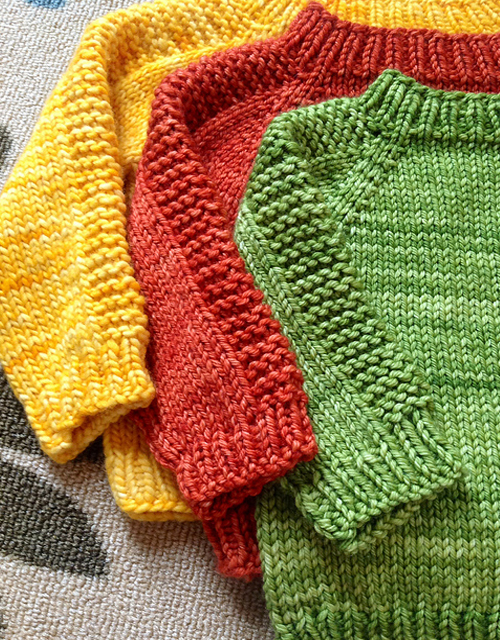
Looking for a versatile free sweater knitting pattern for babies, children, and adults? The Flax Sweater by Tin Can Knits is a modern top-down pullover designed to help knitters build confidence while learning seamless sweater construction.

Flax is part of the popular Simple Collection, a series of free patterns and tutorials created to teach essential knitting skills. With sizes ranging from babies to adults, it is a practical pattern that can be used again and again for different family members.

Flax Sweater Pattern at a Glance

Pattern: Flax Sweater

Designer: Tin Can Knits

Craft: Knitting

Category: Pullover / Sweater

Construction: Top-down and seamless

Yarn Weight: Worsted / Aran

Gauge: 18 stitches and 22 rows = 4 inches in stockinette stitch in the round

Needle Sizes: US 6 / 4.0 mm and US 8 / 5.0 mm

Yardage: Approximately 220–2100 yards (201–1920 m)

Sizes: 0–6 months through 6XL

Pattern Availability: Free

About the Flax Sweater

The Flax Sweater is one of those patterns that works especially well as a first garment project. It is designed with clean lines, simple shaping, and a seamless construction method that helps knitters understand how a sweater comes together without adding unnecessary complexity.

The sweater is worked from the top down, which means you begin at the neckline and continue through the yoke, body, and sleeves. This construction style is popular because it allows you to see the garment take shape as you knit.

Flax is also designed as part of a teaching collection, so it is supported by tutorials from Tin Can Knits that explain many of the techniques used throughout the project.

Sizes from Baby to Adult

One of the biggest advantages of the Flax pattern is its wide size range. The current worsted-weight version includes 19 sizes, beginning with babies and continuing through larger adult sizes.

Available sizes include:

  • 0–6 months
  • 6–12 months
  • 1–2 years
  • 2–4 years
  • 4–6 years
  • 6–8 years
  • 8–10 years
  • Adult sizes XS through 6XL

Because the pattern covers such a broad range, it can be a useful staple if you enjoy knitting sweaters for different members of the family.

Yarn and Gauge

The Flax worsted pattern is written for worsted / aran-weight yarn. The published gauge is:

18 stitches × 22 rows = 4 inches in stockinette stitch in the round

The listed yarn requirement ranges from approximately 220 to 2100 yards (201 to 1920 meters), depending on the size you choose.

Since Flax is available in both child and adult sizes, yarn requirements vary significantly. Always check the original pattern for the exact yardage needed for your selected size before purchasing yarn.

Needles

The pattern lists two main needle sizes:

  • US 6 / 4.0 mm
  • US 8 / 5.0 mm

The larger needles are used to achieve the main stockinette gauge, while the smaller size is used for specific sections of the sweater. Follow the original pattern instructions for the exact needle setup and construction details.

Why Flax Is Popular with Newer Sweater Knitters

Flax was created as part of Tin Can Knits' learn-to-knit series, which makes it especially useful for knitters who want to move from smaller projects into garment knitting.

The design introduces several important sweater-making skills in a relatively straightforward project, including top-down construction, knitting in the round, shaping, and finishing a seamless pullover.

At the same time, the finished sweater has a simple modern look that works well for babies, children, teenagers, and adults.

Other Versions of the Flax Sweater

Tin Can Knits now offers Flax in more than one yarn-weight version. In addition to Flax worsted, there are also lighter-weight versions including Flax DK and Flax Light.

These are separate pattern versions with different gauges, needle sizes, and yarn requirements, so be sure you are following the version that matches the yarn weight you want to use.

Is the Flax Sweater Pattern Free?

Yes. The Flax worsted sweater pattern by Tin Can Knits is currently available as a free knitting pattern.

The pattern can be accessed through the official Tin Can Knits website and is also available through Ravelry.

Get the Free Flax Sweater Pattern

Amazing Knitting does not reproduce the designer's knitting instructions. Please visit the official Tin Can Knits pattern page for the complete pattern, current sizing, tutorials, updates, and download options.

Get the Free Flax Sweater Pattern →

Pattern credit: Flax was created by Tin Can Knits as part of The Simple Collection. Pattern availability, sizing, and technical details are controlled by the designers and may change over time.

More Free Sweater Knitting Patterns

If you enjoy knitting simple sweaters, explore more free sweater knitting patterns and baby sweater knitting patterns from the Amazing Knitting archive.

Before You Start

Check the official pattern page before choosing yarn or needles so you can confirm the latest sizing, gauge, materials, and pattern notes for the version you plan to knit.

Discover More From the Archive

A fresh mix of knitting patterns and tutorials from the Amazing Knitting archive.

Finding patterns from the archive…