Skip to content

...

Showing posts sorted by date for query mitered square knitting. Sort by relevance Show all posts

Mitered Squares Throw With a Fabric Lining – Knitting Project Guide

Mitered Squares Throw with a fabric lining knitted blanket project

This colorful Mitered Squares Throw With a Fabric Lining is a beautiful example of how a knitter can take the construction ideas from an established blanket pattern and give the finished project a very different look.

The version shown here was created by Elaine of Italian Dish Knits. Her project was inspired by Mitered Crosses Blanket by Kay Gardiner, but Elaine made several important modifications, including replacing the original crosses with colorful mitered squares and adding a fabric backing to the finished blanket.

The result has the visual character of both knitting and patchwork quilting: color-changing knitted squares are surrounded by broad light-colored borders, while the fabric lining gives the reverse side a clean, finished appearance.

Featured project and photos: Elaine / Italian Dish Knits. Original blanket design inspiration: Mitered Crosses Blanket by Kay Gardiner.

Mitered Squares Throw Project Overview

  • Featured project: Mitered Squares Throw With a Fabric Lining
  • Project by: Elaine / Italian Dish Knits
  • Based on: Mitered Crosses Blanket
  • Original designer: Kay Gardiner
  • Project type: Knitted throw / blanket
  • Main technique: Mitered garter-stitch knitting
  • Featured modification: Squares instead of crosses
  • Finishing modification: Fabric lining
  • Construction: Modular knitted blocks
  • Original pattern availability: Paid

About the Featured Mitered Squares Throw

Elaine originally discovered Kay Gardiner's Mitered Crosses Blanket and decided to use its modular construction as the starting point for her own throw.

Instead of reproducing the cross motif from the original design, she changed the colorful sections into mitered squares.

This creates a striking geometric effect: multicolored squares appear to float inside wide light-colored frames.

The individual blocks also make the project portable during much of the knitting process because the blanket does not become one large piece until the blocks are assembled.

The Original Mitered Crosses Blanket

The inspiration for this project is Mitered Crosses Blanket by Kay Gardiner, originally published in 2011.

Kay Gardiner's original blanket combines two modular knitting ideas: mitering and log-cabin construction.

Each original block begins with knitted miters that form a cross. The cross is then surrounded by garter-stitch strips to create a larger square block.

The blocks are eventually joined and finished with an applied edging.

How Elaine Changed the Design

The blanket featured in the photographs should not be confused with an unaltered sample of the original pattern.

Elaine deliberately changed several elements to create her own version.

Most noticeably, she chose mitered squares rather than mitered crosses for the colorful centers.

She then surrounded those colorful sections with a neutral background, producing the strong grid-like appearance visible in the finished throw.

What Is a Mitered Knitted Square?

A mitered square is shaped by strategically decreasing stitches around a central point.

As the decreases are repeated, the knitted fabric develops diagonal lines that travel toward the center of the square.

When worked in garter stitch with a self-striping or color-changing yarn, those diagonal lines can make the color changes look especially dramatic.

Once the technique becomes familiar, mitered squares can be satisfying small modules to knit one at a time.

A Portable Modular Blanket Project

One advantage Elaine noted about this style of blanket is its portability.

For much of the project, you are working on individual blocks rather than holding an entire blanket on your needles.

That makes modular blankets particularly convenient for knitters who like taking a project with them while traveling or working away from home.

Only later, when the blocks are assembled, does the project grow into its full blanket size.

Using Color-Changing Yarn

The colorful centers are especially effective when knitted with yarn that changes gradually from one shade to another.

Because the mitered construction creates diagonal lines, the changing colors develop differently across each square.

Surrounding those colorful centers with a quieter neutral shade helps define each block and prevents the overall blanket from becoming visually overwhelming.

This makes the project an interesting source of inspiration for combining self-striping yarn with a solid background color.

The Fabric Lining

One of the most useful ideas in Elaine's project is the fabric backing.

After completing the knitted blanket, she added fabric to the reverse side. This gives the throw a finished appearance similar to a quilt and hides the back of the knitted construction.

The combination of knitted blocks on the front and fabric on the back also creates an interesting meeting point between knitting and sewing.

Why Add Fabric to a Knitted Blanket?

A fabric lining can serve several purposes.

It can give the reverse side of a modular blanket a cleaner appearance, cover yarn ends or joins, and add another decorative element to the finished project.

However, knitted fabric and woven fabric behave differently. Knitting is naturally stretchy, while many woven fabrics have much less give.

For that reason, the lining should be attached carefully so that it does not pull, distort or restrict the knitted blanket.

Preparing the Knitting Before Adding Fabric

Before attaching a lining, finish the knitted portion completely.

Weave in loose ends and block the blanket according to the care requirements of your yarn.

Blocking first allows the knitted fabric to settle into its final dimensions before the lining is measured and attached.

This is especially useful for a modular blanket because blocking can help the individual sections sit more evenly.

Choosing Fabric for the Backing

If you want to use Elaine's project as inspiration for your own lined blanket, choose a backing fabric that works well with the weight and intended use of your knitting.

The fabric should be large enough for the finished dimensions of the blocked blanket, including any allowance required for finishing the edges.

Washable materials are practical when the finished throw will be used regularly, but always consider the care requirements of both the yarn and fabric before combining them.

Skills Used in This Style of Project

Depending on whether you follow the original Kay Gardiner design or create a modified version inspired by Elaine's throw, useful skills may include:

  • Garter stitch
  • Mitered knitting
  • Decreasing stitches
  • Picking up stitches
  • Modular knitting
  • Joining knitted blocks
  • Weaving in ends
  • Blocking
  • Basic sewing for adding a fabric backing

Original Pattern Specifications

For reference, the published information for Kay Gardiner's Mitered Crosses Blanket lists:

  • Yarn weight: Aran
  • Suggested yarn: Noro Silk Garden
  • Needles: US 6 / 4 mm
  • Gauge: 20 stitches and 40 rows = 4 inches in garter stitch
  • Original finished size: approximately 40 × 52 inches
  • Sizing: Easily adaptable larger or smaller

These specifications refer to Kay Gardiner's original Mitered Crosses Blanket, not necessarily to every modification used in Elaine's Mitered Squares Throw.

Important Pattern Availability Note

Older references to this project may describe the underlying pattern as a charity pattern or may point to an older download location.

The situation has changed over time.

Kay Gardiner's Mitered Crosses Blanket is currently a paid pattern.

For that reason, Amazing Knitting does not describe this project as a free knitting pattern.

Visit the Featured Mitered Squares Project

Elaine's original article explains how she adapted the Mitered Crosses idea into squares and how she added a fabric lining to her finished throw.

See the Mitered Squares Throw Project →

Get the Original Mitered Crosses Blanket Pattern

If you want to knit Kay Gardiner's original design rather than Elaine's modified project, the Mitered Crosses Blanket pattern is currently available as a paid Ravelry download.

View the Original Mitered Crosses Blanket Pattern →

Pattern Availability

Amazing Knitting links readers to legitimate designer or publisher sources whenever possible. Pattern prices, download locations and availability can change after an article is published.

Read Our Pattern Availability Policy →

Amazing Knitting is an independent pattern discovery and project-guide site. Mitered Crosses Blanket and its original knitting instructions remain the intellectual property of Kay Gardiner. The featured modification and photographs belong to their respective creator. This article provides project information and links readers to the credited sources rather than reproducing the complete knitting pattern.
Sampler Block Throw - Free Knitting Pattern

Sampler Block Throw - Free Pattern
Design by © Cathy Payson

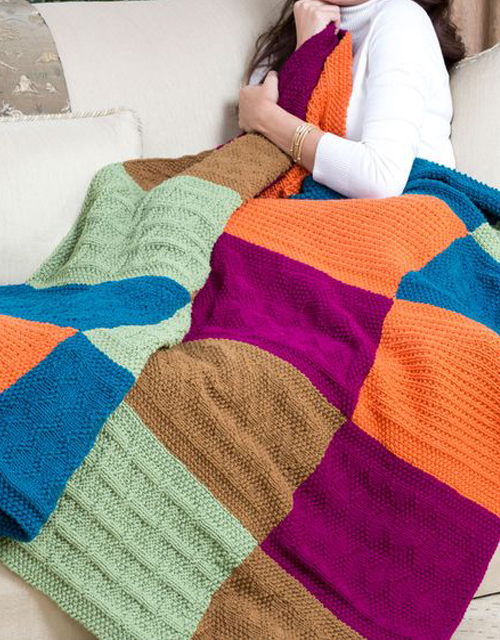
Sampler Block Throw by Cathy Payson is a colorful knitted blanket that lets you practice several different stitch patterns while creating one cozy finished project.

The original Red Heart pattern is still available as a free official download from Yarnspirations.

✓ Free Pattern Available

The original Red Heart Sampler Block Throw pattern is currently available as a free download from Yarnspirations. Some of the original yarn shades may have been discontinued, but the knitting pattern itself remains available.

Pattern at a Glance

Pattern: Sampler Block Throw

Designer: Cathy Payson

Brand: Red Heart / Yarnspirations

Craft: Knitting

Skill Level: Easy

Finished Size: 50 × 60 in (127 × 152.5 cm)

Yarn Weight: Aran

Availability: Free official download

A Blanket That Lets You Practice New Stitches

The fun of a sampler blanket is that you do not spend the entire project repeating one stitch pattern.

Sampler Block Throw combines several textured designs, including Moss Diamonds, Broken Rib, Zigzag Moss, Square Lattice and Vertical Zigzag.

The blocks are arranged into panels and then joined to create the finished throw. This also makes the project convenient to work on in smaller sections instead of carrying an entire blanket on your needles.

Written Instructions and Charts

Another useful feature of the original pattern is that the stitch patterns are provided in both written and charted form.

This makes the project a nice opportunity to practice reading knitting charts while still having written instructions available for reference.

Choosing Yarn

The original design uses Red Heart With Love yarn. Some original shades associated with the pattern may no longer be available, but that does not prevent you from knitting the throw.

Choose a compatible yarn and make a gauge swatch before beginning, especially if you want to reproduce the original 50 × 60 inch finished size.

Get the Free Sampler Block Throw Pattern

Yarnspirations currently provides the complete original Red Heart pattern as a free download with no sign-up required.

Get the Free Sampler Block Throw Pattern →

More Free Knitted Blankets

Pattern credit: Sampler Block Throw was designed by Cathy Payson for Red Heart. Amazing Knitting provides this independent project guide and links to the authorized free pattern rather than reproducing the complete knitting instructions.

Mitered Corner Blanket - Free Pattern

Mitered Corner Blanket - Free Pattern
Photo above © purlsoho

Mitered Corner Blanket by Purl Soho is a striking modular blanket built from 192 small mitered squares that flow through a carefully planned sequence of colors.

Although the finished blanket looks complex, its construction is wonderfully logical: each new square grows directly from neighboring squares by picking up stitches along their edges.

That means all 192 squares become one continuous blanket without sewing the individual squares together. The original Purl Soho pattern remains available online for free.

✓ Free Pattern Availability

Mitered Corner Blanket is currently available as a free knitting pattern directly from Purl Soho. Use the official pattern page linked below for the complete knitting instructions, schematic and current pattern information.

Mitered Corner Blanket at a Glance

Pattern: Mitered Corner Blanket

Designer: Jake Canton for Purl Soho

Published: January 2019

Category: Blanket / Throw

Original Yarn: Purl Soho Linen Quill

Yarn Weight: Fingering, held double

Needles: US 6 / 4 mm

Gauge: 22 stitches × 44 rows = 4 in / 10 cm in garter stitch, yarn held double

Sizes: Small Throw and Large Throw

Finished Size: 36 × 48 in or 48 × 64 in

Number of Squares: 192

Construction: Modular mitered squares joined as you knit

Seaming: No square assembly required

Availability: Free official Purl Soho pattern

About the Mitered Corner Blanket

Mitered Corner Blanket was designed for Purl Soho by Jake Canton and first published in January 2019.

The blanket is built from a grid of 192 small squares. Color changes across the grid create gradual transitions that make the finished project look almost like a textile painting.

What makes the construction especially clever is that these are not 192 separately knitted squares waiting to be sewn together at the end.

Instead, the blanket grows continuously as stitches for each new square are picked up from previously completed squares.

Two Finished Sizes

Purl Soho provides two sizes:

  • Small Throw: approximately 36 × 48 inches / 91 × 122 cm
  • Large Throw: approximately 48 × 64 inches / 122 × 163 cm

Both versions use the same 192-square layout.

The difference is the size of each individual square.

Square Size

Each finished square should measure approximately:

  • Small Throw: 3 × 3 inches
  • Large Throw: 4 × 4 inches

This is why gauge matters even though the project is a blanket. Small differences multiplied across many squares can noticeably change the final dimensions.

192 Squares — But No Sewing Them Together

Seeing “192 squares” might make you imagine an enormous pile of motifs that must eventually be assembled.

Fortunately, that is not how this blanket is constructed.

After the initial square, stitches for subsequent squares are picked up along the edges of existing squares as directed in the pattern.

The blanket therefore grows as one connected piece.

For knitters who enjoy modular blankets but dislike sewing dozens or hundreds of pieces together, this is one of the most appealing features of the design.

How a Mitered Square Gets Its Shape

A knitted mitered square begins as a row of stitches and becomes progressively smaller through centered decreases.

Those decreases pull the fabric toward the center diagonal, creating the characteristic square shape and visible directional lines.

Once you understand the rhythm of one square, the basic process becomes highly repetitive.

Amazing Knitting does not reproduce Purl Soho's complete square instructions here. Use the official free pattern for the exact stitch counts and decrease sequence.

Original Yarn: Linen Quill

The original blanket uses Purl Soho Linen Quill.

Linen Quill is a fingering-weight yarn containing:

  • 50% fine highland wool
  • 35% alpaca
  • 15% linen

Each 100-gram skein contains approximately 439 yards / 401 meters.

Important: The Yarn Is Held Double

Important Yarn Note

Although Linen Quill is a fingering-weight yarn, the Mitered Corner Blanket is knitted with two strands held together throughout the project. Keep this in mind when choosing a substitute yarn or calculating yardage.

Holding two strands together is also important to the original color design because combining different shades creates intermediate colors between the main palette tones.

Color Mixing Is Part of the Design

This blanket is more than a collection of solid-colored squares.

By holding two strands together, Purl Soho can combine two different colors in a single square.

Those combinations create gradual visual transitions as the blanket moves from one color family into another.

This is what gives the original blanket its watercolor-like appearance.

Original Color Palettes

Purl Soho has presented the blanket in several coordinated palettes, including:

  • Warm
  • Cool
  • Dawn
  • Mountain

You can follow one of the published palettes or use the construction as inspiration for your own color arrangement.

Choosing Your Own Colors

If you want to create a custom palette, think about how adjacent colors will interact when two strands are held together.

A useful approach is to arrange your skeins from one color family into another before beginning.

Photograph the arrangement or label each color so that you can reproduce your plan later.

With 192 squares, relying on memory alone can become confusing.

Needles

The published needle size is:

US 6 / 4 mm

Purl Soho notes that either circular or straight needles can be used.

Use whichever style feels comfortable, but choose the actual needle size according to the gauge you obtain with your yarn.

Gauge

The published gauge is:

22 stitches × 44 rows = 4 × 4 inches / 10 × 10 cm

This is measured in garter stitch with the yarn held double.

Knit Garter and Purl Garter

An interesting feature of the original blanket is that some squares are worked with knit garter stitch while others use purl garter stitch.

Purl Soho specifically recommends making sure that your gauge is correct in both.

If your knit and purl tension differs significantly, you may need to adjust your needle size or technique to keep the squares consistent.

Why Consistent Square Size Matters

A single square that is slightly larger may not seem important.

Across a grid of 192 squares, however, repeated gauge differences can affect the overall shape of the blanket.

Measure some of your early squares before progressing too far.

For the Small Throw, aim for approximately 3 inches square; for the Large Throw, approximately 4 inches square.

Picking Up Stitches Neatly

Picking up stitches is one of the key skills in this project.

Because each new square grows directly from its neighbors, consistent pickup technique helps keep the joins neat and the grid even.

Avoid picking up stitches at random intervals just to reach the required number. Follow the edge structure and the designer's instructions so the new square sits naturally against the existing fabric.

A Good Modular Knitting Project

One advantage of this construction is psychological as well as practical.

Instead of thinking about knitting an entire 48- or 64-inch blanket, you can focus on completing one small square at a time.

Each finished square becomes a visible unit of progress.

That can make a large long-term blanket project feel much more manageable.

Managing Yarn Ends

A project involving many colors naturally creates yarn ends.

Do not wait until the very last square to think about finishing them.

Weaving in ends periodically can prevent the back of the blanket from becoming overwhelming near the end of the project.

Leave tails long enough to secure them properly according to your yarn and finishing method.

Choosing a Substitute Yarn

You do not have to use Linen Quill, but substitution requires some planning because the original pattern holds fingering-weight yarn double.

Consider:

  • The published gauge
  • The size of each finished square
  • How two strands behave together
  • Color-mixing possibilities
  • Drape and weight of the finished blanket
  • Total yardage
  • Washing and care requirements

Make at least one complete mitered square with your substitute yarn before committing to enough yarn for the full blanket.

Blocking the Finished Blanket

Blocking can help even out the grid and settle small differences between neighboring squares.

Follow the care instructions for your chosen yarn and arrange the blanket so that the outer edges are straight without aggressively stretching individual squares.

Skills Used in Mitered Corner Blanket

  • Garter stitch
  • Centered decreases
  • Picking up stitches
  • Working modular squares
  • Holding two yarn strands together
  • Changing and combining colors
  • Maintaining consistent gauge
  • Weaving in ends
  • Blocking a large knitted blanket

Is Mitered Corner Blanket Still Free?

Yes.

Purl Soho continues to provide the complete Mitered Corner Blanket pattern for free on its official website.

This is the best source to use because it contains the designer's instructions, color information, schematic and current pattern notes.

Amazing Knitting does not reproduce Purl Soho's complete copyrighted knitting instructions.

Get the Free Mitered Corner Blanket Pattern

Visit Purl Soho for the complete official free pattern:

Get the Free Mitered Corner Blanket Pattern →

You can also view the Ravelry record for project examples and pattern specifications:

View Mitered Corner Blanket on Ravelry →

More Free Blanket Knitting Patterns

If you enjoy geometric or textured blankets, these already-verified Amazing Knitting patterns are also worth exploring:

Or browse:

Before You Start

Make one complete test square before beginning the full 192-square blanket. Check both your gauge and the finished square dimensions.

Remember that the original fingering-weight Linen Quill is held double throughout, and organize your colors before beginning if you plan to reproduce the gradual color transitions.

Finally, keep the official Purl Soho pattern open while working so that you can follow the correct square sequence and color schematic rather than relying on copied versions elsewhere.

Pattern credit: Mitered Corner Blanket was designed for Purl Soho by Jake Canton and first published in 2019. The existing photograph on this Amazing Knitting page is credited to Purl Soho. Amazing Knitting provides an independent project guide and does not reproduce Purl Soho's complete copyrighted knitting instructions.

Discover More From the Archive

A fresh mix of knitting patterns and tutorials from the Amazing Knitting archive.

Finding patterns from the archive…