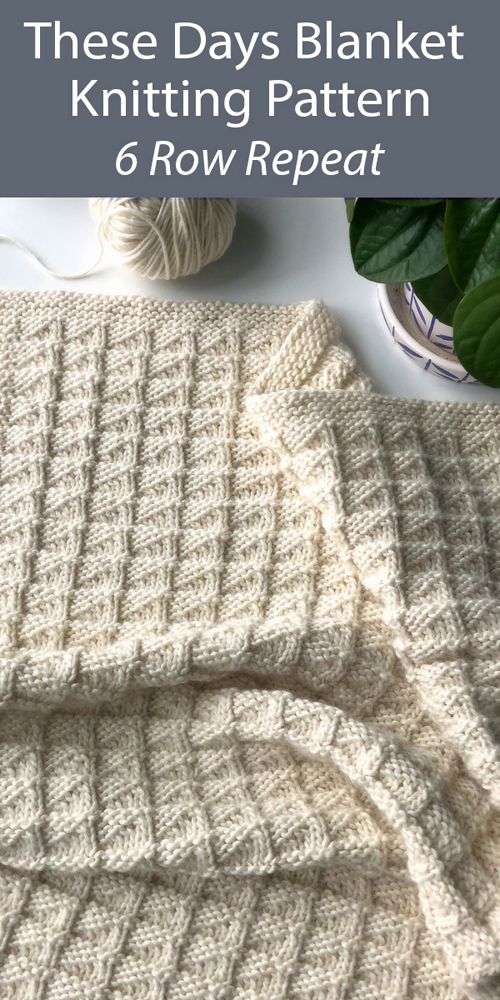
These Days Blanket designed by © Fifty Four Ten Studio.
These Days Blanket by Fifty Four Ten Studio is a
modern reversible blanket knitting pattern featuring a beautifully
simple geometric texture made entirely with knit and purl stitches.
The repeating design resembles small triangles inside squares, creating
a clean contemporary texture that looks attractive on both sides of the
blanket.
Even better, the blanket is knitted flat in one piece and the pattern
includes six sizes, from a baby blanket to a generous
XXL throw.
Pattern availability: These Days Blanket is currently
available as a paid PDF knitting pattern directly from Fifty Four Ten
Studio. You will find the official pattern link near the end of this
guide.
These Days Blanket at a Glance
- Pattern: These Days Blanket
- Designer: Mary Lee / Fifty Four Ten Studio
- Published: February 2020
- Category: Baby blanket / throw
- Construction: Worked flat in one piece
- Yarn weight: Worsted #4
- Needles: US 7 / 4.5 mm circular needles
- Gauge: Approximately 19 sts × 30 rows = 4 in / 10 cm in pattern stitch
- Yardage: Approximately 760–2,400 yd (695–2,195 m), depending on size
- Sizes: Baby, Small, Medium, Large, XL and XXL
- Stitch pattern: 6-row knit-and-purl repeat
- Design: Fully reversible geometric texture
- Skill level: Easy / confident beginner
- Pattern language: English, using standard U.S. knitting terms
- Current availability: Paid PDF pattern
A Modern Geometric Knitted Blanket
The main attraction of These Days Blanket is its understated geometric
texture.
A repeating combination of knit and purl stitches creates small
triangle-in-a-square shapes across the surface of the blanket.
From a distance, the repeated shapes form a clean modern pattern. Up
close, the raised and recessed stitches give the fabric plenty of
texture without the need for cables, lace or colorwork.
The Blanket Is Fully Reversible
One of the most useful features of These Days Blanket is that the stitch
pattern is reversible.
The geometric design looks the same on both sides, so there is no
obvious right or wrong side of the finished blanket.
This is especially useful for baby blankets and throws because they are
constantly folded, wrapped and turned over during everyday use.
Only Knit and Purl Stitches
Although the finished texture looks detailed, the stitch pattern is
created entirely with knit and purl stitches.
There are no complicated cables or lace techniques required to produce
the geometric design.
This makes These Days Blanket an appealing project for knitters who have
mastered the basic stitches and are ready to practice following a
repeating textured pattern.
A Simple 6-Row Repeat
The geometric texture is built from a
six-row repeating stitch pattern.
Short repeats can make a large blanket much more enjoyable to knit
because the rhythm of the design becomes familiar after you have worked
several repetitions.
You still need to keep track of your rows carefully, but once the
pattern becomes recognizable it can develop into relaxing,
straightforward knitting.
Six Blanket Sizes
The pattern includes instructions for six finished sizes, making it
useful for everything from a baby gift to a large sofa throw.
- Baby: approximately 27 × 30 in
- Small: approximately 30 × 34 in
- Medium: approximately 33.5 × 37 in
- Large: approximately 36 × 41 in
- XL: approximately 39 × 48 in
- XXL: approximately 46 × 54 in
These measurements are approximate after blocking. Your finished
dimensions may vary slightly depending on your yarn, gauge and knitting
tension.
You Can Make the Blanket Longer
Another useful feature of the design is the ability to add extra pattern
repeats if you want a longer blanket.
According to the designer, each additional repeat adds approximately
0.75 inch to the length.
Remember that making the blanket longer will require additional yarn, so
plan your yardage before modifying the size.
Yarn Requirements
These Days Blanket is designed primarily for
worsted #4 weight yarn.
Approximate yarn requirements for the six sizes are:
- Baby: 760–780 yd
- Small: 950–980 yd
- Medium: 1,140–1,180 yd
- Large: 1,350–1,400 yd
- XL: 1,700–1,800 yd
- XXL: 2,300–2,400 yd
Buy additional yarn if you plan to increase the length or if your gauge
differs significantly from the pattern gauge.
Choosing Yarn for These Days Blanket
The designer recommends using a solid-color yarn for
the best appearance.
This is good advice for textured knitting. The shadows created by knit
and purl stitches are easier to see when the yarn color does not compete
with the stitch pattern.
Light and medium shades can make the geometric shapes particularly
visible.
Wool, Cotton or Acrylic?
The pattern can work with many worsted-weight yarns and is not limited
to one particular fiber.
Wool can provide warmth and excellent stitch definition. A washable
wool or wool blend can be especially practical for a baby blanket.
Acrylic may offer easy care and a wide range of affordable colors, while
suitable cotton yarn can create a different drape and feel.
Whatever fiber you choose, make a swatch first to make sure you like the
appearance and feel of the textured fabric.
Needles
The designer used US 7 / 4.5 mm needles.
Although the blanket is knitted flat rather than in the round, circular
needles are recommended because the cable can comfortably hold the
large number of stitches required for a blanket.
Work back and forth on the circular needle exactly as you would on
straight needles.
Gauge
The listed gauge is approximately
19 stitches and 30 rows = 4 inches / 10 cm in the
pattern stitch using US 7 / 4.5 mm needles.
The designer notes that exact gauge is not essential, but the textured
pattern tends to look best when the stitches are fairly firm.
A significantly different gauge can change the finished dimensions and
the amount of yarn required.
Is These Days Blanket Beginner Friendly?
The designer rates These Days Blanket as an
easy knitting pattern.
It is particularly suitable for a confident beginner who already knows
how to knit and purl and wants to move beyond plain stockinette or
garter-stitch projects.
The main challenge is not a difficult knitting technique. Instead, it is
accurately following the row-by-row sequence that creates the geometric
texture.
Skills You Will Need
Before beginning These Days Blanket, you should be comfortable with:
- Casting on stitches
- Knitting
- Purling
- Reading row-by-row knitting instructions
- Keeping track of pattern repeats
- Binding off
- Weaving in yarn ends
No advanced cable or lace techniques are required to create the main
geometric texture.
Use a Row Counter
Because the design depends on a six-row repeat, keeping track of your
current row is important.
A row counter, notebook, phone app or simple pencil mark beside each
completed row can help prevent mistakes.
Once you have knitted several repeats, you may begin to recognize the
visual rhythm of the pattern, but it is still useful to maintain an
accurate row count.
Check Your Texture Regularly
Take a moment every few rows to look at the geometric shapes developing
across the blanket.
Since the design is created by the placement of knit and purl stitches,
a mistake can interrupt the repeating texture.
Catching an error early is much easier than discovering it after many
additional rows have been knitted.
Why Solid Yarn Is a Smart Choice
Highly variegated yarn can sometimes hide subtle knit-and-purl textures.
If the geometric pattern is the feature you love most about These Days
Blanket, consider a solid or gently tonal yarn that allows the
triangle-in-a-square design to remain visible.
The simplicity of one color also gives the finished blanket a clean,
contemporary appearance.
Knitting the Baby Size
The smallest version measures approximately
27 × 30 inches after blocking and requires roughly
760–780 yards of worsted-weight yarn.
This size can be a good choice for a handmade baby gift because it
allows you to enjoy the complete geometric design without committing to
the yardage required for a full-size throw.
If the blanket will be used for a baby, choose a soft yarn with care
instructions that suit the recipient.
Knitting a Larger Throw
If you want a blanket for a sofa, reading chair or bedroom, one of the
larger sizes may be more appropriate.
The XL and XXL versions allow the repeating texture to cover a much
larger surface, producing a simple but visually impressive throw.
Larger sizes require considerably more yarn, so checking dye lots and
purchasing enough yarn at the beginning of the project is a sensible
precaution.
Blocking Makes a Difference
Blocking is particularly useful for a textured blanket like this one.
Before blocking, the edges may appear slightly wavy and the geometric
texture may not look completely settled.
Gentle blocking can help square the blanket, relax the fabric and make
the stitch pattern appear more defined.
Always use a blocking method appropriate for the fiber content of your
chosen yarn.
A Relaxing Repetitive Project
Large blankets often involve many hours of knitting, so a memorable
stitch repeat can make the process much more enjoyable.
These Days Blanket combines enough texture to keep the project
interesting with a short enough repeat to become familiar.
For many knitters, this balance makes it a good project for relaxed
evening knitting once the pattern sequence has been learned.
The Story Behind the Name
Designer Mary Lee named the pattern These Days because
the geometric stitch design reminded her of the boxes on a paper
calendar.
The repeating squares reflect the idea of individual days: some filled
with important events, others with challenges, and many with the simple
everyday moments that are easy to overlook.
That inspiration gives the otherwise minimalist geometric blanket a
thoughtful personal story.
Why These Days Blanket Is So Versatile
The combination of six sizes, worsted-weight yarn and a reversible
texture makes this pattern useful for many different projects.
Knit the smaller version as a baby blanket, choose a middle size for a
lap blanket, or work one of the larger versions as a cozy throw.
Because the design is geometric rather than themed, it also works well
with many decorating styles and gift occasions.
These Days Blanket Pattern Availability
These Days Blanket is currently a paid knitting pattern.
The original designer, Fifty Four Ten Studio, currently offers the
downloadable PDF directly through the official studio website.
At the time of our latest availability check, the official PDF is
listed at $6 USD.
We also checked for a legitimate currently available free version of
this exact pattern but did not find one. Therefore, we are linking
directly to the designer's official pattern page rather than directing
readers to an unofficial copy.
Get the These Days Blanket Pattern
Visit Fifty Four Ten Studio to see the complete pattern details and
purchase the downloadable PDF directly from the designer.
Get the These Days Blanket Pattern →
These Days Blanket is designed by Mary Lee of Fifty Four Ten Studio.
Amazing Knitting does not reproduce the copyrighted row-by-row pattern
instructions. Pattern pricing and availability may change, so please
check the designer's official page for the latest information.
Read Our Pattern Availability Policy →