|
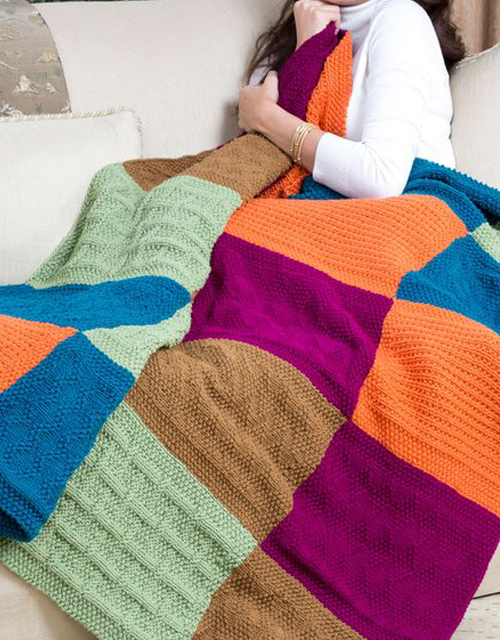
| Photo above © purlsoho |
Mitered Corner Blanket by Purl Soho is a striking modular blanket built from 192 small mitered squares that flow through a carefully planned sequence of colors.
Although the finished blanket looks complex, its construction is wonderfully logical: each new square grows directly from neighboring squares by picking up stitches along their edges.
That means all 192 squares become one continuous blanket without sewing the individual squares together. The original Purl Soho pattern remains available online for free.
✓ Free Pattern Availability
Mitered Corner Blanket is currently available as a free knitting pattern directly from Purl Soho. Use the official pattern page linked below for the complete knitting instructions, schematic and current pattern information.
Mitered Corner Blanket at a Glance
Pattern: Mitered Corner Blanket
Designer: Jake Canton for Purl Soho
Published: January 2019
Category: Blanket / Throw
Original Yarn: Purl Soho Linen Quill
Yarn Weight: Fingering, held double
Needles: US 6 / 4 mm
Gauge: 22 stitches × 44 rows = 4 in / 10 cm in garter stitch, yarn held double
Sizes: Small Throw and Large Throw
Finished Size: 36 × 48 in or 48 × 64 in
Number of Squares: 192
Construction: Modular mitered squares joined as you knit
Seaming: No square assembly required
Availability: Free official Purl Soho pattern
About the Mitered Corner Blanket
Mitered Corner Blanket was designed for Purl Soho by Jake Canton and first published in January 2019.
The blanket is built from a grid of 192 small squares. Color changes across the grid create gradual transitions that make the finished project look almost like a textile painting.
What makes the construction especially clever is that these are not 192 separately knitted squares waiting to be sewn together at the end.
Instead, the blanket grows continuously as stitches for each new square are picked up from previously completed squares.
Two Finished Sizes
Purl Soho provides two sizes:
- Small Throw: approximately 36 × 48 inches / 91 × 122 cm
- Large Throw: approximately 48 × 64 inches / 122 × 163 cm
Both versions use the same 192-square layout.
The difference is the size of each individual square.
Square Size
Each finished square should measure approximately:
- Small Throw: 3 × 3 inches
- Large Throw: 4 × 4 inches
This is why gauge matters even though the project is a blanket. Small differences multiplied across many squares can noticeably change the final dimensions.
192 Squares — But No Sewing Them Together
Seeing “192 squares” might make you imagine an enormous pile of motifs that must eventually be assembled.
Fortunately, that is not how this blanket is constructed.
After the initial square, stitches for subsequent squares are picked up along the edges of existing squares as directed in the pattern.
The blanket therefore grows as one connected piece.
For knitters who enjoy modular blankets but dislike sewing dozens or hundreds of pieces together, this is one of the most appealing features of the design.
How a Mitered Square Gets Its Shape
A knitted mitered square begins as a row of stitches and becomes progressively smaller through centered decreases.
Those decreases pull the fabric toward the center diagonal, creating the characteristic square shape and visible directional lines.
Once you understand the rhythm of one square, the basic process becomes highly repetitive.
Amazing Knitting does not reproduce Purl Soho's complete square instructions here. Use the official free pattern for the exact stitch counts and decrease sequence.
Original Yarn: Linen Quill
The original blanket uses Purl Soho Linen Quill.
Linen Quill is a fingering-weight yarn containing:
- 50% fine highland wool
- 35% alpaca
- 15% linen
Each 100-gram skein contains approximately 439 yards / 401 meters.
Important: The Yarn Is Held Double
Important Yarn Note
Although Linen Quill is a fingering-weight yarn, the Mitered Corner Blanket is knitted with two strands held together throughout the project. Keep this in mind when choosing a substitute yarn or calculating yardage.
Holding two strands together is also important to the original color design because combining different shades creates intermediate colors between the main palette tones.
Color Mixing Is Part of the Design
This blanket is more than a collection of solid-colored squares.
By holding two strands together, Purl Soho can combine two different colors in a single square.
Those combinations create gradual visual transitions as the blanket moves from one color family into another.
This is what gives the original blanket its watercolor-like appearance.
Original Color Palettes
Purl Soho has presented the blanket in several coordinated palettes, including:
- Warm
- Cool
- Dawn
- Mountain
You can follow one of the published palettes or use the construction as inspiration for your own color arrangement.
Choosing Your Own Colors
If you want to create a custom palette, think about how adjacent colors will interact when two strands are held together.
A useful approach is to arrange your skeins from one color family into another before beginning.
Photograph the arrangement or label each color so that you can reproduce your plan later.
With 192 squares, relying on memory alone can become confusing.
Needles
The published needle size is:
US 6 / 4 mm
Purl Soho notes that either circular or straight needles can be used.
Use whichever style feels comfortable, but choose the actual needle size according to the gauge you obtain with your yarn.
Gauge
The published gauge is:
22 stitches × 44 rows = 4 × 4 inches / 10 × 10 cm
This is measured in garter stitch with the yarn held double.
Knit Garter and Purl Garter
An interesting feature of the original blanket is that some squares are worked with knit garter stitch while others use purl garter stitch.
Purl Soho specifically recommends making sure that your gauge is correct in both.
If your knit and purl tension differs significantly, you may need to adjust your needle size or technique to keep the squares consistent.
Why Consistent Square Size Matters
A single square that is slightly larger may not seem important.
Across a grid of 192 squares, however, repeated gauge differences can affect the overall shape of the blanket.
Measure some of your early squares before progressing too far.
For the Small Throw, aim for approximately 3 inches square; for the Large Throw, approximately 4 inches square.
Picking Up Stitches Neatly
Picking up stitches is one of the key skills in this project.
Because each new square grows directly from its neighbors, consistent pickup technique helps keep the joins neat and the grid even.
Avoid picking up stitches at random intervals just to reach the required number. Follow the edge structure and the designer's instructions so the new square sits naturally against the existing fabric.
A Good Modular Knitting Project
One advantage of this construction is psychological as well as practical.
Instead of thinking about knitting an entire 48- or 64-inch blanket, you can focus on completing one small square at a time.
Each finished square becomes a visible unit of progress.
That can make a large long-term blanket project feel much more manageable.
Managing Yarn Ends
A project involving many colors naturally creates yarn ends.
Do not wait until the very last square to think about finishing them.
Weaving in ends periodically can prevent the back of the blanket from becoming overwhelming near the end of the project.
Leave tails long enough to secure them properly according to your yarn and finishing method.
Choosing a Substitute Yarn
You do not have to use Linen Quill, but substitution requires some planning because the original pattern holds fingering-weight yarn double.
Consider:
- The published gauge
- The size of each finished square
- How two strands behave together
- Color-mixing possibilities
- Drape and weight of the finished blanket
- Total yardage
- Washing and care requirements
Make at least one complete mitered square with your substitute yarn before committing to enough yarn for the full blanket.
Blocking the Finished Blanket
Blocking can help even out the grid and settle small differences between neighboring squares.
Follow the care instructions for your chosen yarn and arrange the blanket so that the outer edges are straight without aggressively stretching individual squares.
Skills Used in Mitered Corner Blanket
- Garter stitch
- Centered decreases
- Picking up stitches
- Working modular squares
- Holding two yarn strands together
- Changing and combining colors
- Maintaining consistent gauge
- Weaving in ends
- Blocking a large knitted blanket
Is Mitered Corner Blanket Still Free?
Yes.
Purl Soho continues to provide the complete Mitered Corner Blanket pattern for free on its official website.
This is the best source to use because it contains the designer's instructions, color information, schematic and current pattern notes.
Amazing Knitting does not reproduce Purl Soho's complete copyrighted knitting instructions.
Get the Free Mitered Corner Blanket Pattern
Visit Purl Soho for the complete official free pattern:
Get the Free Mitered Corner Blanket Pattern →
You can also view the Ravelry record for project examples and pattern specifications:
View Mitered Corner Blanket on Ravelry →
More Free Blanket Knitting Patterns
If you enjoy geometric or textured blankets, these already-verified Amazing Knitting patterns are also worth exploring:
- Waffle Blanket - Free Pattern
- Shivaree Throw - Free Pattern
- Slip Stitch Sampler Throw - Free Pattern
Or browse:
Before You Start
Make one complete test square before beginning the full 192-square blanket. Check both your gauge and the finished square dimensions.
Remember that the original fingering-weight Linen Quill is held double throughout, and organize your colors before beginning if you plan to reproduce the gradual color transitions.
Finally, keep the official Purl Soho pattern open while working so that you can follow the correct square sequence and color schematic rather than relying on copied versions elsewhere.
Pattern credit: Mitered Corner Blanket was designed for Purl Soho by Jake Canton and first published in 2019. The existing photograph on this Amazing Knitting page is credited to Purl Soho. Amazing Knitting provides an independent project guide and does not reproduce Purl Soho's complete copyrighted knitting instructions.