Skip to content

...

Showing posts sorted by relevance for query free blanket square knitting pattern. Sort by date Show all posts

Cable Square Blanket - Knitting Pattern Guide

Cable Square Blanked - Knitting Pattern
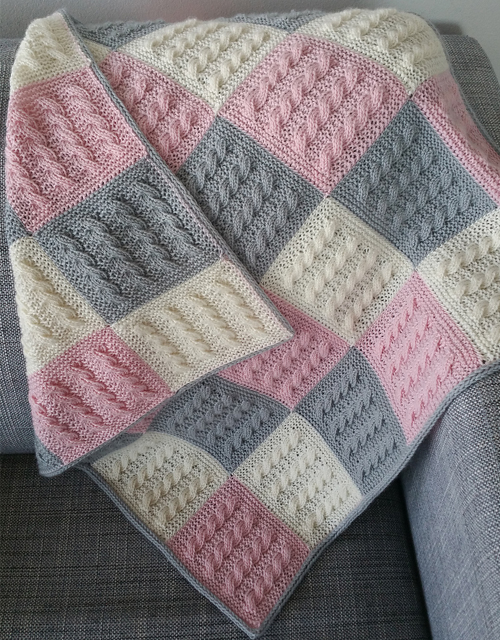
Photo above © Audurbjort 

Cable Square Blanket by Auður Björt Skúladóttir is a striking modular knitted blanket built from colorful cable squares with an unusual feature: the cable designs are intended to look attractive from both sides.

Originally listed under the Icelandic name Kaðlabútateppi and the English title Cable Square Blanked, the project combines reversible cable knitting, multiple colors and modular blanket construction.

Pattern Availability Note

This design is still listed among Auður Björt Skúladóttir's patterns, but we could not verify a current legitimate free download for the original pattern. For that reason, Amazing Knitting does not describe it as a free pattern or link to unauthorized archived copies.

Cable Square Blanket at a Glance

Original Name: Kaðlabútateppi / Cable Square Blanked

Designer: Auður Björt Skúladóttir

Craft: Knitting

Category: Blanket / Throw

Construction: Knitted cable squares joined into a blanket

Special Feature: Reversible cable designs

Color: Designed to work beautifully with multiple colors

Finishing: I-cord edging/bind-off is associated with the designer's blanket workshop

Current Pattern Status: Original design verified; free availability not verified

About the Cable Square Blanket

Cable Square Blanket is a modular knitting project by Icelandic designer Auður Björt Skúladóttir.

Instead of knitting one very large blanket from edge to edge, the project is based around individual knitted squares. Each square provides an opportunity to work cable textures while different yarn colors add variety across the finished blanket.

The result is particularly effective because the strong cable textures and changing colors give every section its own identity while the repeated square format holds the complete design together.

The Original Icelandic Name

The pattern appears in the designer's catalog as:

Kaðlabútateppi / cable square blanked

You may therefore encounter both this original listing and the more natural English description Cable Square Blanket when searching for the project.

Amazing Knitting uses “Cable Square Blanket” in this guide because it clearly describes the project for English-speaking knitters, while retaining the original pattern name above for identification.

Reversible Cable Knitting

One of the most interesting aspects of this project is the use of reversible cables.

Traditional cable knitting often has a very obvious right side and a much less decorative reverse side. Auður Björt Skúladóttir has a particular interest in designing knitted pieces that remain attractive when viewed from either side.

This characteristic is especially useful for blankets, scarves and shawls because both surfaces are likely to remain visible during normal use.

Why Reversible Cables Work Well for Blankets

A blanket is rarely displayed with only one side visible.

It may be folded over a chair, wrapped around someone or turned in different directions. A reversible texture therefore makes practical as well as decorative sense.

In this design, the cable structure becomes part of the appearance of both sides rather than leaving the reverse as something that always needs to be hidden.

Modular Square Construction

Working a blanket as separate squares has several practical advantages.

Individual blocks are easier to carry than an entire growing blanket, making modular knitting convenient for travel or short knitting sessions.

It also allows you to experiment with different colors without carrying all of the blanket's yarn at once.

The squares are eventually arranged and joined to create the complete throw.

Playing With Color

The original project is especially attractive when worked in several colors.

You might choose a coordinated palette of related shades, use contrasting colors for a more graphic effect, or build the blanket gradually from suitable yarn in your stash.

When planning a multi-color blanket, laying the finished squares on the floor before joining them can help distribute light, dark and dominant colors more evenly.

I-Cord Finishing

Auður Björt Skúladóttir has taught this particular Cable Square Blanket as a workshop project.

In that workshop, knitters first explored reversible cable techniques and then worked on assembling and finishing the blanket with an I-cord bind off.

An I-cord finish can give a modular blanket a clean outer edge and help visually unite the individual blocks.

Needles

A Reykjavík knitting workshop taught by the designer for this blanket asked participants to bring:

4 mm / US 6 circular needles, 60–80 cm / 24–32 inches

This is useful historical information about how the project has been taught, but always follow the specifications in any current copy of the designer's pattern rather than assuming workshop materials necessarily replace the pattern's complete requirements.

Skill Level

A Reykjavík Knitting Festival class devoted to this blanket was classified as Advanced.

That does not necessarily mean every individual square will feel equally difficult, but knitters should be comfortable managing cable techniques and following textured stitch patterns.

Skills That Help

Useful skills for a project of this type include:

  • Casting on and binding off
  • Knitting and purling confidently
  • Working cable stitches
  • Understanding cable crossings
  • Following repeating stitch patterns
  • Working reversible textures
  • Maintaining consistent gauge between squares
  • Joining knitted blocks
  • Working an I-cord edge or bind-off
  • Blocking individual squares

Keeping the Squares Consistent

Gauge deserves particular attention in a modular blanket.

If one square is noticeably larger than the others, joining the blocks neatly becomes much more difficult.

Try to use yarns with compatible weights and characteristics, and check the dimensions of your first completed squares before producing a large number of blocks.

Blocking Before Assembly

Blocking the squares before final assembly can make joining considerably easier.

It allows you to bring the blocks to consistent dimensions and straighten their edges before arranging the final blanket.

Follow the care instructions appropriate for your yarn and avoid overstretching the cable texture.

Planning the Final Layout

One of the enjoyable stages of a modular blanket is arranging the finished squares.

Before joining anything permanently, place the blocks together and try several layouts. Pay attention to color balance as well as the direction and visual weight of the cable motifs.

Taking a quick photograph of each possible arrangement can make the alternatives easier to compare.

Is the Original Cable Square Blanket Pattern Free?

We could verify that Kaðlabútateppi / Cable Square Blanked is an original design by Auður Björt Skúladóttir and remains associated with her pattern catalog.

However, we could not verify a current legitimate free download for the complete original pattern.

For that reason, Amazing Knitting does not label this project as a free pattern and does not reproduce or link to unauthorized copies of the designer's instructions.

Find the Original Designer

The safest place to check the current status of the original design is Auður Björt Skúladóttir's Ravelry designer catalog.

View Auður Björt Skúladóttir's Designs →

Looking for a Free Alternative?

If you mainly like the idea of building a blanket from knitted squares, you do not need to rely on an unauthorized copy of the original pattern.

Amazing Knitting has many free blanket and cable-knitting projects in the archive that you can explore instead.

Explore Free Knitted Blanket Squares →

You can also browse free cable blankets, knitted square blankets, and free blanket knitting patterns.

Before You Start

If you obtain the original pattern legitimately, read through the designer's instructions before selecting yarn or beginning a large number of squares.

Make one test square first. Check its dimensions, cable definition and appearance from both sides before committing yarn to the complete blanket.

Pattern credit: Kaðlabútateppi / Cable Square Blanked was designed by Auður Björt Skúladóttir. The existing photograph on this Amazing Knitting page is credited to Audurbjort. Amazing Knitting does not reproduce the designer's copyrighted charts or row-by-row knitting instructions.

Mitered Corner Blanket - Free Pattern

Mitered Corner Blanket - Free Pattern
Photo above © purlsoho

Mitered Corner Blanket by Purl Soho is a striking modular blanket built from 192 small mitered squares that flow through a carefully planned sequence of colors.

Although the finished blanket looks complex, its construction is wonderfully logical: each new square grows directly from neighboring squares by picking up stitches along their edges.

That means all 192 squares become one continuous blanket without sewing the individual squares together. The original Purl Soho pattern remains available online for free.

✓ Free Pattern Availability

Mitered Corner Blanket is currently available as a free knitting pattern directly from Purl Soho. Use the official pattern page linked below for the complete knitting instructions, schematic and current pattern information.

Mitered Corner Blanket at a Glance

Pattern: Mitered Corner Blanket

Designer: Jake Canton for Purl Soho

Published: January 2019

Category: Blanket / Throw

Original Yarn: Purl Soho Linen Quill

Yarn Weight: Fingering, held double

Needles: US 6 / 4 mm

Gauge: 22 stitches × 44 rows = 4 in / 10 cm in garter stitch, yarn held double

Sizes: Small Throw and Large Throw

Finished Size: 36 × 48 in or 48 × 64 in

Number of Squares: 192

Construction: Modular mitered squares joined as you knit

Seaming: No square assembly required

Availability: Free official Purl Soho pattern

About the Mitered Corner Blanket

Mitered Corner Blanket was designed for Purl Soho by Jake Canton and first published in January 2019.

The blanket is built from a grid of 192 small squares. Color changes across the grid create gradual transitions that make the finished project look almost like a textile painting.

What makes the construction especially clever is that these are not 192 separately knitted squares waiting to be sewn together at the end.

Instead, the blanket grows continuously as stitches for each new square are picked up from previously completed squares.

Two Finished Sizes

Purl Soho provides two sizes:

  • Small Throw: approximately 36 × 48 inches / 91 × 122 cm
  • Large Throw: approximately 48 × 64 inches / 122 × 163 cm

Both versions use the same 192-square layout.

The difference is the size of each individual square.

Square Size

Each finished square should measure approximately:

  • Small Throw: 3 × 3 inches
  • Large Throw: 4 × 4 inches

This is why gauge matters even though the project is a blanket. Small differences multiplied across many squares can noticeably change the final dimensions.

192 Squares — But No Sewing Them Together

Seeing “192 squares” might make you imagine an enormous pile of motifs that must eventually be assembled.

Fortunately, that is not how this blanket is constructed.

After the initial square, stitches for subsequent squares are picked up along the edges of existing squares as directed in the pattern.

The blanket therefore grows as one connected piece.

For knitters who enjoy modular blankets but dislike sewing dozens or hundreds of pieces together, this is one of the most appealing features of the design.

How a Mitered Square Gets Its Shape

A knitted mitered square begins as a row of stitches and becomes progressively smaller through centered decreases.

Those decreases pull the fabric toward the center diagonal, creating the characteristic square shape and visible directional lines.

Once you understand the rhythm of one square, the basic process becomes highly repetitive.

Amazing Knitting does not reproduce Purl Soho's complete square instructions here. Use the official free pattern for the exact stitch counts and decrease sequence.

Original Yarn: Linen Quill

The original blanket uses Purl Soho Linen Quill.

Linen Quill is a fingering-weight yarn containing:

  • 50% fine highland wool
  • 35% alpaca
  • 15% linen

Each 100-gram skein contains approximately 439 yards / 401 meters.

Important: The Yarn Is Held Double

Important Yarn Note

Although Linen Quill is a fingering-weight yarn, the Mitered Corner Blanket is knitted with two strands held together throughout the project. Keep this in mind when choosing a substitute yarn or calculating yardage.

Holding two strands together is also important to the original color design because combining different shades creates intermediate colors between the main palette tones.

Color Mixing Is Part of the Design

This blanket is more than a collection of solid-colored squares.

By holding two strands together, Purl Soho can combine two different colors in a single square.

Those combinations create gradual visual transitions as the blanket moves from one color family into another.

This is what gives the original blanket its watercolor-like appearance.

Original Color Palettes

Purl Soho has presented the blanket in several coordinated palettes, including:

  • Warm
  • Cool
  • Dawn
  • Mountain

You can follow one of the published palettes or use the construction as inspiration for your own color arrangement.

Choosing Your Own Colors

If you want to create a custom palette, think about how adjacent colors will interact when two strands are held together.

A useful approach is to arrange your skeins from one color family into another before beginning.

Photograph the arrangement or label each color so that you can reproduce your plan later.

With 192 squares, relying on memory alone can become confusing.

Needles

The published needle size is:

US 6 / 4 mm

Purl Soho notes that either circular or straight needles can be used.

Use whichever style feels comfortable, but choose the actual needle size according to the gauge you obtain with your yarn.

Gauge

The published gauge is:

22 stitches × 44 rows = 4 × 4 inches / 10 × 10 cm

This is measured in garter stitch with the yarn held double.

Knit Garter and Purl Garter

An interesting feature of the original blanket is that some squares are worked with knit garter stitch while others use purl garter stitch.

Purl Soho specifically recommends making sure that your gauge is correct in both.

If your knit and purl tension differs significantly, you may need to adjust your needle size or technique to keep the squares consistent.

Why Consistent Square Size Matters

A single square that is slightly larger may not seem important.

Across a grid of 192 squares, however, repeated gauge differences can affect the overall shape of the blanket.

Measure some of your early squares before progressing too far.

For the Small Throw, aim for approximately 3 inches square; for the Large Throw, approximately 4 inches square.

Picking Up Stitches Neatly

Picking up stitches is one of the key skills in this project.

Because each new square grows directly from its neighbors, consistent pickup technique helps keep the joins neat and the grid even.

Avoid picking up stitches at random intervals just to reach the required number. Follow the edge structure and the designer's instructions so the new square sits naturally against the existing fabric.

A Good Modular Knitting Project

One advantage of this construction is psychological as well as practical.

Instead of thinking about knitting an entire 48- or 64-inch blanket, you can focus on completing one small square at a time.

Each finished square becomes a visible unit of progress.

That can make a large long-term blanket project feel much more manageable.

Managing Yarn Ends

A project involving many colors naturally creates yarn ends.

Do not wait until the very last square to think about finishing them.

Weaving in ends periodically can prevent the back of the blanket from becoming overwhelming near the end of the project.

Leave tails long enough to secure them properly according to your yarn and finishing method.

Choosing a Substitute Yarn

You do not have to use Linen Quill, but substitution requires some planning because the original pattern holds fingering-weight yarn double.

Consider:

  • The published gauge
  • The size of each finished square
  • How two strands behave together
  • Color-mixing possibilities
  • Drape and weight of the finished blanket
  • Total yardage
  • Washing and care requirements

Make at least one complete mitered square with your substitute yarn before committing to enough yarn for the full blanket.

Blocking the Finished Blanket

Blocking can help even out the grid and settle small differences between neighboring squares.

Follow the care instructions for your chosen yarn and arrange the blanket so that the outer edges are straight without aggressively stretching individual squares.

Skills Used in Mitered Corner Blanket

  • Garter stitch
  • Centered decreases
  • Picking up stitches
  • Working modular squares
  • Holding two yarn strands together
  • Changing and combining colors
  • Maintaining consistent gauge
  • Weaving in ends
  • Blocking a large knitted blanket

Is Mitered Corner Blanket Still Free?

Yes.

Purl Soho continues to provide the complete Mitered Corner Blanket pattern for free on its official website.

This is the best source to use because it contains the designer's instructions, color information, schematic and current pattern notes.

Amazing Knitting does not reproduce Purl Soho's complete copyrighted knitting instructions.

Get the Free Mitered Corner Blanket Pattern

Visit Purl Soho for the complete official free pattern:

Get the Free Mitered Corner Blanket Pattern →

You can also view the Ravelry record for project examples and pattern specifications:

View Mitered Corner Blanket on Ravelry →

More Free Blanket Knitting Patterns

If you enjoy geometric or textured blankets, these already-verified Amazing Knitting patterns are also worth exploring:

Or browse:

Before You Start

Make one complete test square before beginning the full 192-square blanket. Check both your gauge and the finished square dimensions.

Remember that the original fingering-weight Linen Quill is held double throughout, and organize your colors before beginning if you plan to reproduce the gradual color transitions.

Finally, keep the official Purl Soho pattern open while working so that you can follow the correct square sequence and color schematic rather than relying on copied versions elsewhere.

Pattern credit: Mitered Corner Blanket was designed for Purl Soho by Jake Canton and first published in 2019. The existing photograph on this Amazing Knitting page is credited to Purl Soho. Amazing Knitting provides an independent project guide and does not reproduce Purl Soho's complete copyrighted knitting instructions.

Sea Shell Baby Blanket - Knitting Pattern Guide

Sea Shell Baby Blanket - Free Pattern
Photo from the web

This Sea Shell Baby Blanket is a beautiful example of how simple lace shaping can create flowing, shell-like waves across a knitted blanket.

The original Amazing Knitting post described this project as a free pattern discovered through Pinterest. However, we have not been able to verify the original designer or a legitimate current download for this exact blanket. Rather than attribute the design incorrectly, this updated page preserves the project as a knitting inspiration and pattern guide.

Pattern Availability Update

This page was originally published in 2019 as a free-pattern discovery. We can no longer verify a legitimate free source for the exact blanket shown here or confidently identify its original designer. Amazing Knitting therefore does not provide an unverified download or reproduce instructions from an unknown source.

Sea Shell Baby Blanket at a Glance

Project: Sea Shell Baby Blanket

Craft: Knitting

Category: Baby Blanket

Style: Lace / Wave / Shell Texture

Inspiration: Feather-and-fan style lace

Construction: Flat knitted blanket

Original Designer: Not reliably identified

Current Availability: Exact original free pattern not verified

About the Sea Shell Baby Blanket

The attraction of this blanket comes from its repeating waves of textured lace.

In the photograph, the knitted fabric creates a series of curved, shell-like sections that give the blanket considerably more movement than plain stockinette or garter stitch.

It is a particularly effective style for baby blankets because the repeating pattern can create an elaborate appearance without requiring complicated colorwork.

A Feather-and-Fan Style of Lace

The original Amazing Knitting post described the stitch pattern as belonging to the broad feather-and-fan family of lace patterns.

Feather-and-fan style knitting uses carefully arranged increases and decreases to make the fabric naturally rise and fall into decorative waves.

Different designers use this basic idea in many different ways, changing the number of stitches, spacing, texture and arrangement to create everything from gentle waves to pronounced scallops and shell-like motifs.

Why the Pattern Looks More Difficult Than It Is

Lace blankets can appear intimidating because a finished piece contains hundreds of openings, curves and textured sections.

In reality, many designs of this type are based on a relatively short stitch repeat worked again and again across the blanket.

Once the knitter understands where the increases and decreases occur, the visual complexity comes primarily from repetition rather than from learning a completely new technique on every row.

How Knitted Waves Are Created

The characteristic movement in feather-and-fan inspired knitting comes from balancing increases and decreases.

Yarn overs add stitches and create decorative openings. Decreases remove stitches and pull sections of the fabric together.

When these operations are arranged systematically across a row, the fabric develops the flowing curves associated with wave and shell patterns.

Choosing Yarn for a Lace Baby Blanket

Yarn choice has a major effect on how clearly a lace pattern appears.

A smooth yarn generally allows the increases, decreases and openings to remain visible. Very fuzzy yarn can soften those details and make an intricate stitch pattern harder to see.

For a baby blanket, also consider:

  • Softness against sensitive skin
  • Washability
  • Durability
  • Good stitch definition
  • Comfortable finished weight
  • Appropriate fiber care requirements

Solid Colors Show the Texture Beautifully

A single color can be especially effective for this type of blanket.

Without frequent color changes competing for attention, light and shadow emphasize the raised and open sections of the knitted fabric.

Pale neutrals can create a traditional baby-blanket appearance, while stronger colors can make the same lace structure look much more modern.

Keep Your Stitch Count Under Control

One of the most useful habits when knitting lace is checking the stitch count regularly.

A missed yarn over or decrease may not become visually obvious until several rows later. By then, correcting the error can require undoing a substantial amount of knitting.

Count stitches after important pattern rows and consider placing markers between repeats when the pattern allows it.

Use Lifelines for Lace Knitting

A lifeline is a strand of contrasting yarn or thread passed through a completed row of live stitches.

If a mistake occurs later, the knitting can be carefully unraveled back to that protected row without losing the entire project.

For a large lace blanket, inserting a lifeline periodically can save a considerable amount of time.

Blocking Makes a Big Difference

Lace often looks uneven or compressed while it is still on the needles.

Appropriate blocking after knitting allows the fabric to settle and can make the openings and wave shapes much more visible.

Always follow the care instructions for your chosen fiber and avoid stretching a baby blanket beyond the dimensions intended by the pattern.

Skills That Help

A shell or feather-and-fan style blanket commonly uses skills such as:

  • Casting on and binding off
  • Knit and purl stitches
  • Yarn overs
  • Basic decreases
  • Repeating lace sections
  • Counting stitches accurately
  • Reading written lace instructions or charts
  • Correcting simple lace mistakes
  • Blocking finished lace

Is This Exact Sea Shell Blanket Pattern Still Free?

The original 2019 Amazing Knitting post described this project as a free pattern found through Pinterest.

During our current review, however, we could not reliably identify the original designer or confirm a legitimate current free download for the exact blanket shown in the photograph.

Several unrelated knitting and crochet patterns use very similar names, so linking one of those designs here as though it were the original would be misleading.

Amazing Knitting therefore does not reproduce the old instructions or link to unofficial pattern copies.

Looking for a Free Alternative?

If you love the shell and wave effect but need a pattern that is genuinely available free today, you can still create a similar ocean-inspired look with a verified free knitted square.

Seashell Square by Daisy and Storm is a free knitting pattern that creates a seashell motif using knit and purl stitches. Individual squares can be joined with other blocks to create an afghan or blanket.

Get the Free Seashell Square Pattern →

More Free Baby Blanket Patterns

Amazing Knitting also has many baby blanket projects in the archive that you can explore for a currently available free pattern.

Explore Free Baby Blanket Patterns →

You can also browse lace baby blankets, feather-and-fan knitting, and free knitting blanket patterns.

Before You Start

If your main goal is to recreate the appearance of the blanket shown here, avoid assuming that another pattern with “Sea Shell” in its title is the same design.

Instead, choose a verified lace or feather-and-fan blanket pattern, check its required yarn and gauge, and make a swatch before committing to the full project.

Source note: This page was originally published by Amazing Knitting in 2019 as a Pinterest pattern discovery. The original designer and a legitimate current download for the exact photographed blanket could not be reliably verified during our latest review. Amazing Knitting does not claim ownership of the original photographed design or reproduce unverified pattern instructions.

Little Soldier Blanket - Knitting Pattern Guide

Little Soldier Blanket - Free Pattern
Photo above © Julie Ferguson

The Little Soldier Blanket, officially published as the Patriotic Soldier Blanket by Julie Ferguson, is a charming knitted blanket featuring classic soldier motifs against a simple textured background.

Originally featured on Amazing Knitting as a free pattern, its availability has changed. The official pattern is now offered through Let's Knit Together membership, so we have updated this guide to reflect the current legitimate source.

Pattern Availability Update

This Amazing Knitting page previously described the Little Soldier Blanket as a free pattern. The official Let's Knit page currently lists the pattern as available to Let's Knit Together members. We have updated this page so readers are not promised a free download that is no longer offered on the same terms.

Little Soldier Blanket at a Glance

Official Pattern: Patriotic Soldier Blanket

Designer: Julie Ferguson

Craft: Knitting

Category: Blanket / Throw

Difficulty: Intermediate

Yarn Weight: DK / 8 ply

Needle Size: US 6 / 4.0 mm circular needle

Finished Size: Approximately 75 × 75 cm

Techniques: Garter stitch, moss stitch, colourwork

Current Availability: Let's Knit Together membership

About the Little Soldier Blanket

Designed by Julie Ferguson, this square knitted blanket combines a practical baby-blanket shape with distinctive soldier motifs.

The official pattern is called Patriotic Soldier Blanket. Its soldier design gives the project a recognizable character, while the surrounding knitted fabric provides texture without making every section of the blanket colourwork.

Finished Size

The official finished measurement is approximately:

75 × 75 cm

This compact square format makes it suitable as a decorative small blanket or keepsake project.

Yarn Requirements

The official pattern uses King Cole Merino Blend DK. The listed yarn quantities are:

  • Main colour: six 50g balls
  • Black: one 50g ball
  • Scarlet: one 50g ball
  • Aran: one 50g ball

Other DK-weight yarns may be suitable, but matching the pattern gauge and choosing yarn appropriate for the intended use of the blanket are more important than simply matching the yarn label.

Needles

The pattern calls for:

US 6 / 4.0 mm circular knitting needle

A circular needle is useful for accommodating the large number of blanket stitches even though the project is not simply a small item knitted in continuous rounds.

The Soldier Motifs

The soldier figures are the feature that gives this blanket its distinctive appearance.

According to the official pattern information, knitters can use colourwork techniques, and the soldier details can also be added afterwards using Swiss darning.

Swiss darning, sometimes called duplicate stitch, allows decorative colour to be added over existing knitted stitches. This can be an approachable alternative for knitters who would rather add some motif details after completing the main fabric.

Skills That Help

Useful skills for this project include:

  • Casting on
  • Knit and purl stitches
  • Garter stitch
  • Moss stitch
  • Following colour placement
  • Intarsia or decorative colourwork
  • Swiss darning / duplicate stitch
  • Binding off
  • Weaving in yarn ends

Let's Knit currently categorizes the project as Intermediate, although its official description notes that the basic knitting itself is approachable because the soldier motifs can be added afterwards.

Is the Little Soldier Blanket Still Free?

Not through the current official source.

Older references to this project, including the original Amazing Knitting page, described it as a free knitting pattern. The current official Let's Knit listing states that the pattern is available to Let's Knit Together members.

Because availability can change over the lifetime of an older knitting pattern, we recommend using the current publisher page rather than downloading copies reproduced by unrelated websites.

View the Official Little Soldier Blanket Pattern

Visit Let's Knit for the current pattern details and access information for Julie Ferguson's Patriotic Soldier Blanket.

View the Official Soldier Blanket Pattern →

Looking for a Free Baby Blanket Instead?

If you arrived here specifically looking for a free knitted baby blanket, Amazing Knitting has many currently free alternatives in the archive.

Explore Free Baby Blanket Knitting Patterns →

Before You Start

Check the current Let's Knit pattern page before choosing your yarn. Confirm the current access requirements, prepare the DK yarn colours needed for the soldier design, and read through the colourwork sections before casting on.

Pattern credit: Patriotic Soldier Blanket was designed by Julie Ferguson and published by Let's Knit. The original project image on this Amazing Knitting page is credited to Julie Ferguson. Amazing Knitting does not reproduce the designer's copyrighted pattern instructions or charts.

Treasured Heirloom Baby Blanket - Free Pattern

Treasured Heirloom Baby Blanket - Free Pattern
Designed by © Lion Brand

Treasured Heirloom Baby Blanket by Lion Brand is a lovely corner-to-corner knitted blanket that combines relaxing garter stitch with delicate eyelet lace.

The diagonal construction gives this small baby blanket much more visual interest than a basic square, while the repeating garter and lace sections keep the knitting approachable.

Best of all, the original pattern is still available for free from Lion Brand, making this a beautiful choice for a baby gift or handmade keepsake.

✓ Free Pattern Availability

Treasured Heirloom Baby Blanket is currently available as a free knitting pattern from Lion Brand. Use the official Lion Brand page linked below for the complete pattern and current download access.

Treasured Heirloom Baby Blanket at a Glance

Pattern: Treasured Heirloom Baby Blanket

Designer / Publisher: Lion Brand Yarn

Lion Brand Pattern Number: 90485

Category: Baby Blanket / Afghan

Skill Level: Easy (Beginner+)

Original Yarn: LB Collection Cashmere

Yarn Weight: Light / DK

Needles: US 8 / 5 mm circular needle for the 90485 version

Gauge: 17 stitches + 22 rows = 4 in / 10 cm in garter stitch

Finished Size: Approx. 27 × 27 in / 68.5 × 68.5 cm

Construction: One piece, corner to corner

Texture: Garter stitch and diagonal eyelet lace

Availability: Free from Lion Brand

About the Treasured Heirloom Baby Blanket

The Treasured Heirloom Baby Blanket is a classic Lion Brand design that combines a simple diagonal construction with alternating sections of garter stitch and open lace.

Instead of casting on enough stitches for one full side of the blanket, the project begins at a corner and grows diagonally.

Once the blanket reaches its widest point, the shaping reverses and the fabric gradually decreases toward the opposite corner.

Finished Size

The published finished measurement is approximately:

27 × 27 inches / 68.5 × 68.5 cm

This makes it a relatively compact baby blanket that works well for gifting, stroller use or as a handmade nursery keepsake.

Corner-to-Corner Construction

One of the most appealing features of this design is its corner-to-corner construction.

The blanket is worked in one piece, beginning at one corner and increasing to create the first half of the square.

The second half decreases back toward the opposite corner.

This diagonal structure creates strong visual lines even before the lace sections are added.

Garter Stitch and Eyelet Lace

The design alternates comfortable garter-stitch sections with decorative eyelet lace.

This combination is particularly effective in a baby blanket because the garter sections provide texture and structure while the lace keeps the overall fabric visually light.

It also gives the knitter a pleasant rhythm: simple knitting is broken up by sections that require a little more attention.

Skill Level

Lion Brand classifies Treasured Heirloom Baby Blanket as:

Level 2 — Easy (Beginner+)

It is therefore a good next project for a knitter who is comfortable with basic knit stitches and wants to begin exploring simple lace, increases and decreases.

Original Yarn

Lion Brand pattern 90485 was designed using LB Collection Cashmere.

This is the version historically known as the Treasured Heirloom Baby Blanket.

The luxurious cashmere yarn helps explain the “heirloom” name, but you do not need to use the original yarn to enjoy the design.

An Interesting Pattern History

Treasured Heirloom Baby Blanket belongs to a family of Lion Brand versions built from the same basic pattern.

The design has also appeared under the name Diagonal Eyelet Baby Blanket and later as Diagonal Eyelet Baby Afghan.

The basic instructions, gauge and finished dimensions are the same, while Lion Brand changed the suggested yarn and needle size for different versions.

This is useful information if you encounter another Lion Brand version of the blanket while searching online.

Needles

For the Treasured Heirloom version (pattern 90485), the published needle is:

US 8 / 5 mm circular needle, approximately 29 in / 73.5 cm long

A circular needle is useful for holding the growing number of stitches, even though the blanket itself is worked back and forth rather than joined in the round.

Gauge

Lion Brand gives the following gauge:

17 stitches + 22 rows = 4 inches / 10 cm in garter stitch

Gauge is not only about matching a number. It affects the finished size, drape and amount of yarn your blanket will require.

Choosing a Substitute Yarn

The original cashmere creates a very soft and luxurious blanket, but many knitters will prefer a more practical yarn for everyday baby use.

When substituting, consider:

  • Softness against sensitive skin
  • Washability
  • Good stitch definition for the eyelet sections
  • Enough drape for a comfortable blanket
  • The published gauge
  • Care instructions suitable for the recipient

A washable DK or similar yarn that achieves the required gauge can be a practical choice for a frequently used baby blanket.

Do Not Choose Yarn by Weight Label Alone

An interesting detail about this Lion Brand design is that different published versions have recommended different yarns.

For that reason, matching the 17-stitch garter gauge and the fabric you want is more useful than relying only on the yarn-weight name printed on a label.

Make a swatch before committing to the entire blanket if finished size is important to you.

Why the Diagonal Layout Works So Well

Knitting a square diagonally creates natural visual movement from one corner to another.

In Treasured Heirloom, the eyelet panels emphasize those diagonal lines and make a relatively simple square blanket look much more elaborate.

This is one reason the design can look impressive without requiring extremely complicated knitting.

Keeping the Lace Sections Accurate

The eyelet sections depend on increases and decreases being correctly positioned.

If you miss a yarn over or decrease, the problem may affect both the appearance of the lace and your stitch count.

Check your work at the end of each lace section instead of waiting until much later in the blanket.

Use Lifelines If You Are New to Lace

If this is one of your first lace projects, a lifeline can make the experience much less stressful.

Insert a contrasting thread through a known-correct row before a lace section. If something goes seriously wrong, you have a safe point to return to.

Watch the Center Transition

A corner-to-corner blanket has an important transition where the increasing half becomes the decreasing half.

Mark this point carefully in your pattern or row notes so that you do not continue increasing beyond the intended size.

Keep Simple Project Notes

The repeating sections make this an excellent project to pick up and put down, but only if you know where you stopped.

Record whether you are in a garter or lace section and note your current row before putting the project away.

A simple row counter or paper checklist is enough.

Blocking the Finished Blanket

Blocking can make a noticeable difference to this design because it helps the eyelets open and allows the diagonal square to settle into an even shape.

Use a blocking method appropriate for your chosen yarn and arrange the four sides evenly without overstretching the lace.

Baby Blanket Safety and Practicality

For a baby project, yarn choice and finishing deserve as much attention as appearance.

Secure all yarn ends carefully and avoid adding loose decorative elements that could detach.

Always follow current safe-sleep guidance when deciding how and when a handmade blanket is used around an infant.

Skills Used in Treasured Heirloom Baby Blanket

  • Garter stitch
  • Working flat on circular needles
  • Increasing
  • Decreasing
  • Yarn overs
  • Simple eyelet lace
  • Corner-to-corner construction
  • Maintaining stitch counts
  • Blocking

Is Treasured Heirloom Baby Blanket Still Free?

Yes.

Lion Brand currently maintains an official page for the Treasured Heirloom Baby Blanket Pattern (Knit), pattern number 90485, with free pattern access.

Amazing Knitting does not reproduce Lion Brand's complete copyrighted knitting instructions. Use the official Lion Brand page for the current pattern.

Get the Free Treasured Heirloom Baby Blanket Pattern

Visit Lion Brand for the official pattern:

Get the Free Treasured Heirloom Baby Blanket Pattern →

More Free Baby Blankets on Amazing Knitting

If you like this combination of texture and lace, we have already verified several other free baby blanket patterns in the Amazing Knitting archive.

Or explore:

Before You Start

Download or open the current Lion Brand pattern first, then make a small garter-stitch swatch if you are substituting yarn.

Pay attention to the transition from increasing to decreasing and check your stitch count after the lace sections.

Once you understand the corner-to-corner rhythm, this becomes a satisfying combination of relaxing garter stitch and just enough lace to keep the project interesting.

Pattern credit: Treasured Heirloom Baby Blanket is a Lion Brand Yarn design, pattern 90485. The existing image on this Amazing Knitting page is credited to Lion Brand. Amazing Knitting provides an independent project guide and does not reproduce Lion Brand's complete copyrighted knitting instructions.

Celebration Blanket – 12 Stitch Pattern Squares

Celebration Blanket – 12 Stitch Pattern Squares
The photo above © Ewe Ewe Yarns

Knitting enthusiasts, rejoice! The Celebration Blanket is an exciting project that features 12 unique stitch pattern squares, each crafted by a different designer. This free pattern not only celebrates Ewe Ewe Yarns' 10th anniversary but also offers a wonderful way to create a stunning blanket one square at a time. Perfect for knitters of all levels, it allows you to explore various techniques while making something beautiful.

I encourage you to check out the full pattern for detailed instructions and tips on yarn and supplies. With the finished blanket measuring 42" x 56", this project is perfect for snuggling or adding a pop of color to your home. Don’t miss the chance to embark on this joyful knitting journey—explore the link and get started today!

Full Post: Celebration Blanket 

Simple Bunny Lovey - Free Pattern

Simple Bunny Lovey - Free Pattern
Photos above © Julia VR
What beautiful soft bunnies knitting pattern! I found it on Ravelry...
This is just a simple recipe for making quick soft bunnies. Years ago I improvised one of these with a knitted square and was asked several times how I did it, so here it is.
These bunnies can be easily turned into teethers if added a wooden theether at the bottom.

Download Pattern: Simple Stripe Knit Blanket 

Triple Slip Rib Square - Free Pattern

Triple Slip Rib Square - Free Pattern
Photos above © Bethany A Dailey
What amazing knitting stitch! I found it on Pinterest.
It’s time to work up a stitch on our looms that doesn’t take too much thinking or tricky finger-work to accomplish.  This stitch pattern is just the ticket!  It is a simple 8 row repeat, and once you get the hang of them, they can be worked entirely from memory.  The long alternating dashes resemble a nice rustic weave and result in a relatively thick and sturdy panel.  It would be a perfect stitch for a cowl or scarf or even an entire blanket!

Discover More From the Archive

A fresh mix of knitting patterns and tutorials from the Amazing Knitting archive.

Finding patterns from the archive…