
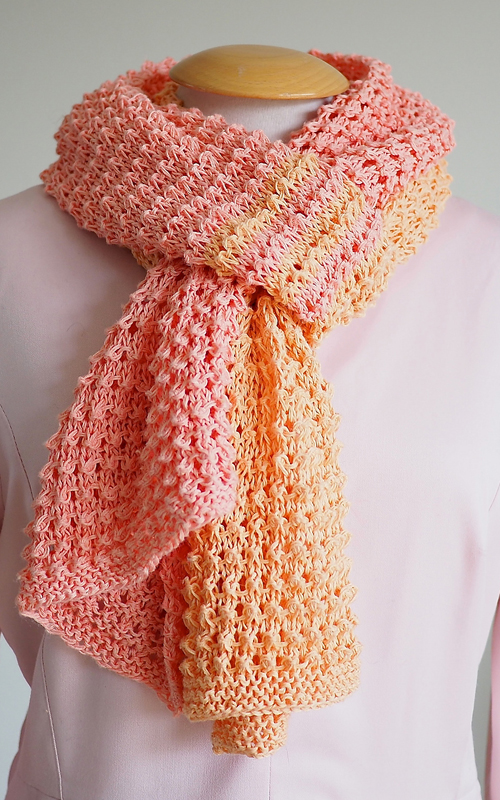
Primavera Scarf. Photo © Lidy Nooij
Primavera Scarf by Lidy Nooij is a colorful two-tone knitted scarf featuring simple textured sections and stripes worked with strands of yarn held together.
Originally published in 2018, the design combines pink and coral shades in a long rectangular scarf measuring approximately 32 × 160 cm (12.6 × 63 inches).
Important availability update: the original digital pattern is currently listed as discontinued and is no longer available online from its original source. We are keeping this page as a reference to the design and its documented specifications.
Primavera Scarf Pattern Details
- Designer: Lidy Nooij
- Published: March 2018
- Craft: Knitting
- Category: Scarf
- Pattern status: Discontinued / no longer available online
- Finished size: Approximately 32 × 160 cm (12.6 × 63 inches)
- Yarn weight: Sport
- Original yarn: Borgo de' Pazzi Olmeca
- Yardage: Approximately 987–1148 yards (903–1050 m)
- Needles: US 7 (4.5 mm) and US 8 (5 mm)
- Gauge: 20 stitches × 32 rows = 4 inches (10 cm)
- Colors: Two
- Features: Stripes, texture and repeating stitch pattern
- Original languages: English and Dutch
A Colorful Two-Tone Knitted Scarf
Primavera is built around the contrast between solid sections and striped sections.
The original version uses pink and coral, creating a warm spring-inspired palette that suits the name Primavera.
The simple rectangular shape lets the color and stitch texture become the main features of the finished scarf.
A Simple 4-Row Repeat
One of the appealing characteristics of the original design is its relatively short 4-row repeating sequence.
The scarf alternates textured solid-color sections with striped areas, creating visual variety without requiring complicated garment shaping.
Once the repeating structure is established, the project becomes a good example of how a simple sequence can create an effective all-over texture.
Two Strands Held Together
The striped sections of Primavera use two strands of sport-weight yarn held together.
Holding strands together changes both the appearance and thickness of the knitted fabric and helps distinguish the striped sections from the surrounding texture.
This construction is worth keeping in mind when choosing substitute yarn because simply replacing the original yarn with a single strand of a different weight may produce a different fabric.
The Original Yarn
Primavera was designed using Borgo de' Pazzi Olmeca, a sport-weight yarn made from a blend of bamboo-derived rayon and linen.
The documented original colors were:
- Color A: Olmeca Pink, shade 124
- Color B: Olmeca Coral, shade 123
The original project used two 100-gram balls of each color.
Yarn Amount
The documented total yarn requirement is approximately 987–1148 yards (903–1050 m).
If you are substituting yarn, compare meterage or yardage rather than relying only on the number of balls, since different yarns can contain very different lengths per skein.
Choosing Substitute Yarn
If you would like to create a scarf inspired by Primavera, look for a smooth sport-weight yarn with enough drape for a long scarf.
The original bamboo-and-linen blend naturally creates a fabric with different behavior from a highly elastic wool yarn, so fiber content can noticeably affect the finished result.
Two coordinating or closely related colors will preserve the characteristic two-tone appearance of the original design.
Needles and Gauge
The documented pattern specifications list two needle sizes: US 7 (4.5 mm) and US 8 (5 mm).
Gauge is approximately:
20 stitches × 32 rows = 4 inches (10 cm)
Matching gauge is useful if you want to reproduce the approximate dimensions and fabric density of the original scarf.
Finished Size
Primavera measures approximately:
32 cm wide × 160 cm long
(12.6 × 63 inches)
This creates a relatively wide, generously sized rectangular scarf that can be wrapped comfortably around the neck.
The designer also noted that the fabric has a tendency to stretch somewhat after finishing, so extra length is not necessarily needed while knitting.
Why Fiber Choice Matters
The original yarn contains bamboo-derived rayon and linen, both of which can contribute drape to the finished fabric.
If you substitute a springy wool yarn, the scarf may behave differently even when the stitch gauge is similar.
Making a generous swatch and washing it before measuring can help you understand how your chosen yarn will behave after finishing.
Color Ideas for a Primavera-Inspired Scarf
The original pink-and-coral combination gives Primavera its distinctive warm appearance, but the two-color structure offers plenty of room for experimentation.
You might pair two neighboring colors for a subtle effect or choose contrasting shades to make the striped sections stand out more strongly.
Because the scarf already contains texture, relatively simple solid or tonal yarns can help keep the stitch pattern visible.
Skills Associated With the Primavera Scarf
The documented design involves techniques such as:
- Knitting and purling
- Working flat in rows
- Following a repeating stitch sequence
- Changing colors
- Working stripes
- Holding strands of yarn together
- Maintaining consistent gauge
- Blocking and finishing a rectangular scarf
A Useful Lesson in Color and Texture
One reason Primavera remains an interesting design is the way it creates variety without complicated shaping.
The rectangular construction stays simple while changes in color, texture and yarn arrangement provide the visual interest.
It is a good example of how a scarf can become distinctive through repetition and color placement rather than complex garment construction.
About the Original Pattern Availability
The original Primavera Scarf digital pattern by Lidy Nooij is currently discontinued and is no longer available online from its original source.
For that reason, Amazing Knitting does not provide an unauthorized copy of the pattern or reproduce the designer's complete instructions here.
This page is retained as an informational reference to the original design, designer and documented project specifications.
Read Our Pattern Availability Policy →
Pattern availability was checked when this article was updated. If the designer republishes the original pattern through an authorized source in the future, this page can be updated with the new official link.